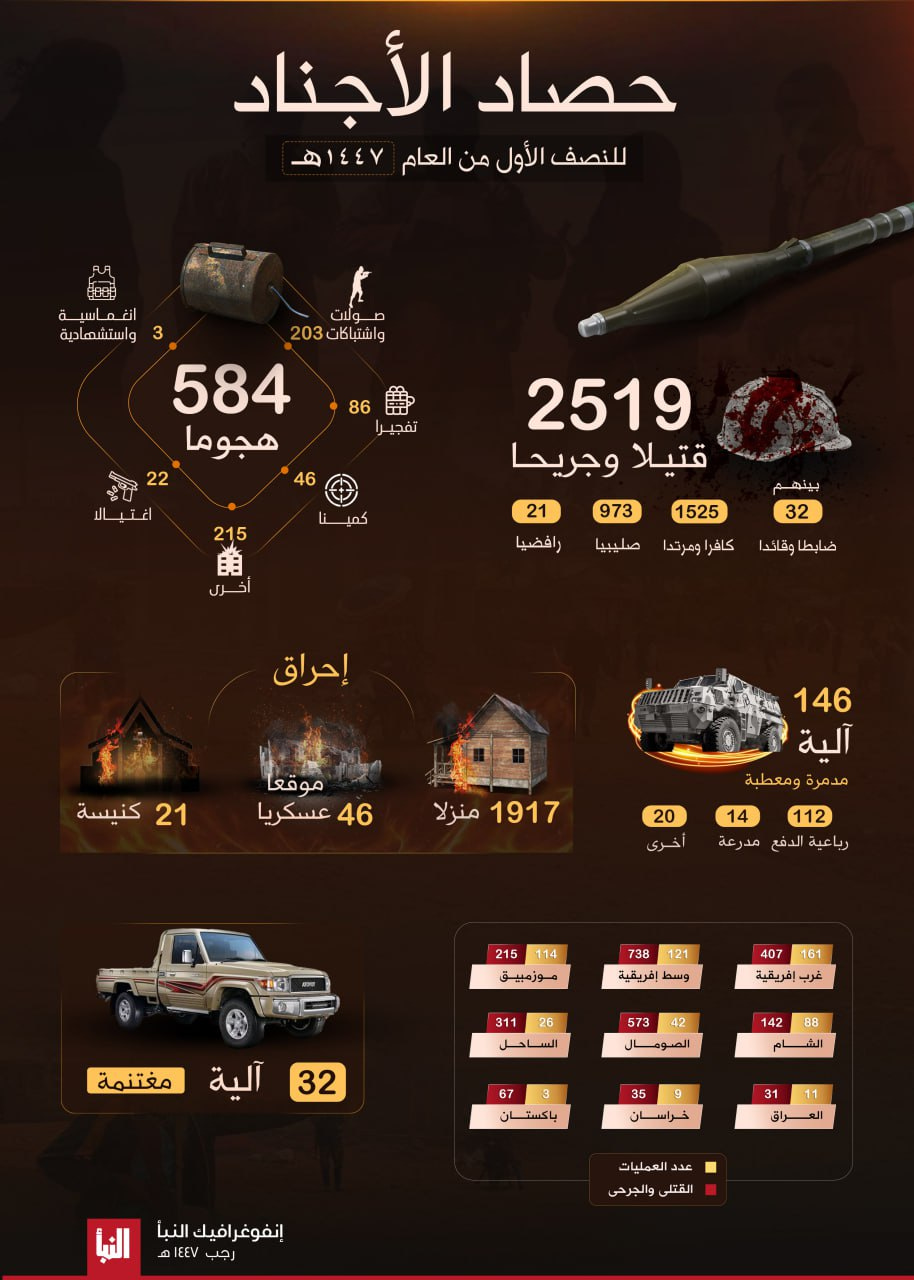

Executive Intelligence Summary
The Islamic State (IS) continues to pose a persistent but predominantly low-intensity strategic threat, characterised by geographic diffusion, operational fragmentation, and limited capacity for coordinated large-scale operations. The infographic published in al-Naba’ issue 527, summarising IS activity during the first half of 1447H (from June 27, 2025, to December 21, 2025), should be assessed primarily as a strategic communication product rather than a transparent operational reporting tool.
The data presented suggest that IS retains the ability to conduct frequent, localised attacks across multiple theatres, with a marked concentration in African provinces and a continued decline in the strategic centrality of Syria and Iraq. However, the predominance of low-complexity attacks and soft targets indicates organisational persistence rather than offensive momentum.
From a strategic perspective, IS appears to be consolidating a model of distributed survival, prioritising symbolic continuity, internal morale, and perceived ubiquity over operational escalation. The infographic’s emphasis on aggregate numbers, geographic breadth, and temporal continuity is designed to obscure qualitative limitations in command-and-control, force projection, and battlefield effectiveness.
In the near term, IS is unlikely to reconstitute the capacity for sustained territorial control or coordinated mass-casualty operations. Nonetheless, its adaptive structure and propaganda-driven resilience ensure that the organisation remains a chronic security challenge, particularly in fragile theatres where governance vacuums, weak security forces, and local grievances persist.
Key Judgements
KJ-1. IS currently represents a persistent but low-intensity strategic threat, with operational activity driven more by survivability and signalling than by expansion or escalation. (High confidence)
KJ-2. The geographic dispersion highlighted in al-Naba’ 527 reflects organisational fragmentation rather than centralised operational strength. (High confidence)
KJ-3. The concentration of reported activity in African theatres suggests a shift in narrative focus aligned with permissive environments, not a uniform global resurgence. (Medium confidence)
KJ-4. The majority of reported attacks indicate limited tactical sophistication, consistent with decentralised cells operating with minimal logistical support. (High confidence)
KJ-5. The infographic functions primarily as a morale-sustaining and legitimacy-reinforcing instrument, aimed at internal and sympathiser audiences rather than as a factual operational ledger. (High confidence)
KJ-6. Absent major external shocks or state collapse in core regions, IS is unlikely to regain strategic initiative in the short to medium term. (Medium confidence)
Scope and Methodology
Scope
This assessment examines the strategic implications of the infographic published in al-Naba’ issue 527, covering reported IS activities during the first half of 1447H. The analysis focuses on strategic-level threat assessment, rather than tactical effectiveness or individual attack verification.
The scope includes:
Geographic distribution of reported activity
Types of operations and targets
Organizational signaling and strategic posture
The analysis excludes:
Tactical after-action assessments
Independent casualty verification
Attribution disputes at the incident level
Methodology
The assessment combines:
Structured qualitative analysis of jihadist primary-source material
Trend comparison with full-year 1446H IS activity patterns.
Geographic weighting to account for theatre-specific permissiveness
Capability-based inference, distinguishing frequency from operational complexity
Declared IS data are treated as claims, not verified facts, and are evaluated against known patterns of IS operational behaviour and organisational constraints.
Limitations and Analytical Caveats
This analysis relies on self-reported data produced by IS, a source inherently shaped by propaganda imperatives. Reported figures may involve:
Selective over-reporting to amplify perceived reach
Omission of failed or inconsequential operations
Ambiguity in target classification, particularly regarding civilian versus security targets
The absence of independent verification limits precision in casualty and attack-type assessment. However, these limitations do not invalidate the strategic inferences drawn, which are based on patterns, distribution, and qualitative indicators, rather than on absolute figures.
The analysis prioritises trend direction and organisational behaviour over numerical accuracy, reducing sensitivity to potential inflation or misreporting.
Geographic Distribution and Theatre Weighting
The infographic published by the Islamic State, which covers the first six months of the Islamic year 1447 (from June 27, 2025, to December 21, 2025), presents 584 attacks, distributed across a set of theaters that IS selects as its showcase: Mozambique, Central Africa, West Africa, the Sahel, Somalia, al-Sham, Iraq, Khorasan, and Pakistan.