


🔹Methodological note:
Nature of the source and analytical approach: This work is based on the direct analysis of a primary jihadist source, specifically the editorial published in issue 526 of al-Naba, the official weekly magazine of the Islamic State. The text analysed is considered not as a media product in the journalistic sense, but as a strategic document attributable to the organisation’s information operations.
The approach adopted is that of direct and continuous monitoring of jihadist propaganda production, conducted without interpretative mediation by third parties. The analysis is therefore based on primary observation of language, narrative choices, omissions and conceptual recurrences, placing the document within a broader doctrinal and strategic trajectory.
This approach favours internal understanding of the communicative frame over external verification of the events cited. The aim is not to ascertain legal responsibility or reconstruct specific operational dynamics, but to analyse how the organisation attributes meaning to violence and how it attempts to shape its perception.
Qualitative and comparative analysis: The work employs a qualitative method that involves textual and semantic analysis of the editorial, comparison with previous editorials and similar propaganda cycles, and contextualization within the evolutionary framework of post-Caliphate jihadism. Particular attention is paid to the mechanisms of ambiguous attribution, enablement, threat construction and cognitive warfare. These elements are treated as strategic variables, not as mere rhetorical devices.
The comparison with previous cases (Europe, United States) lacks causal value, but serves to identify continuity and adaptations in the way violence is narratively managed and capitalised upon.
🔹Sources:
Absence of secondary sources and justification: The work does not make limited use of secondary sources. This choice is intentional and methodologically motivated. In an analysis focused on a primary source and direct monitoring, excessive use of literature or external reporting risks introducing interpretative bias, reproducing irrelevant journalistic or institutional frames, and diluting the analysis of the original text. The absence of external citations does not indicate a lack of documentation, but reflects the nature of the work: direct analysis of primary material. The assessments proposed derive from systematic observation of jihadist production and not from the mere reworking of pre-existing analyses.
🔹Limitation of the analysis: Like any analytical work, this one also has limitations that must be made explicit. First, the analysis does not allow us to establish operational relationships between the organisation and individual violent events. This choice is consistent with the subject of study: strategic and cognitive attribution, not criminal or military responsibility. Secondly, as this is a propaganda document, the text analysed is by definition performative and manipulative. The statements contained therein are not taken as factual descriptions of reality, but as tools for narrative construction. Finally, the work does not claim to offer deterministic predictions. Threat and cognitive impact assessments are formulated in probabilistic and structural terms, not as anticipations of specific events.
🔹Analytical positioning and purpose: This study falls within the scope of strategic analysis and security studies, with a strong focus on the cognitive and perceptual dimensions of contemporary terrorism. It has no regulatory, judicial or political purpose in the strict sense, but aims to provide useful interpretative tools for: intelligence analysts; military planners; political and strategic decision-makers; scholars of jihadism and cognitive warfare.
The decision to treat al-Naba as a primary source stems from the belief that, at this stage, understanding how the organisation thinks and communicates is at least as important as measuring its remaining operational capabilities.
In a context characterised by widespread violence, ambiguous attribution and competition in the cognitive domain, direct analysis of jihadist sources is not an abstract academic exercise, but an analytical necessity. Ignoring or over-filtering these sources means giving up on understanding the language through which the adversary attempts to define the conflict.
🔹Structure of the Analysis: The analysis is constructed as a progressive path that leads the reader from the conceptual to the operational level, deliberately avoiding both a journalistic description of the event and theoretical abstraction as an end in itself. The overall logic is to begin with the meaning attributed to violence and then move on to its concrete implications in terms of security, intelligence, and political decision-making.
The paper begins with a reconstruction of the conceptual framework necessary to correctly interpret the document being analysed. This phase clarifies the key concepts—attribution, enablement, information operations, and cognitive warfare—that form the interpretative framework for the entire study. This choice responds to the need to avoid the use of categories that are no longer adequate for describing contemporary jihadism and to provide a coherent analytical language from the outset, acceptable to scholars and security professionals.
This conceptual foundation is the starting point for a direct analysis of the al-Naba editorial 526, treated as a primary source and strategic document. The text is not read as a commentary on a news story, but as a deliberate act of communication, aimed at managing the meaning of violence. Particular attention is paid to the indirect claim and the function of the final threat, considered key elements in understanding how the organisation exerts influence without assuming direct operational responsibility.
The analysis of each document is then expanded through a comparison with previous propaganda cycles from European and US contexts. This step serves a crucial purpose: to verify whether the observed mechanisms are contingent or, conversely, reflect doctrinal and strategic continuity. The comparison allows us to identify what persists over time and what adapts to changing operational conditions, revealing the evolution of the Islamic State’s propaganda frame from the phase of territorial control to that of widespread and enabled violence.
From this evidence, the work shifts explicitly to the security dimension, translating the qualitative analysis into a structured threat assessment. This phase examines the implicit operational model, targeting logics, the scalability of violence, and early warning indicators. The goal is not to predict specific events, but to describe a persistent risk configuration characterised by low attributability and high cognitive impact.
The next step concerns the implications for intelligence, the military, and policymakers. Attention is focused on the limitations of traditional attribution and response models, the difficulties of prevention in the absence of visible operational structures, and the risks of political reactions that, while motivated by security concerns, can unintentionally reinforce the jihadist narrative. This part of the analysis highlights the growing gap between the nature of the threat and the conceptual and operational tools used to address it.
Finally, the work focuses on the domain of cognitive warfare, analysing the long-term effects this model of violence has on collective perceptions, trust in institutions, and decision-making processes. From this perspective, terrorism is no longer considered merely as a series of violent acts, but as a process aimed at colonising the way violence itself is interpreted and anticipated.
The analysis concludes by reconstructing these layers in an operational conclusion, which does not introduce new elements but summarises the strategic lessons learned. The resulting recommendations are not tactical, but structural: they concern the adaptation of analytical tools, inter-institutional coordination, and the need to permanently integrate the cognitive dimension into security management.
Overall, the framework is designed to reflect the complexity of the phenomenon analysed: non-linear, not immediately attributable, and deeply interconnected between the physical and perceptual dimensions. It is a framework that does not aim to simplify, but rather to make understandable a threat that deliberately operates in ambiguity.
🔹Abstract: The editorial published in issue 526 of al-Naba, the official weekly magazine of the Islamic State, offers a relevant case study for understanding the contemporary evolution of jihadist terrorism towards models of widespread violence, with low attribution and high cognitive impact. Although there has been no formal claim of responsibility for the attack in Sydney (Bondi Beach), the text incorporates the event into the organisation’s strategic narrative, presenting it as a “response to the call” previously made to supporters to target Jews and “crusaders” globally.
The analysis shows how the Islamic State uses indirect management of violence, based on the ideological empowerment of individual or micro-cell actors. This model allows the organisation to maximise the deterrent and destabilising effect of attacks, while reducing operational costs, interdiction risks and vulnerabilities associated with immediate attribution.
The editorial analysed is part of a broader cognitive warfare strategy aimed at eroding confidence in the security capabilities of Western states, normalising identity-based targeting of Jewish communities, and reinforcing processes of unmediated self-radicalisation. A comparison with previous editorials on attacks or threats in Europe and the United States highlights a doctrinal continuity in the framing of violence as a global, replicable and inevitable phenomenon.
The analysis concludes that ambiguous attribution is not a communicative weakness of the Islamic State, but rather a deliberate strategic choice with significant implications for counter-terrorism policies, preventive intelligence, and the protection of vulnerable communities. The persistence of this model suggests the need to update traditional threat indicators by integrating cognitive and narrative dimensions into security analysis.
Introduction and Theoretical Framework: Attribution, Enablement, Information Operations, and Cognitive Warfare
The analysis of contemporary jihadist terrorism requires a substantial updating of the interpretative categories traditionally employed in security and intelligence studies. Ambiguous attribution itself becomes a strategic tool: it serves not so much to establish legal or military authorship, but to guide the perception of the public, the media, and decision-makers. The absence of an explicit claim does not signal discontinuity or marginalisation of the organisation, but rather a different way of exercising influence. It is within this framework that the concept of enablement fits. Unlike direct operational command, enablement consists of the creation of an ideological and symbolic ecosystem that makes the action violent, legitimate, expected, and replicable. Through reiterated appeals, simplified moral framing, and the construction of an absolute enemy identity, the organisation transfers the initiative to the individual while retaining control of the interpretative framework. The violent actor does not act “on behalf of” the organisation in the strict sense, but rather operates within a deliberately constructed cognitive framework.
This dynamic is inseparable from the role of information operations (IO). In the jihadist case, IO is not limited to propaganda in the classical sense, but involves a systematic use of information as a weapon: selecting events to exploit, strategic silences, semantic ambiguities, and amplifying perceptions of vulnerability and state failure. Publications like al-Naba should not be read as mere organs of communication, but as narrative command tools, capable of integrating heterogeneous events into a coherent vision of the global conflict. The ultimate goal of these operations is not so much immediate recruitment as the manipulation of perceptions of reality. This is where the concept of cognitive warfare takes on analytical centrality. Physical violence becomes just one vector through which to attack the cognitive domain: what matters is inducing permanent insecurity, eroding trust in institutions, polarising societies, and normalising the idea of inevitable and omnipresent violence. From this perspective, even a single, low-sophistication attack can produce disproportionate strategic effects if properly embedded in a global narrative.
Ambiguous attribution, enablement, information operations, and cognitive warfare are therefore not separate categories, but interdependent elements of a single operational model. The Islamic State is not relinquishing control; it exercises it less visibly, shifting its focus from the military to the perceptual. Understanding this transformation is essential to avoid reductive interpretations of the phenomenon and to develop appropriate analytical and response tools for a threat that increasingly operates in the realm of ideas, emotions, and collective expectations.
Complete translation of the al-Naba editorial no. 526
(All religious references and quotations in the editorial have been intentionally omitted).
“The Glories of Sydney.
Attacks against Jews continue to be one of the most obvious manifestations of the security failures of the Crusader states, despite the enormous resources invested and the total surveillance they impose on their societies. What recently happened in Sydney is only further confirmation that the war against the Jews and their allies knows no geographical borders or security barriers.
The Sydney operation demonstrates that Jews are safe nowhere, and that their communities, wherever they are, remain a legitimate target as long as they continue to support aggression against Muslims, desecrate al-Aqsa, and participate in the global war against Islam.
This operation is not an isolated event, but a direct response to the Islamic State’s repeated call to Muslims to strike Jews and Crusaders wherever possible, with whatever means available, without waiting for orders or coordination.
The lions of the Caliphate have repeatedly demonstrated that individual initiative is sufficient to terrorise the enemies of God, destabilise their societies, and drag them into a permanent spiral of fear. Governments’ Crusaders lie when they claim to be in control; the reality is that they live in a constant state of alarm.
The Jews have realised that their security is an illusion, that the walls, the police, and the intelligence services cannot protect them from Muslim vengeance. And this will push them to retreat, to hide, to doubt the future they have built on the ruins of Muslim lands.
Let Jews and their supporters know that what happened in Sydney could happen in Paris, London, New York, or any other city. As long as they continue to fight Islam, the answer will reach them in their homes, in their markets, and on their streets.
And this is just the beginning”.
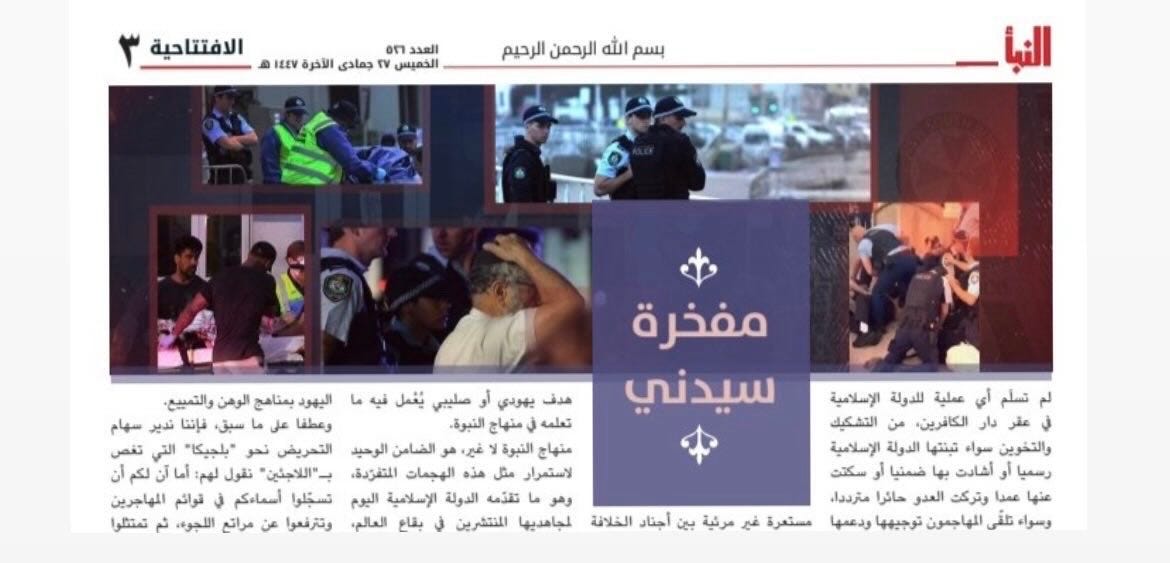
Editorial Analysis
The editorial deliberately places itself outside the scope of traditional claims of responsibility. There is no reference to operational structures, a specific wilaya, or a chain of command; ritualistic forms of accountability are missing. This absence is not a gap, but the core of the communication strategy.
The Islamic State does not deny the event, nor does it treat it as an external and contingent fact. On the contrary, it semantically reabsorbs it, presenting it as a direct consequence of a previously announced strategic line: the “call” to strike Jews and enemies of Islam wherever they are. In this way, the organisation does not claim responsibility for the attack in an operational sense, but rather asserts the ideological causality that made it possible.
From the perspective of attribution, we are faced with an advanced model of plausible ownership. The event is certified as compatible with the organisation’s doctrine without incurring any political, military, or legal costs. Responsibility is thus shifted to an abstract and diffuse level: not “we struck,” but “this is happening because our strategy was followed.” It is a form of remote control that preserves ambiguity and, at the same time, strengthens the organisation’s centrality as the interpretive hub of global jihad.
This choice responds to a specific need in the post-Caliphate era: maintaining strategic relevance without having to demonstrate complex planning capabilities. Effectiveness is no longer measured in terms of command and control, but in terms of the ability to direct the violent behaviour of non-directly coordinated actors.
The editorial’s concluding section takes on an importance disproportionate to its brevity. It is not an operational announcement, nor a timeline for future attacks. The threat is formulated in deliberately vague, universalistic, and unverifiable terms: what has happened could happen anywhere. This vagueness is not a weakness, but a deterrent.
Analytically, the final threat serves at least three distinct functions. First, it transforms a single episode into a strategic precedent. The event is not narratively closed, but left open as a replicable model. Every urban context, every community perceived as a legitimate target, is implicitly included in the threat space. Second, the threat is directed less at institutions than at collective perceptions. The goal is not to force a state to change a specific policy, but to instil the idea of permanent vulnerability. The editorial emphasises the failure of Western security systems not to demonstrate it empirically, but to erode their symbolic credibility. Security is portrayed as an illusion; fear as a structural condition.
Third, the final formulation serves as a delayed activation mechanism. It does not indicate what to strike, nor when, but establishes a ready-made framework of legitimacy. In this sense, the threat is directed not at the enemy, but at the potential violent actor: it communicates that future individual action, if consistent with the proposed framework, will be recognised and valued a posteriori.
It is important to emphasise that this threat does not necessarily increase the likelihood of an imminent coordinated attack; rather, it increases the cumulative probability of isolated acts, which are difficult to predict and difficult to attribute. This is a reverse deterrence: it does not deter, but normalises the expectation of violence.
Read in this light, the al-Naba 526 editorial is not a propagandistic commentary on a news story, but an act of strategic violence management. The indirect claim of responsibility allows the Islamic State to maintain ideological centrality; the final threat consolidates a cognitive environment favourable to the spontaneous reproduction of violence.
For analysts, military planners, and policymakers, the critical element is not the absence of a formal claim of responsibility, but how this absence is exploited to expand the grey area of attribution. It is in this space that a significant part of the jihadist threat today resides: not in controlling attacks, but in controlling their meaning.
Comparison with precedents: Continuity, Discontinuity, and Evolution of the Propaganda Frame
Comparing the al-Naba 526 editorial with previous propaganda cycles linked to Paris, Brussels, and the United States reveals a profound doctrinal continuity. The Islamic State maintains a fundamental strategic conviction: violence in the West is not an episodic tactical tool, but a permanent means of psychological pressure and systemic destabilisation.
In all the cases analysed, the organisation uses the attack (or reference to the attack) as ex post proof of the validity of its global narrative. Paris and Brussels, in the 2015–2016 cycle, were presented as demonstrations of the vulnerability of European metropolises; the United States as a symbol of the “centre” of crusader power; Sydney today as confirmation that no geographical context is marginal or peripheral. The places change, not the function: each episode is decontextualised and reinserted into a symbolic geography of global conflict.
A second element of continuity concerns the role of fear as a primary objective. In none of the cases is the emphasis placed on concrete military results or expected political concessions. Success is measured in terms of perception: widespread insecurity, loss of trust in institutions, a sense of permanent exposure. This is a constant trait that runs through both the territorial Caliphate phase and its subsequent phase.
The main discontinuity concerns the management of attribution. In the Paris and Brussels cycle, jihadist propaganda operated in a context in which the Islamic State still had a credible capacity for centralised planning. Claims were explicit, detailed, and functional in demonstrating organisational strength, coordination, and external projection.
In the current context, and particularly in editorial 526, this requirement has disappeared. The organisation no longer needs to demonstrate its ability to “strike” through complex structures; it simply needs to demonstrate its ability to inflict strikes. Consequently, direct claims of responsibility become a constraint rather than an advantage. Ambiguous attribution allows for avoiding exposure to targeted retaliation, maintaining narrative flexibility, and absorbing heterogeneous events without having to control their execution. Compared to Paris and Brussels, where the attack was the culmination of an operational chain, Sydney is presented as the starting point for a potentially endless sequence of similar acts. This is a qualitative, not just quantitative, difference.
In framing the United States, jihadist propaganda has always attributed totemic value to the target. Attacking, or threatening, the United States means striking the symbolic pinnacle of the opposing international order. However, here too, an evolution can be observed. While in the past, the emphasis was on the spectacular and exceptional nature of the attack, today the reference to the United States serves a different function: normalising the idea that even the centre of the system is exposed to banal, not necessarily sophisticated, violence. The message is no longer “we can organise,” but “it doesn’t take much to strike anywhere.” In this sense, the Sydney case is perfectly consistent: it demonstrates that an iconic target isn’t necessary to achieve a global strategic effect.
Placing Paris, Brussels, the United States, and editorial 526 in sequence, we observe a progressive transformation of the propaganda frame. In the initial phase, the frame focused on organisational power; in the intermediate phase, on resilience; and today, on the cognitive orchestration of widespread violence. The current frame presents three distinctive characteristics: operational decentralisation: the organisation is no longer the director of attacks, but the curator of their interpretation; universalisation of the previous one: each episode immediately becomes a replicable model, regardless of the context; and open temporality: the threat is not tied to deadlines, but to a permanent state of conflict.
This frame is particularly effective because it adapts to contexts of high surveillance and low risk tolerance. The more state control increases, the more the organisation shifts the confrontation to the cognitive level, where asymmetry is favourable. A comparison with previous issues shows that the editorial in al-Naba 526 does not represent a deviation, but rather a mature phase in the jihadist strategy. Ideological continuity ensures consistency, while operational discontinuity ensures adaptability. For political and military decision-makers, the main risk is not to underestimate a single threat, but to continue to interpret the phenomenon using outdated categories based on the search for signs of command and control that are no longer central today. In this scenario, the challenge is not only to prevent attacks, but to disrupt the organisation’s ability to attribute meaning to violence, even indirectly. It is on this ground that the current phase of the confrontation is being played out.
Threat Assessment
The operational model emerging from the al-Naba 526 editorial is one of enabled, undirected violence, in which the Islamic State exercises strategic influence without assuming immediate operational responsibility. There are no elements of command and control, nor signs of centralised planning; instead, the text presupposes and values uncoordinated individual initiative, provided it is consistent with the proposed ideological framework. This model presents four significant operational characteristics: the absence of an identifiable decision-making chain, which drastically reduces the possibility of preemptive interdiction; low capacity requirements, both in terms of training and material resources; open temporality, in which action can occur at any time without the need for synchronization; and post-factum attribution, which allows the organization to capitalize on heterogeneous events without exposing itself. From a military and internal security perspective, this model shifts the threat from the realm of planning to that of distributed probability: individual acts with a low level of sophistication, but with cumulative strategic impact. The targeting outlined in the editorial is intentionally broad and identity-based. The explicit reference to Jews, untethered from any state or military context, indicates a desire to target civilian communities defined by religious or symbolic affiliation, not by operational role. This lowering of the target selection threshold has direct implications for risk assessment. Alongside primary targeting, the text maintains a residual but flexible category of “crusaders” and supporters of the West, which allows for the inclusion of highly frequented public spaces, symbolic but not necessarily protected locations, and urban contexts perceived as “normal” and therefore reassuring. For policymakers, the critical point is that this framework breaks the traditional distinction between hard and soft targets: any social space can be narratively converted into a legitimate target. This results in constant pressure on protection systems, which is difficult to sustain in the long term with purely security measures. Scalability is one of the main strengths of the model analysed. Unlike terrorist structures based on organised cells, this configuration is intrinsically scalable because it does not depend on stable lines of communication, traceable financial flows, or complex logistical infrastructures. Each potentially radicalised individual actor constitutes an autonomous node, capable of acting independently of others. The organisation does not need to “expand” in the traditional sense; it simply needs to maintain the cognitive framework that makes violence understandable, justifiable, and imitable. From a strategic perspective, this implies that the threat does not grow linearly, but through the accumulation of probabilities. Even in the absence of frequent attacks, the perception of risk tends to remain high, with disproportionate effects on public opinion, vulnerable communities, and decision-makers. In such a model, early warning indicators do not necessarily coincide with traditional operational signals. Prevention requires greater attention to cognitive and narrative indicators, including: intensified ex post legitimation rhetoric: increased editorials or content that “certifies” unclaimed violent acts; Obsessive repetition of universalizing frames (”it can happen anywhere”), which pave the way for replicability; Normalization of identity-based language, in which the target is defined less by actions and more by affiliation; Deliberate absence of operational details, which signals a strategic choice of non-exposure, not a lack of interest; Selective echo on informal channels, where marginal events are amplified as “signs” of an ongoing war.
For intelligence agencies and the military, this means that early warning cannot rely solely on wiretaps, financial movements, or logistical networks. It is necessary to structurally integrate the analysis of discursive dynamics because that is where this threat model takes shape and reproduces itself. The threat outlined in the editorial of al-Naba 526 is not immediate in the traditional sense of the term, but it is persistent, adaptive and cumulative. The main risk is not a single attack, but rather the Islamic State’s ability to maintain an ecosystem of potential violence, in which individual action finds recognition and strategic significance. For decision-makers, the challenge is not only to “prevent the next attack” but to reduce the cognitive fertility of the context in which this model thrives. It is on this level, rather than on a purely repressive one, that the sustainability of the response in the medium and long term will be played out.
Intelligence & Policy Assessment
The al-Naba 526 editorial highlights a transformation that directly impacts intelligence analytical models: attribution is no longer just a technical issue, but a strategic variable deliberately manipulated by the Islamic State. The choice not to formally claim responsibility, while still incorporating the event into its narrative, drastically reduces the effectiveness of traditional tools for assessing responsibility. For intelligence agencies, this poses at least three structural challenges. First, the erosion of the link between event and organisation makes it more difficult to establish operational priorities and allocate resources. In the absence of a clear claim, the risk oscillates between overinterpretation and underinterpretation. Second, ambiguous attribution hinders the construction of reliable predictive patterns, as violent actors are not embedded in traceable organised networks. Third, the capacity for targeted deterrence is reduced, as there is no clearly responsible party to exert pressure on. This configuration requires a shift in perspective: intelligence cannot limit itself to searching for command and control signals, but must evaluate the narrative and doctrinal coherence of violent events as a possible indicator of strategic influence, even in the absence of operational connections.
From a military and internal security perspective, the emerging model confirms the limits of a predominantly kinetic or reactive response. The absence of infrastructure to target, operational leaders to neutralise, or logistical chains to disrupt reduces the effectiveness of traditional countermeasures. This does not mean that the military dimension is irrelevant—quite the contrary—but that it is no longer sufficient as the backbone of the strategy. The organisation benefits from a structural asymmetry: every increase in control and security pressure tends to further shift the confrontation to the cognitive level, where the costs for the state actor grow in a non-linear fashion.
For armed forces engaged in counterterrorism missions, this requires a redefinition of objectives: not only degrading residual capabilities, but also reducing the organisation’s ability to present itself as a central player in global conflict, even when it does not directly control violence.
In terms of public policy, al-Naba 526’s editorial highlights a recurring risk: reacting to the jihadist frame by unintentionally reinforcing it. Visible emergency measures, alarmist communications, or polarising political narratives can easily be integrated into the organisation’s propaganda as evidence of the state’s “failure” or the persecution of Muslim communities. For policymakers, the challenge is twofold: on the one hand, ensuring adequate levels of security and protection for vulnerable communities; on the other, avoiding turning every incident into a public confirmation of the jihadist narrative. Managing institutional communications thus becomes an integral part of the strategic response, not an accessory. In this context, exclusively repressive policies risk addressing the symptoms without impacting the conditions that make the model of enabled violence effective. The lack of structural investment in cognitive prevention and social resilience leaves the foundation on which the organisation operates untouched. Another important element is the need for coordination among political, military, and professional personnel involved in daily monitoring and analysis. The transnational and narrative nature of the threat renders fragmented responses ineffective. Cooperation must not be limited to the exchange of operational information, but must include shared analyses of propaganda frames, radicalisation dynamics, and ambiguous attribution strategies. Without a common analytical language, the same events risk being interpreted inconsistently, with negative effects on the overall response. The editorial in al-Naba 526 confirms that the Islamic State has not simply survived the loss of its territorial caliphate, but has internalised the lesson of its own vulnerability, transforming it into a strategic advantage. Ambiguous attribution and indirect management of violence allow the organisation to remain relevant without exposing itself.
For intelligence, military and policy makers, the critical point is not to prove “who did it”, but to understand who benefits strategically from the meaning attributed to violence. As long as this dimension remains underestimated, the risk will not be so much the individual attack, but the persistence of a cognitive environment in which violence always appears possible, always justifiable and always replicable.
Cognitive Warfare Assessment
The al-Naba 526 editorial should be read as a fully-fledged cognitive warfare operation. Physical violence, while central on a symbolic level, is not the final objective, but rather the initial vector of an action aimed at influencing collective perceptions, expectations, and behaviours. In this framework, the attack is not the message: it is the material evidence that makes the message credible. The Islamic State uses the event to intervene on at least three simultaneous cognitive levels: the perception of security, the representation of conflict, and the self-perception of potentially mobilised actors. The effectiveness of the operation depends not on the amount of violence produced, but on its ability to establish a narrative of inevitability. One of the central objectives of jihadist cognitive warfare is the symbolic delegitimisation of the state as a provider of security. The editorial emphasises the idea that no surveillance apparatus, however sophisticated, is capable of preventing violence. This message is not so much aimed at demonstrating a technical failure as at undermining systemic trust. In the cognitive domain, security is assessed not based on statistics but based on perceptions. Even a limited number of incidents, if inserted into a coherent narrative, is sufficient to produce a sense of permanent vulnerability. The strategic effect is twofold: on the one hand, it generates pressure on decision-makers to adopt visible and often reactive measures; on the other, it fuels a spiral of alarm that reinforces the centrality of the jihadist threat in public discourse. A second axis of cognitive warfare concerns the normalisation of violence. The editorial does not present the attack as an exception or an extraordinary event, but as a “natural” and coherent response to a state of ongoing conflict. This framing progressively lowers the cognitive threshold separating radical dissent from violent action. In practical terms, violence is stripped of its traumatic dimension and transformed into a plausible option. A long and structured radicalisation process is not necessary; It is sufficient for the individual to recognise the act as morally justified and narratively legitimate. This step is crucial because it reduces the effectiveness of traditional prevention strategies based on identifying signs of advanced radicalisation. On an identity level, the editorial’s cognitive warfare is equally relevant. The text proposes a rigid and simplified dichotomy, in which the world is divided between a besieged “us” and an aggressive and omnipresent “them.” This polarisation serves not so much to recruit new members in an organisational sense, but rather to provide a ready-made identity framework. The potentially violent individual must not perceive himself as part of a structure; he must perceive himself as an autonomous moral agent, called to act consistently with an already internalised narrative. In this sense, cognitive warfare does not aim to create obedience, but initiative. It is a form of indirect mobilisation that reduces coordination costs and increases the model’s resilience over time. An often overlooked aspect of jihadist cognitive warfare is its impact on institutional decision-making processes. Public pressure, amplified by media coverage and the perception of unpredictability, tends to push decision-makers toward rapid, visible, and sometimes disproportionate responses. These responses, in turn, can be integrated into the jihadist narrative as confirmation of the West’s systemic hostility. In this way, the organisation can indirectly influence the political agenda, without any formal capacity for dialogue. Cognitive warfare does not impose decisions; it narrows the range of decisions perceived as possible or acceptable. As a whole, the editorial in al-Naba 526 represents a mature example of cognitive warfare applied to terrorism. The strength of the operation lies not in the novelty of the message, but in its systemic coherence: ambiguous attribution, open threats, normalisation of violence and indirect mobilisation are elements that reinforce each other.
For intelligence, military and policy makers, the main lesson is that the threat operates not only in the physical domain, but also in the perceptual domain. Countering it requires not only prevention and response capabilities, but also awareness of the cognitive terrain on which the organisation has chosen to fight. Ignoring this dimension means leaving control of meaning to the adversary, even when control of action seems to be lacking.
Operational Conclusion and Strategic Recommendations
The analysis of al-Naba 526’s editorial confirms that the contemporary jihadist threat can no longer be interpreted according to categories based exclusively on centralised planning, formal claims of responsibility, or conventional military capability. The observed pattern is less visible, less attributable, and, precisely for this reason, more resilient over time. Violence is no longer the centre of the system, but one of its possible outputs; the centre is the control of meaning. From an operational perspective, the primary risk lies not in the likelihood of a single large-scale attack, but in the persistence of a cognitive ecosystem that makes episodic violence plausible, justifiable, and replicable. In this context, the absence of a direct claim of responsibility should not be interpreted as a reduction in the threat, but rather as an indicator of strategic maturity. The organisation no longer competes based on demonstrable strength, but on that of perceived influence.
For intelligence and military planners, this implies a shift in analytical priorities. Continuing to focus resources primarily on identifying chains of command, operational infrastructure, or organisational links risks creating a misalignment between the real threat and the tools for interpreting it. This does not mean abandoning these tools, but integrating them into a broader model capable of assessing ideological and narrative influence as an autonomous strategic factor.
In terms of security policies, the limits of exclusively reactive and visible responses are clearly evident. Every measure adopted under emotional pressure, every hyper-security-focused institutional communication, and every simplification of public discourse potentially contribute to strengthening the adversary’s frame. Security, in this context, is not merely an operational function; it is a perceptual construct. Ignoring this aspect is equivalent to giving the adversary a structural advantage.
This leads to a first strategic recommendation: permanently integrate cognitive analysis into decision-making processes. This means equipping intelligence agencies and decision-makers with analytical tools capable of assessing not only what is happening, but how it is interpreted, amplified, or normalised. Cognitive warfare cannot be approached as an ancillary domain; it must be considered an integral part of national security.
A second recommendation concerns inter-agency coordination. In a context of ambiguous attribution and widespread violence, the rigid separation between internal security, external defence, and institutional communication becomes a factor of vulnerability. It is necessary to develop coordination mechanisms that explicitly include the narrative dimension, so that operational, political, and communication responses do not produce dissonant effects.
A third recommendation concerns the protection of vulnerable communities. The identity targeting observed in the editorial is not a rhetorical byproduct, but a strategic choice. The response cannot be limited to increased physical protection; it must include actions aimed at reducing the social and symbolic isolation of these communities, preventing them from becoming, even unintentionally, epicentres of polarisation and fear.
Finally, for policymakers, the most relevant lesson is perhaps the most uncomfortable: not every attack requires a spectacular response. In a model of enabled violence, overreaction can cause more damage than underreaction. The measure of success should not be the visibility of counteraction, but the ability to erode the credibility of the jihadist narrative as a key to interpreting reality over time.
In conclusion, the al-Naba 526 editorial shows that the Islamic State, despite being weakened territorially and operationally, has been able to adapt by shifting the confrontation to the cognitive realm. The challenge for state actors is not simply to neutralise a residual threat, but to prevent this threat from continuing to define the meaning of violence and security in Western societies. It is on this less visible but crucial level that the sustainability of the strategic response is played out today.
© Daniele Garofalo Monitoring - All rights reserved.
Daniele Garofalo is an independent researcher and analyst specialising in jihadist terrorism, Islamist insurgencies, and armed non-state actors.
His work focuses on continuous intelligence monitoring, threat assessment, and analysis of propaganda and cognitive/information dynamics, with an emphasis on decision-oriented outputs, early warning, and strategic trend evaluation.
Daniele Garofalo Monitoring is registered with the Italian National ISSN Centre and the International Centre for the Registration of Serial Publications (CIEPS) in Paris.ISSN (International Standard Serial Number): 3103-3520ORCID Code: 0009-0006-5289-2874Support my research, analysis and monitoring with a donation here, PayPal.Me/DanieleGarofalo88
I really like how you assess Ambiguous attribution as a strategic tool. Your thinking behind it is solid and I quite respect it. I do also like your angle and awareness around information operations as a strategic surface. It does lead to how cognitive warfare as a core security domain for many democracies as thinking is now a target.
Nice work.
(All religious references and quotations in the editorial have been intentionally omitted)...This omission, from an analytical and strategic point of view, is intended to avoid playing their own game. That is, to refrain from using religious texts to confer greater ideological meaning—both for Muslims and non-Muslims. In other words, a kind of implicit ideological disengagement?
I would like to add that, in the editorial, the organization not only refrains from acknowledging any direct responsibility for what occurred, but also actively seeks to emotionally influence the Muslim community, capitalizing on a particularly sensitive historical moment—one that has emotionally involved not only Muslims, but also non-Muslims. The underlying message resembles a subtle “we told you so”, conveyed not through explicit accusation, but through emotional and identity-based cues.
In this context, the use of the term “Jews” rather than “Zionists” is far from accidental. In everyday Arabic discourse—especially among segments of the population with lower levels of education—this distinction is often not clearly articulated or internalized, making the message more accessible and therefore more susceptible to emotional manipulation.
Another crucial aspect is the deliberate decision to withdraw from the scene in a non-direct manner. The organization appears well aware that the emotional and psychosocial conditions necessary to generate new adherents are already in place, allowing it to foster support without resorting to explicit or direct indoctrination.
This is where the mechanism of "soft indoctrination" becomes central. Rather than relying on rigid ideological instruction or overt propaganda, the organization favors a gradual, indirect process of radicalization, embedded in shared emotions, collective grievances, and perceived moral injustices. Ideology is not imposed; it is absorbed organically through identification, outrage, and a growing sense of belonging. Soft indoctrination functions precisely by avoiding direct messaging: individuals are encouraged to arrive at ideological conclusions independently, interpreting them as personal insights rather than externally imposed beliefs. As a result, the indoctrination process appears natural and self-generated, making it more resilient and significantly harder to challenge or dismantle.
This strategy exploits not only the Palestinian issue, but also broader forms of unrest and rebellion, including causes often dismissed by governments as marginal or politically inconvenient, yet deeply felt by the public and mass movements—such as climate change, veganism, and other moral or identity-driven mobilizations.
Stunning article ✨️