


Executive Snapshot
A propaganda statement attributed to the Cyber Jihad Movement, disseminated on Telegram and Signal on 4 March 2026, signals the emergence of a low-capability but strategically framed digital mobilization node within the pro-al-Qaeda ecosystem. The document combines cognitive activation, opportunistic alignment with ongoing geopolitical tensions, and an explicit call for participation in cyber activities targeting state and financial entities. It does not indicate advanced cyber capabilities, but it reflects an adaptive attempt to position jihadist actors within the cyber domain as a supplementary arena of engagement. The artifact should be assessed as a positioning signal rather than a capability indicator, with relevance primarily to narrative evolution, recruitment logic, and potential convergence with broader hacktivist environments.
Assessment Focus
This assessment emphasizes the narrative construction and strategic framing of the Cyber Jihad Movement statement within the jihadist digital ecosystem, helping readers understand its positioning rather than focusing solely on operational capabilities.
📌 Inside This Assessment
Nature and classification of the Cyber Jihad Movement within the pro-al-Qaeda digital ecosystem
Analysis of narrative construction and strategic framing linked to current geopolitical tensions
Assessment of mobilization and recruitment logic targeting digitally capable sympathizers
Evaluation of the gap between declared intent and likely operational capabilities
Positioning of the node within the wider jihadist and hybrid cyber ecosystem
Implications for information environment dynamics and low-level cyber threat activity
Early indicators and short-term outlook for monitoring and intelligence purposes.
Source Document and Context
Organization: Cyber Jihad Movement (CJM)
Ecosystem/Alignment: al-Qaeda
Format: Statement
Language: English
Period: Ramadan 1447H (March 4, 2026)
Type: Strategic propaganda, cognitive warfare-oriented
Distribution channels: Telegram, Signal.
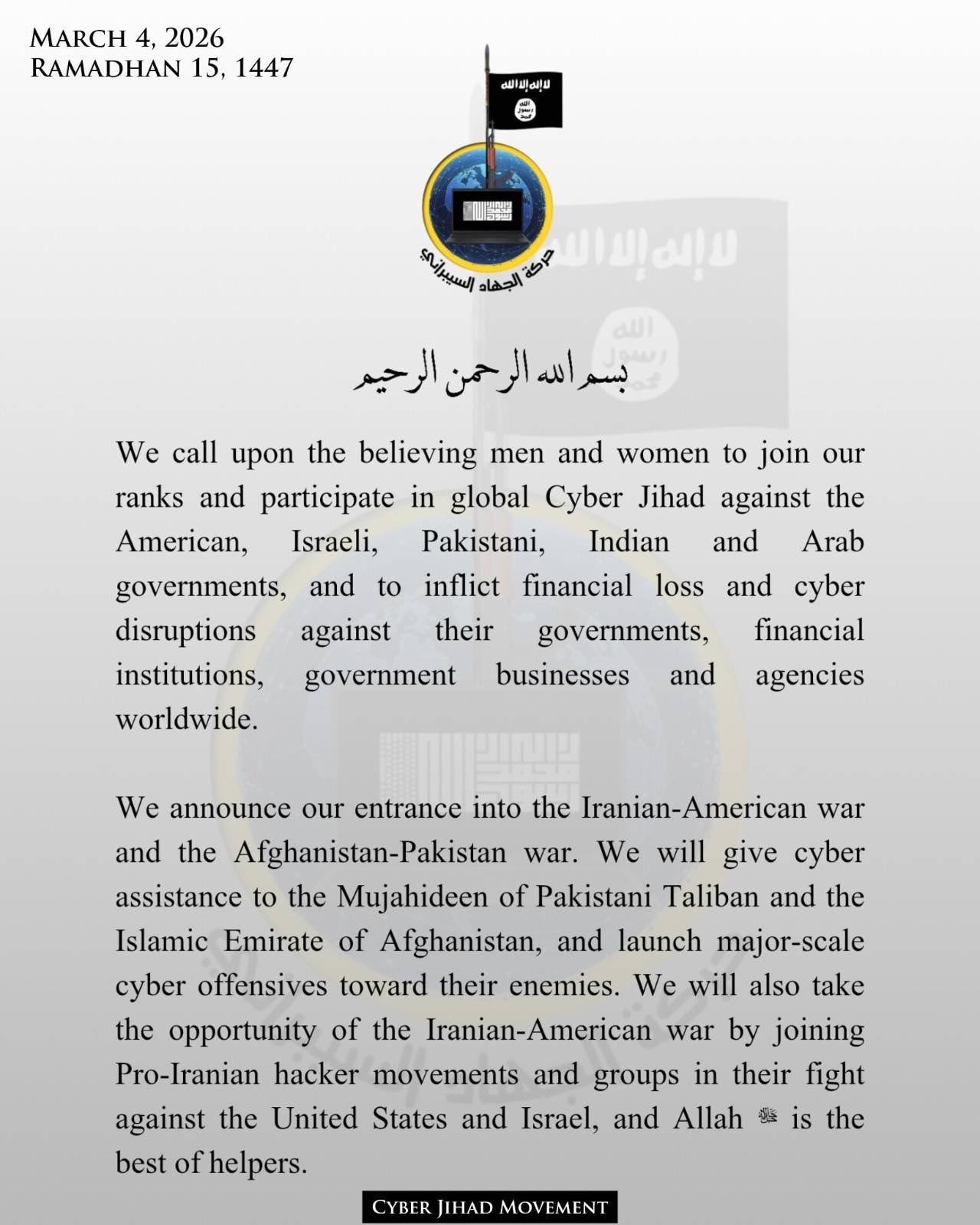
The analyzed document, released on 4 March 2026 during Ramadan, was disseminated through jihadist channels on Telegram and Signal, underscoring its role in strategic propaganda within the Salafi-jihadist media ecosystem.
The issuing label, Cyber Jihad Movement, does not correspond to a known centralized organization or to an officially recognized media wing of al-Qaeda. It should be assessed as a decentralized or loosely structured digital node operating within the broader pro-al-Qaeda online environment. Such entities typically function as informal aggregators of sympathizers, facilitators of content dissemination, and amplifiers of mobilization narratives, rather than as operational cyber units with structured command-and-control.
The document is written primarily in English, with religious references in Arabic, indicating an intended transnational audience. The messaging aligns with established jihadist propaganda patterns, including religious legitimization, identification of multiple adversaries, and calls for participation framed as accessible and globally relevant.
Key Judgments
The Cyber Jihad Movement statement represents a low-capability but deliberate attempt to position jihadist actors within the cyber domain as part of a broader hybrid engagement strategy.
The document reflects opportunistic strategic alignment with ongoing geopolitical tensions, particularly Iran–United States dynamics and the Afghanistan–Pakistan theatre, to increase perceived relevance and legitimacy.
The primary objective is mobilization rather than execution, targeting individuals with limited or moderate technical skills and lowering barriers to entry into jihadist participation through digital means.
There is no evidence within the material of advanced cyber capabilities or coordinated operational planning, indicating a significant gap between declared intent and realistic execution capacity.
The reference to potential cooperation with pro-Iranian hacker groups suggests a narrative of tactical convergence based on shared adversaries, although structural or sustained collaboration remains unlikely.
Key Assumptions
The Cyber Jihad Movement does not constitute a structured or centralized cyber unit within the al-Qaeda ecosystem.
The analyzed material reflects intent signaling and mobilization efforts rather than evidence of operational planning or execution capability.
Observed behavior aligns with patterns typical of decentralized jihadist digital nodes operating with limited coordination and low technical sophistication.
Key Findings
The document employs a standardized propaganda architecture that combines religious invocation, global-threat framing, and a direct call to action in the cyber domain.
The messaging expands the concept of jihad into the digital space, presenting cyber activities as a legitimate and necessary extension of armed and informational struggle.
The identification of multiple state adversaries, including the United States, Israel, Pakistan, India, and Arab governments, reinforces a broad conflict narrative aimed at maximizing resonance across different audiences.
The explicit mention of support to Tehrik-e-Taliban Pakistan and the Islamic Emirate of Afghanistan indicates alignment with the Afghanistan–Pakistan jihadist theatre and reinforces integration within the al-Qaeda-aligned ecosystem.
The framing of cyber operations as capable of generating financial damage and systemic disruption reflects aspirational objectives rather than demonstrated capabilities.
The overall structure and language indicate an intent to attract decentralized participation, rather than to signal imminent or coordinated cyber operations.
Scope and Methodology
This assessment is based on direct analysis of primary jihadist propaganda material disseminated through Telegram and Signal channels associated with the pro-al-Qaeda digital ecosystem.
The analytical approach focuses on the exploitation of content, narrative deconstruction, and contextualization within broader jihadist communication patterns and strategic behavior.
The assessment integrates qualitative analysis of messaging, identification of the target audience, and comparison with established trends in jihadist media production and digital mobilization practices.
No reliance has been placed on secondary reporting for core analytical judgments, ensuring that conclusions are grounded in direct evaluation of sources.
Limitations
The decentralized nature of the Cyber Jihad Movement label limits the ability to attribute the material to a defined organizational structure or to assess internal command dynamics.
The absence of verifiable operational data prevents precise evaluation of technical capabilities or intent beyond the narrative level.
Propaganda material inherently reflects exaggeration, aspirational framing, and strategic signaling, which may not correspond to actual capabilities or planned activities.
Intelligence Gaps
The actual size, composition, and geographic distribution of the network associated with the Cyber Jihad Movement remain unknown.
There is no visibility on the presence or involvement of individuals with advanced cyber capabilities within this node.
Potential links, formal or informal, with established hacktivist groups or pro-Iranian cyber actors cannot be verified at this stage.
The persistence, evolution, or replication of this label across platforms and timeframes remains uncertain.
Narrative and Strategic Framing
The document adopts a structured propaganda architecture designed to maximize accessibility, legitimacy, and perceived operational relevance within the cyber domain. The messaging opens with religious invocation and symbolic references to Ramadan, establishing immediate doctrinal legitimacy and framing participation as both timely and religiously sanctioned. It then transitions into a global threat narrative, identifying a broad set of adversaries and portraying the international environment as a unified front against Islam. This framing reduces complexity and creates a binary conflict structure, enabling rapid cognitive alignment for the target audience. The final layer introduces a direct call to action, presenting cyber activity as a viable, low-risk, and impactful form of participation, effectively lowering the threshold for engagement and expanding the potential recruitment base.
The strategic dimension of the message is centered on the opportunistic exploitation of ongoing geopolitical tensions. The reference to confrontation dynamics involving the United States and Iran, alongside tensions in the Afghanistan–Pakistan theatre, functions as a narrative multiplier rather than an analytical assessment of those conflicts. The document seeks to insert the Cyber Jihad Movement into these contexts by framing cyber activity as a complementary tool to support broader anti-state efforts. This reflects a pattern of parasitic positioning, in which weak or emergent actors seek relevance by attaching themselves to higher-visibility crises without the capability to shape those dynamics directly.
Within this framework, the document advances a claim of functional utility. Cyber operations are presented as capable of generating economic disruption, targeting financial systems, and imposing indirect pressure on state structures. This claim serves a dual purpose. It legitimizes the role of digitally oriented actors within the broader jihadist ecosystem, and it reframes cyber participation as strategically meaningful rather than auxiliary. The emphasis is not on demonstrated capability but on perceived impact, which is sufficient to support mobilization and reinforce the idea of contributing to a collective effort.
The construction of a multi-front conflict narrative is a central component of the messaging. The document identifies multiple state adversaries across different regions, including Western states, regional governments, and South Asian actors, and integrates them into a single operational and ideological framework. This aggregation of targets expands the message’s relevance across geographically dispersed audiences and supports the creation of a transnational mobilization space. It also aligns with established al-Qaeda communication patterns, in which decentralization is combined with a unifying narrative of global confrontation.
Overall, the document does not introduce new ideological elements, but it adapts existing jihadist narratives to the cyber domain and current geopolitical conditions. The strategic objective is not to signal capability, but to establish presence, relevance, and potential utility within an evolving hybrid conflict environment.
Targeting Logic
The document implicitly defines a broad targeting framework focused on state institutions, financial systems, and politically symbolic entities. This targeting logic prioritizes visibility and perceived systemic impact over technical feasibility, reinforcing the narrative of cyber operations as a strategic equalizer accessible to low-capability actors.
Cognitive Control Assessment
The target audience is composed primarily of digitally literate sympathizers, individuals within diaspora networks, and younger cohorts already exposed to pathways to online radicalization. The use of English as the main language, combined with simplified religious references, indicates a deliberate effort to reach a transnational audience with varying levels of ideological depth but sufficient digital familiarity. The absence of complex doctrinal argumentation suggests that the message is calibrated for accessibility rather than ideological consolidation.
The main cognitive entry points are built around the concept of cyber empowerment and operational accessibility. The document frames participation in cyber activities as achievable without specialized training or physical exposure, positioning digital engagement as a low-risk alternative to traditional forms of jihad. This reduces perceived barriers to entry and aligns with behavioral patterns observed in online radical milieus, where ease of participation directly influences mobilization rates.
Emotional activation remains controlled and functional rather than intense. The message does not rely on graphic content or high emotional triggers; instead, it emphasizes utility, contribution, and strategic relevance. This creates a rationalized form of engagement, where individuals are encouraged to act not out of immediate emotional impulse but through a perceived sense of purpose and effectiveness within a broader conflict framework.
Identity reinforcement is constructed at a global level. The individual is positioned as part of a wider, borderless community engaged in a shared struggle against multiple adversaries. This reduces the importance of local context and strengthens alignment with a transnational jihadist identity. The framing supports decentralized participation while maintaining coherence through a unified narrative of global confrontation.
Moral disengagement is facilitated through the exclusive focus on state actors, institutions, and economic systems as legitimate targets. By avoiding direct reference to civilian harm, the message lowers ethical resistance and reframes cyber activity as a legitimate form of conflict targeting impersonal systems. This aligns with established mechanisms of cognitive justification observed in both jihadist and hacktivist environments.
The decision pathway is intentionally simplified. The document does not require formal affiliation, advanced skills, or structured commitment. Participation is presented as immediate, individual, and digitally mediated, allowing for rapid transition from exposure to potential action. This low-threshold model increases the probability of spontaneous or uncoordinated engagement, particularly among loosely connected individuals.
Mobilization potential remains limited in terms of immediate operational impact but retains scalability under specific conditions. In the absence of enabling infrastructure or technical guidance, activity is likely to remain symbolic or low-level. However, the model can expand if linked to external triggers, such as major geopolitical events, viral propaganda cycles, or interaction with more capable hacktivist actors.
Confidence Assessment
Confidence is assessed as medium due to reliance on a single primary-source artifact, the decentralized nature of the ecosystem, and limited visibility on network depth, coordination mechanisms, and downstream behavioral outcomes.
Mobilization and Recruitment Logic
The call to action is direct, simplified, and intentionally inclusive. The message does not define specific operational tasks, but invites participation in generic cyber activities framed as impactful against state and financial systems. This ambiguity is functional; it allows for broad interpretation and lowers the cognitive and technical barriers to engagement.
The implicit target is individuals with basic digital literacy rather than specialized operators. The absence of explicit technical requirements, tools, or structured pathways indicates a mass mobilization approach rather than selective recruitment. The objective is to activate a distributed pool of sympathizers capable of contributing at different levels, including low-skill actions such as content amplification, basic intrusion attempts, or symbolic targeting.
The messaging emphasizes potential economic and systemic impacts, portraying cyber activity as capable of generating disproportionate effects relative to the effort invested. This framing reinforces perceived utility and encourages participation by linking individual action to broader strategic outcomes. The recruitment logic is therefore based on scalability, accessibility, and perceived relevance, rather than capability concentration.
Operational Reality vs Claimed Intent
There is a clear gap between declared intent and realistic operational capacity. The document projects ambitions related to economic disruption and systemic targeting, but provides no evidence of technical capability, organizational structure, or operational planning required to achieve such outcomes.
Observed patterns within similar jihadist digital nodes indicate that activities are typically limited to low-level operations, including defacement of unsecured websites, basic doxing, opportunistic exploitation of weak targets, and propaganda dissemination. There is no indication that the Cyber Jihad Movement possesses the expertise or coordination required for sustained or high-impact cyber operations.
As a result, the probability of structural or critical infrastructure impact remains low in the short to medium term. The primary effect of such initiatives is symbolic and informational, rather than operational. The messaging should therefore be interpreted as aspirational and signaling intent, not as an indicator of imminent capability.
Strategic Positioning within the Jihadist Ecosystem
The Cyber Jihad Movement should be assessed as a peripheral and non-central node within the broader pro-al-Qaeda ecosystem. It does not display characteristics of an official media wing or an integrated operational unit, and there is no evidence of formal affiliation with central command structures.
Its function appears to be supportive and complementary. It contributes to the expansion of the jihadist narrative into the digital domain, reinforces mobilization dynamics, and attempts to create additional channels of engagement for sympathizers unable or unwilling to participate in kinetic activities.
This positioning is consistent with al-Qaeda’s long-term decentralization strategy, in which loosely connected actors operate under a shared ideological framework without direct command and control. The explicit references to the Afghanistan–Pakistan theatre, including alignment with Tehrik-e-Taliban Pakistan and the Islamic Emirate of Afghanistan, further situate this node within a geographically and operationally relevant cluster of the al-Qaeda-aligned environment.
Cross-Ecosystem Dynamics
The document introduces a narrative of potential alignment with actors associated with pro-Iranian cyber activity. This reflects an opportunistic attempt to bridge traditionally distinct ecosystems by identifying shared adversaries, primarily Western states and allied governments.
Hacktivism represents the primary space of interaction. It provides a low-threshold environment in which ideological boundaries can be temporarily reduced in favor of tactical convergence. The adoption of hacktivist language and objectives indicates an effort to integrate into this broader digital confrontation space.
The presence of al-Qaeda leadership elements in Iran and the longstanding pattern of pragmatic, non-ideological arrangements with Iranian structures, including suspected links of convenience with elements of the IRGC, provide contextual grounding for this narrative. However, any form of sustained or structured cooperation remains unlikely due to enduring doctrinal divergences and strategic mistrust.
The risk of limited, opportunistic cooperation cannot be excluded. This would likely take the form of parallel or loosely coordinated actions rather than integrated operations, particularly in response to high-visibility geopolitical events.
Implications
From an informational perspective, the emergence of this type of node contributes to increased noise within the digital information environment. It amplifies propaganda output, introduces additional mobilization narratives, and supports the diffusion of low-level cyber activity across a broader audience. This can complicate attribution and increase the volume of minor incidents.
This development aligns with a broader trend within the jihadist ecosystem, in which cyber activity is increasingly normalized as an auxiliary domain, with participation-driven models replacing capability-driven approaches.
From a security perspective, the immediate technical threat remains limited. There is no indication of advanced capability or targeting of critical infrastructure. However, the emphasis on symbolic and economic targets suggests a potential increase in low-impact but visible actions, including defacement, disruption of minor services, and reputational targeting.
For decision-makers and security actors, the key development is the continued expansion of the jihadist operational concept into the digital domain. The reduction of entry barriers increases the potential for participation, while the decentralized model complicates detection and response. In the short term, the impact is likely to remain reputational and informational rather than structural.
Early Warning Indicators
The emergence of new Telegram or Signal channels explicitly linked to the Cyber Jihad Movement label or its variants.
The release of technical material, including guides, toolkits, or operational instructions related to cyber activity.
The appearance of coordinated or repeated cyber claims associated with the same branding across multiple platforms.
Observable interaction, endorsement, or content sharing between this node and known hacktivist groups or pro-Iranian cyber actors.
Short -Term Outlook 60–90 days
The narrative is likely to persist, with continued attempts to position cyber activity as a legitimate and accessible component of jihadist engagement.
The probability of escalation in technical capability remains low, given the absence of enabling structures and expertise.
An increase in symbolic or low-level cyber activity is possible, particularly in response to major geopolitical developments or periods of heightened tension, where such actions can be leveraged for visibility and narrative reinforcement.
Analytical Note
This type of artifact holds limited value as a direct indicator of operational threat, but significant value as an early signal of adaptive behavior within the jihadist ecosystem. This reflects our ongoing efforts to expand engagement domains, lower participation thresholds, and align with evolving forms of hybrid conflict.
Monitoring these signals allows identification of trajectory shifts before they materialize into more structured or capable forms. The relevance is therefore longitudinal and analytical, rather than immediate and operational.
Why This Matters Now
The circulation of this material, amid current geopolitical tensions, increases the likelihood that the narrative will be amplified and exploited opportunistically. Although the operational impact remains limited, the convergence of timing, narrative framing, and accessibility reinforces the digital domain’s role as an expanding space for low-threshold engagement within the jihadist ecosystem.
🔒 Executive Intelligence Cycle
This assessment is part of a broader analytical cycle.
Founding subscribers receive the Executive Intelligence Briefing, which integrates all threat assessments, cognitive domain analysis, and a rolling 30–90 day forecast into a single monthly strategic synthesis.
© Daniele Garofalo Monitoring - All rights reserved.
Daniele Garofalo is an independent researcher and analyst specializing in jihadist terrorism, Islamist insurgencies, and armed non-state actors.
His work focuses on continuous intelligence monitoring, threat assessment, and analysis of propaganda and cognitive/information dynamics, with an emphasis on decision-oriented outputs, early warning, and strategic trend evaluation.
ISSN (International Standard Serial Number): 3103-3520
NATO NCAGE: AX664 (NATO Commercial and Governmental Entity)
ORCID Code: 0009-0006-5289-2874