


Executive Intelligence Summary
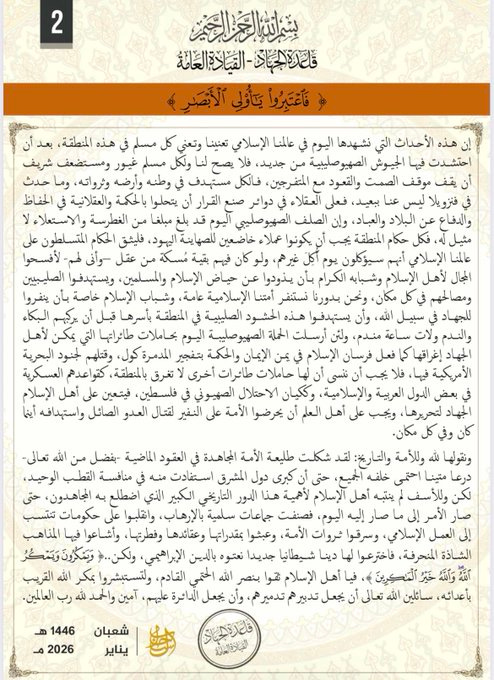
This assessment examines al-Qaeda’s 2026 (early February) central leadership statement as a strategic communication artifact designed primarily to reinforce organizational cohesion and restore ideological legitimacy rather than to signal imminent large-scale operational escalation. The document should be interpreted within a cognitive warfare framework: it seeks to shape perceptions, recalibrate identity alignment, and sustain networked resilience under sustained counterterrorism pressure and intra-jihadist competition.
The statement reframes contemporary geopolitical conflicts as elements of a unified civilizational confrontation against Islam, consolidating disparate theatres into a single narrative battlefield. This framing performs three interlinked functions. First, it sacralizes political conflict, transforming strategic setbacks into evidence of moral righteousness and divine testing. Second, it reconstructs al-Qaeda’s claim to doctrinal authority, positioning the organization as the disciplined and legitimate custodian of global jihad in contrast to both Western adversaries and rival jihadist actors. Third, it enables controlled decentralization by encouraging localized initiative while avoiding explicit operational directives, thereby preserving plausible deniability and reducing exposure to detection.
The document reflects a phase of strategic constraint. Indicators of expansionist intent are limited; instead, emphasis is placed on unity, patience, and perseverance. This suggests prioritization of cognitive continuity over territorial ambition. The primary target audience is ideologically engaged supporters and mid-level cadres rather than mass constituencies, indicating a focus on elite reconstitution and long-term endurance.
The immediate threat impact is assessed as moderate in inspirational terms and limited in directive terms. The principal risk lies in narrative reinforcement across affiliated theatres, particularly in the Sahel, Somalia, and Yemen, where alignment with existing insurgent messaging may enhance cohesion and recruitment. Early warning indicators to monitor include doctrinal amplification by affiliates, increased theological discourse within jihadist forums, and rhetorical convergence across decentralized nodes.
Overall, the statement functions as an instrument of cognitive warfare aimed at organizational survival rather than as a precursor to coordinated transnational escalation.
Inside This Assessment
This assessment provides a cognitive warfare–oriented analysis of al-Qaeda’s 2026 central leadership statement. It examines the document as an influence operation rather than a tactical communiqué. The analysis focuses on:
narrative architecture,
authority claims,
emotional triggers,
mobilization logic,
implications for affiliated theatres, including the Sahel, Somalia, Yemen, Afghanistan, and the Indian Subcontinent.
Particular attention is given to organizational survival mechanisms under strategic pressure and intra-jihadist competition dynamics.
The document is assessed not for its rhetorical surface but for its functional intent within the cognitive domain: identity consolidation, legitimacy reconstruction, and decentralized activation potential.
Source Document Box
Primary Source Analysed: Official central leadership statement to al-Qaeda core, released via jihadist media distribution channels in 2026 (Hijri 1446).
Language: Arabic
Format: Written Statements
Distribution: Encrypted and semi-public jihadist-aligned dissemination ecosystems (Telegram, Rocket Chat, Element, Chirpwire).
Assessment Confidence in Attribution: Moderate
Attribution is consistent with known al-Qaeda rhetorical patterns and authority-signaling structures, though independent verification of internal authorship remains unavailable in the open-source context.
Key Judgments
The 2026 statement is primarily a cognitive consolidation instrument, not an operational escalation directive.
The document seeks to reassert al-Qaeda’s doctrinal authority within a fragmented jihadist ecosystem marked by competition with the Islamic State and localized autonomy of affiliates.
Narrative unification of global conflicts into a single civilizational war functions as a cognitive compression mechanism that eliminates ambiguity and reinforces binary identity alignment.
The communication enables decentralized mobilization while deliberately avoiding specific operational guidance, thereby reducing detectability and preserving strategic flexibility.
The immediate transnational risk of attack is assessed as low to moderate; however, the inspirational and cohesion-enhancing effects across affiliated theatres are assessed as moderate.
The statement signals organizational endurance mode rather than expansion mode.
Key Findings
The document sacralizes contemporary geopolitical conflict, transforming strategic setbacks into narratives of moral validation and divine testing.
Enemy construction follows a layered hierarchy: Western actors, Israel, and Muslim-majority governments are characterized as illegitimate. This structure supports both external and internal justifications for targeting.
Authority claims are embedded through theological framing, appeals to unity, and implicit differentiation from rival jihadist methodologies.
Emotional architecture oscillates between victimhood and resilience, a mechanism designed to prevent demoralization while sustaining mobilization potential.
Absence of explicit operational directives suggests strategic caution and awareness of surveillance constraints.
The primary audience appears to be ideologically committed cadres and sympathizers capable of doctrinal engagement rather than mass mobilization targets.
Why This Document Matters (Cognitive Domain)
This document matters because it demonstrates that al-Qaeda’s center of gravity has shifted from territorial contestation to cognitive continuity.
In environments of kinetic pressure and leadership attrition, narrative authority becomes a substitute for operational dominance. The statement attempts to:
Preserve organizational identity coherence across geographically dispersed affiliates.
Reinforce legitimacy claims in competition with rival jihadist actors.
Sustain long-term mobilization capacity without triggering counterterrorism escalation.
Normalize protracted struggle as a permanent condition.
The strategic objective is not immediate action but sustained alignment of beliefs. In cognitive warfare terms, the document functions as institutional life support.
Failure to interpret such communications within the cognitive domain risks underestimating their long-term influence effects while overestimating short-term operational implications.
Bottom Line Assessment
Al-Qaeda’s 2026 central leadership statement reflects a strategy of survival through narrative control. The document prioritizes ideological cohesion, authority restoration, and decentralized activation potential over immediate coordinated escalation.
The threat trajectory remains structurally persistent but not imminently amplified at the transnational level. The most significant risk vector lies in narrative reinforcement within existing insurgent theatres, where ideological synchronization may enhance recruitment, local legitimacy, and endurance.
This is a consolidation signal, not an offensive breakthrough.
Scope and Methodology
This assessment is based on direct intelligence analysis of a primary jihadist source.
Methodological components:
• Primary Source Analysis: Full-text qualitative analysis of the original Arabic communiqué without reliance on secondary interpretation.
• Structured Narrative Coding: Identification of ontological framing, moral positioning, emotional triggers, behavioral licensing, and authority anchoring.
• OSINT: Contextualization within established al-Qaeda strategic communication patterns and historical doctrinal outputs.
• SOCMINT (limited): Consideration of resonance patterns within jihadist-aligned ecosystems, without platform-level quantitative analytics.
• Digital HUMINT (analytical): Interpretative inference of intent, audience targeting, and strategic signaling derived from language structure, emphasis patterns, and omission analysis.
The assessment applies a cognitive warfare framework to translate rhetorical constructs into indicators of influence architecture.
Limitations
Intent Inference Risk: Interpretative analysis of messaging intent may overestimate strategic coherence when rhetorical convention is at play.
Temporal Limitation: Immediate post-release analysis may not capture delayed amplification effects or derivative propaganda outputs.
Behavioral Gap: Narrative presence does not equate to operational activation; the translation of rhetoric into action remains contingent on local conditions.
Despite these limitations, the document provides reliable insight into al-Qaeda’s current cognitive positioning and organizational survival strategy.
1. Introduction
Cognitive Warfare as Organizational Survival Strategy
In 2026, al-Qaeda issued a central leadership statement, a period characterized not by territorial expansion but by strategic constraint. The organization operates within a fragmented jihadist ecosystem, faces sustained counterterrorism pressure, and competes ideologically with rival actors. Under such conditions, strategic communication assumes heightened operational relevance. When territorial control contracts and leadership networks degrade, influence over perception becomes a substitute for control over terrain.
This paper examines the 2026 statement not as routine propaganda, but as a deliberate instrument of cognitive warfare designed to preserve organizational continuity, restore legitimacy, and recalibrate authority within a dispersed militant network. The core research question guiding this analysis is the following:
How does al-Qaeda employ strategic communication as a cognitive warfare mechanism to ensure organizational survival under sustained structural pressure?
The analytical premise is that contemporary jihadist movements increasingly rely on narrative dominance as a compensatory strategy during periods of operational limitation. Influence operations, rather than battlefield offensives, become the primary vector for maintaining relevance. In this context, the statement functions as a strategic artifact whose purpose is less about immediate mobilization and more about long-term ideological anchoring.
Cognitive warfare, as conceptualized within contemporary security discourse, refers to the deliberate targeting of perception, identity, belief systems, and decision-making processes. Unlike traditional information operations that focus on visibility of messaging, cognitive warfare aims to restructure interpretive frameworks. It shapes how audiences understand reality, attribute causality, define legitimacy, and justify action. In insurgent contexts, this dimension is particularly critical because non-state actors lack structural power and must instead cultivate interpretive authority.
Al-Qaeda’s communication strategy historically reflects this dynamic. From its formative ideological texts to post-9/11 communiqués, the organization has repeatedly sought to define the moral architecture of conflict rather than merely claim operational responsibility. The 2026 statement continues this pattern, but within a transformed strategic landscape characterized by decentralization, affiliate autonomy, and intra-jihadist rivalry. The document, therefore, represents an attempt at cognitive re-centralization in a structurally decentralized movement.
To analyze this process, this paper introduces an Influence Architecture Model structured across five interlocking layers:
Ontological Framing: Construction of reality and conflict definition.
Moral Positioning: Allocation of righteousness and delegitimization of adversaries.
Emotional Activation: Deployment of grievance, humiliation, resilience, and transcendence.
Behavioral Licensing: Expansion of what becomes morally permissible.
Organizational Anchoring: Reassertion of authority and leadership centrality.
This model enables a systematic assessment of how the statement seeks to shape belief systems and mobilization pathways, without issuing explicit operational directives. Rather than focusing on overt calls for violence, the framework interrogates the deeper architecture through which violence becomes cognitively normalized and strategically sustainable.
The central argument advanced here is that al-Qaeda in 2026 prioritizes cognitive continuity over territorial ambition. The statement reflects an organization in survival mode, where narrative cohesion substitutes for battlefield initiative. Its function is to prevent ideological entropy, mitigate fragmentation, and reassert doctrinal legitimacy in a competitive jihadist marketplace.
This approach differs from conventional threat assessments that privilege kinetic indicators. While operational capabilities remain relevant, the decisive variable in this phase is influence resilience. An insurgent organization that maintains cognitive coherence across dispersed nodes preserves the capacity for future regeneration, even in the absence of immediate operational escalation.
The implications extend beyond al-Qaeda itself. Understanding such communications through a lens of cognitive warfare enables more accurate calibration of counterterrorism responses. Overreaction risks validating victimhood narratives, while underestimation risks allowing influence networks to consolidate. Strategic response, therefore, requires recognizing that organizational survival in contemporary insurgency increasingly depends on narrative architecture.
The sections that follow apply the Influence Architecture Model to the 2026 statement, mapping its ontological framing, moral positioning, emotional mechanisms, mobilization logic, and implications across key theatres. The objective is not to interpret rhetoric at face value, but to decode the structural functions embedded within it.
2. The Influence Architecture Model
The Influence Architecture Model conceptualizes jihadist strategic communication as a layered system designed to shape perceptions, emotions, legitimacy, and actions. Each layer performs a distinct cognitive function while reinforcing the others.
Layer 1: Ontological Framing
Definition: Construction of reality and definition of the conflict environment.
This layer determines how the world is described. It establishes causal chains, assigns systemic intent, and compresses complexity into coherent explanation.
Observable Variables:
Framing of global conflict as unified or fragmented
Attribution of causality to centralized conspiratorial actors
Binary versus pluralistic representations of political order
Coding Indicators:
References to “global war,” “civilizational struggle,” unified enemies
Simplification of geopolitical events into a single explanatory schema
Erasure of internal Muslim diversity
Analytical Function:
Ontological framing reduces ambiguity and establishes a cognitive baseline for subsequent moral positioning.
Layer 2: Moral Positioning
Definition: Allocation of righteousness and delegitimization of adversaries.
This layer transforms political conflict into a moral dichotomy. It distinguishes pure from corrupt, legitimate from apostate.
Observable Variables:
Religious justification of violence
Dehumanization language
Delegitimization of Muslim-majority governments
Coding Indicators:
Terms equating opponents with betrayal or apostasy
Moral absolutist language
Sacralization of in-group identity
Analytical Function:
Moral positioning licenses future behavioral justification.
Layer 3: Emotional Activation
Definition: Structured deployment of grievance, humiliation, resilience, and transcendence.
This layer energizes identity through emotional oscillation.
Observable Variables:
Victimhood narratives
Collective humiliation framing
Divine promise and inevitability language
Coding Indicators:
Lexical markers of suffering and injustice
References to divine reward or testing
Emotional escalation followed by reassurance
Analytical Function:
Emotion stabilizes belief adherence under material stress.
Layer 4: Behavioral Licensing
Definition: Expansion of what becomes morally permissible.
This layer translates moral positioning into actionable cognitive space without necessarily issuing direct commands.
Observable Variables:
Implicit encouragement of action
Obligation framing
Ambiguity regarding means and targets
Coding Indicators:
Language of duty or individual responsibility
Absence of explicit operational detail paired with moral urgency
Justificatory precedents
Analytical Function:
Behavioral licensing enables decentralized activation while preserving strategic deniability.
Layer 5: Organizational Anchoring
Definition: Reassertion of leadership authority and doctrinal centrality.
This layer ensures that mobilization remains tethered to organizational identity.
Observable Variables:
Appeals to unity under specific leadership
Doctrinal referencing aligned with organizational lineage
Implicit differentiation from rival movements
Coding Indicators:
Claims of custodianship of true jihad
Emphasis on patience, discipline, and method
Central authority tone
Analytical Function:
Anchoring prevents ideological fragmentation and sustains brand continuity.
Comparative Applicability
The Influence Architecture Model is designed for cross-document comparison. It allows analysts to:
Compare pre- and post-leadership loss communications.
Assess divergence between al-Qaeda and Islamic State rhetoric.
Measure trends in escalation or moderation over time.
Identify shifts from expansionist to survival-oriented narratives
Because each layer includes observable variables and coding indicators, the model supports structured qualitative comparison and can be adapted for mixed-methods analysis.
Applied to the 2026 statement, the model enables systematic evaluation of whether the communication signals escalation, consolidation, fragmentation, or competitive repositioning. It transforms doctrinal rhetoric into analyzable influence architecture.
3. Ontological Framing: Constructing a Unified Civilizational Battlefield
The first analytical layer of the Influence Architecture Model concerns ontological framing: the construction of reality within which moral judgments and behavioral expectations become intelligible. In insurgent strategic communication, ontology is not descriptive; it is instrumental. It defines the conflict, identifies the relevant actors, and determines whether ambiguity is permitted. In the 2026 al-Qaeda statement, ontological framing functions as the foundational cognitive operation upon which all subsequent layers depend.
3.1 Compression of Geopolitical Complexity
The statement systematically compresses multiple geopolitical theatres into a single, unified confrontation. Conflicts in different regions are presented not as discrete crises with localized drivers, but as manifestations of a coherent and intentional campaign against Islam. Political diversity, regional variation, and intra-Muslim pluralism are largely subsumed under a single explanatory schema.
This compression performs a cognitive simplification function. By reducing complexity, the text lowers interpretive thresholds for its audience. Political ambiguity is cognitively expensive; binary conflict is cognitively efficient. The world is redefined as structurally antagonistic. There are no neutral arenas, only extensions of the same struggle.
From a cognitive warfare perspective, this maneuver establishes what may be termed a totalized battlespace of meaning. The battlefield is no longer territorial but ontological. Every political development is pre-coded as confirmation of systemic hostility. Such framing inoculates supporters against contradictory evidence and prevents narrative fragmentation.
3.2 Systemic Intent Attribution
A recurring feature of the statement is the attribution of coordinated intent to adversaries. Western states, Israel, and Muslim-majority governments are presented as components of an integrated anti-Islamic order. Whether explicitly articulated or implied through cumulative rhetorical association, the effect is to suggest strategic unity among adversaries.
This systemic attribution has two key implications. First, it eliminates the possibility of isolated or contingent events. No action is accidental; all are intentional components of an overarching design. Second, it collapses distinctions between local grievances and global structures. A local military operation becomes proof of a global conspiracy.
In ontological terms, the document constructs a closed explanatory system. Such closure is essential for cognitive durability. Open systems permit reinterpretation; closed systems resist it. Once adversaries are integrated into a single moral and political bloc, dissenting interpretations appear as naivety or betrayal.
3.3 Temporal Unification and Historical Continuity
The statement also engages in temporal compression. Historical references are invoked to situate contemporary events within a long arc of confrontation. Past conflicts, colonial interventions, and prior military campaigns are rhetorically aligned with present developments.
This temporal unification produces a sense of inevitability and permanence. The conflict is not episodic but enduring. The implication is that compromise is structurally impossible. By embedding current grievances within a multi-generational narrative, the document transforms situational anger into civilizational consciousness.
From a cognitive warfare standpoint, temporal compression serves resilience. If struggle is permanent, setbacks are temporary. The organization’s operational decline cannot invalidate the narrative, as it predates and transcends any specific operational phase.
3.4 Erasure of Internal Diversity
A significant ontological feature is the marginalization of internal Muslim plurality. Political disagreements, sectarian diversity, and local governance complexities are subordinated to a unified identity category. The “umma” is portrayed as a singular moral body under assault.
This homogenization is strategically functional. Diversity introduces interpretive friction. Unity introduces mobilization clarity. By redefining identity as collective and undifferentiated, the statement narrows permissible interpretive space—those who deviate from the prescribed understanding of conflict risk being positioned outside the moral community.
This ontological move also supports later layers of moral positioning and organizational anchoring. If the community is unified and under siege, centralized leadership claims become more plausible.
3.5 Ontological Consequences for Behavioral Space
The cumulative effect of these framing techniques is to create a structurally antagonistic reality in which neutrality is rendered illegitimate. When the world is defined as a coherent system of hostility, disengagement becomes moral abdication.
Importantly, the statement does not require explicit operational instructions at this stage. Ontological restructuring itself alters behavioral expectations. If conflict is universal and intentional, then defensive obligation becomes self-evident.
In intelligence terms, this layer signals strategic consolidation rather than escalation. The document does not introduce new theatres or announce specific campaigns. Instead, it reinforces the cognitive scaffolding necessary for long-term endurance. It stabilizes the interpretive environment in which decentralized actors may later operate.
3.6 Assessment
The ontological framing embedded in the 2026 statement reflects an organization prioritizing cognitive coherence over operational innovation. By compressing geopolitical complexity into a unified civilizational struggle, attributing systemic intent to adversaries, and erasing internal plurality, al-Qaeda constructs a durable interpretive architecture resistant to fragmentation.
This layer does not increase immediate kinetic threat indicators. However, it strengthens the cognitive infrastructure upon which future mobilization can rest. In survival phases, such ontological consolidation is strategically rational. It preserves identity alignment, reduces interpretive drift among affiliates, and sustains belief continuity despite material constraints.
4. Moral Positioning: Sacralization, Delegitimization, and Binary Ethics
If ontological framing defines the structure of reality, moral positioning assigns value within that structure. It determines who is righteous, who is corrupt, and which forms of action become morally defensible. In the 2026 statement, al-Qaeda moves from describing a unified civilizational conflict to morally ordering it. This shift is decisive: without moral hierarchy, ontological framing remains abstract. With it, conflict becomes ethically charged and behaviorally consequential.
4.1 Sacralization of the In-Group
The document consistently elevates the in-group through religious sacralization. The Muslim community is portrayed not merely as politically aggrieved but as morally pure and divinely observed. Suffering is framed as evidence of righteousness rather than weakness. Hardship becomes a sign of spiritual selection.
Sacralization performs two cognitive functions. First, it shields identity from erosion under pressure. If adversity confirms divine favor, defeat cannot invalidate commitment. Second, it elevates participation in the struggle from a political choice to a religious vocation. This reframing subtly shifts the motivational baseline from optional activism to moral duty.
Importantly, sacralization does not rely exclusively on explicit theological argument. It is embedded in tone, lexical choices, and the integration of sacred references into political commentary. Religion is not an add-on; it is the interpretive lens through which all events are filtered.
4.2 Delegitimization of Adversaries
Parallel to sacralization is systematic delegitimization. Adversaries are not described as geopolitical competitors but as morally deviant actors. Western states are positioned as aggressors in a historical continuum of hostility. Israel is embedded within this antagonistic system. Muslim-majority governments are portrayed as complicit, corrupt, or apostate.
This layered delegitimization collapses distinctions between external and internal enemies. The “near enemy” and “far enemy” are morally synchronized. In doing so, the document reduces the thresholds for confronting issues within Muslim societies. If rulers are illegitimate and morally compromised, resistance becomes purification rather than rebellion.
The language used is not merely critical; it is categorical. Opponents are placed outside the moral community. In cognitive terms, this reduces the bandwidth of empathy. Moral exclusion is a prerequisite for sustained radicalization.
4.3 Binary Ethical Structuring
The statement exhibits pronounced binary structuring. There is righteousness and corruption, belief and betrayal, authenticity and deviation. Ambivalence is absent. Moral gray zones are eliminated.
Binary ethics serve as an accelerator of mobilization. Complex moral landscapes demand deliberation. Binary landscapes demand alignment. When neutrality is equated with complicity, passivity becomes ethically untenable.
This structuring also fortifies internal discipline. Intra-movement disagreement risks being interpreted as deviation from righteousness. Thus, moral positioning supports organizational cohesion by narrowing legitimate interpretive space.
4.4 Moral Absolutism and Behavioral Implications
Although the document avoids explicit operational instructions, moral absolutism implicitly expands the domain of permissible action. When conflict is sacralized and adversaries are delegitimized, the defensive obligation becomes elastic. Violence becomes framed as restorative justice rather than aggression.
This is a critical transition point within the Influence Architecture Model. Moral positioning does not command violence; it normalizes it. The absence of specific directives does not reduce behavioral implication. On the contrary, ambiguity may enhance adaptability. Actors internalize moral logic and apply it locally.
From an intelligence perspective, this is strategically efficient. Explicit operational guidance invites disruption. Moral absolutism, diffused across decentralized networks, enables initiatives without centralized exposure.
4.5 Differentiation Within the Jihadist Field
The moral language of the 2026 statement also contains implicit differentiation from rival jihadist methodologies. The emphasis on discipline, unity, and measured perseverance contrasts with narratives historically associated with excessive takfir or indiscriminate violence. While rivals are not named, the moral tone signals doctrinal positioning.
This is competitive outbidding in a cognitive register. Rather than escalating brutality, al-Qaeda competes based on legitimacy and restraint. It frames itself as morally grounded and strategically coherent. In fragmented ecosystems, moral credibility can substitute for spectacle.
4.6 Assessment
The moral positioning embedded in the 2026 statement consolidates the ontological framework established in the previous layer. By sacralizing the in-group, delegitimizing adversaries, and enforcing binary ethical boundaries, al-Qaeda transforms structural grievance into a moral imperative.
This layer increases inspirational risk more than operational risk. It strengthens justification architecture without specifying action pathways. In survival phases, such moral consolidation is strategically rational. It preserves loyalty, deters ideological drift, and maintains readiness for future mobilization opportunities.
5. Emotional Activation: Victimhood, Humiliation, and Transcendent Resilience
If ontological framing constructs reality and moral positioning orders it ethically, emotional activation energizes it. Without affective mobilization, ideological structures remain inert. In insurgent cognitive warfare, emotion is not rhetorical decoration; it is a stabilizing force that sustains commitment in the face of adversity.
The 2026 al-Qaeda statement deploys a calibrated emotional architecture built around three interlocking axes: collective victimhood, civilizational humiliation, and transcendent resilience.
5.1 Collective Victimhood as Identity Glue
The document consistently frames the Muslim community as subject to systemic aggression. This victimhood is not episodic but structural. Political events are interpreted as evidence of deliberate oppression rather than contingent conflict.
Collective victimhood performs several cognitive functions:
It externalizes blame, preventing internal attribution of failure.
It reinforces in-group cohesion by emphasizing shared suffering.
It lowers psychological barriers to radical solidarity.
Importantly, victimhood is not framed as weakness. It is reframed as a moral distinction. Suffering becomes proof of righteousness. This inversion transforms grievance into identity reinforcement rather than demoralization.
From a cognitive warfare standpoint, victimhood narratives inoculate supporters against counterterrorism messaging. If repression is expected and interpreted as confirmation of hostility, deterrence loses symbolic effect.
5.2 Civilizational Humiliation and Moral Shock
Beyond victimhood, the statement amplifies humiliation. It portrays the Muslim community as dishonored by foreign domination and betrayed by internal rulers. Humiliation is a powerful mobilizer because it attacks collective dignity.
The text evokes a sense of historical injustice, implying that contemporary conditions represent a continuation of long-standing degradation. This temporal layering intensifies emotional charge. The humiliation is not recent; it is inherited.
Emotional escalation is carefully structured. The narrative does not remain at the level of grievance. It moves toward moral shock. By presenting suffering as intolerable and systemic, the text constructs a psychological threshold beyond which passivity appears dishonorable.
Humiliation thus becomes catalytic. It transforms identity into urgency.
5.3 Oscillation Between Despair and Transcendence
A notable feature of the emotional architecture is oscillation. The statement alternates between highlighting oppression and invoking divine promise. This fluctuation prevents emotional exhaustion.
Extended exposure to grievance without hope produces disengagement. Conversely, optimism without acknowledgment of suffering appears disconnected from reality. The document balances both.
Transcendent resilience is introduced through references to divine testing, the inevitability of justice, and historical perseverance. Hardship is reframed as purification. Struggle becomes spiritually meaningful.
This oscillation stabilizes long-term commitment. Emotional regulation within extremist narratives is often overlooked. Here it is deliberate. The audience is guided from outrage to reassurance, from despair to transcendence.
5.4 Emotional Conditioning and Decentralized Action
Although no explicit operational directives are issued, the emotional charge embedded in the text creates permissive psychological space for action. When humiliation is framed as intolerable and resilience as divinely mandated, behavioral thresholds shift.
Emotion lowers cognitive inhibition. It reduces deliberative friction. Actors exposed to such narratives may internalize urgency without receiving direct orders.
This mechanism is particularly relevant in decentralized ecosystems. Emotional activation allows for distributed initiative while preserving plausible deniability at the central level.
From an intelligence perspective, emotional intensity correlates more strongly with inspirational risk than doctrinal complexity. Monitoring emotional escalation patterns may therefore offer more predictive value than tracking theological nuance alone.
5.5 Competitive Emotional Framing
Within the broader jihadist ecosystem, emotional tone also functions competitively. The statement avoids apocalyptic frenzy or indiscriminate rage. Instead, it channels anger through structured endurance.
This calibrated emotionality differentiates al-Qaeda from more spectacle-oriented rivals. It signals maturity and discipline. In doing so, it seeks to attract cadres who value strategic patience over impulsive escalation.
Emotional moderation, paradoxically, can enhance credibility among ideologically committed audiences.
5.6 Assessment
The emotional architecture of the 2026 statement reinforces organizational survival by stabilizing commitment under structural pressure. Victimhood binds identity. Humiliation mobilizes urgency. Transcendent resilience prevents collapse.
This layer significantly strengthens inspirational cohesion but, by itself, does not signal imminent operational escalation. Instead, it prepares psychological terrain for potential future mobilization should a strategic opportunity arise.
Emotion here functions as endurance infrastructure.
6. Behavioral Licensing: Moral Obligation Without Operational Directives
Behavioral licensing represents the transition from belief to action. Within the Influence Architecture Model, it refers to the process through which strategic communication expands the domain of morally permissible behavior without necessarily issuing explicit operational instructions. In decentralized insurgent ecosystems, this mechanism is central to maintaining mobilization capacity while minimizing exposure to centralization.
The 2026 al-Qaeda statement demonstrates a calibrated form of behavioral licensing that avoids tactical specificity yet reshapes the psychological conditions under which action becomes legitimate.
6.1 From Moral Clarity to Moral Obligation
The document progressively moves from moral positioning toward implicit obligation. Once conflict is defined as existential and adversaries are morally delegitimized, neutrality becomes ethically unstable. The framing of struggle as a religious duty shifts participation from political preference to moral necessity.
Crucially, the statement does not outline operational targets or methods. Instead, it relies on obligation framing language—duty, responsibility, perseverance—to signal that engagement is not optional. This approach transfers interpretive agency to the audience while preserving strategic ambiguity at the leadership level.
The effect is subtle but consequential: behavioral thresholds are lowered without triggering explicit command-and-control markers.
6.2 Ambiguity as Strategic Shield
The absence of concrete directives is not a weakness but a protective feature. In high-surveillance environments, explicit calls for attack create legal and operational vulnerabilities. Ambiguity, by contrast, distributes interpretive responsibility.
The statement employs broad exhortations rather than tactical detail. This creates a space of elasticity in which local actors may interpret their duties in context. Behavioral licensing thus becomes adaptive rather than prescriptive.
From an intelligence perspective, such elasticity complicates threat forecasting. Action pathways are not centrally scripted but cognitively enabled. This model is consistent with post-2015 jihadist communication trends emphasizing inspiration over instruction.
6.3 Defensive Framing and Offensive Elasticity
The document’s framing primarily functions defensively. However, defensive narratives can generate offensive elasticity. When defense is defined expansively—protection of faith, dignity, community—behavioral boundaries widen.
This elasticity operates cognitively. If the enemy is everywhere and aggression is systemic, defensive action can manifest beyond traditional battlefield contexts. The statement does not specify such manifestations, but it creates the moral conditions under which they can be justified.
This mechanism is particularly relevant for lone-actor dynamics. Individuals may internalize defensive obligation in highly localized environments, interpreting personal grievance as participation in a broader struggle.
6.4 Delegated Agency and Decentralized Initiative
The statement’s behavioral licensing reflects a decentralized organizational reality. Affiliates operate with significant autonomy. Central leadership influence depends more on ideological coherence than direct command.
By emphasizing duty and perseverance while avoiding operational micromanagement, the document reinforces delegated agency. It implicitly communicates trust in dispersed actors to interpret strategic intent.
This is a resilience strategy. Even if central nodes are disrupted, cognitively licensed actors retain motivational structure. Organizational continuity becomes distributed rather than hierarchical.
6.5 Controlled Radicalization Boundaries
Importantly, the statement does not escalate into indiscriminate or apocalyptic incitement. There is restraint in tone. The absence of explicit mass-casualty glorification suggests strategic calibration.
This restraint differentiates al-Qaeda’s licensing model from more escalationist jihadist competitors. Rather than amplifying spectacle, the document promotes disciplined endurance. Behavioral permission is embedded within structured identity, not chaotic rage.
In competitive ecosystems, this calibrated licensing may appeal to cadres seeking long-term insurgent legitimacy rather than immediate notoriety.
6.6 Assessment
The 2026 statement operationalizes behavioral licensing through moral obligation framing, strategic ambiguity, and reinforcement of decentralized agency. It does not signal imminent coordinated transnational attacks. However, it strengthens the cognitive permissibility of localized initiative.
Risk Assessment Implication:
The short-term probability of centralized operational escalation remains low.
Inspirational and decentralized activation probability remains moderate.
Behavioral licensing in this document functions as a latent activation mechanism rather than an immediate operational trigger.
7. Organizational Anchoring: Reasserting Authority in a Decentralized Ecosystem
The final layer of the Influence Architecture Model concerns organizational anchoring: the mechanisms through which mobilization, moral positioning, and emotional activation are tethered to a specific leadership structure. Without anchoring, decentralized activation risks fragmentation, drift, or appropriation by rival actors. In survival phases, this layer becomes decisive.
The 2026 al-Qaeda statement operates as an instrument of symbolic re-centralization. While the organization’s operational footprint remains geographically dispersed and structurally fragmented, the document seeks to reassert doctrinal authority at the cognitive level.
7.1 Leadership Tone and Custodianship Claims
The statement adopts a tone consistent with custodianship rather than agitation. It speaks as a guardian of orthodoxy and strategic continuity. The rhetorical posture is instructive but not frantic, authoritative but not reactionary.
This tone signals stability. In a competitive jihadist environment, rhetorical calm can communicate institutional maturity. The implication is that al-Qaeda remains the legitimate steward of global jihad despite operational setbacks.
The document implicitly positions central leadership as the interpreter of events and the arbiter of correct methodology. This interpretive authority is critical. In decentralized networks, whoever defines meaning retains influence.
7.2 Unity Appeals and Hierarchical Reaffirmation
Repeated emphasis on unity reinforces vertical alignment. Unity language functions both defensively and competitively. It mitigates the risk of fragmentation within affiliated structures and counters ideological drift toward rival organizations.
The statement does not call for structural reorganization. Instead, it reinforces symbolic cohesion. Affiliates are implicitly reminded that doctrinal authenticity flows from central lineage. Even without operational command, narrative gravity remains centralized.
This form of anchoring reflects contemporary insurgent adaptation. Where command chains cannot be tightly controlled, ideological synchronization substitutes for structural hierarchy.
7.3 Differentiation Without Direct Confrontation
Organizational anchoring also operates through implicit differentiation. The document emphasizes discipline, patience, and methodical struggle. These elements contrast with models associated with rapid territorial declaration, spectacle-driven escalation, or indiscriminate takfir.
Without naming rivals, the text signals methodological superiority. This is a cognitive contest for legitimacy. Rather than engaging in a rhetorical attack, it positions al-Qaeda as the mature, strategically grounded alternative within the jihadist spectrum.
Competitive anchoring reduces the risk of supporter defection. It reframes loyalty as alignment with an authentic method rather than emotional intensity.
7.4 Continuity as Strategic Asset
A recurring theme within the statement is continuity. Historical references, lineage claims, and invocation of enduring struggle situate al-Qaeda within a long trajectory rather than a reactive posture.
Continuity performs dual functions:
It insulates the organization from reputational damage associated with territorial loss.
It reinforces trust in leadership endurance despite attrition.
In cognitive warfare terms, continuity stabilizes brand identity. If the organization is perceived as historically anchored and methodologically consistent, temporary weakness does not translate into existential doubt.
7.5 Distributed Resilience Through Central Narrative Gravity
Paradoxically, the document accepts decentralization while resisting fragmentation. It does not attempt to micromanage affiliates. Instead, it provides narrative gravity. Local actors operate autonomously but within a shared interpretive framework.
This approach reflects structural realism. Centralized operational control is limited. Narrative centrality remains achievable.
Organizational anchoring, therefore, functions as a distributed resilience architecture. Even if central figures are neutralized, the doctrinal center persists in symbolic form.
7.6 Assessment
The organizational anchoring embedded in the 2026 statement indicates a strategic priority: preserving brand coherence across a dispersed insurgent network.
This layer suggests:
• Leadership insecurity is being managed through symbolic consolidation.
• Competition with rival jihadist actors is being addressed at the legitimacy level rather than through escalation.
• Organizational survival is being pursued through doctrinal gravity rather than operational spectacle.
From an intelligence standpoint, anchoring reduces the risk of fragmentation but may increase the potential for long-term resilience. Cohesive networks regenerate more effectively than ideologically diffuse ones.
The document closes the cognitive loop: it constructs reality, orders it morally, energizes it emotionally, licenses behavior, and binds all elements to centralized authority.
8. Cross-Theatre Implications: Narrative Utility and Strategic Fit
The strategic significance of al-Qaeda’s 2026 central leadership statement cannot be assessed solely at the global level. Its impact depends on narrative compatibility, organizational structure, competitive environment, and local conflict dynamics within specific theatres.
This section evaluates whether the document enhances affiliate positioning, alters mobilization dynamics, or shifts threat trajectories across five key regions: the Sahel, Somalia, Yemen, Afghanistan, and the Indian Subcontinent.
8.1 Sahel – Jama’at Nusrat al-Islam wal-Muslimin (JNIM)
The Sahel represents the most strategically consequential theatre for al-Qaeda’s contemporary ecosystem. Jama’at Nusrat al-Islam wal-Muslimin (JNIM) operates as a structurally embedded insurgent actor with deep local integration and calibrated governance strategies.
Narrative Compatibility: High
The 2026 statement’s emphasis on disciplined endurance, anti-Western framing, and delegitimization of regional governments aligns closely with JNIM’s operational model. The document reinforces JNIM’s self-presentation as a legitimate resistance movement against both foreign military presence and local regimes.
Organizational Utility: Moderate to High
The statement strengthens ideological coherence between local insurgency and global jihadist identity. It may bolster recruitment narratives by situating local grievances within a broader civilizational struggle.
Competitive Environment:
The Sahel features competition with Islamic State–aligned factions. The central statement’s tone of strategic patience and moral restraint implicitly supports JNIM’s differentiation from more escalationist actors.
Threat Shift Assessment:
Short-term escalation probability: Low
Medium-term cohesion reinforcement: High
The document consolidates ideological depth rather than triggering operational expansion.
8.2 Somalia – Harakat al-Shabaab al-Mujahidin
In Somalia, Harakat al-Shabaab al-Mujahideen (al-Shabaab) maintains one of the strongest and most institutionalized alignments with al-Qaeda core.
Narrative Compatibility: Very High
Al-Shabaab already operates within a structured ideological framework emphasizing discipline, governance, and strategic endurance. The central statement reinforces existing messaging rather than altering it.
Organizational Utility: Symbolic Reinforcement
The communiqué functions as a legitimacy affirmation rather than a doctrinal innovation. It strengthens the perception of al-Shabaab as part of a broader global struggle while preserving its operational autonomy.
Competitive Environment:
The Islamic State’s presence in Somalia remains limited relative to al-Shabaab’s dominance. The document’s restrained tone indirectly supports al-Shabaab’s claim to strategic maturity.
Threat Shift Assessment:
Operational trajectory: Stable
Narrative reinforcement: High
The document enhances cohesion but does not materially alter operational calculus.
8.3 Yemen – Al-Qaeda in the Arabian Peninsula (AQAP)
Al-Qaeda in the Arabian Peninsula (AQAP) has historically demonstrated sophisticated media production and external operations capability, though degraded in recent years.
Narrative Compatibility: High
The framing of defensive jihad and the delegitimization of regional actors align with Yemen’s fragmented political landscape. The civil war context provides fertile ground for embedding global narratives within local grievances.
Organizational Utility: Potential Regeneration Tool
The statement may assist AQAP in rebuilding ideological coherence and reasserting relevance amid diminished visibility. The emphasis on patience and continuity is particularly suited to low-intensity survival phases.
Competitive Environment:
AQAP faces competition from both Islamic State elements and local armed factions. The central statement strengthens doctrinal anchoring and may reduce drift among supporters.
Threat Shift Assessment:
Short-term external operations probability: Low
Long-term regeneration potential: Moderate
The document supports ideological stabilization rather than immediate activation.
8.4 Afghanistan – Residual al-Qaeda and ISK Competition
Afghanistan presents a complex environment where residual al-Qaeda elements coexist with the presence of Islamic State Khorasan Province (ISIS-K) and evolving Taliban governance dynamics.
Narrative Compatibility: Moderate
The document’s global framing may resonate ideologically, but al-Qaeda’s operational space is constrained. The absence of explicit confrontation with Taliban authorities reflects strategic caution.
Organizational Utility: Competitive Positioning
The statement serves primarily as an ideological differentiation from ISIS-K, emphasizing methodological discipline over spectacle-driven violence.
Competitive Environment: High
ISIS-K actively seeks relevance through high-profile attacks. Al-Qaeda’s restrained approach contrasts with this strategy.
Threat Shift Assessment:
Immediate operational shift: Low
Ideological competition impact: Moderate
The document functions as positioning in a contested narrative space rather than as an operational directive.
8.5 Indian Subcontinent – Al-Qaeda in the Indian Subcontinent (AQIS)
Al-Qaeda in the Indian Subcontinent (AQIS) operates with limited operational visibility but sustained ideological messaging.
Narrative Compatibility: Moderate to High
Themes of systemic oppression and religious obligation resonate within localized communal tensions. However, structural constraints limit large-scale operational translation.
Organizational Utility: Identity Consolidation
The central statement reinforces AQIS’s alignment with global jihadist identity, potentially sustaining recruitment pipelines even in low-intensity environments.
Competitive Environment:
Competition from Islamic State–inspired actors remains present but fragmented.
Threat Shift Assessment:
Short-term escalation probability: Low
Inspirational resonance probability: Moderate
The document sustains ideological alignment without significantly altering operational dynamics.
8.6 Cross-Theatre Assessment
Across theatres, the 2026 statement functions primarily as a cohesion amplifier rather than an escalation catalyst.
Common Patterns:
High narrative compatibility in established al-Qaeda affiliate environments
Strengthening of doctrinal anchoring
Limited evidence of imminent coordinated transnational escalation
Enhanced resilience potential in decentralized ecosystems
The document’s greatest strategic impact lies in reinforcing ideological gravity across dispersed nodes. Its value is cumulative rather than immediate.
9. Strategic Intelligence Assessment and Early Warning Indicators
The 2026 al-Qaeda central leadership statement should be interpreted as a signal of consolidation rather than an escalation trigger. Its primary functions are cognitive stabilization, legitimacy reinforcement, and strengthening distributed resilience. However, consolidation phases can precede regeneration. For intelligence practitioners, the relevant question is not whether the document calls for immediate action, but whether it alters structural conditions for future mobilization.
9.1 Strategic Posture Assessment
Current Strategic Phase: Survival and Cognitive Re-centralization
Indicators supporting this assessment:
Emphasis on unity and endurance over operational innovation
Absence of tactical directives or named targets
Doctrinal reaffirmation over escalation rhetoric
Competitive differentiation framed around authenticity rather than intensity
This suggests al-Qaeda is prioritizing ideological continuity and network cohesion over immediate operational expansion.
Threat Level Assessment:
Short-term coordinated transnational attack probability: Low
Inspirational lone-actor activation probability: Moderate
Affiliate-level localized insurgent continuity: High
The primary risk vector lies in cumulative narrative reinforcement across established theatres rather than sudden centralized action.
9.2 Early Warning Indicators
To detect potential transition from cognitive consolidation to operational activation, the following indicators should be monitored:
Doctrinal Amplification
Increased frequency of central leadership releases
Circulation of derivative theological commentaries reinforcing obligation language.
Affiliate Echo Synchronization
Explicit referencing of the 2026 statement in affiliate propaganda
Convergent rhetorical patterns across Sahel, Somalia, Yemen, and South Asia
Escalation in Obligation Framing
Shift from perseverance language toward immediacy language.
Emergence of more explicit individual duty rhetoric
Tactical Suggestion Emergence
Introduction of target categories, geographic focus, or operational inspiration narratives
Release of attack-justification case studies
Increased Competitive Friction with IS
Direct rhetorical confrontation
Outbidding through operational spectacle
Emotional Intensification
Escalation from resilience framing to urgency framing
Increased glorification of martyrdom narratives
The convergence of at least three of these indicators over a short time horizon would suggest a potential strategic phase transition.
9.3 Intelligence Implications
Counterterrorism responses must avoid conflating narrative consolidation with immediate operational intent. Overreaction may validate victimhood narratives and strengthen cognitive framing.
Conversely, dismissal of such communications as mere propaganda risks underestimating their long-term mobilization value.
Effective response requires:
Monitoring narrative ecosystems, not only kinetic indicators
Disrupting doctrinal amplification pathways
Targeting ideological anchoring nodes rather than symbolic releases alone
In cognitive warfare contexts, resilience is built gradually and eroded gradually. Subtle narrative shifts often precede sudden spikes in violence.
10. Conclusion: Cognitive Survival as Strategic Doctrine
The 2026 al-Qaeda central leadership statement reflects an organization adapting to structural constraints through cognitive prioritization. Rather than pursuing territorial ambition or spectacular escalation, al-Qaeda appears focused on preserving ideological gravity and preventing fragmentation.
This analysis has demonstrated that the document operates through five interlocking cognitive layers:
Ontological framing that totalizes conflict
Moral positioning that sacralizes struggle
Emotional activation that stabilizes commitment
Behavioral licensing that expands permissibility
Organizational anchoring that reasserts central authority
Together, these layers constitute a resilience architecture. The statement does not seek to mobilize immediate transnational campaigns. It seeks to ensure that, should opportunity arise, mobilization remains cognitively viable.
In decentralized insurgent ecosystems, narrative continuity can substitute for territorial control. Ideological cohesion becomes strategic capital. An organization that maintains interpretive authority across dispersed affiliates retains regeneration capacity even under sustained repression.
Al-Qaeda in 2026 demonstrates strategic patience. Its center of gravity is no longer geographic but cognitive. Survival is pursued not through expansion but through the stabilization of belief.
Understanding this shift is essential. Contemporary jihadist movements operate within a competitive and surveilled environment. Influence operations, rather than battlefield breakthroughs, may increasingly determine organizational longevity.
The 2026 statement is therefore best understood not as a declaration of renewed global offensive, but as an exercise in cognitive survival.
A structured Red Cell Notes assessment accompanies this analysis, providing adversarial stress-testing of the core judgments and evaluating alternative escalation scenarios.
🔒 Executive Intelligence Cycle
This assessment is part of a broader analytical cycle.
Founding subscribers receive the Executive Intelligence Briefing, which integrates all threat assessments, cognitive domain analysis, and a rolling 30–90 day forecast into a single monthly strategic synthesis.
© Daniele Garofalo Monitoring - All rights reserved.
Daniele Garofalo is an independent researcher and analyst specialising in jihadist terrorism, Islamist insurgencies, and armed non-state actors.
His work focuses on continuous intelligence monitoring, threat assessment, and analysis of propaganda and cognitive/information dynamics, with an emphasis on decision-oriented outputs, early warning, and strategic trend evaluation.
ISSN: 3103-3520
NATO NCAGE: AX664
ORCID Code: 0009-0006-5289-2874
"Suffering is framed as evidence of righteousness rather than weakness. Hardship becomes a sign of spiritual selection."
In Islamic thought, suffering is certainly a trial (ibtilā’) that can shape the human being, purify the heart, and strengthen faith. However, it is not something to romanticize or instrumentalize. A trial is not an end in itself, nor is it automatically a sign of moral superiority.
In the Qur'an, Allah speaks about hardship always alongside hope and mercy, not as a permanent state of spiritual elevation through pain. It is written:
“Indeed, with hardship comes ease. Indeed, with hardship comes ease.”
(Surah 94:5–6)
This verse does not glorify suffering; rather, it contextualizes it. Hardship is not absolute, not eternal, not an identity. It is a phase accompanied by the promise of ease.
To instrumentalize people’s pain in order to turn it into hatred or revenge is to betray the very meaning of a trial. Some jihadist groups do precisely this: they plant seeds of resentment in wounded souls, presenting suffering as proof of spiritual selection and violence as a legitimate response, using religion as a political and emotional tool.
But Islam does not sanctify hatred. A trial is an opportunity for patience (ṣabr), justice, and awareness—not for destruction. True spiritual elevation does not arise from suffering itself, but from how one responds to it: with mercy, balance, and trust in Allah.
Thank you for this thoughtful and well-structured analysis🙏🏼