


Executive Summary
This assessment examines a primary al-Qaeda propaganda product as an instrument of Cognitive Warfare rather than ideological commentary. The analysed editorial reframes U.S. counterterrorism policies as strategically ineffective, morally illegitimate, and structurally self-defeating, with the explicit purpose of legitimising jihadist violence, sustaining long-term mobilisation, and normalising a protracted war of attrition.
The document demonstrates how al-Qaeda weaponises policy critique, civilian harm narratives, legal-financial pressure, and the Gaza conflict to construct a totalising strategic narrative in which U.S. military and non-military tools are portrayed not as constraints but as accelerants of jihadist expansion. The product is designed to influence multiple audiences simultaneously, erode the stigma attached to terrorism designations, and reposition jihadist actors as resilient proto-governance entities rather than clandestine militant groups.
This is a cognitive-domain operation aimed at shaping perception, managing expectations, and building legitimacy over time.
Inside This Assessment
This assessment provides:
A cognitive warfare analysis of a primary jihadist source;
An evaluation of narrative intent, mechanisms, and target audiences;
An intelligence-driven interpretation of how propaganda is used to offset operational pressure.
Identification of narrative vulnerabilities and exploitable blind spots;
Strategic implications for counterterrorism, strategic communications, and policy.
It does not assess operational claims for factual accuracy; it evaluates their cognitive function.
Key Judgments
The analysed editorial constitutes a deliberate cognitive warfare product intended to reframe U.S. counterterrorism as strategic failure rather than constraint.
al-Qaeda uses policy critique to invert moral and strategic hierarchies, transforming designation, sanctions, and strikes into sources of jihadist legitimacy.
The narrative is structured to normalise a long-term war of attrition and to manage expectations amid sustained military pressure.
Gaza is operationalised as a meta-narrative accelerator, enabling cross-theatre emotional mobilisation and grievance transfer.
Claims of “governance” and “emirates” signal a shift toward cognitive competition over legitimacy, rather than mere propaganda for recruitment.
The product targets multiple audiences simultaneously, including militants, local populations, non-violent Islamist actors, and dissident Western audiences.
The narrative contains internal contradictions that create measurable vulnerabilities in the cognitive domain.
Key Findings
Semantic Warfare: Terrorism designations are reframed as political tools rather than legal classifications, neutralising their reputational effect.
Moral Inversion: Civilian harm narratives are used to reposition the United States as the primary source of instability and violence.
Strategic Attrition Framing: U.S. counterterrorism is depicted as incapable of decisive victory, reinforcing patience and endurance among supporters.
Narrative Bridging: Gaza is used to link geographically distinct theatres (Sahel, Somalia, Middle East) into a unified grievance ecosystem.
Governance Signalling: Assertions of administrative capacity aim to project state-like legitimacy and resilience against financial and military pressure.
Expectation Management: The narrative pre-empts tactical losses by embedding them within an inevitable, divinely sanctioned long war.
Why This Document Matters (Cognitive Domain)
This document matters because it illustrates how jihadist actors increasingly compete in the cognitive domain, not only on the battlefield. The editorial seeks to:
Shape how success and failure are defined;
Redefine legitimacy away from international norms;
Undermine confidence in counterterrorism efficacy;
Sustain mobilisation despite sustained pressure.
Ignoring such products as “mere propaganda” misses their strategic function. They are designed to outlast military campaigns by operating on perceptions, beliefs, and identities.
Bottom Line Assessment
Al-Qaeda is not attempting to defeat U.S. counterterrorism militarily in the near term. It is trying to outlast it cognitively.
By reframing pressure as proof of righteousness and endurance, the organisation seeks to erode the strategic credibility of counterterrorism itself. The ultimate objective is not immediate operational freedom, but long-term legitimacy, narrative dominance, and audience retention across multiple theatres.
This is a war of meaning, not metrics.
Source Document Box - Primary Source Analysed
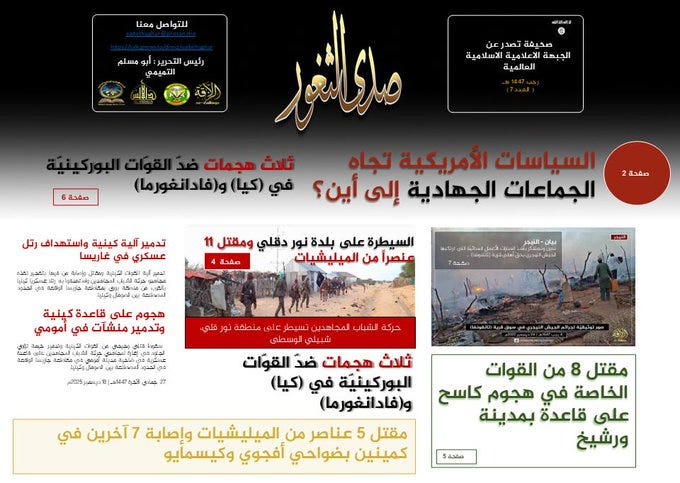
Source: Editorial titled “U.S. Policies Toward Jihadist Groups: Where to Go From Here?”
Publisher: Global Islamic Media Front (GIMF)
Affiliated Media: Al-Kataib Media, Al-Andalus Foundation, Az-Zallaqa Media
Publication: Sada al-Thughur (Issue 7)
Pages Analysed: 2–3
Actor: al-Qaeda
Language: Arabic
Date: Rajab 1447 H / 2026 (Gregorian)
Scope and Methodology
This assessment is based on direct intelligence analysis of a primary jihadist source.
Methodological components:
Primary Source Analysis: Full-text analysis of jihadist media without intermediary interpretation.
OSINT: Contextualisation within known al-Qaeda strategic communication patterns.
SOCMINT (limited): Consideration of how similar narratives circulate and resonate within jihadist-aligned ecosystems (without platform-level analytics).
Digital HUMINT (analytical): Interpretative inference of intent, audience targeting, and strategic signalling based on content structure and language.
Limitations
The analysis evaluates narrative intent and cognitive function, not the factual accuracy of operational claims.
Audience reception is inferred rather than empirically measured.
Findings are specific to the analysed document and should not be mechanically generalised to all jihadist communications.
The absence of platform-level engagement data limits the quantitative assessment of impact.
Strategic Narrative Architecture
The editorial analysis constitutes a deliberately engineered strategic narrative, designed to operate simultaneously across cognitive, moral, and temporal dimensions of conflict. Its architecture is not accidental, nor purely rhetorical. It reflects a mature understanding of how perception, legitimacy, and expectation management function as force multipliers under conditions of sustained military and political pressure.
At its core, the narrative is constructed as a closed causal system. U.S. counterterrorism policies are presented not as discrete instruments, such as military strikes, sanctions, legal designations, or ideological countermeasures, but as components of a single, coherent strategy whose alleged outcome is systemic failure. This framing is critical. By collapsing diverse tools into one unified adversarial project, the narrative removes analytical nuance and replaces it with moral clarity. Complexity is portrayed as deception, while simplification becomes truth.
The narrative begins with an appeal to historical continuity. By anchoring U.S. counterterrorism in the post-9/11 paradigm, the editorial situates current policies within a long war portrayed as unchanging in intent and character. This historical anchoring serves two cognitive purposes. First, it strips recent policy adjustments of their novelty and credibility, presenting them as tactical variations within a fundamentally hostile, immutable strategy. Second, it conditions the audience to interpret duration itself as evidence of failure. Longevity becomes proof that the adversary cannot prevail.
From this foundation, the narrative advances through a sequence of mutually reinforcing frames. Military pressure is depicted as indiscriminate and counterproductive, producing civilian harm that allegedly fuels resentment and radicalisation. Legal and financial measures are framed not as rule-based instruments, but as arbitrary tools of political coercion, selectively applied to suppress any form of Islamic agency deemed incompatible with Western interests. Ideological counterterrorism is portrayed as cultural and moral aggression, aimed at reshaping identity, belief systems, and social structures within Muslim societies.
These frames are not presented independently. They are deliberately fused to generate the perception of total encirclement. The intended cognitive effect is to convey that there exists no neutral space outside the conflict. Education, finance, media, law, and security are all subsumed into a single hostile ecosystem. Within such a construct, resistance is no longer framed as a choice but as an existential necessity.
A central pillar of this architecture is semantic inversion. The concept of terrorism, traditionally used to delegitimise violence against civilians, is reframed as a political label devoid of moral or legal substance. Designation becomes evidence not of criminality but of authenticity. This inversion neutralises reputational damage and converts stigma into symbolic capital. In cognitive terms, it immunises the audience against one of the most potent tools of international counterterrorism, namely delegitimisation through naming.
Equally significant is the narrative’s temporal design. The editorial explicitly rejects the notion of decisive victory, reframing the conflict as a prolonged war of attrition governed by patience, endurance, and inevitability. Time is weaponised. Tactical setbacks are rendered irrelevant, while survival itself is elevated to strategic success. This temporal reframing performs a critical expectation-management function. It reduces the psychological impact of losses and pre-empts disillusionment among supporters by embedding hardship within a teleological arc.
The use of Gaza as a central reference point exemplifies advanced narrative bridging. Rather than treating the conflict as a discrete theatre, the editorial employs it as a symbolic amplifier that can transfer emotional resonance across geographically and operationally distinct contexts. This technique enables the narrative to unify audiences in Africa, the Middle East, and the diaspora under a shared moral grievance, regardless of local conditions. The result is a trans-theatre cognitive linkage that enhances mobilisation potential without requiring operational coordination.
Claims regarding governance and the existence of “emirates” serve a further strategic function within this architecture. They are not merely assertions of control but signals of legitimacy. By presenting jihadist entities as providers of order, justice, and social organisation, the narrative competes directly with state authority in the cognitive domain. It reframes counterterrorism not as a fight against non-state violence, but as an external attempt to dismantle emergent political orders. This shift is crucial, as it elevates the conflict from security to sovereignty.
The narrative’s effectiveness in the cognitive domain derives from its internal coherence rather than its empirical accuracy. Each component reinforces the others, creating a self-sealing belief system resistant to disconfirmation. Military pressure validates grievance, grievance validates resistance, resistance validates identity, and identity validates endurance. Within this loop, external facts are reinterpreted to sustain the narrative rather than challenge it.
In sum, the strategic narrative architecture employed here is designed to outlast operational pressure by operating at the level of meaning rather than at the level of events. It seeks not to persuade through evidence, but to condition perception through structure. For counterterrorism and strategic communications practitioners, this underscores a critical reality. The contest is not over facts alone, but over the frameworks through which facts are interpreted. Failure to engage at this level cedes the cognitive domain by default.
This is not traditional propaganda. It is strategic narrative warfare.
Narrative Objectives and Intended Effects
The strategic narrative examined in this assessment is not constructed solely for descriptive or justificatory purposes. It is engineered to generate specific cognitive effects across multiple audiences, operating through deliberate manipulation of legitimacy, motivation, and strategic expectation. Its objectives are both immediate and longitudinal, designed to shape behaviour, sustain alignment, and degrade adversary credibility over time rather than to provoke short-term operational outcomes.
The primary objective is to reframe pressure as proof of success. Military strikes, sanctions, legal designations, and ideological countermeasures are systematically presented not as constraints, but as indicators of adversary anxiety and strategic exhaustion. This inversion is central. By redefining coercive measures as evidence that jihadist actors pose an existential challenge, the narrative transforms external pressure into internal validation. The intended cognitive effect is to prevent deterrence by absorption, ensuring that the adversary’s escalation reinforces rather than undermines commitment.
Closely linked to this is the objective of legitimacy construction. The narrative seeks to displace international legal and normative frameworks with an alternative moral order in which legitimacy derives from endurance, sacrifice, and resistance rather than recognition. In this construct, being designated, sanctioned, or targeted becomes a credential. This approach directly challenges the foundational logic of counterterrorism, which relies on delegitimisation to isolate violent non-state actors. By neutralising stigma, the narrative preserves social and ideological space for mobilisation.
A further objective is to manage expectations under conditions of asymmetric power. The narrative explicitly rejects the premise of a decisive victory, instead advancing a model of strategic attrition in which time, patience, and persistence are the decisive variables. This has a stabilising effect on supporter psychology. Tactical losses, leadership decapitation, and territorial contraction are cognitively absorbed as natural phases within a prolonged struggle rather than interpreted as indicators of failure. The intended outcome is resilience, not momentum.
Recruitment and retention constitute another core objective, but they are pursued indirectly. Rather than relying on emotive calls to action or glorification of violence alone, the narrative offers a comprehensive explanatory framework that renders participation rational and morally coherent. By portraying the conflict as unavoidable, total, and externally imposed, the narrative reduces moral friction for potential recruits and reinforces identity alignment among existing supporters. Joining becomes not an escalation, but a logical response to structural injustice.
The narrative also aims to broaden its audience beyond committed militants. Through sustained critique of legal designations, financial sanctions, and ideological countermeasures, it deliberately reaches toward non-violent Islamist actors, politically marginalised religious communities, and segments of the Muslim public that may not endorse armed action but share perceptions of discrimination or repression. This is a coalition-building function at the cognitive level, intended to blur boundaries between violent and non-violent opposition to Western security frameworks.
An additional, often overlooked objective is adversary delegitimisation in the eyes of third parties. By framing U.S. counterterrorism as indiscriminate, hypocritical, and structurally aligned with external political agendas, the narrative seeks to erode confidence among partners, local populations, and international observers. The aim is not to convince these audiences to support jihadist actors directly, but to weaken trust in the coherence, morality, and effectiveness of counterterrorism efforts. Doubt, rather than conversion, is the desired effect.
The use of Gaza as a narrative anchor serves a specific amplifying function within this objective set. It operates as an emotional and moral accelerant capable of transferring grievance across contexts. By embedding local counterterrorism actions within a broader narrative of global injustice, the editorial increases emotional salience and lowers the threshold for identification across disparate theatres. This enables synchronised cognitive mobilisation without operational integration.
Finally, the narrative seeks to impose a strategic frame on future interpretation. By pre-emptively defining how actions, successes, and failures should be understood, it constrains the interpretative space available to audiences. This is anticipatory cognitive control. When future strikes occur, when sanctions are expanded, or when negotiations shift, the narrative has already provided the lens through which these events will be processed. In this sense, the objective is not merely influence, but pre-conditioning.
In aggregate, the intended effects of this narrative are cumulative rather than immediate. It is designed to sustain mobilisation, absorb shocks, expand legitimacy, and erode adversary confidence over time. Its effectiveness does not depend on factual precision, but on internal coherence and emotional resonance. Within the cognitive domain, these qualities often prove more decisive than empirical accuracy.
This understanding is essential for policymakers and security practitioners. Countering such narratives requires engagement at the levels of meaning, legitimacy, and expectation, not solely at the level of messaging or fact-checking. Failure to recognise the intent behind these narratives risks conceding the cognitive battlespace even where tactical and operational advantages remain intact.
Target Audiences and Cognitive Segmentation
The effectiveness of the analysed strategic narrative derives in large part from its capacity to operate across multiple audience segments simultaneously, without fragmenting its core message. Rather than tailoring distinct narratives for separate constituencies, al-Qaeda employs a layered cognitive architecture in which a single explanatory framework generates differentiated effects depending on the audience’s prior beliefs, grievances, and positionality within the conflict.
This form of cognitive segmentation is implicit rather than explicit. The narrative does not announce its targets. It assumes them.
The primary audience consists of committed militants and active supporters. For this group, the narrative performs a stabilising and sustaining function. By framing U.S. counterterrorism as structurally incapable of achieving decisive victory, and by redefining endurance as success, the narrative reinforces internal cohesion under pressure. It reduces the psychological impact of leadership losses, territorial setbacks, and operational disruption, embedding these events within a longer arc of strategic attrition. The intended effect is not mobilisation, which already exists, but retention, discipline, and patience.
A second, closely related audience comprises prospective recruits and sympathisers operating in a pre-radicalisation or early radicalisation phase. For this segment, the narrative functions as a cognitive bridge between grievance and action. By portraying the conflict as total, unavoidable, and externally imposed, it lowers moral and psychological barriers to engagement. Participation is framed not as an escalation into violence, but as a rational and defensive response to systemic injustice. The emphasis on legitimacy, rather than heroism or martyrdom alone, is particularly relevant for this audience, as it provides an intellectualised justification for alignment.
A third target audience includes local populations in jihadist-affected theatres, particularly in Africa and peripheral conflict zones. For these communities, the narrative is designed to delegitimise external security actors and their local partners, while positioning jihadist organisations as authentic representatives of resistance and order. Claims regarding governance, justice, and social organisation are not primarily directed at external observers, but at populations living under conditions of insecurity and state absence. The objective is cognitive accommodation rather than ideological conversion, fostering passive acceptance, reduced cooperation with counterterrorism forces, and eventual normalisation of jihadist presence.
Beyond these core groups, the narrative deliberately reaches toward non-violent Islamist actors and politically marginalised religious communities. By criticising terrorism designations, financial sanctions, and ideological countermeasures as arbitrary and politically motivated, the editorial seeks to blur the boundary between violent and non-violent opposition to Western security frameworks. This is a classic cognitive convergence strategy. It does not endorse violence. It requires a shared perception of victimisation. The intended effect is the creation of a broader discursive environment in which jihadist actors are seen as part of a broader struggle rather than as isolated extremists.
A further, indirect audience consists of Western and international observers predisposed to scepticism toward military intervention, security legislation, or perceived double standards in global politics. For this segment, the narrative foregrounds civilian harm, legal overreach, and moral inconsistency. The goal is not persuasion in favour of jihadist ideology, but erosion of confidence in counterterrorism legitimacy and coherence. Doubt, fragmentation, and moral fatigue within adversary societies are sufficient outcomes in the cognitive domain.
The use of Gaza as a narrative reference point is critical to this segmentation strategy. It serves as a universal moral signifier that resonates across ideological, geographic, and cultural boundaries. By anchoring disparate grievances to a single, emotionally charged symbol, the narrative enables cognitive synchronisation across otherwise disconnected audiences. This allows al-Qaeda to operate within a shared emotional and moral space without requiring organisational integration or direct communication between audience segments.
What distinguishes this approach from traditional propaganda is its reliance on cognitive layering rather than message differentiation. The same narrative structure produces reassurance for militants, justification for sympathisers, accommodation among local populations, solidarity among non-violent Islamists, and scepticism among external observers. Each audience extracts what it needs from the same framework.
For intelligence and security practitioners, this segmentation model presents a significant challenge. Counter-narratives aimed at one audience risk reinforcing the narrative’s credibility with another. Addressing this requires a precise understanding of audience-specific cognitive effects rather than generic messaging. Failure to disaggregate audiences at the mental level risks treating a multidimensional influence operation as a monolithic propaganda effort.
In the cognitive domain, the adversary is not merely speaking to everyone. It is being understood differently by everyone, by design.
Key Cognitive Warfare Mechanisms
The strategic narrative analysed operates through identifiable, repeatable cognitive warfare mechanisms. These mechanisms are not incidental rhetorical devices, but structured tools designed to shape perception, regulate interpretation, and condition behaviour over time. Their effectiveness lies in their cumulative interaction rather than in any single persuasive claim.
The first and most central mechanism is semantic reframing. Core concepts traditionally employed by counterterrorism frameworks, such as terrorism, legitimacy, security, and law, are systematically stripped of their conventional meaning and reassigned new cognitive functions. Terrorism is no longer presented as an inherently illegitimate form of violence, but as a political label applied selectively by dominant powers. Through this reframing, the act of designation loses its stigmatizing force and becomes evidence of authenticity and threat relevance. In cognitive terms, this neutralises delegitimisation and inoculates the audience against reputational damage.
Closely connected to semantic reframing is moral inversion. The narrative reverses the conventional moral hierarchy by positioning Western counterterrorism as the primary source of injustice, instability, and civilian suffering. Military strikes, sanctions, and legal instruments are portrayed as structurally violent regardless of intent or context, while jihadist violence is reframed as reactive, defensive, and morally compelled. This inversion does not seek to deny violence, but to redefine its ethical ownership. Responsibility is cognitively transferred from the actor who commits the act to the system that is alleged to necessitate it.
A third mechanism is victimhood amplification. Civilian harm, displacement, and social disruption are presented not as collateral outcomes of conflict, but as deliberate and intrinsic features of Western policy. These claims are not employed primarily to establish factual narratives but to generate emotional resonance and moral urgency. Victimhood functions here as a unifying identity marker, capable of transcending ideological and geographic boundaries. It also serves to suppress internal dissent by framing critique as complicity with oppression.
The narrative further employs temporal manipulation as a strategic device. By explicitly rejecting short-term metrics of success and redefining victory as endurance, patience, and survival, the narrative reshapes how time itself is perceived within the conflict. Tactical losses are cognitively downgraded, while continuity becomes success. This temporal framing performs a critical resilience function, protecting the audience from demoralisation and preventing strategic fatigue. Time is transformed from a constraint into a weapon.
Another key mechanism is narrative bridging across theatres. The editorial deliberately links distinct conflict zones through shared symbols, grievances, and moral reference points, most notably Gaza. This technique enables the transfer of emotional intensity from one theatre to another without operational linkage. The result is a shared cognitive battlespace in which geographically distant events reinforce one another’s significance. This mechanism amplifies mobilisation potential while maintaining organisational decentralisation.
The assertion of governance capacity constitutes a further cognitive mechanism with strategic implications. Claims of administrative control, justice provision, and social order are not merely descriptive, but performative. They seek to reposition jihadist actors as political entities rather than security threats. In the cognitive domain, this shifts the conflict from one of law enforcement and counterterrorism to one of contested sovereignty. It challenges the state-centric legitimacy model and invites local populations to accommodate jihadist authority as a functional alternative cognitively.
The narrative also relies on anticipatory framing, a mechanism designed to pre-empt future interpretation. By establishing in advance how to understand military escalation, sanctions, or political decisions, the narrative constrains the interpretative space available to audiences. Future actions by the adversary are absorbed into an existing explanatory framework rather than evaluated on their own terms. This reduces the disruptive potential of new information and reinforces narrative continuity.
Finally, the narrative exhibits self-sealing coherence. Its internal logic is structured to absorb contradiction without collapse. Evidence of pressure confirms persecution, proof of loss confirms endurance, and evidence of adaptation confirms strategic depth. This circularity is not a flaw, but a feature. It ensures resilience against external counter-messaging by converting challenge into validation.
Taken together, these mechanisms enable the narrative to function as a long-term influence system rather than a reactive propaganda product. It does not seek to persuade through evidence, but to condition perception through structure, repetition, and emotional alignment. Its power in the cognitive domain derives from its capacity to define not only what is true, but what is meaningful.
For military and intelligence practitioners, recognising these mechanisms is essential. Countering them requires more than message rebuttal. It involves disrupting frames, exposing inversion logics, and competing over legitimacy narratives. Absent such engagement, tactical and operational successes risk being cognitively neutralised by an adversary that has learned to fight for meaning rather than territory
Vulnerabilities and Cognitive Blind Spots
Despite the high degree of internal coherence and cognitive sophistication of the narrative analyzed, it presents structural vulnerabilities and blind spots that, if correctly identified, can be exploited in the cognitive domain. These weaknesses do not emerge at the superficial rhetorical level, but become evident when the narrative is evaluated as a long-term system of influence rather than as an isolated propaganda product.
The first vulnerability lies in its reliance on causal simplification. The narrative reduces the complexity of counterterrorism policies to a linear cause-and-effect relationship, in which Western action inevitably produces radicalization, violence, and jihadist legitimacy. This construction is cognitively effective but strategically fragile. It requires the systematic removal of local factors, intra-community dynamics, competition between armed groups, and the direct responsibility of jihadist actors. In the presence of evidence that makes these factors visible, the narrative loses explanatory power and risks appearing ideological rather than analytical.
A second vulnerability concerns the contradiction between normative delegitimization and the claim to sovereignty. On the one hand, narratives reject the international legal order, definitions of terrorism, and mechanisms of state legitimacy as arbitrary instruments of domination. On the other hand, they assert political status through typically state-based concepts such as governance, administration of justice, territorial control, and population representation. This ambivalence creates a cognitive friction point. When an actor rejects the rules of the system but demands the symbolic benefits of statehood, they expose their narrative to contestation due to structural incoherence.
A third area of vulnerability emerges in the ongoing instrumentalization of victimization. The intensive use of civilian harm and collective suffering as the moral foundation of narratives produces a saturation effect over time. When the victim becomes an exclusive identity, all forms of agency are subordinated to suffering, reducing the narrative’s ability to explain internal coercion, endogenous violence, and repression exerted by jihadist actors themselves on local populations. This creates an exploitable cognitive space in which the discrepancy between narratives of protection and practices of control becomes visible.
Another blind spot concerns the management of time as an infinite resource. Narrative constructs war as a process of unlimited attrition, in which duration itself constitutes proof of legitimacy and success. However, this approach presupposes the audience’s long-term resilience. In contexts marked by social fatigue, economic deterioration, and daily pressure on the population, the promise of endless conflict can shift from a mobilizing factor to an element of alienation. Narrative offers no temporal threshold of return, nor a concrete vision of future stability, limiting itself to an abstract teleology.
Particularly relevant is the vulnerability associated with governance claims. When an actor claims administrative capacity, it exposes itself to concrete evaluation criteria. Taxation, justice, security, access to services, and dispute management become observable parameters. Any discrepancy between the narrative and the lived experience of local populations undermines the cognitive credibility of the entire framework. Governance, in the cognitive domain, is a double-edged sword.
Another blind spot is the reliance on external symbolic events, such as Gaza, to emotionally synchronize audiences. While this strategy is effective in the short term, it ties narrative power to dynamics beyond the jihadist actor’s control. Shifts in media attention, political developments, or processes of normalization can reduce the symbolic centrality of such events, forcing narratives to seek new emotional catalysts with uncertain efficacy.
Finally, narratives present a systemic vulnerability in their self-referential closure. The self-confirming nature of the cognitive system, which absorbs every event as proof of its own correctness, ensures resilience but limits adaptability. In complex information environments, this rigidity can reduce the ability to respond to emerging dissonances, especially when they come from sources perceived as internal or culturally legitimate.
Taken together, these vulnerabilities do not negate the narrative’s effectiveness, but rather limit its room for maneuver. They indicate that the cognitive domain is not an uncontested space but a field of competition in which the opponent’s internal coherence can, over time, become a source of strategic exposure.
For political, military, and intelligence decision-makers, the value of this analysis lies precisely here. Understanding where a narrative is strong is essential. Understanding where it is fragile is crucial.
Implications for Counterterrorism and Strategic Communications
The narrative analysed in this assessment carries direct implications for the design, communication, and evaluation of contemporary counterterrorism strategies. Its effectiveness in the cognitive domain underscores a widening gap between operational success and perceived legitimacy, a gap that adversarial actors increasingly exploit with strategic intent.
First, the analysis highlights the risk of cognitive backfire associated with narrowly kinetic or legalistic counterterrorism approaches when their communicative effects are not systematically assessed. Military strikes, sanctions, and designations may achieve immediate security objectives while simultaneously reinforcing adversarial narratives of persecution, hypocrisy, and structural injustice. In the absence of an integrated cognitive impact assessment, tactical effectiveness can coexist with strategic narrative loss.
Second, the narrative demonstrates how delegitimisation as a policy tool is no longer sufficient when adversaries actively contest the meaning of legitimacy itself. Terrorism designations and financial sanctions, traditionally employed to isolate and stigmatise violent actors, are reframed as political instruments devoid of normative authority. This challenges counterterrorism frameworks that assume reputational damage as a given outcome. In the cognitive domain, legitimacy is increasingly relational rather than declarative.
Third, the findings underscore the importance of temporal framing in strategic communications. Adversarial narratives that normalise protracted conflict and redefine success as endurance undermine short-term metrics of effectiveness. Counterterrorism messaging that emphasises disruption counts, leadership decapitation, or territorial losses risks misalignment with audience expectations shaped by long-war narratives. Strategic communications must therefore account for how time, patience, and inevitability are framed by adversaries and perceived by affected populations.
The analysis also reveals the strategic costs of narrative convergence across theatres. The use of emotionally resonant reference points, such as Gaza, enables adversaries to link disparate operational environments into a unified cognitive grievance space. This complicates theatre-specific communication strategies and increases the risk that actions in one context produce unintended cognitive effects in another. Counterterrorism and stabilisation efforts cannot be treated as narratively isolated.
For strategic communications practitioners, the assessment reinforces the need to move beyond reactive counter-messaging toward frame-aware engagement. Addressing individual claims without engaging the underlying interpretative structures risks reinforcing adversarial coherence. Effective cognitive-domain engagement requires exposing internal contradictions, challenging inversion logics, and introducing alternative frames of legitimacy grounded in lived experience rather than abstract norms.
Finally, the analysis suggests that claims of governance and social order advanced by jihadist actors should be treated as cognitive assertions, subject to scrutiny, rather than as aspirational rhetoric. Where such claims are left uncontested, they may gain traction by default. Counterterrorism strategies that integrate governance support, accountability mechanisms, and local legitimacy-building are better positioned to compete in this space than those relying exclusively on coercive measures.
In sum, the implications extend beyond messaging. They point to the need to integrate cognitive-domain considerations into the planning, execution, and evaluation of counterterrorism policy.
Intelligence Assessment and Outlook
From an intelligence perspective, the analysed narrative reflects a broader evolution in jihadist strategic communication, characterised by increased conceptual sophistication and an explicit focus on long-term cognitive competition. This trend is likely to persist and deepen under conditions of sustained military and financial pressure.
In the near to medium term, jihadist actors associated with al-Qaeda are likely to continue prioritising analytical-style propaganda that mimics policy critique and strategic assessment rather than emotive exhortation alone. Such products are designed to appeal to educated audiences, local elites, and intermediaries who shape opinion within affected communities. This suggests a continued investment in narrative credibility and intellectualisation as tools of influence.
Narrative emphasis on governance, endurance, and legitimacy is expected to increase, particularly in contexts where territorial control or population influence is contested. Assertions of administrative capacity and social order will likely be amplified following periods of external pressure, serving to counter perceptions of weakness and to signal resilience to both supporters and rivals.
The continued use of cross-theatre narrative linking should be anticipated, with high-salience events leveraged to reinforce mobilisation and grievance synchronisation across regions. This approach reduces dependence on local triggers and allows strategic communications to remain adaptive to shifting operational realities.
From an early-warning perspective, increased frequency of content addressing legal, financial, and ideological dimensions of counterterrorism may indicate heightened sensitivity to non-kinetic pressure. Similarly, greater attention to civilian harm narratives may signal efforts to pre-empt or respond to anticipated military activity.
At the same time, the identified vulnerabilities suggest potential points of narrative stress. Sustained discrepancies between governance claims and local experience, internal coercion, or visible fragmentation among jihadist actors may erode cognitive coherence over time. Monitoring such discrepancies, particularly when highlighted by culturally proximate or locally credible voices, will be critical.
Overall, the outlook points toward a prolonged contest in the cognitive domain, in which success will be measured less by immediate behavioural change than by narrative endurance and legitimacy retention. Intelligence efforts that prioritise pattern recognition, audience-specific effects, and early identification of narrative adaptation will be better positioned to anticipate and counter these dynamics.
The strategic significance of this evolution should not be underestimated. As kinetic and financial pressure constrain operational freedom, the cognitive domain is increasingly where jihadist actors seek to preserve relevance, influence, and strategic depth.
Conclusion – Cognitive Warfare as Strategic Contest
This assessment demonstrates that contemporary jihadist propaganda, particularly within al-Qaeda’s media ecosystem, has evolved beyond ideological messaging into a structured form of cognitive warfare. The analysed editorial does not seek immediate mobilisation through emotive appeal alone. Instead, it constructs a durable strategic narrative designed to contest legitimacy, manage expectations, and reframe counterterrorism pressure as evidence of adversary failure.
By operating simultaneously across semantic, moral, temporal, and emotional dimensions, the narrative aims to outlast military and political constraints by shaping how conflict itself is understood. Its effectiveness lies not in factual accuracy but in coherence, repetition, and the ability to provide audiences with an interpretative framework resilient to disruption. Within this framework, endurance becomes victory, designation becomes validation, and pressure becomes proof of relevance.
The findings underscore a critical challenge for counterterrorism and security communities. Tactical and operational success does not automatically translate into cognitive advantage. Where adversarial actors can define the meaning of actions taken against them, they retain the capacity to neutralise, reinterpret, or even exploit those actions in the perceptual domain.
At the same time, the analysis identifies clear vulnerabilities within the narrative architecture. Claims of governance, moral authority, and strategic inevitability expose jihadist actors to scrutiny, contradiction, and erosion when confronted with lived realities, internal coercion, and structural inconsistency. The cognitive domain remains contested, not predetermined.
Ultimately, this product reinforces a central analytical conclusion. The struggle against jihadist actors is not confined to territory, leadership, or resources. It is also a contest over meaning, legitimacy, and time. Failing to engage this dimension risks conceding strategic ground even where operational superiority is maintained.
Understanding how adversaries think, frame, and condition perception is therefore not an ancillary task. It is a core requirement for sustained effectiveness in modern counterterrorism and security policy.
🔒 Executive Intelligence Cycle
This assessment is part of a broader analytical cycle.
Founding subscribers receive the Executive Intelligence Briefing, which integrates all threat assessments, cognitive domain analysis, and a rolling 30–90 day forecast into a single monthly strategic synthesis.
© Daniele Garofalo Monitoring - All rights reserved.
Daniele Garofalo is an independent researcher and analyst specialising in jihadist terrorism, Islamist insurgencies, and armed non-state actors.
His work focuses on continuous intelligence monitoring, threat assessment, and analysis of propaganda and cognitive/information dynamics, with an emphasis on decision-oriented outputs, early warning, and strategic trend evaluation.
Daniele Garofalo Monitoring is registered with the Italian National ISSN Centre and the International Centre for the Registration of Serial Publications (CIEPS) in Paris.ISSN (International Standard Serial Number): 3103-3520ORCID Code: 0009-0006-5289-2874
I had written two comments, in the articles from December 22 and December 27, that summarize this idea, and I was referring precisely to this process when I spoke of gentle/soft indoctrination. I love these articles—write many more focused on the cognitive domain, because it is central to tactical and military analysis, especially in this historical period. Thank you ☺️