


Cover & Classification Note
Document Type: Executive Intelligence Briefing
Scope: Global Jihadist, Insurgent & Hybrid Warfare Threat Assessment
Time Horizon: Rolling Forecast (30–90 Days)
Reference Period: May- July 2026
This document is an independent analytical product intended for professional use by analysts, policy planners, security practitioners, and decision-makers.
Intended Audience & Use
This Executive Intelligence Briefing is intended for use by intelligence analysts, policy planners, military and security decision-makers, international organizations, and applied academic researchers concerned with jihadist, insurgent, and hybrid warfare threat dynamics.
The document supports strategic awareness, forward-looking risk assessment, and prioritizing monitoring over a rolling 30–90-day horizon. It is not intended to provide tactical-level tasking, real-time operational guidance, or event-specific prediction. The briefing should be used as a decision-support and situational-awareness tool, informing planning, posture adjustment, and analytical focus rather than immediate response.
📌 Inside this Executive Intelligence Briefing
This briefing includes:
Regional Strategic Snapshots
Africa: ISWAP, IS-Sahel, IS-Somalia, ISM, ISCAP, JNIM, al-Shabaab, Boko Haram, Lakurawa.
Middle East & Asia: IS Syria/Iraq, Ajnad Beit al-Maqdis, AQAP, AQIS, ISKP, ISPP, ISEAP, TTP, Ittehad-ul-Mujahidin Pakistan, Ansar al-Furqan, People’s Fighters’ Front.
Cognitive & Information Domain – Key Signals
Propaganda trends, narrative targeting, mobilization signals, Cognitive Warfare dynamics, and Cognitive Control assessment.Transnational Networks & Secondary Threat Environment
Monitoring the spread of external threats.
Forward Threat Forecast (30–90 Days) & Escalation Triggers Matrix
Baseline and alternative scenarios, early warning indicators, and escalation triggers.Implications & Monitoring Priorities
Decision-relevant implications for intelligence, policy, military planning, and security practitioners.Monitoring Checklist, Executive “So What?” & Strategic Risk Hierarchy
A structured checklist for the next 30–90 days and a final executive-level synthesis.
Executive Overview – Strategic Context
Entering the May–July 2026 window, the defining characteristic of the global jihadist and insurgent threat environment is not escalation, but structured persistence under constraint. Across Africa, the Middle East, South and Central Asia, and the transnational layer, armed non-state actors continue to operate within a stable yet permissive configuration that favors endurance, decentralization, and cumulative pressure over rapid transformation.
The operational system remains active across multiple theatres, yet it is not converging toward a unified strategic offensive. Instead, actors such as Islamic State affiliates, al-Qaeda networks, TTP, al-Shabaab, JNIM, and a growing set of hybrid and emerging groups are sustaining parallel campaigns shaped by local conditions, corridor dynamics, and opportunity structures. The result is a distributed threat environment where violence is continuous, geographically dispersed, and strategically calibrated.
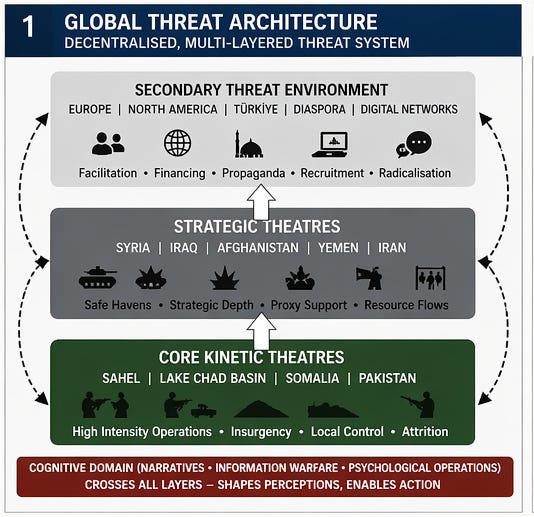
Africa remains the global center of gravity for kinetic jihadist activity. The Sahel, Lake Chad Basin, Somalia, and eastern Democratic Republic of Congo continue to generate the highest operational volume, driven by permissive structural conditions, weak governance, and entrenched insurgent ecosystems. These theatres function as pressure generators, reinforcing the credibility of global jihadists and sustaining narrative legitimacy.
The Middle East and South Central Asia remain strategically relevant despite lower attack volume. Syria, Iraq, Afghanistan, Pakistan, and Yemen form a symbolic and operational backbone, where insurgent actors maintain survivability, exploit political fragmentation, and generate disproportionate strategic signaling relative to their kinetic output. Pakistan, in particular, represents a high-intensity insurgent system, while Syria remains a permissive transition space for residual Islamic State activity and emerging actors.
The transnational layer is increasingly relevant as a secondary threat environment, not because of large-scale operational capability, but because of its role in facilitation, inspiration, hybrid activity, and cognitive amplification. Europe, Turkey, and parts of North America are exposed to low-complexity plots, proxy operations, and hybrid influence campaigns, often characterized by attribution ambiguity and symbolic targeting.
The most significant structural evolution concerns the integration of the cognitive and operational domains. Propaganda is no longer a supporting function. It is an operational enabler, facilitating capability transfer, lowering thresholds for violence, shaping perceptions, and sustaining mobilization. The emergence of technical dissemination ecosystems, simplified operational guidance, and resilient communication infrastructures indicates a shift toward decentralized, scalable threat models.
Strategic risk is therefore not driven by singular events. It is driven by the continuous interaction between insurgent activity, cognitive mobilization, and hybrid dynamics, which together produce cumulative degradation of security, governance, and institutional legitimacy.
Key Judgments
The global jihadist and insurgent threat environment for May–July 2026 is characterized by operational continuity, decentralized execution, and structural resilience, rather than by coordinated escalation.