


Executive Intelligence Summary
Al-Naba Newspaper editorial no. 541 introduces a direct and time-bound call to action against synagogues and Jewish communities during Passover. The message is not descriptive but prescriptive, designed to activate individuals or micro-cells in the very short term. The call for the Bondi Beach stabbing attack December 2025 provides a replicable operational model, already validated in the jihadist narrative as an effective and low-cost action.
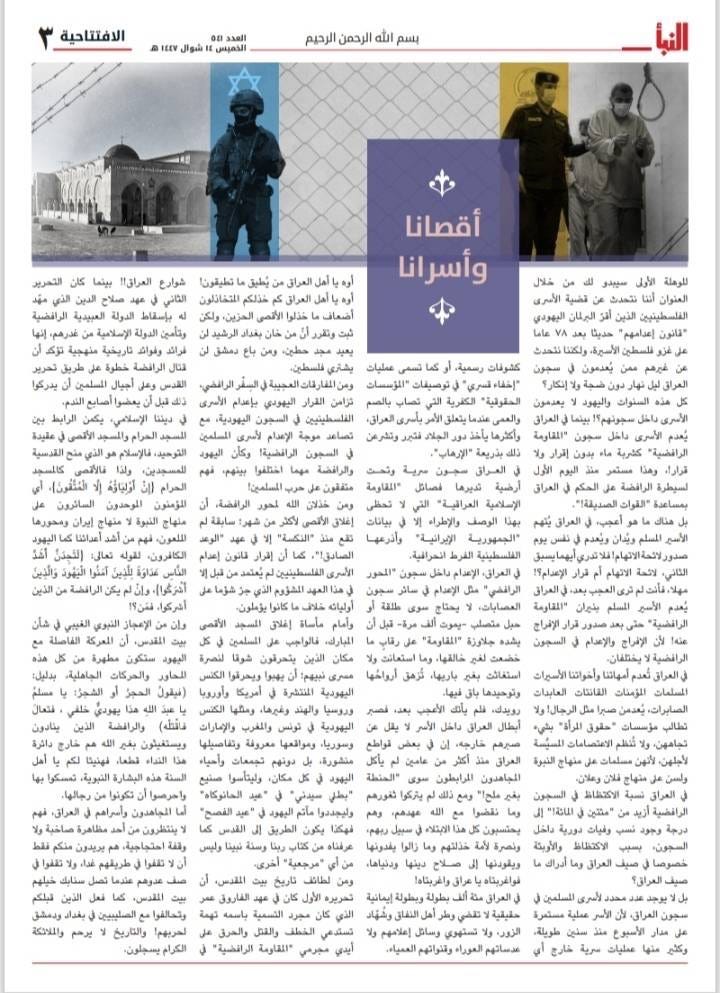
The picture suggests a shift from ideological propaganda to immediate opportunistic mobilization, with a high probability of attempted attacks within the April 3–9 window, without the need for central coordination.
Executive Risk Matrix
Threat type: inspired attacks, lone actor or micro-cell
Likelihood: high
Impact: medium to high
Time horizon: 0–7 days
Geographic distribution: global, concentration in Western urban contexts
Primary targets: synagogues, community centers, religious events
Confidence Level: moderate.
Key Judgments
High probability of low-complexity attack attempts within 7 days
The dominant vector is the lone actor with simple weapons, knives, vehicles, and arson
The narrative uses a real event to lower the threshold for action and normalize individual attacks
The narrow time frame indicates opportunistic intent, not a structured campaign
The main risk arises from the replicability and predictability of targets.
Strategic Risk Hierarchy
Threat 1
Attack with a knife, vehicle, or firearm against entrances or traffic areas of synagogues
Threat 2
Arson or sabotage of community infrastructure
Threat 3
Failed attempts with strong media coverage and subsequent imitation
Threat Assessment
The threat level is high in the very short term. The operational capacity required is minimal and does not require advanced logistical support. The global distribution of targets, combined with the predictability of religious events, reduces complexity for the attacker.
The risk lies not in sophistication, but in the potential frequency and difficulty of preventing isolated actors.
Operational Indicators
Increase in pro-IS content that revisits and reinterprets editorial 541
Explicit references to Passover, religious vengeance, and the Gaza narrative
Sharing rudimentary instructions for improvised attacks
Online searches for times, locations, and access to places of worship.
Escalation Chain
Phase 1
Editorial publication with a call to action
Phase 2
Amplification in the pro-IS digital ecosystem
Phase 3
Self-radicalization and identification with the message
Phase 4
Individual mobilization and minimal planning
Phase 5
Attack or attempted attack
Phase 6
Media coverage and propaganda exploitation
Phase 7
Copyright effect within 24–72 hours.
Tripwires — Assessment of Changing Indicators
Successful attack in Europe or North America
Quick claim via Amaq News Agency
Dissemination of detailed operational instructions on closed platforms
Preventive arrests directly linked to al-Naba’s call 541.
Early Warning Indicators
Surveillance activities near synagogues
Presence of isolated individuals exhibiting unusual behavior during religious events
Increase in localized chatter in specific countries
Reports of the purchase or preparation of incendiary materials.
Vulnerabilities
Uncontrolled entrances or limited security
Predictable routines related to prayer times
Public events with high concentrations of people
Low perception of threat at the local level.
Cognitive Domain Assessment
Target audience
Inactive sympathizers, marginalized individuals, and those already exposed to jihadist propaganda
Cognitive triggers
Religious revenge, identity defense, polarization related to the Israeli-Palestinian conflict
Activation pathway
Emotional stimulus → ideological legitimacy → simple operational model → individual action
Mobilization potential
High in the very short term, rapidly decaying without further stimulation
Information effect
Maximum propaganda yield even with low-lethality attacks.
Key Intelligence Questions
Which channels are most amplifying Editorial 541?
Are there geographic clusters with a significant increase in online activity?
Are there any signs of pre-operational surveillance?
Are there known individuals showing behavioral acceleration?
Intelligence Gaps
Actual number of individuals activated or in the process of being mobilized
Level of coordination between pro-IS channels
Ability to transform the message into concrete action
Actual geographic distribution of risk.
Protective Posture Recommendations
Visible presence of security forces at sensitive targets
Temporary access control during religious events
Direct coordination with community security
Activation of rapid reporting channels
Increased patrols in high-density urban areas
Implications for Decision-Makers
The critical window is immediate, with the initial 72 hours crucial
Visible deterrence reduces the likelihood of opportunistic attacks
The main risk remains unpredictable and decentralized
The response must be rapid, visible, and coordinated.
Forecast 0–7 Days
Most likely scenario
Isolated or failed attempts with high media coverage
Alternative scenario
A successful attack in a Western urban context with rapid copycat effect
Low probability scenario
Multiple uncoordinated but temporally close events.
Confidence Assessment
High confidence on intent and timing
Moderate confidence on execution
Low confidence on scale and distribution of attacks.
Executive Intelligence Conclusion
The current threat environment is defined by a narrow and immediate activation window, driven by direct incitement from Islamic State messaging aligned with a high-visibility religious event. The risk is not rooted in organisational capability, but in the speed and accessibility of individual mobilisation.
The most credible threat scenario involves low-complexity attacks against exposed and predictable targets, particularly synagogues and community gatherings, where symbolic value and operational feasibility intersect.
Over the next 72 hours, deterrence posture and visible security measures will play a decisive role in reducing attack probability. The primary risk remains the unpredictability of self-activated individuals, operating without detectable coordination but within a clearly defined narrative and temporal framework.
Operational focus must remain on immediate protection, rapid information sharing, and early detection of behavioural anomalies. Delay in response directly increases exposure.
🔒 Executive Intelligence Cycle
This assessment is part of a broader analytical cycle.
Founding subscribers receive the Executive Intelligence Briefing, which integrates all threat assessments, cognitive domain analysis, and a rolling 30–90 day forecast into a single monthly strategic synthesis.
© Daniele Garofalo Monitoring - All rights reserved.
Daniele Garofalo is an independent researcher and analyst specialising in jihadist terrorism, Islamist insurgencies, and armed non-state actors.
His work focuses on continuous intelligence monitoring, threat assessment, and analysis of propaganda and cognitive/information dynamics, with an emphasis on decision-oriented outputs, early warning, and strategic trend evaluation.
ISSN (International Standard Serial Number): 3103-3520
NATO NCAGE: AX664 (NATO Commercial and Governmental Entity)
ORCID Code: 0009-0006-5289-2874