


Executive Intelligence Overview
This weekly intelligence brief documents and structures official jihadist propaganda output released between 9 and 17 August, highlighting recent threat trends and providing structured situational awareness across multiple organisations and theatres.
This brief highlights operational claims and targets, emphasising their importance for threat recognition and strategic focus, and helping analysts and policymakers understand ongoing threats and their strategic implications.
This product supports systematic monitoring, reassuring analysts and policymakers that threat trends are being tracked thoroughly and that their efforts are vital to maintaining a clear understanding of threats.
This publication does not include threat assessments, intent evaluation, or operational forecasting. Those components are addressed separately in dedicated analytical outputs.
🔹 Scope of Monitoring
This issue covers all identifiable official propaganda from a predefined list of jihadist groups, selected for operational relevance and threat level, during the reporting period, enhancing situational awareness.
The focus on documentation, classification, and structured presentation of primary-source material aims to instil confidence in analysts and policymakers about the reliability of the data used for threat assessment.
🔹 Sources & Collection Methodology
The analysis relies solely on primary-source propaganda, such as official magazines, videos, photos, statements, claims, and audio recordings, to clarify the scope of sources and bolster the reliability of the data for threat assessment.
Official magazines,
Videos,
Photo sets,
Statements and claims of responsibility,
Audio statements.
Material is collected and categorised by organisation, media outlet, and content type.
The study relies on OSINT, IMINT, SOCMINT, and Digital HUMINT collection streams.
No secondary reporting, media commentary, or interpretative overlay is applied.
🔹 Analytical Boundaries & Limitations
Fluctuations in volume, language, or format signal activity trends that analysts should interpret within the broader context of operational tempo, recent events, and known threat indicators to support accurate threat assessment and prevent misinterpretation of their significance.
They shouldn’t be considered in isolation as indicators of strategic shifts, operational escalation, or changes in intent and capability; instead, they should be integrated within broader intelligence products such as Strategic Threat Outlooks and Cognitive Assessments to support comprehensive threat evaluations.
Strategic shifts,
Operational escalation,
Intent or capability changes.
All higher-order analytical interpretation is conducted separately within:
Intelligence Briefs,
Strategic Threat Outlooks,
Cognitive and Information Domain Assessments.
🔹 Monitored Propaganda Output and Weekly Monitoring Notes
This issue includes all primary propaganda material released during the week by:
Al-Qaeda and affiliates
JNIM
Al-Shabaab
Islamic State
al-Naba Newspaper (weekly Issue)
Official IS media channels.
Independent Jihadist Groups
Ittehad Mujahidin Pakistan
The conclusions are included in the Weekly Monitoring Notes.
Al-Qaeda (AQ)
Az-Zallaqa Media, Jamat Nusrat al-Islam wal-Muslimin (JNIM), released a video lasting 4 minutes and 18 seconds showing an attack on the headquarters of pro-government militias in Bam province, Burkina Faso.
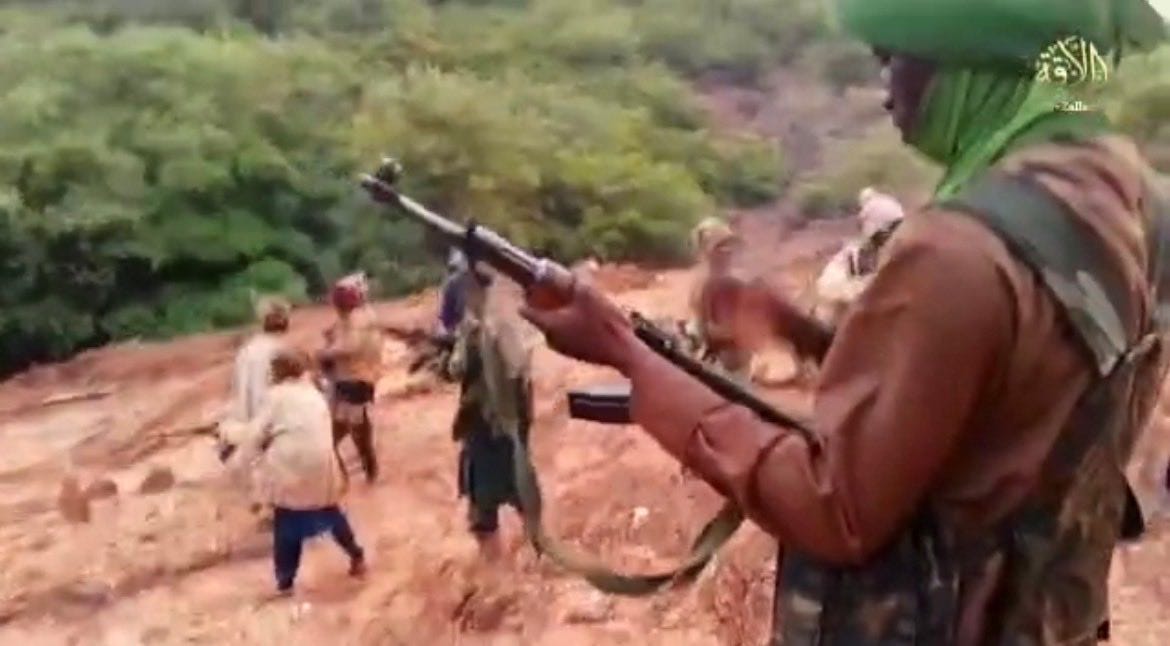
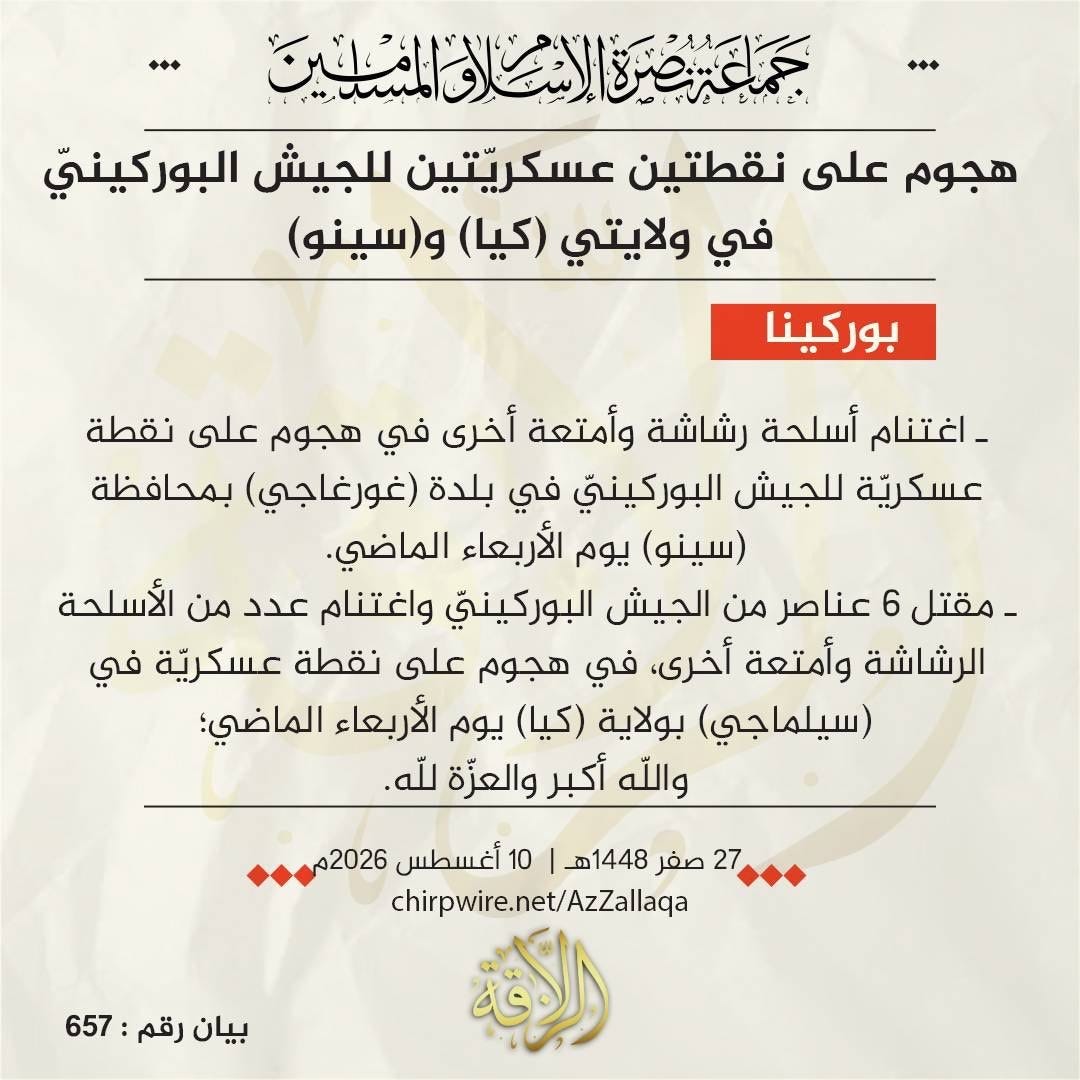
Az-Zallaqa Media, Jama’at Nasr al-Islam wal Muslimin (JNIM), issued 10 statements and 6 photos, claiming 12 attacks.
The targets of the attacks were: Malian Army, Dozo militia, Russian PMC Africa Corps, Burkinabé Army, VDP militia.
The areas of the attacks were :
1) Burkina Faso = 4
- Gourma province, Sissili province, Poni province, Sèno province, Bam province.
2) Mali = 8
- Kayes region, Mopti region, Sikasso region, Segou region.
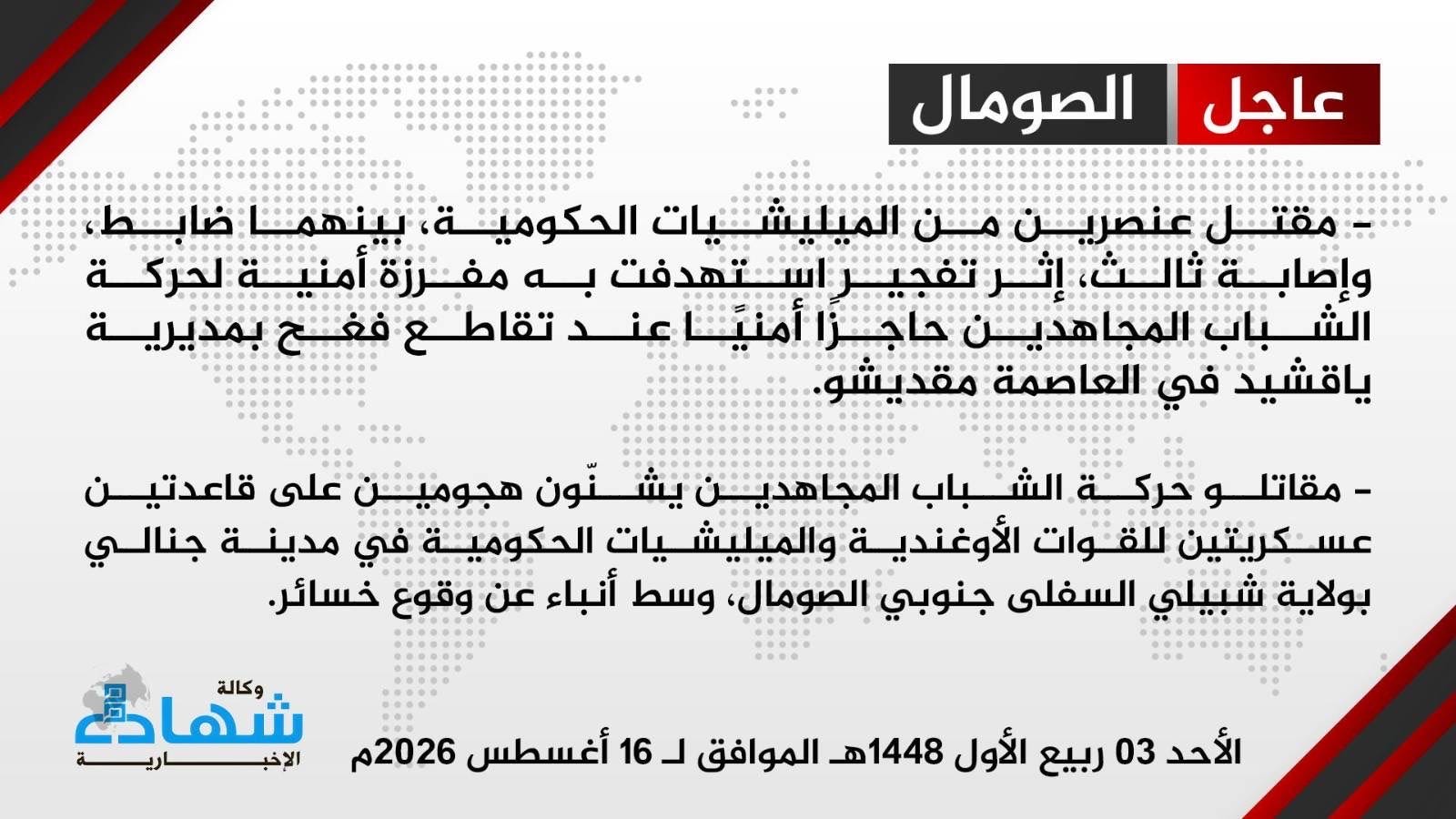
The Shahada News Agency, Harakat al-Shabaab al-Mujahidin (AS), released 21 statements claiming responsibility for 46 attacks.
The targets of the attacks were:
Somali Army, Somali Intelligence, Somali pro-government militia, Burundian Army, Ugandan Army, Ethiopian Army, Kenyan Army.
The areas affected by the attacks were:
1) Somalia = 39
- Afgooye area, Zubayd area, Barire area, Janale area, Bulomerer area, Mubarak area, Qoryooley area, Awdheegle area, Lower Shabelle region;
- Afmadow area, Lower Juba;
- Wajid area, Hudur area, Bakool region;
- Bardhare area, El Wak area, Gedo region;
- Jowhar area, Balad area, Middle Shabelle region;
- Mogadishu area.
2) Kenya = 7
- Lafey area, El Galo area, Mandera County;
- Kenton area, Wajir County.
Islamic State (IS)
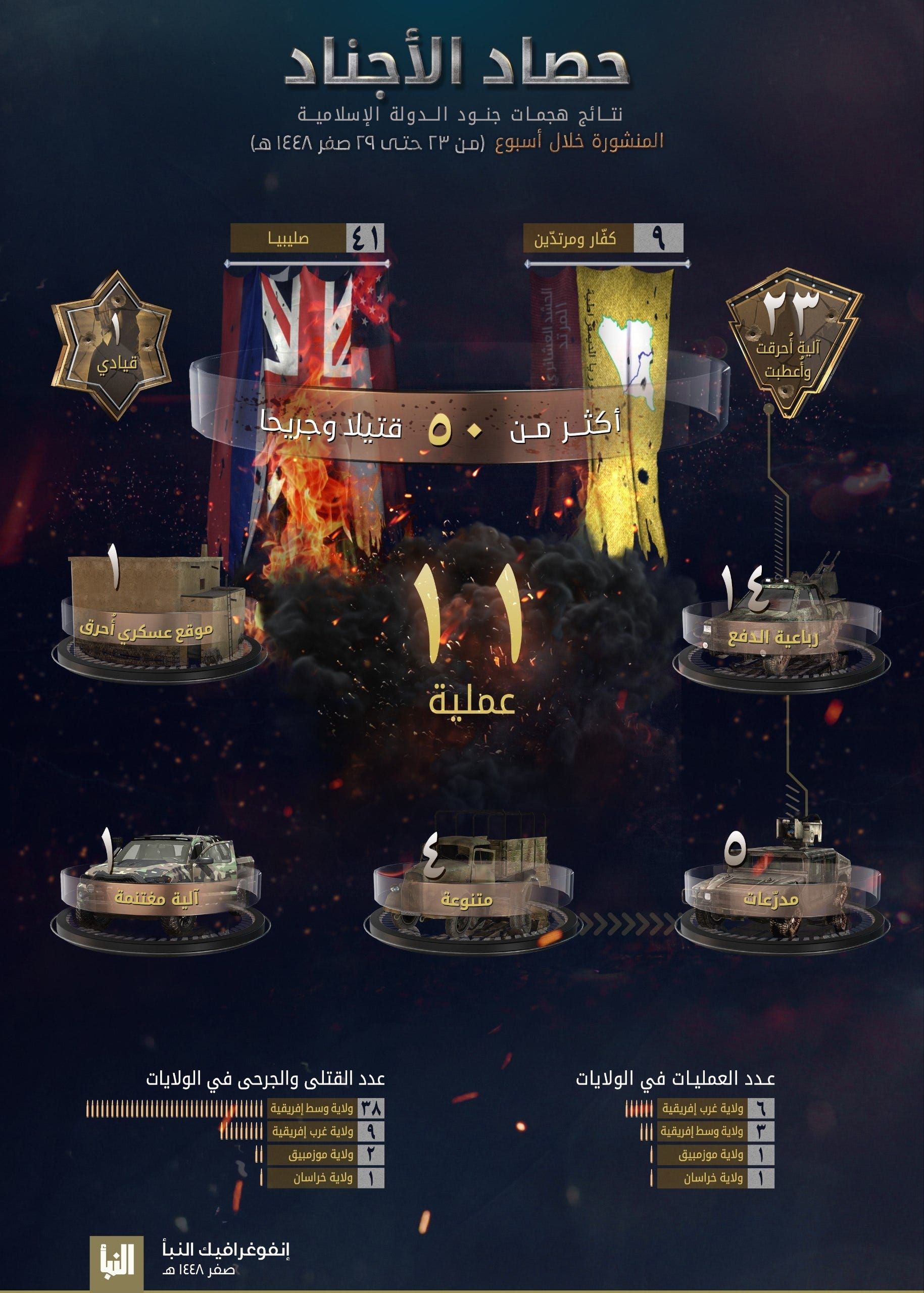
The Islamic State’s official media published 2 issues of the weekly al-Naba this week (560). Issue 560, eight pages long, covers the week of 23 to 29 Safar 1448, from 6 to 12 August 2026. The main infographic summarises the areas affected by military operations this week, including:
Nigeria, Niger, Mozambique, Pakistan, and the Democratic Republic of Congo.
IS claims to have conducted 11 operations in all the mentioned areas and to have caused 50 deaths and injuries.
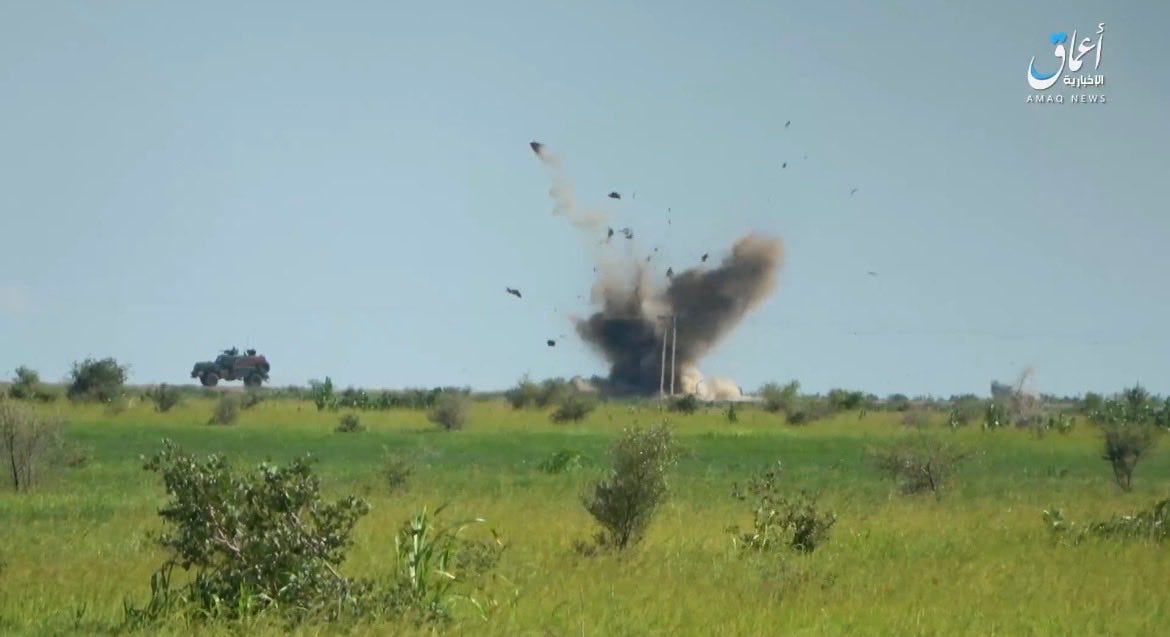
Amaq News Agency, the Islamic State’s official media outlet, has released a 22-second video showing an ISWAP attack using an IED against a Nigerian army convoy in the Dikwa area, in Borno State, Nigeria.
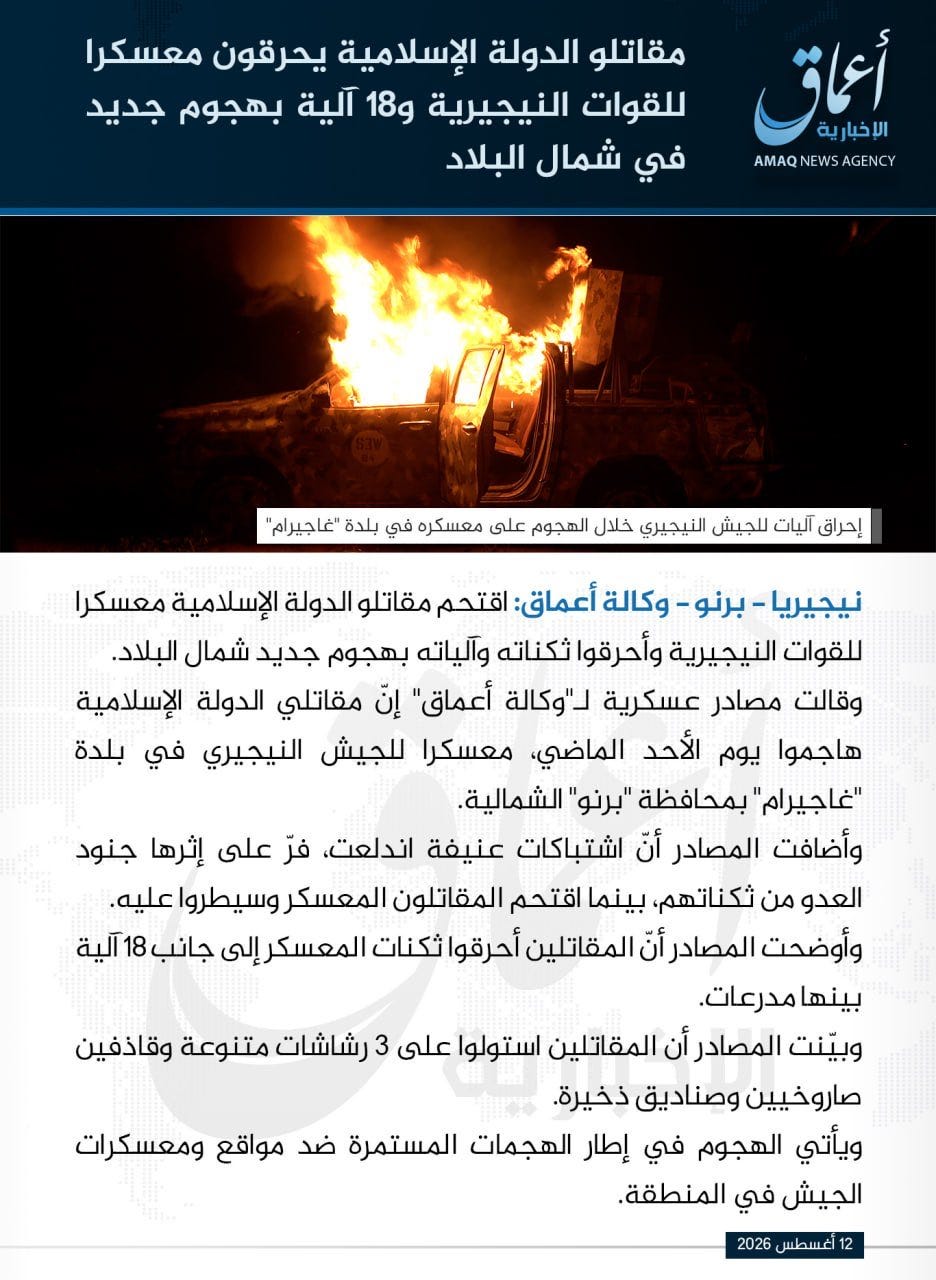
The Amaq News Agency, the official media of the Islamic State, released a lengthy statement setting out their claims of a major night-time attack by militants from the West African Province (ISWAP) on a Nigerian army camp in the Gajiram area, in Borno State, Nigeria.
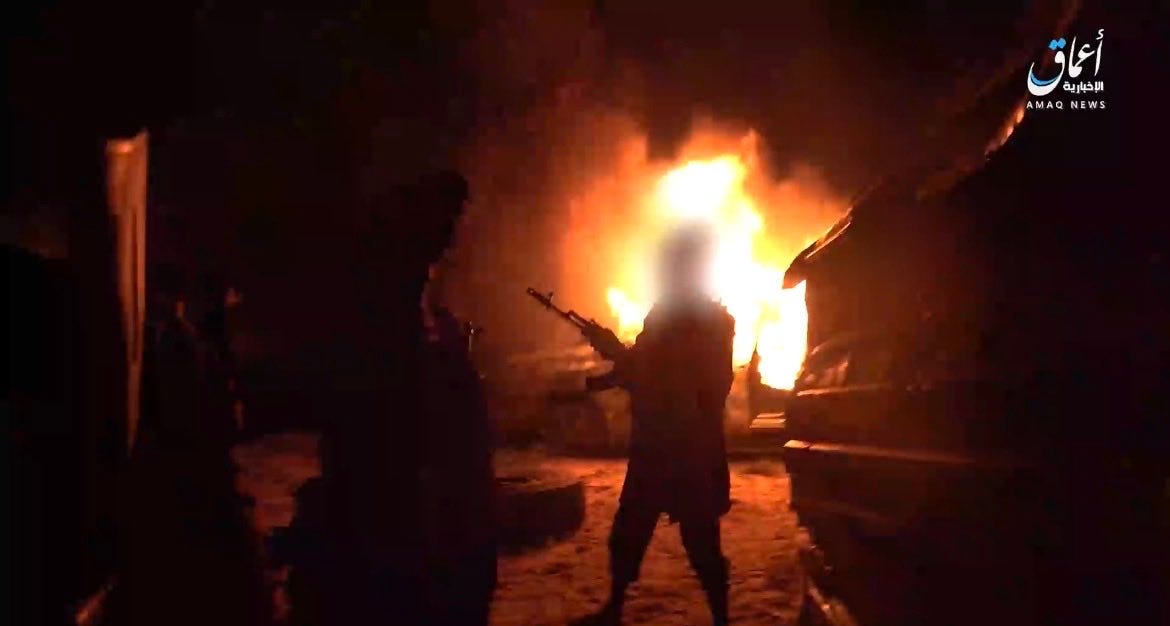
The Amaq news agency, the official media of the Islamic State, released a 3-minute 20-second video showing a major night-time attack by militants from the West African Province (ISWAP) on a Nigerian army camp in the Gajiram area, in Borno State, Nigeria.
Independent Jihadist Groups
Ittehad-ul-Mujahideen Pakistan (IMP), a Pakistani jihadist organisation comprising the Hafiz Gul Bahadur Group (HBG), Lashkar-e-Islam and the Harkat Inqilab-e-Islami Pakistan (HIIP), released 16 statements, claiming 19 attacks.
Target: Pakistan Army, Pakistan Police, Counter Terrorism Department Police (CTD), Secret/Peace Committee.
Area:
- North Waziristan district, Orakzai district, Bannu district, Khyber district; in the Khyber Pakhtunkhwa Province; Pakistan
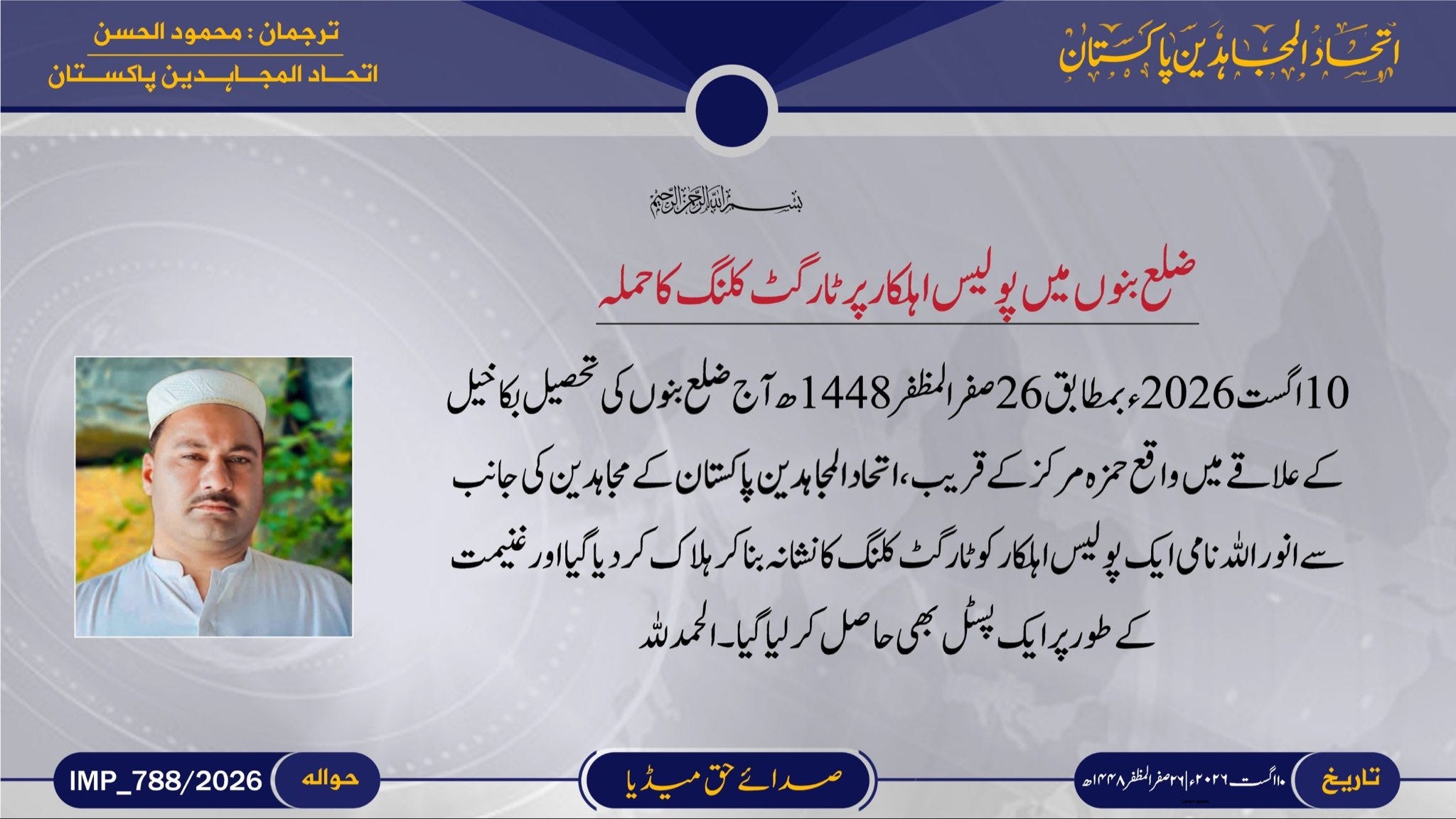
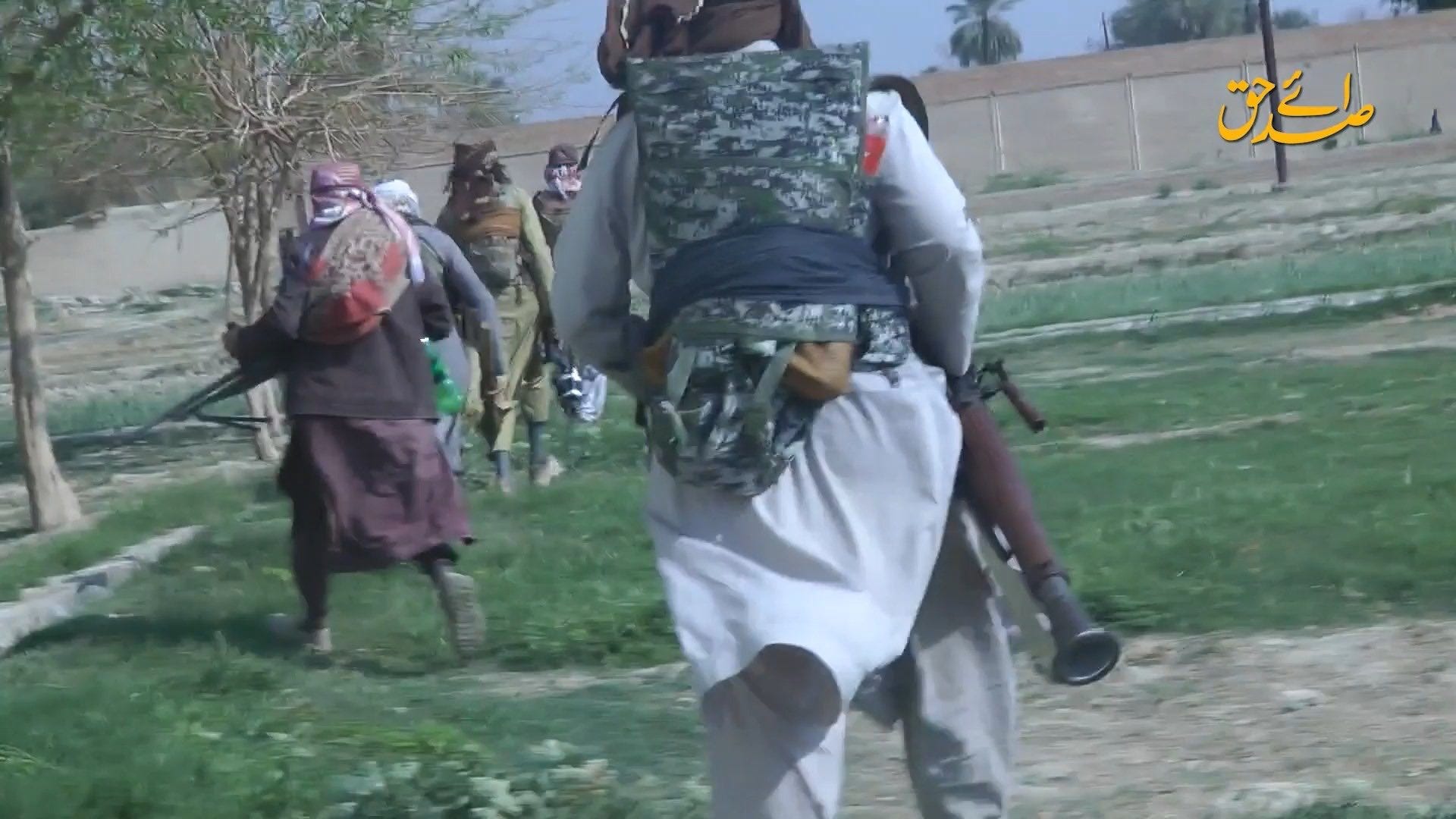
Ittehad-ul-Mujahideen Pakistan (IMP), a Pakistani jihadist organisation comprising Hafiz Gul Bahadur’s (HBG) group, Lashkar-e-Islam and Harkat Inqilab-e-Islami Pakistan (HIIP), has released a 1-minute 22-second video showing an ambush on a Pakistani army convoy in the Bannu district of Pakistan.
🔹Weekly Monitoring Notes
The reporting period from 9 to 17 August reflects a differentiated propaganda cycle across the principal jihadist ecosystems. Overall output remained substantial, but the distribution of activity shifted markedly compared with the previous week. JNIM reduced its operational reporting, Al-Shabaab registered one of its highest weekly claim volumes in recent months, Islamic State maintained a comparatively restrained media posture centred largely on West Africa, and Pakistan-based jihadist organisations continued to sustain a stable operational communications rhythm.
Within the Al-Qaeda ecosystem, Jama’at Nusrat al-Islam wal-Muslimin remained active but at a significantly lower level than during the previous reporting period. Az-Zallaqa Media issued ten statements and six photo reports covering twelve claimed attacks across Mali and Burkina Faso. Mali accounted for the majority of operations, with activity distributed across Kayes, Mopti, Sikasso and Ségou, while Burkina Faso remained represented through attacks across several provinces. The targeting profile was consistent with established patterns, focusing on national armed forces, local militias and Russian Africa Corps personnel.
The principal JNIM visual product was a four-minute video documenting an assault against a pro-government militia headquarters in Bam Province. Unlike the previous week’s extended leadership interview, the current reporting cycle returned to a predominantly operational format. The reduction in strategic messaging is notable, but it does not represent a change in the organisation’s media architecture. Rather, it reflects the familiar alternation between leadership-level communication and routine battlefield documentation.
Al-Shabaab represented the most pronounced expansion in propaganda activity during the week. Shahada News Agency issued twenty-one statements claiming responsibility for forty-six attacks, thirty-nine in Somalia and seven in Kenya. This represents a further increase from the already elevated activity observed during the previous reporting cycle and confirms the group’s capacity to sustain intensive operational communication across multiple fronts simultaneously.
The geographical distribution was broad, encompassing Lower Shabelle, Lower Juba, Bakool, Gedo, Middle Shabelle and Mogadishu, alongside operations in Mandera and Wajir counties in Kenya. The target set remained equally diversified, including Somali military and intelligence structures, local militias and Burundian, Ugandan, Ethiopian and Kenyan forces. The volume and geographic dispersion of claims indicate that Al-Shabaab’s media apparatus is currently functioning at a particularly high tempo, with propaganda closely synchronised to battlefield activity rather than concentrated around a single strategic narrative.
Islamic State official media maintained a considerably lower operational tempo. Al-Naba issue 560 reported eleven operations and fifty deaths and injuries across Nigeria, Niger, Mozambique, Pakistan and the Democratic Republic of the Congo. The limited number of operations represents a clear contraction compared with several recent reporting cycles. However, the geographic structure of the output remains consistent with the organisation’s broader Africa-centred media pattern.
ISWAP dominated the additional official releases. Amaq documented an IED attack against a Nigerian military convoy in Dikwa and subsequently devoted both a detailed statement and a longer operational video to the attack on the Nigerian Army camp in Gajiram. The concentration of multiple media products around the same operation demonstrates Islamic State’s continued practice of selectively amplifying attacks that offer strong visual or tactical value, even during weeks characterised by lower overall claim volumes. The emphasis on Borno State also confirms ISWAP’s continued importance within the Islamic State media ecosystem.
Independent jihadist output remained concentrated on Pakistan. Ittehad-ul-Mujahideen Pakistan released sixteen statements claiming nineteen attacks across North Waziristan, Orakzai, Bannu and Khyber districts. The targeting profile remained unchanged, with the Pakistani Army, Police, Counter Terrorism Department and local security structures continuing to constitute the principal targets. The accompanying video documenting an ambush against a Pakistani military convoy in Bannu reinforced IMP’s established emphasis on tactical battlefield documentation.
Compared with recent weeks, IMP media activity remained stable rather than expansive. The absence of major training packages, drone compilations or long-form capability demonstrations suggests a reporting cycle centred primarily on operational continuity. The organisation nevertheless maintained sufficient claim frequency to preserve a persistent presence within the Pakistani jihadist information environment.
Overall, Week 9 to 17 August is characterised by an asymmetric distribution of propaganda momentum. Al-Shabaab clearly dominated the operational information space, combining exceptional claim volume with broad geographic coverage across Somalia and northeastern Kenya. JNIM remained active but shifted back toward a lower-volume battlefield reporting cycle after the strategically significant leadership messaging of the previous week. Islamic State maintained a more restrained media posture while continuing to prioritise ISWAP within its supporting releases, and IMP preserved a steady operational communications rhythm in Pakistan.
The principal monitoring signal is therefore not a system-wide increase in propaganda, but a redistribution of activity between organisations and theatres. Al-Shabaab’s sustained high-frequency reporting deserves particular attention in subsequent issues to determine whether the current tempo represents a temporary operational surge or the consolidation of a new baseline in its propaganda output.
Distribution patterns remained stable across established encrypted and semi-encrypted platforms (Element, Telegram, Rocket Chat, Chirpwire, Signal, UpScrolled), with no observable shifts in dissemination channels or media architecture.
🔒Executive Intelligence Cycle
This assessment is part of a broader analytical cycle.
Founding subscribers receive the Executive Intelligence Briefing, which integrates all threat assessments, cognitive domain analysis, and a rolling 30–90-day forecast into a single monthly strategic synthesis.
© Daniele Garofalo Monitoring - All rights reserved.
Daniele Garofalo is an independent researcher and analyst specialising in jihadist terrorism, Islamist insurgencies, and armed non-state actors.
His work focuses on continuous intelligence monitoring, threat assessment, and analysis of propaganda and cognitive/information dynamics, with an emphasis on decision-oriented outputs, early warning, and strategic trend evaluation.
ISSN (International Standard Serial Number): 3103-3520
NATO NCAGE: AX664 (NATO Commercial and Governmental Entity)
UNITED NATIONS Global Marketplace ID: 1210727
ORCID Code: 0009-0006-5289-2874