


Executive Intelligence Overview
This weekly strategic intelligence report documents and summarises jihadist propaganda and military activities from 24 to 31 September, highlights recent developments in the threat, and provides a structured overview of the situation across various organisations and operational theatres.
This report emphasises operational claims and objectives, especially their focus on military targets, to reinforce the strategic importance for threat recognition and motivate policymakers to prioritise threats.
This product helps analysts and policymakers track threat trends in depth, supporting their work in shaping strategic responses and maintaining awareness of the active threat environment.
This publication includes brief threat assessments and analyses of operational intentions or forecasts, correlating propaganda content like attack claims and ideological messages with recent activities to help analysts understand groups’ adaptive tactics and the dynamic threat environment.
🔹 Scope of Monitoring
This issue covers all identifiable official and semi-official propaganda from a predefined list of jihadist groups, selected based on operational relevance and threat level during the reference period, to improve situational awareness.
The emphasis on documentation, classification, and structured presentation of firsthand material aims to instil confidence in analysts and policymakers in the reliability of the data used for threat assessment.
🔹 Sources & Collection Methodology
This analysis relies exclusively on primary-source propaganda, such as official magazines, videos, photos, statements, claims, and audio recordings, to clearly define the source scope and enhance data reliability for threat assessment.
Official magazines,
Videos,
Photo sets,
Statements and claims of responsibility,
Audio statements.
The team collects and categorises material by organisation, media outlet, and content type.
The study relies on OSINT, IMINT, SOCMINT, and Digital HUMINT collection streams.
No secondary reporting, media commentary, or interpretative overlay is applied.
🔹 Analytical Boundaries & Limitations
Fluctuations in volume, language, or format, such as increased messaging in local dialects, should be interpreted within the broader context of operational tempo, recent events, and known threat indicators to support analysts’ confidence in threat assessments and minimise misinterpretation risks.
They shouldn’t be considered in isolation as indicators of strategic shifts, operational escalation, or changes in intent and capability; instead, they should be integrated within broader intelligence products such as Strategic Threat Outlooks and Cognitive Assessments to support comprehensive threat evaluations.
Strategic shifts,
Operational escalation,
Intent or capability changes.
All higher-order analytical interpretation is conducted separately within:
Intelligence Briefs,
Strategic Threat Outlooks,
Cognitive and Information Domain Assessments.
🔹 Monitored Propaganda Output and Weekly Strategic Assessments
This issue includes all primary propaganda material released during the week by:
Al-Qaeda and affiliates
JNIM
Al-Shabaab
Pro-AQ media channels (Al-Bayan Newspaper - Weekly Issue)
Islamic State
Al-Naba Newspaper (weekly Issue)
Official IS media channels.
Independent Jihadist Groups
Ittehad Mujahidin Pakistan
Tehrik-i-Taliban Pakistan
People’s Fighters Front
The conclusions include the Weekly Strategic Assessments.
Al-Qaeda (AQ)
Az-Zallaqa Media, Jama’at Nasr al-Islam wal Muslimin (JNIM), issued 18 statements and 37 photos, claiming 18 attacks.
The targets included the Malian Army, the Dozo militia, the Russian PMC Africa Corps, the Burkinabé Army, and the VDP militia.
The areas of the attacks were :
1) Burkina Faso = 12
- Mouhoun province, Sanmatenga province, Yatenga province, Boulgou province, Loroum province.
2) Mali = 6
- Koulikoro region, Mopti region, Segou region.
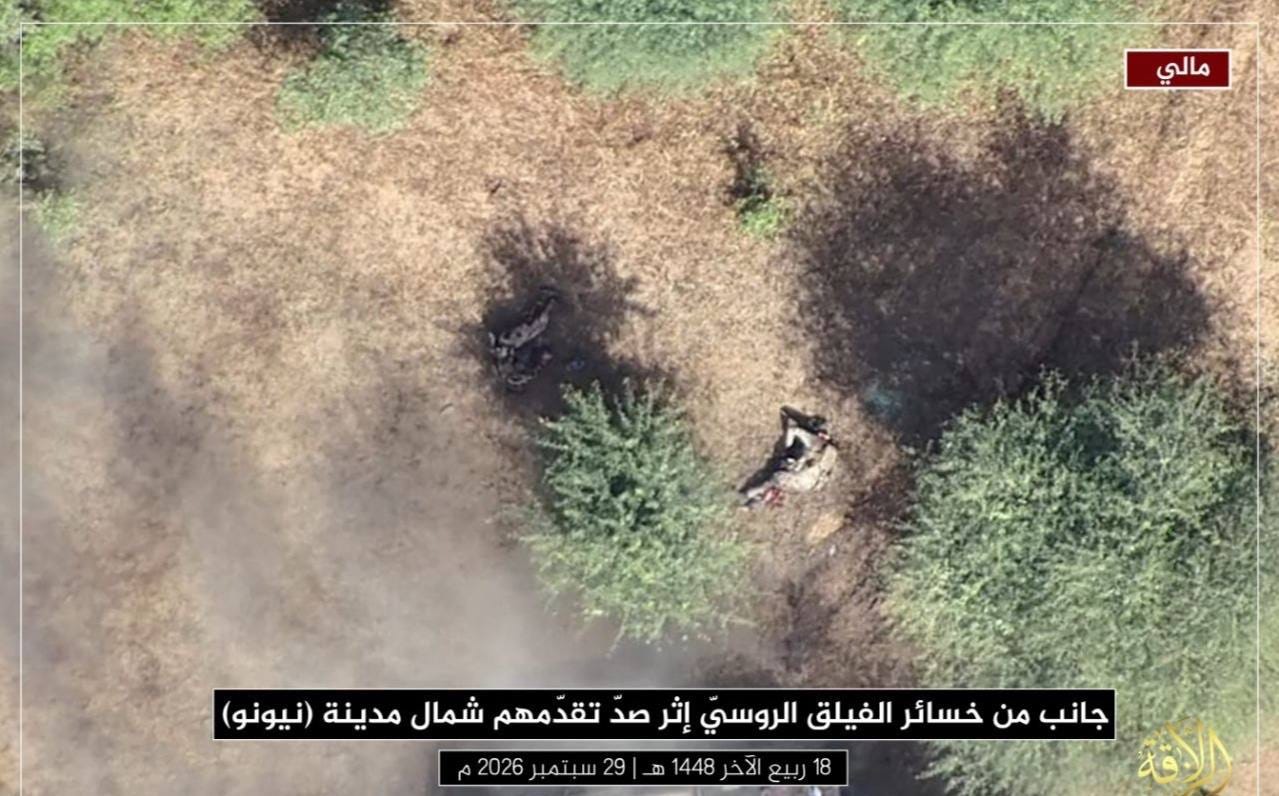
The Shahada News Agency, Harakat al-Shabaab al-Mujahidin (AS), released 13 statements claiming responsibility for 16 attacks.
The targets of the attacks were:
The targets included the Somali Army, Somali pro-government militias, the Ugandan Army, the Burundian Army, the Ethiopian Army, and the Kenyan Army.
The areas affected by the attacks were:
1) Somalia = 12
Harardhere area, Mudug region;
Janale area, Qoryooley area, Bulo Marer area, Afgoye area, Lower Shabelle region;
Jowhar area, Middle Shabelle region;
Baidoa area, Bay region;
Bardhere area, Gedo region;
2) Kenya = 4
Hulugho area, Garissa County;
Saretho area, Harisukow area Fino area, Mandera County.
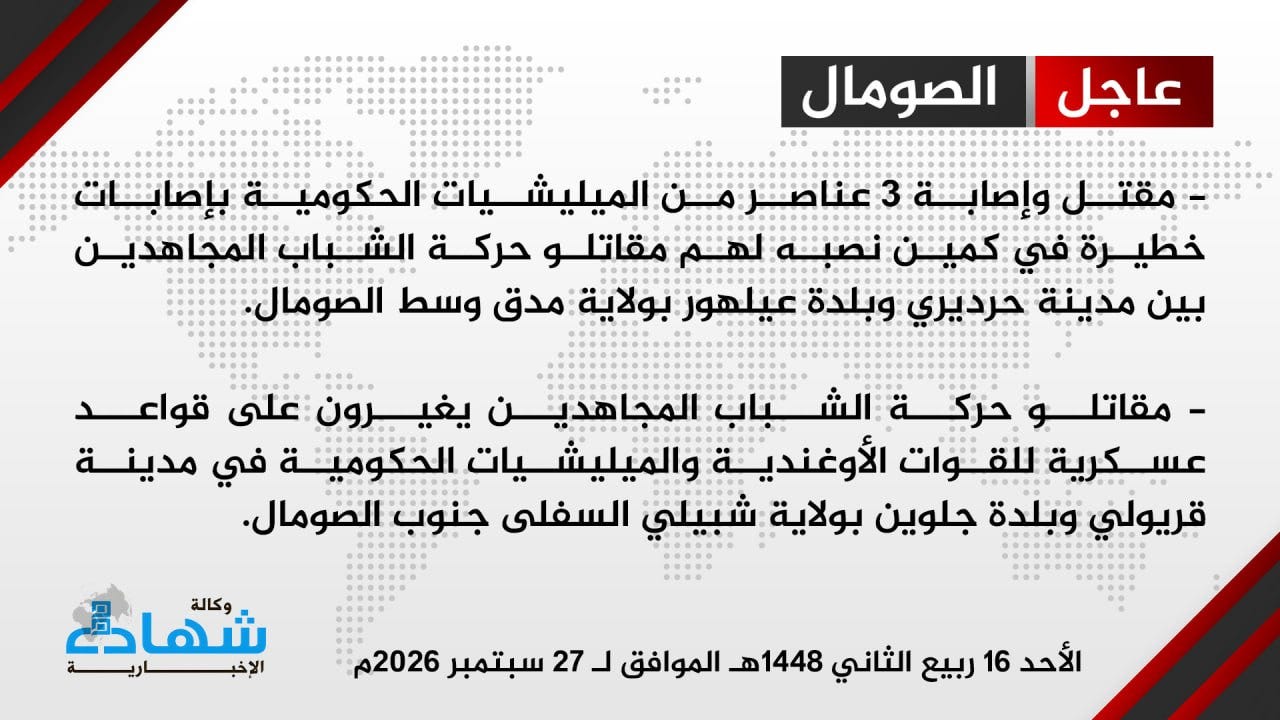
The 10th issue of the weekly Al-Bayan, published by the pro-Al-Qaeda (AQ) media outlet Al-Yaqin, and spanning 14 pages this time, features, alongside the usual infographic summarising the previous week’s attacks, religious messages, and photographic evidence of Al-Shabaab and JNIM activities, several editorials of significant interest. These include a strongly ideological piece on Yemen and the United States, as well as an extensive analysis of the crisis facing the African Union mission in Somalia.
The editorial titled “Between the War of Proxies and the Killing of the Confused” begins with an incident in Hadramawt, where a young man reportedly opened fire on foreign teachers at a US-linked facility while a US drone was simultaneously flying overhead.
Al-Bayan uses this incident to construct an ideological contrast between Sunni jihadists, the United States, and the Houthis. The central argument is that, according to the magazine, Washington and the Houthis may be formal adversaries but pursue converging interests against Sunni jihadism. The text asserts that the Houthis maintain an opportunistic relationship with Washington and that their anti-American and anti-Israeli rhetoric masks a convergence in the suppression of jihadists.
The article also emphasises the Houthis’ relationship with Iran, portraying them as part of Iran’s projection of power in Yemen, and argues that the conflict between Washington and the Houthis does not alter their shared hostility toward Sunni jihadists.
The conclusion is explicitly designed to mobilise: the author presents the young man’s attack in Hadramawt as an example of the need to fight both the United States and its alleged regional allies.
The second editorial is more polemical: “Did Uncle Sam Rule Among You with Justice?!” Al-Bayan criticises the Houthis, described as an Iran-linked Shiite movement, and other Islamist factions that, according to the author, have adopted inconsistent stances toward the United States.
The propaganda argument posits that these actors, despite declaring themselves enemies of Washington or Israel, ultimately accept, albeit implicitly, a US-dictated political order. Al-Bayan thus seeks to portray its own jihadist milieu as the only one consistently hostile to the US, Iran, the Houthis, and regional political systems alike.
Finally, an editorial addresses Somalia and the financial crisis facing the African Union mission. Al-Bayan draws on analyses and statements about the mission’s financial crisis (ATMIS/AMISOM), arguing that it faces a significant funding shortfall that could jeopardise its operational sustainability.
The text specifically cites assessments by the International Crisis Group, noting that insufficient funding could strain African forces and indirectly benefit al-Shabaab. It also discusses the UN funding model and the challenges involved in securing a stable funding mechanism for the mission.
Al-Bayan thus leverages a genuine issue, the mission’s funding and sustainability, to construct a narrative suggesting that al-Shabaab is increasingly benefiting from the structural weakening of the international presence in Somalia.
Islamic State (IS)
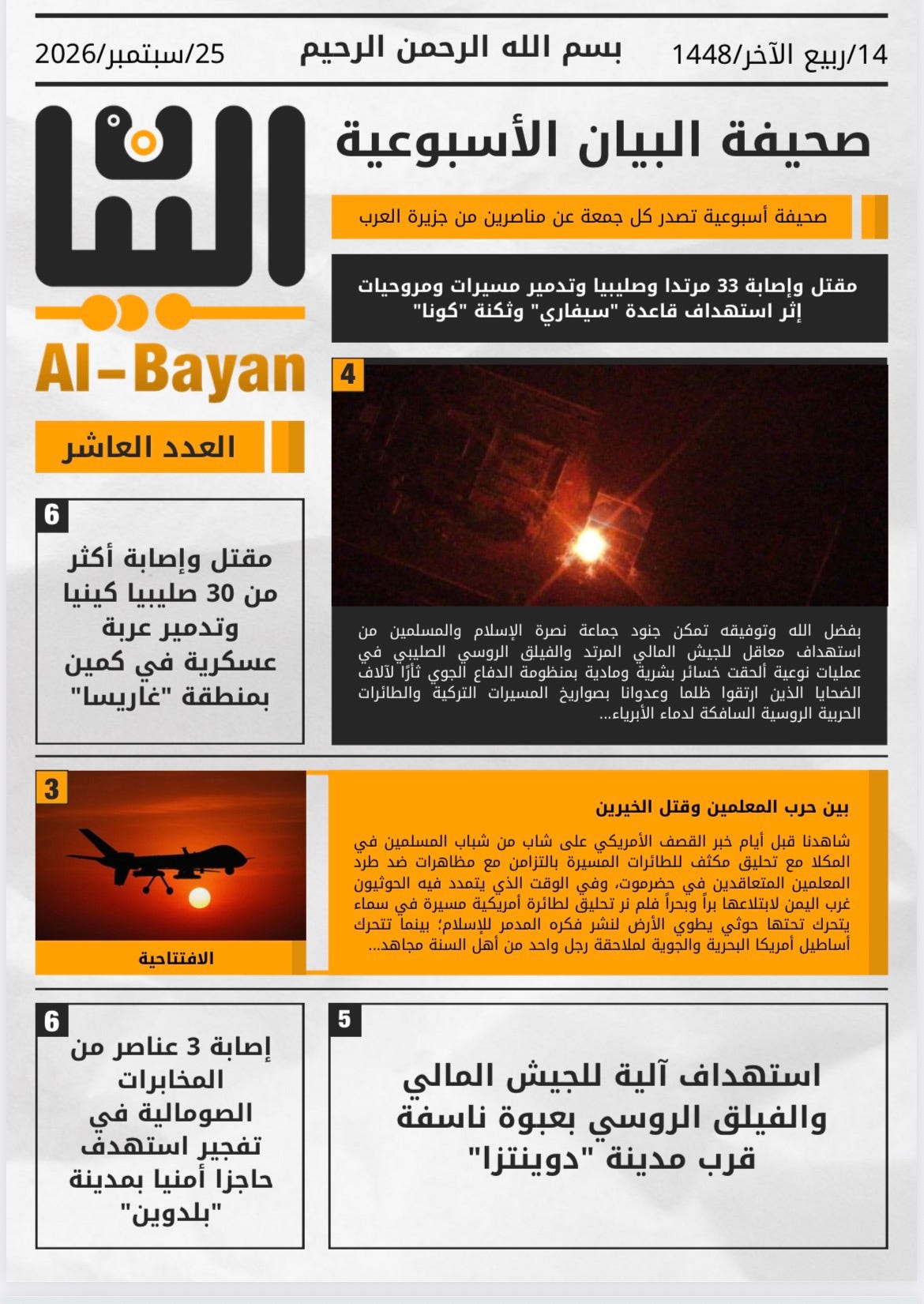
The Islamic State’s official media published the weekly al-Naba this week (566). Issue 566, eight pages long, covers the week of 6–12 Rabi al-Thani 1448 AH (17-23 September 2026). The main infographic summarises the areas affected by military operations this week, including:
Nigeria, Iraq, Pakistan, Mozambique, Somalia and the Democratic Republic of Congo.
IS claims to have conducted 27 operations in all the mentioned areas and to have caused 74 deaths and injuries.
1) West Africa Province: The weekly al-Naba reports that ISWAP militants carried out 9 attacks against checkpoints, convoys, patrols, and camps belonging to the Nigerian army and pro-government militias in the State of Borno, Nigeria.
2) Iraq Province: The weekly al-Naba reports on 3 attacks carried out by Iraqi militants: 1 attack (as part of the economic warfare strategy) against the Iraqi government’s electrical infrastructure, and 2 attacks against patrols of the Tribal Mobilisation Forces and the Iraqi Army, in Anbar, Kirkuk, and Salah al-Din governorates, Iraq.
3) Central Africa Province: The weekly al-Naba reports that ISCAP militants carried out 6 attacks against patrols and checkpoints of the Congolese Army and against a Christian village (70 Christian houses burned), in Ituri Province, in the Democratic Republic of the Congo.
4) Mozambique Province: The weekly newspaper al-Naba reports that ISM militants carried out 5 attacks against checkpoints, convoys, and patrols of the Mozambican and Rwandan armies, as well as against Christian villages, in the districts of Mocímboa da Praia, Muidumbe, and Palma, in the province of Cabo Delgado, Mozambique.
5) Somalia Province: The weekly newspaper al-Naba reports that Somali militants carried out 3 attacks against convoys and patrols of the Puntland Security Forces in the Bari region of the autonomous federal state of Puntland, Somalia
6) Pakistan Province: The weekly al-Naba reports that Pakistani militants carried out 1 attack against a Pakistani police patrol in the province of Balochistan, Pakistan.
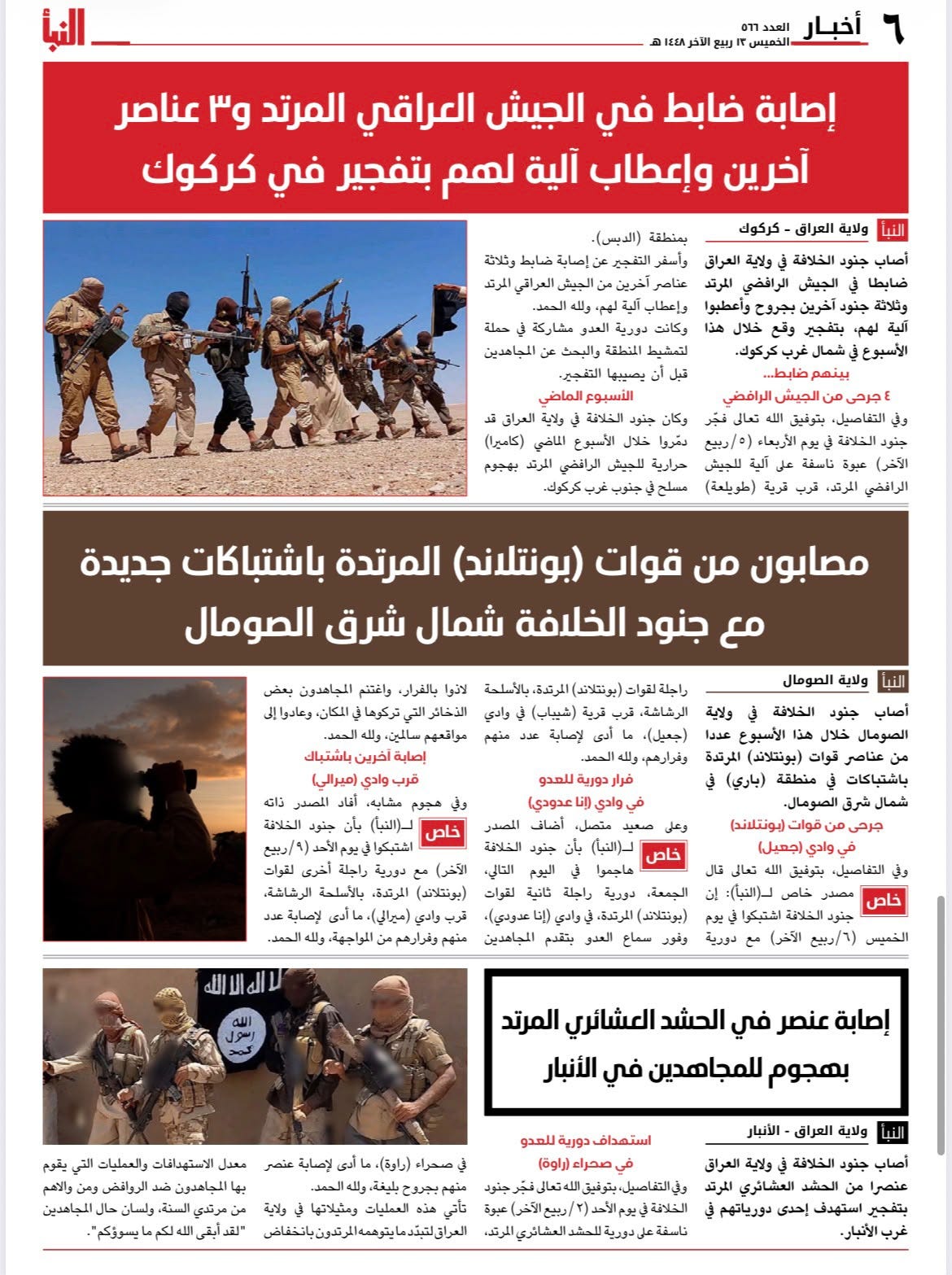
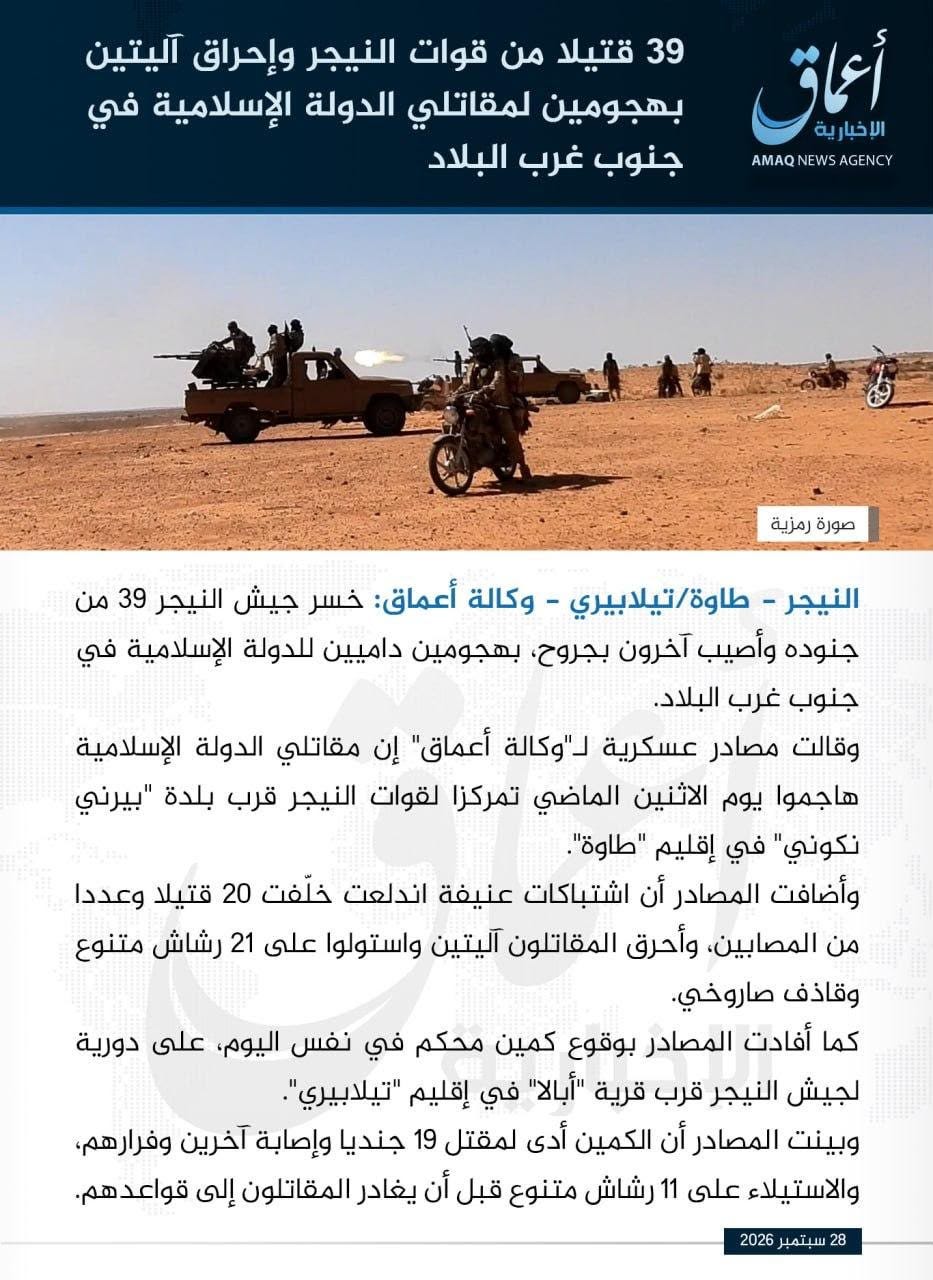
Amaq News Agency, the official news agency of the Islamic State, issued a lengthy statement claiming responsibility for two major attacks carried out by militants of the Islamic State’s Sahel Province against Nigerien forces. The first attack was an armed assault followed by a firefight against a Nigerien army camp near Birni N’Konni, in the Tahoua region, which, according to the statement, resulted in the deaths of 20 Nigerien soldiers.
The second attack was carried out against a Nigerien gendarmerie convoy near the village of Abala in the Tillabéri region, resulting in 19 deaths among Nigerien security forces. Niger
Independent Jihadist Groups
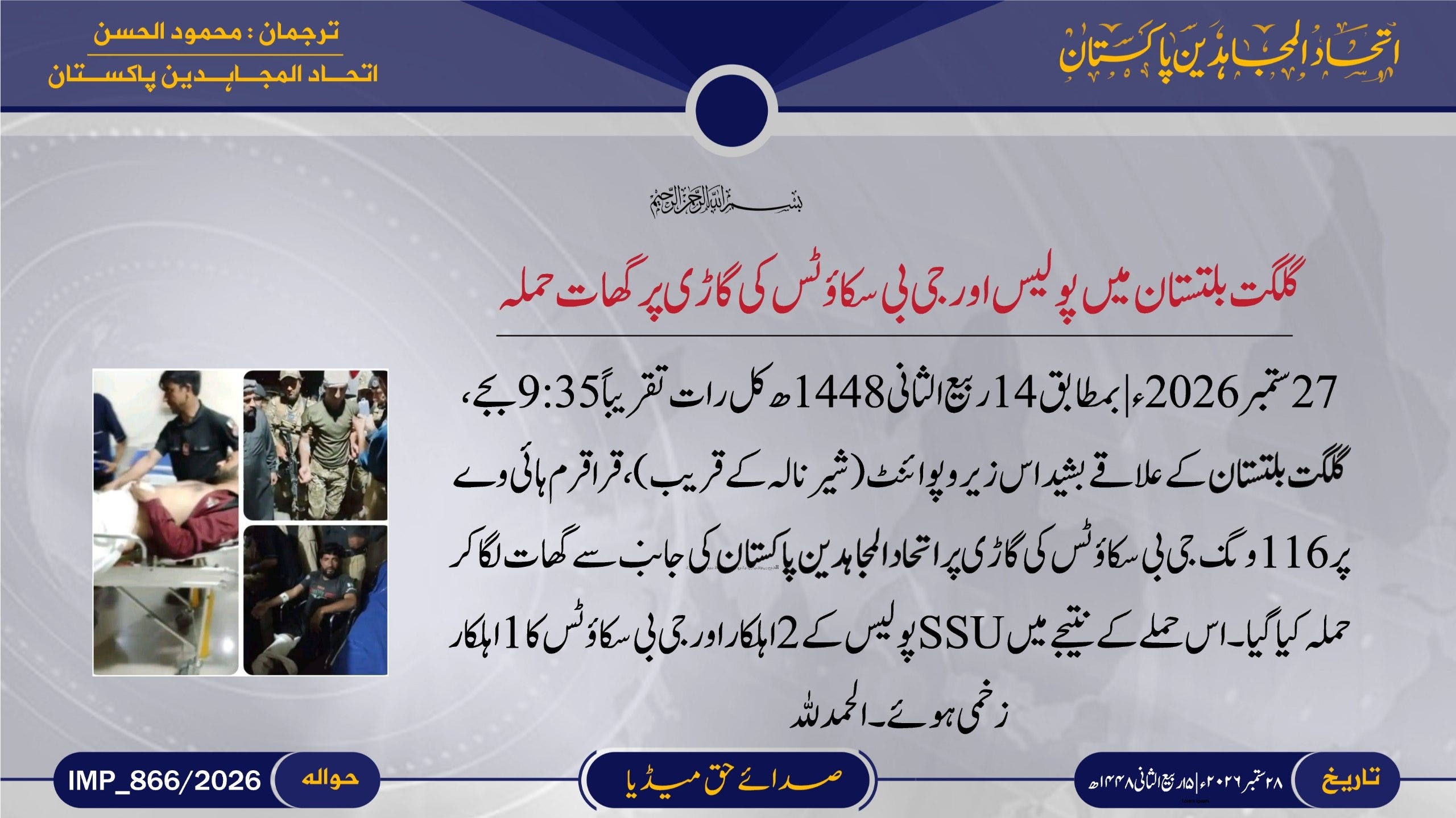
Ittehad-ul-Mujahideen Pakistan (IMP), a Pakistani jihadist organisation comprising the Hafiz Gul Bahadur Group (HBG), Lashkar-e-Islam and the Harkat Inqilab-e-Islami Pakistan (HIIP), released 8 statements, claiming 8 attacks.
Targets: Pakistan Army, Frontier Corps (FC), Pakistan Police, Gilgit-Baltistan Scouts, Special Security Unit (SSU), and Peace Committee.
Area:
North Waziristan district, Khyber district, Orakzai district, and Bannu district, in Khyber Pakhtunkhwa Province:
Ghizer District, in Gilgit-Baltistan Autonumus Region;
Pakistan.
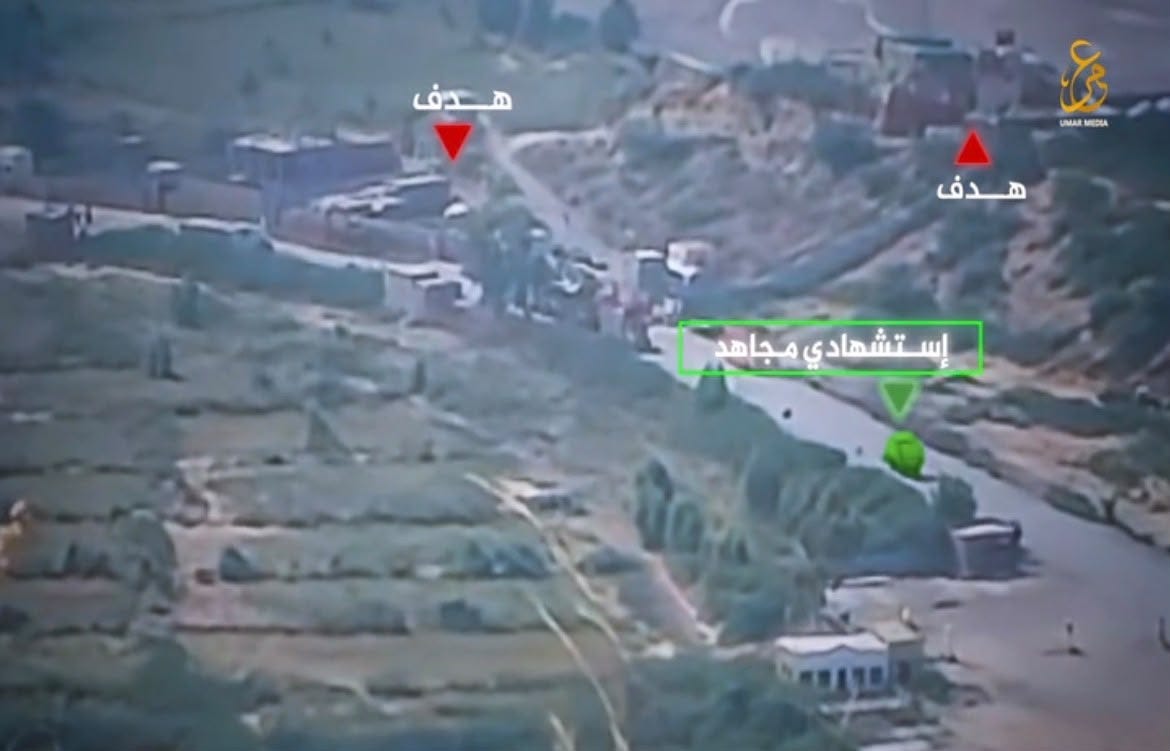
Umar Media, Tehrik-i-Taliban Pakistan (TTP), released a video lasting approximately 3 minutes and 10 seconds showing an istishadi (suicide) attack carried out by a member of the TTP’s “Istishadi” Special Force, in the name of Allah, against a joint command centre of the Pakistani Army, the Pakistani police, and the Counter Terrorism Department (CTD) in the Der Islam Khan district of Pakistan.
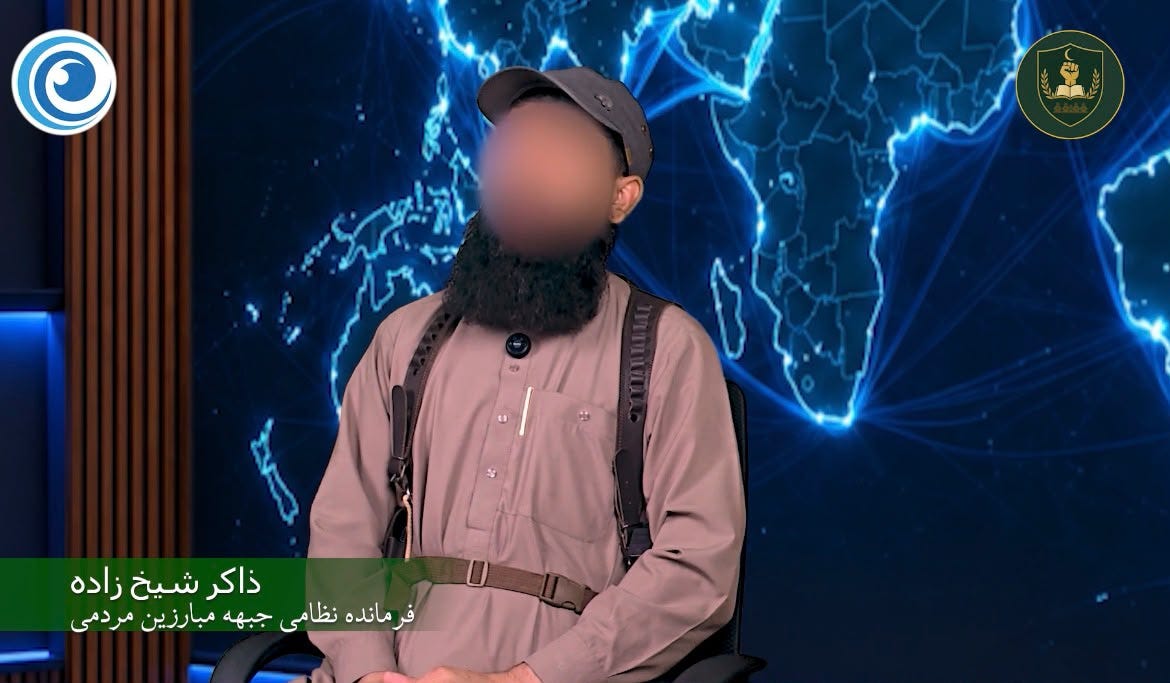
The People’s Fighters Front (PFF), an Iranian jihadist organisation operating in Sistan and Baluchistan, released a 4-minute-and-10-second video in which Zakir Sheikhzadeh, the group’s military commander, describes the clashes between the PFF and IRGC members in Bukshan and Jahadabad, Saravan.
The speaker focused on two incidents that took place during the last week of September in Jahadabad, Saravan. Topics included the outbreak of hostilities, how the Front’s command was informed of its forces’ status, the condition of the besieged troops, communication between field units and command, and decisions on deploying reinforcements.
In the video, Zakir Sheikhzadeh explains how the Front’s forces prepared in Jahadabad before the clashes and how the command responded to the incident in Bukshan. He also discusses dispatching support teams to assist the engaged forces and break the siege. Subsequently, the speaker describes the arrival of jihadist reinforcements and the withdrawal of IRGC military forces from the area.
Zakir Sheikhzadeh then provided details regarding casualties among the military forces as well as the number of Front members killed. He went on to review the specifics of the clashes near the Jame Madani Mosque in Bukshan and the arrival of two support teams to break the siege and evacuate the trapped fighters. Sheikhzadeh recounted how six Front members managed to escape the siege, while four other members of the group were killed. Zakir Sheikhzadeh then explained the Front’s approach over the past few months, the deaths of group members, the presence of the People’s Fighters Front in Baluchistan, and the movement’s social composition, emphasising that the group considers itself a movement born of Baluch society and that its struggle stems from the people’s demands.
🔹Weekly Strategic Assessments
The reporting period presents a jihadist operational environment characterised less by uniform escalation than by the simultaneous consolidation of several distinct theatres.
