


This weekly strategic intelligence report documents and summarises jihadist propaganda and military activities from 9 to 16 November, highlights recent developments in the threat, and provides a structured overview of the situation across various organisations and operational theatres.
This report emphasises operational claims and objectives, especially their focus on military targets, to reinforce the strategic importance for threat recognition and motivate policymakers to prioritise threats.
This report emphasises threat trend analysis to help analysts and policymakers feel confident in their understanding of the active threat environment and support strategic decision-making.
This publication includes threat assessments and analyses that aim to reassure policymakers of the depth of understanding of groups’ tactics and the dynamic threat landscape.
🔹 Scope of Monitoring
This issue covers all identifiable official and semi-official propaganda from a predefined list of jihadist groups, selected based on operational relevance and threat level during the reference period, to improve situational awareness.
This focus on documenting and structuring firsthand material is intended to help analysts and policymakers feel assured of the data’s reliability for threat assessment.
🔹 Monitored Propaganda Output and Weekly Strategic Assessments
This issue includes all primary propaganda material released during the week by:
Al-Qaeda and affiliates
JNIM
Al-Shabaab
Pro-AQ media channels (Al-Bayan Newspaper - Weekly Issue)
Islamic State
Al-Naba Newspaper (weekly Issue)
Official IS media channels.
Independent Jihadist Groups
Ittehad Mujahidin Pakistan
Popular Fighters Front
The conclusions include the Weekly Strategic Assessments.
Al-Qaeda (AQ)
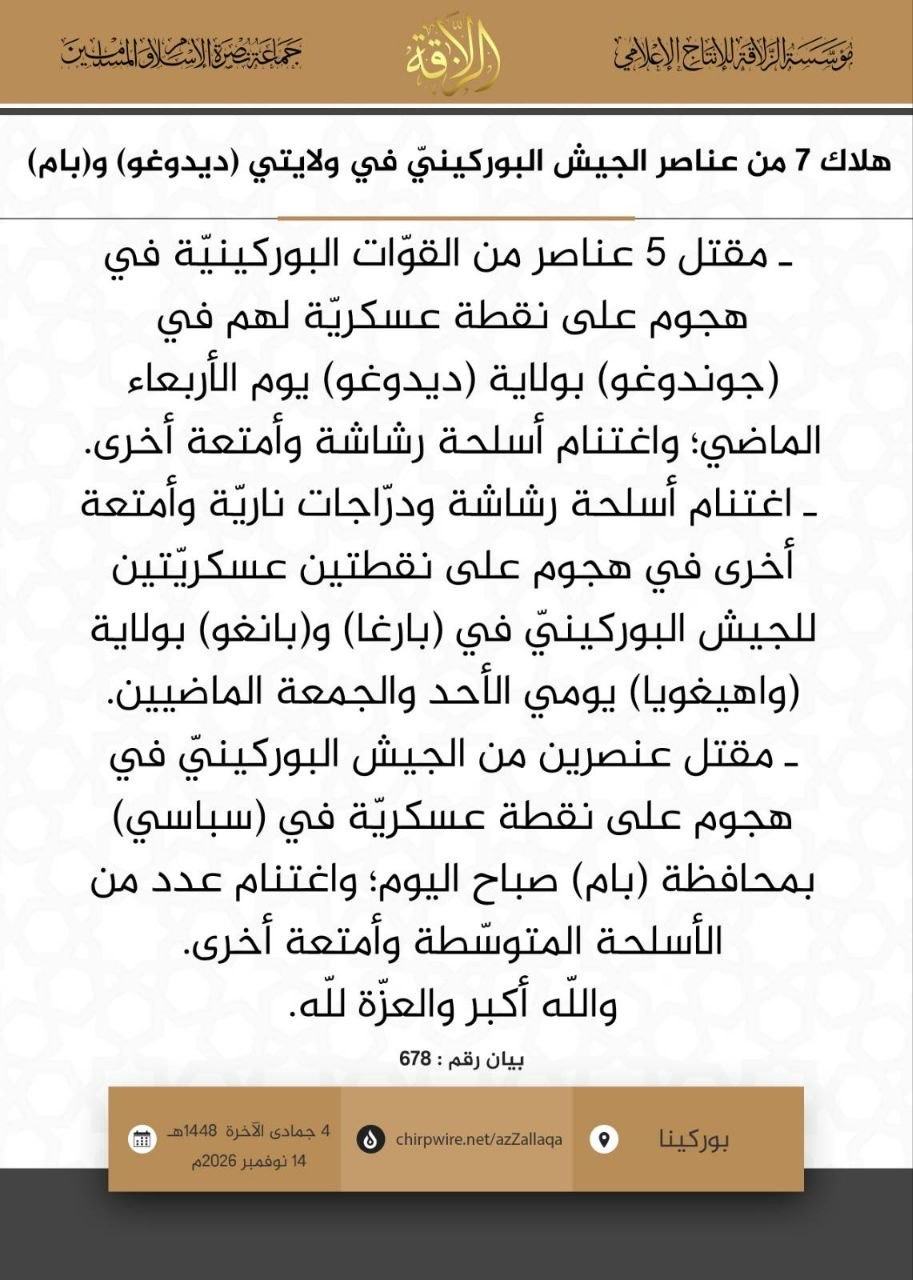
Az-Zallaqa Media, the official media wing of Jama’at Nusrat al-Islam wal-Muslimin (JNIM), released 15 distinct statements between 9 and 16 November 2026, claiming 20 attacks in Burkina Faso and Mali.
The reported operations included attacks on military positions and checkpoints, ambushes, improvised explosive device (IED) attacks, and assaults on militia bases. JNIM also claimed to have seized weapons, ammunition, and military equipment.
The targets included the Burkinabé Army, Burkinabé VDP militias, the Malian Army, Malian government-aligned militias, Dozo militia, the Russian Africa Corps, and Islamic State-affiliated militants.
The geographical distribution of the claimed incidents was:
1) Burkina Faso = 11
Bam province, Mouhoun province, Séno province, Gourma province, Oudalan province, Sanmatenga province and Yatenga province.
2) Mali = 9
Mopti region, Ségou region, Kidal region, Timbuktu region, and Kayes region.
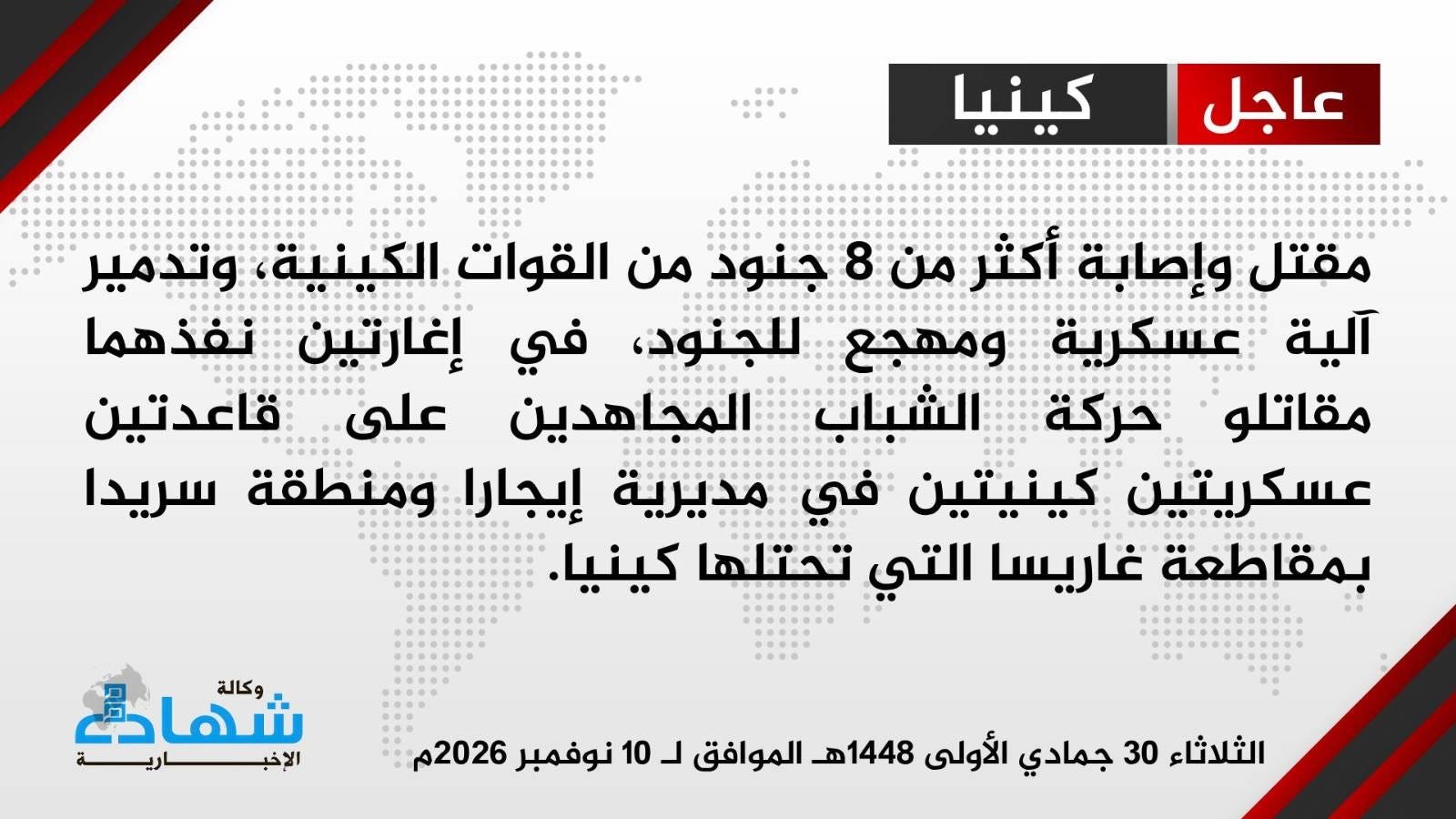
The Shahada News Agency, the media outlet of Harakat al-Shabaab al-Mujahidin (AS), released 15 distinct statements between 9 and 16 November 2026, reporting 22 attacks and targeted operations.
The reported targets included the Somali National Army, Somali government-aligned militias, Somali intelligence and security personnel, Somali special forces, the Ugandan Army, and the Kenyan Army.
The geographical distribution of the reported operations was:
Somalia = 19
Lower Shabelle region: Janale, Mubarak, Bulomarer, Qoryoley, Bariire, Awdheegle and Balidogle areas;
Banaadir region: Mogadishu, including Wadajir and Daynile districts;
Middle Shabelle region: area
Kenya = 3
Garissa County: Ijara constituency, Sarira area and Kamudi area, along the Tana River.
The reported operations included attacks on military bases, roadside bombings, ambushes and targeted killings.
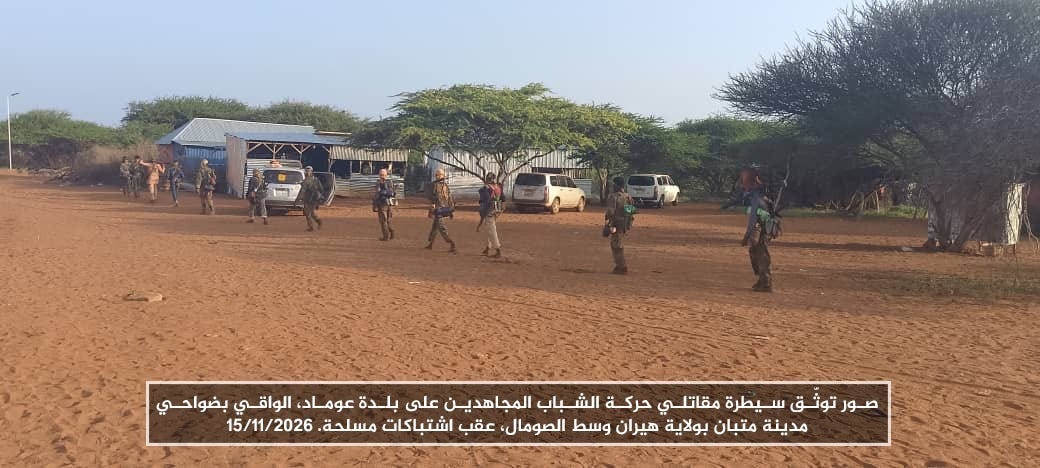
Al-Kataib Media, the official media wing of Harakat al-Shabaab al-Mujahidin (AS), released a photographic report comprising 8 images documenting the group’s claimed takeover of the village of Oomad, near Mahas, in Somalia’s Hiran region, following armed clashes on 15 November 2026.
The photographs reportedly show al-Shabaab fighters inside the village following the clashes. The available image depicts armed personnel moving through a settlement containing buildings and parked vehicles. The report forms part of al-Shabaab’s media coverage of its military operations in central Somalia.
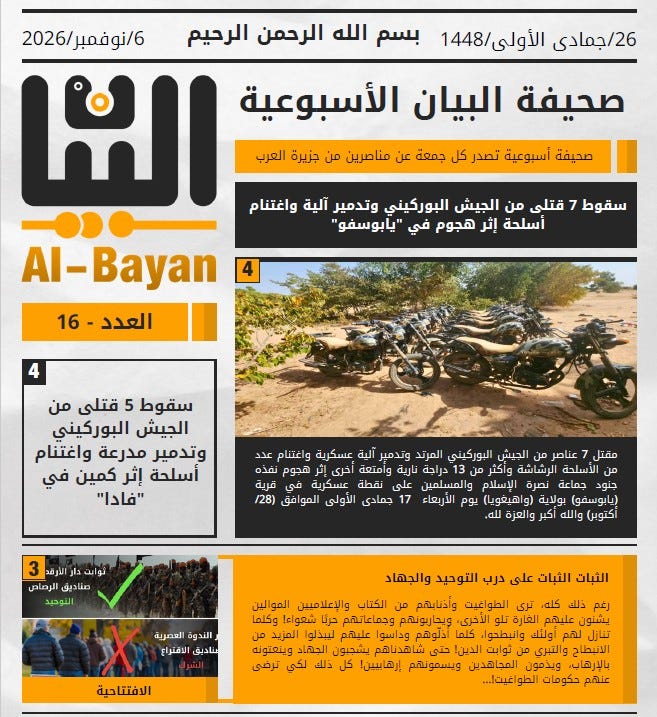
Al-Bayan Weekly, a pro-al-Qaeda publication (al-Yaqin) produced by supporters based in the Arabian Peninsula, released Issue 16. The nine-page edition combines its regular coverage of operations attributed to al-Qaeda-affiliated organisations with an editorial addressing ideological commitment, armed jihad and the rejection of peaceful political approaches.
The central editorial, titled “Steadfastness on the Path of Monotheism and Jihad”, argues that peaceful political methods have failed to protect Muslim communities or achieve the objectives advocated by jihadist movements. The author contrasts political accommodation with armed confrontation, presenting the latter as a religious obligation and criticising those who discourage violence in favour of nonviolent activism. The article emphasises perseverance and ideological consistency. It argues that setbacks, casualties and prolonged confrontation should not lead militants to abandon their objectives. Rather than examining the political and humanitarian consequences of armed conflict, the editorial interprets continued fighting as evidence of religious commitment and frames compromise as weakness. This framing reflects a recurring feature of pro-al-Qaeda propaganda: the attempt to delegitimise alternative forms of Islamist political participation while reinforcing the idea that armed struggle is the only legitimate means of achieving religious and political change.
Beyond the editorial, the issue includes material concerning al-Shabaab’s activities and ideological messaging in Somalia. The publication reproduces militant accounts that portray al-Shabaab as a movement combining military operations with religious discipline, organisational cohesion and commitment to its declared political project. The edition also contains reporting on Jama’at Nusrat al-Islam wal-Muslimin (JNIM) in Burkina Faso and Mali, alongside coverage of al-Shabaab operations in Somalia and Kenya.
Its operational infographic reports more than 23 attacks attributed to al-Qaeda-affiliated groups during the reporting period. The figures represent the publication’s compilation of militant claims rather than independently verified incidents. Among the principal operations highlighted is a JNIM attack against a Burkinabé military position in Yabousgou, where the group claimed to have killed seven soldiers, destroyed a military vehicle and seized weapons and motorcycles. Additional reports concern engagements against Malian government forces and Russian personnel, as well as al-Shabaab attacks against Somali government forces and allied security personnel. The issue’s editorial emphasis is therefore not primarily on the scale of individual operations, but on the ideological justification for sustaining armed confrontation and rejecting political alternatives.
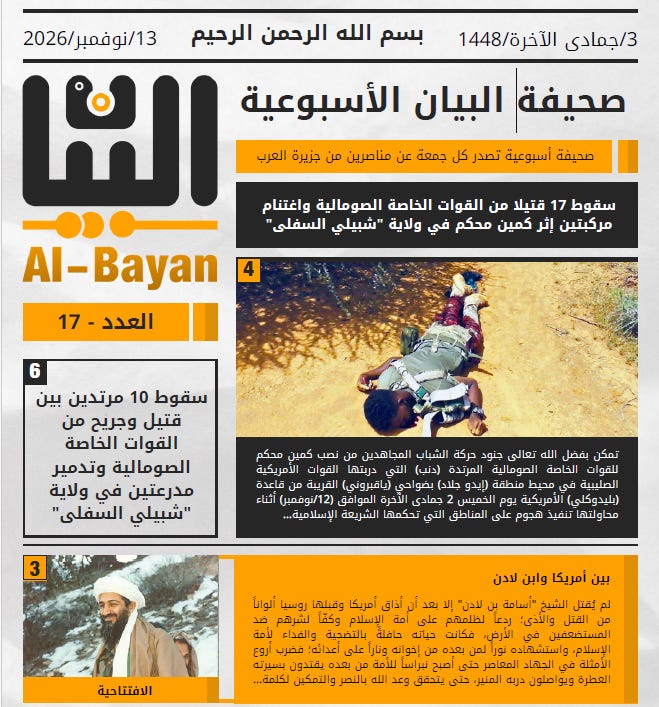
Al-Bayan Weekly, a pro-al-Qaeda publication (al-Yaqin) produced by supporters based in the Arabian Peninsula, released Issue 17 on 13 November 2026. The 14-page edition combines operational reporting from al-Qaeda-affiliated organisations in Africa with ideological editorials, commentary on counterterrorism narratives, and articles addressing jihadist leadership, political mobilisation and media activities.
The principal editorial, titled “Between America and Bin Laden”, commemorates Osama bin Laden and presents his death as an event that failed to undermine the broader jihadist movement. The author revisits the US military campaigns in Afghanistan and Iraq, portraying subsequent American withdrawals as evidence that military intervention cannot eliminate jihadist ideology or prevent its transmission across generations.
The editorial extends this interpretation to contemporary developments in Somalia, Palestine, Syria and the Sahel. It presents these geographically distinct conflicts as components of a wider historical confrontation involving the United States and its allies. Particular attention is given to the idea that the elimination of individual leaders does not necessarily result in the disappearance of the movements or ideological networks associated with them. The article also invokes historical al-Qaeda figures and other Islamist militants to construct a narrative of ideological continuity, portraying contemporary jihadist organisations as successors to earlier generations.
Another substantial article, titled “The Manufacture of Falsehood”, examines the information environment surrounding jihadist movements. The author accuses Arab governments, Western institutions, research centres and media organisations of deliberately misrepresenting jihadist organisations and undermining their legitimacy. Saudi Arabia, the United Arab Emirates and Qatar receive particular attention. The article criticises Saudi-funded media and counter-extremism initiatives, including Al Arabiya and the Etidal centre, while accusing UAE-based institutions such as the Al Mesbar Studies and Research Center, TRENDS Research & Advisory, Hedayah and Sawab of contributing to campaigns against jihadist ideology.
The publication also criticises Qatar’s cooperation with former FBI officer Ali Soufan and his organisation (Tje Soufan Center), presenting counterterrorism research and policy engagement as instruments of a wider political and informational confrontation. The article reproduces remarks attributed to former al-Qaeda leader Ayman al-Zawahiri concerning the importance of jihadist media personnel. Its central argument is that information dissemination, ideological legitimacy and the ability to contest hostile narratives are integral components of the movement’s struggle.
A separate article, “To Our Heroes in Taiz”, addresses developments in Yemen by discussing leadership and organisational decision-making. Drawing on the historical Battle of the Trench, the author identifies consultation, acceptance of advice, collective participation, delegation of responsibilities and recognition of individual contributions as important leadership principles. The article then applies these historical examples to the contemporary situation in Taiz, expressing support for armed Islamist mobilisation while warning against external interference and political arrangements that could redirect local militants’ objectives.
The edition also includes additional material attributed to Ayman al-Zawahiri addressing the role of Islamic and jihadist movements in political and ideological mobilisation. The text emphasises the authority of Islamic law, opposition to foreign influence, criticism of normalisation with Israel, the situation in Gaza and the importance of modern communication platforms for disseminating jihadist messaging.
Islamic State (IS)
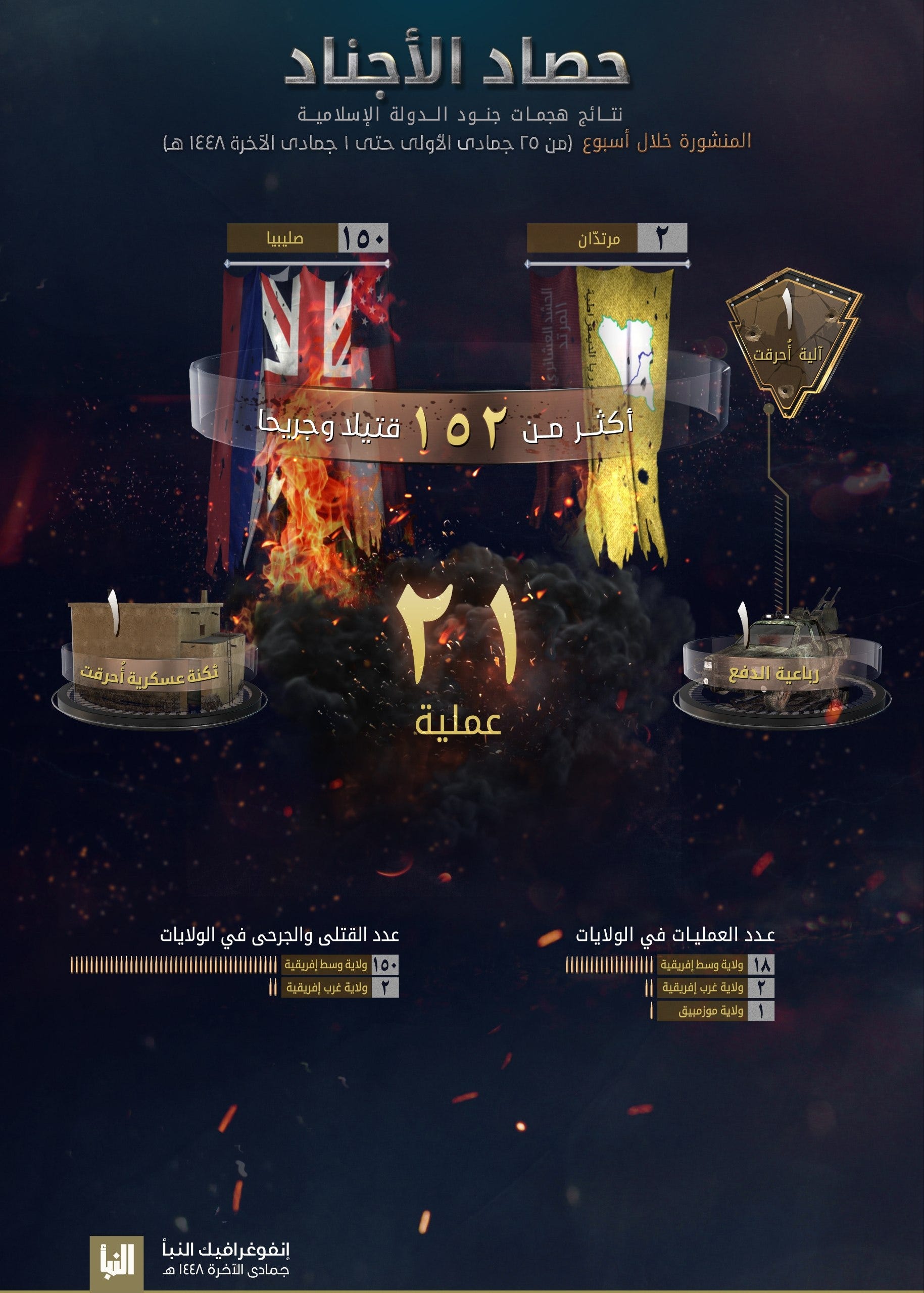
Al-Naba Newspaper, Issue 573, published by the Islamic State’s Central Media Department on 12 November 2026, reported 21 attacks conducted by its fighters between 6 and 11 November 2026 (25 Jumada al-Awwal to 1 Jumada al-Akhirah 1448 AH).
According to the weekly infographic, the attacks were distributed across three Islamic State provinces:
Central Africa Province (ISCAP): 18 attacks.
West Africa Province (ISWAP): 2 attacks.
Mozambique Province (ISMP): 1 attack.
The group claimed more than 152 people were killed and wounded, alongside the destruction of one military barracks and one four-wheel-drive vehicle.
Editorial: “He Has Chosen You”
The editorial, titled “He Has Chosen You” (Huwa Ijtabakum), presents Islamic State militants as individuals divinely selected to defend and advance the group’s interpretation of Islam. It stresses religious commitment, obedience, perseverance and gratitude, while portraying rival jihadist organisations as having abandoned their original objectives. The article also encourages members to remain committed despite criticism and opposition.
Operational Developments
1. Central Africa Province (ISCAP): 18 attacks
Democratic Republic of the Congo (DRC): 18 attacks.
Al-Naba reported a series of operations across eastern DRC, particularly in the Beni and Lubero areas of North Kivu Province and Ituri Province.
In Beni, Islamic State claimed attacks against Congolese military positions and predominantly Christian communities, including an assault on a military barracks in Mabanga and an attack in Kantine, where the group claimed to have killed at least 60 civilians. The latter operation reportedly involved the destruction of more than 200 houses, approximately 30 motorcycles and a vehicle.
In Lubero, the group reported attacks and abductions in several villages, including Mabiolo, where it claimed 21 fatalities, alongside further operations around Kambau and other settlements.
In Ituri, the Islamic State claimed raids against villages and civilians, including operations around Kabotembo and Dongoma, reporting additional fatalities and the burning of residential properties.
Across these operations, the group claimed approximately 150 fatalities, the destruction of around 250 houses and the displacement of thousands of residents.
2. West Africa Province (ISWAP): 2 attacks
Nigeria: 2 attacks.
Borno State: The Islamic State claimed an attack against a Nigerian Army position in Goniri, reporting that soldiers withdrew and that its fighters seized a mortar, a rifle and a motorcycle.
Adamawa State: The group reported a separate attack against a Nigerian Army position in Gandi, near Aba, claiming to have wounded several soldiers.
3. Mozambique Province (ISMP): 1 attack
Mozambique: 1 attack.
Cabo Delgado Province: Islamic State reported a raid against Minguiliwa village in the Muidumbe district, claiming that residents fled and that its fighters seized property. The publication also referred to five attacks conducted during the previous reporting period in the Mueda and Muidumbe districts, which it claimed had resulted in 14 fatalities. These earlier operations are not included in the current weekly total.
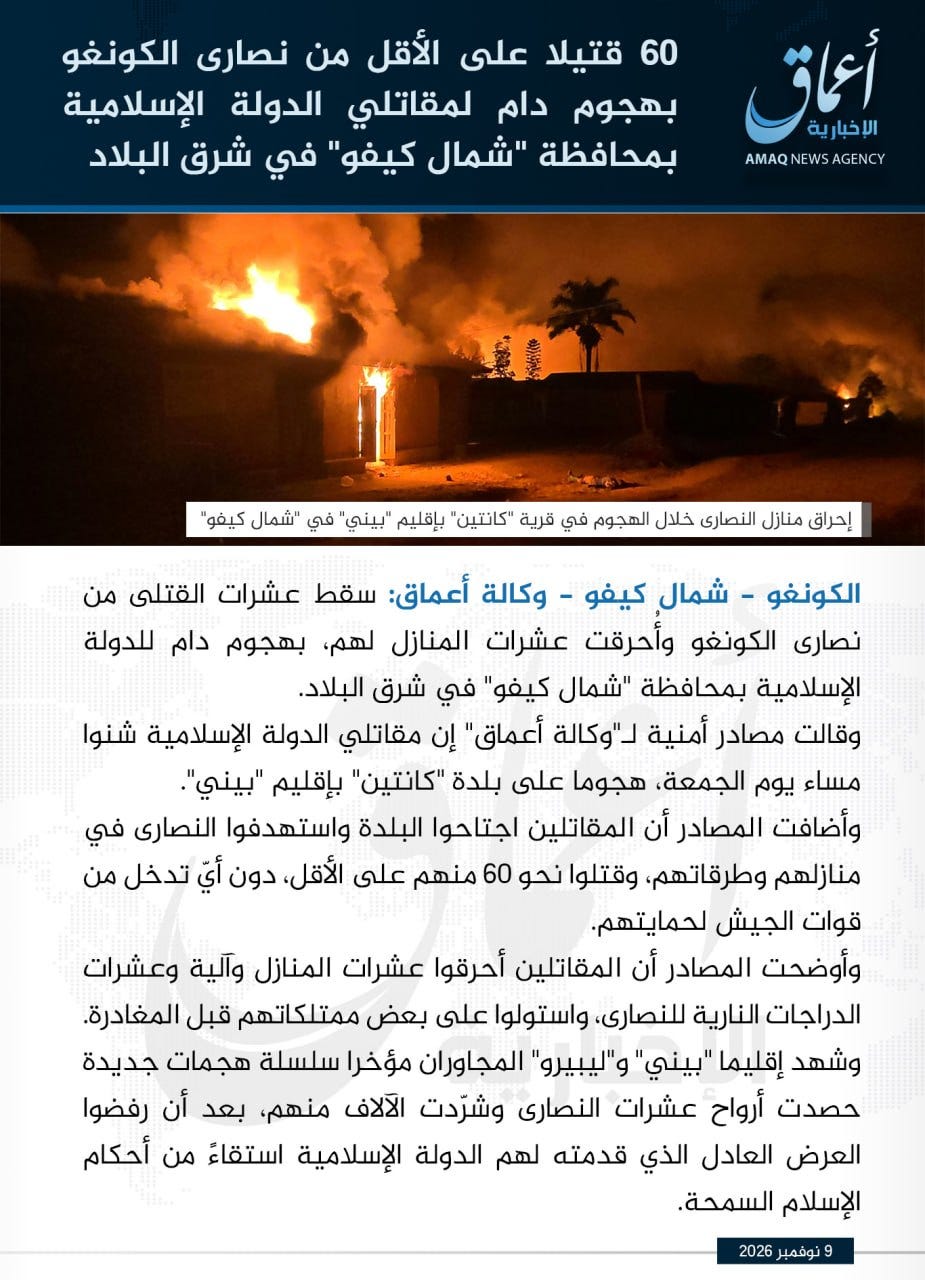
Amaq News Agency, official media of the Islamic State (IS), released a report on 9 November 2026 claiming that ISCAP fighters killed at least 60 Christians during an attack on Katine village, Beni Territory, North Kivu Province, eastern Democratic Republic of the Congo (DRC).
According to Amaq, IS fighters attacked the village on the evening of 6 November, targeting residents in their homes and on local roads. The group claimed to have killed at least 60 people, burned dozens of houses and motorcycles, and seized property before withdrawing.
Amaq also claimed that Congolese Army forces did not intervene during the attack. The report linked the incident to a series of recent IS attacks in the neighbouring Beni and Lubero territories, which the group claimed had caused additional casualties and displaced thousands of residents.
Independent Jihadist Groups
Ittehad-ul-Mujahideen Pakistan (IMP), a Pakistani jihadist organisation comprising the Hafiz Gul Bahadur Group (HBG), Lashkar-e-Islam and Harkat Inqilab-e-Islami Pakistan (HIIP), released 8 statements between 8 and 15 November 2026, claiming 10 distinct attacks.
Targets: Pakistan Army and Pakistan Police.
Areas: North Waziristan district, South Waziristan district, and Lakki Marwat district, in Khyber Pakhtunkhwa Province, Pakistan.
The claimed operations included attacks on military posts, sniper fire, an assault involving a rocket-propelled grenade, and an attack on a police post. IMP also released photographs purporting to show weapons and ammunition seized during the 8 November operation in South Waziristan.
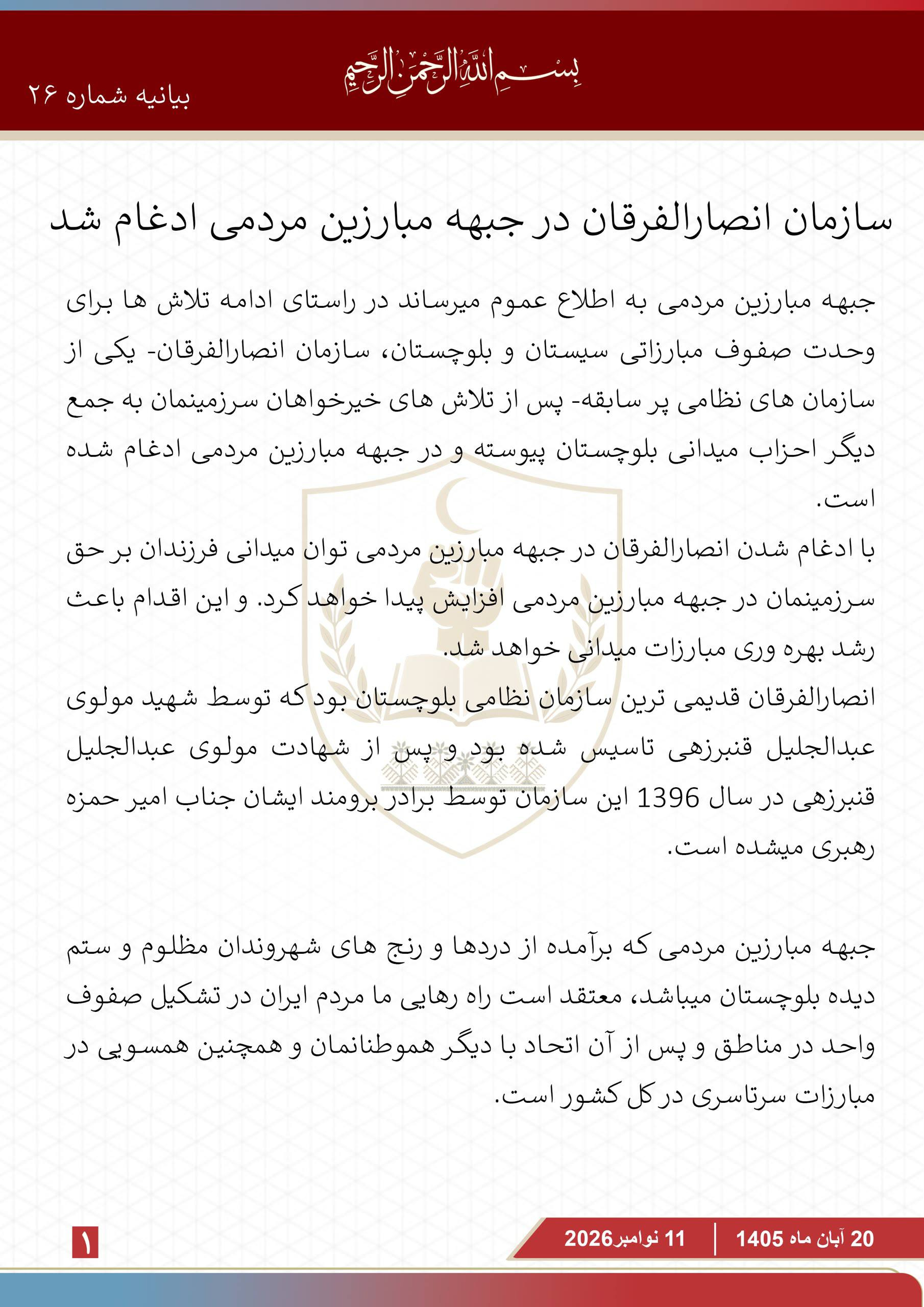
The People’s Fighters Front (PFF), also known as Jebhe-ye Mobarezin-e Mardomi (JMM), an Iranian Baluch armed coalition, released its 26th official statement on 11 November 2026, announcing the integration of Ansar al-Furqan, a Baluch Sunni jihadist organisation, into its ranks.
According to the statement, the integration followed discussions aimed at unifying armed groups operating in Sistan and Balochistan Province, southeastern Iran. The PFF claimed that the merger would strengthen its operational capabilities and expand its armed presence.
The statement also outlined Ansar al-Furqan’s organisational background, identifying Abdul Jalil Qanbarzehi as its founder and Amir Hamza, his brother, as the leader who subsequently headed the organisation.
However, Ansar al-Furqan subsequently clarified that the merger did not involve the entire organisation. According to the group, only one faction agreed to join the PFF, while the faction led by Amir Fares Baloch rejected the integration.
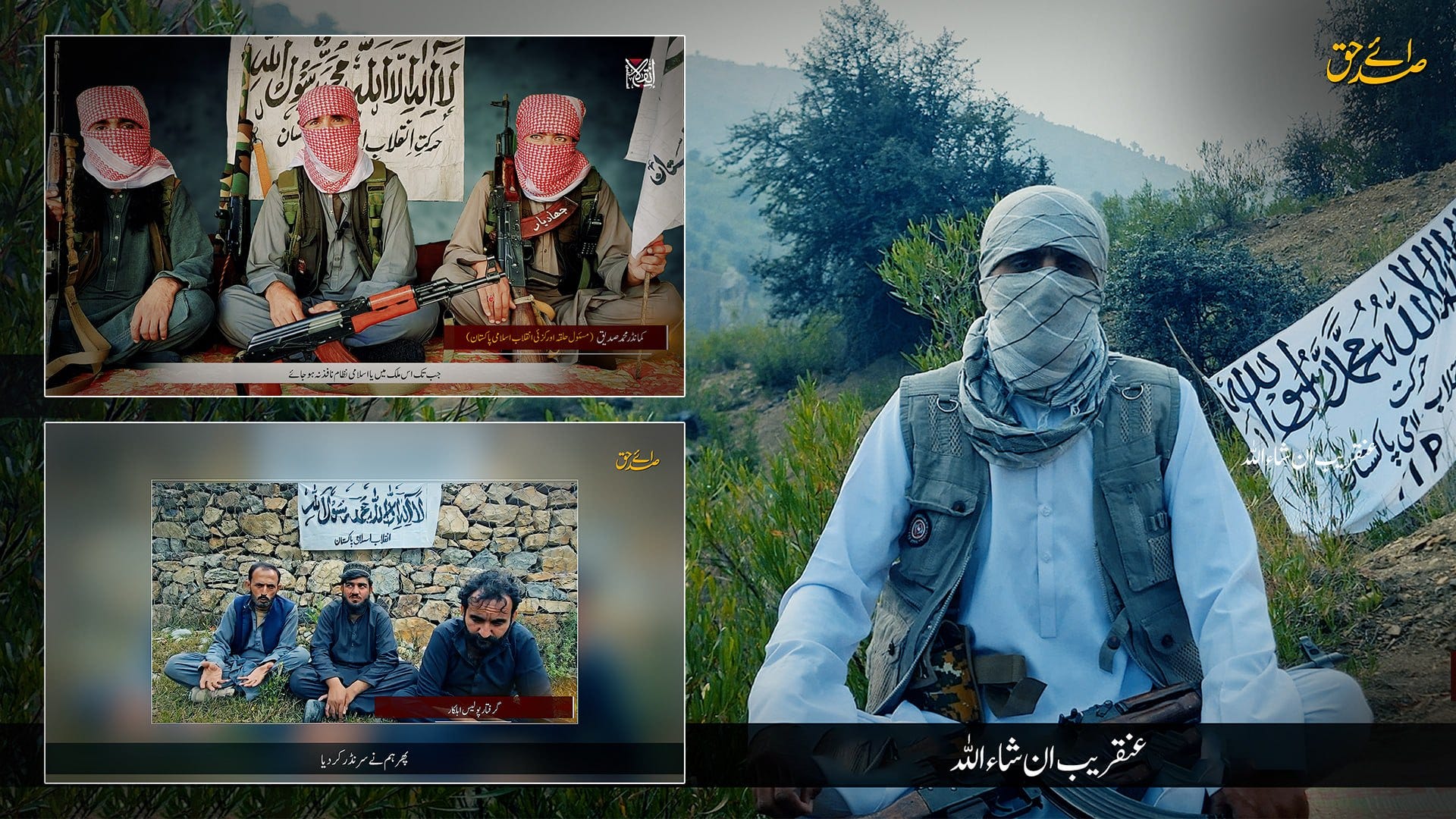
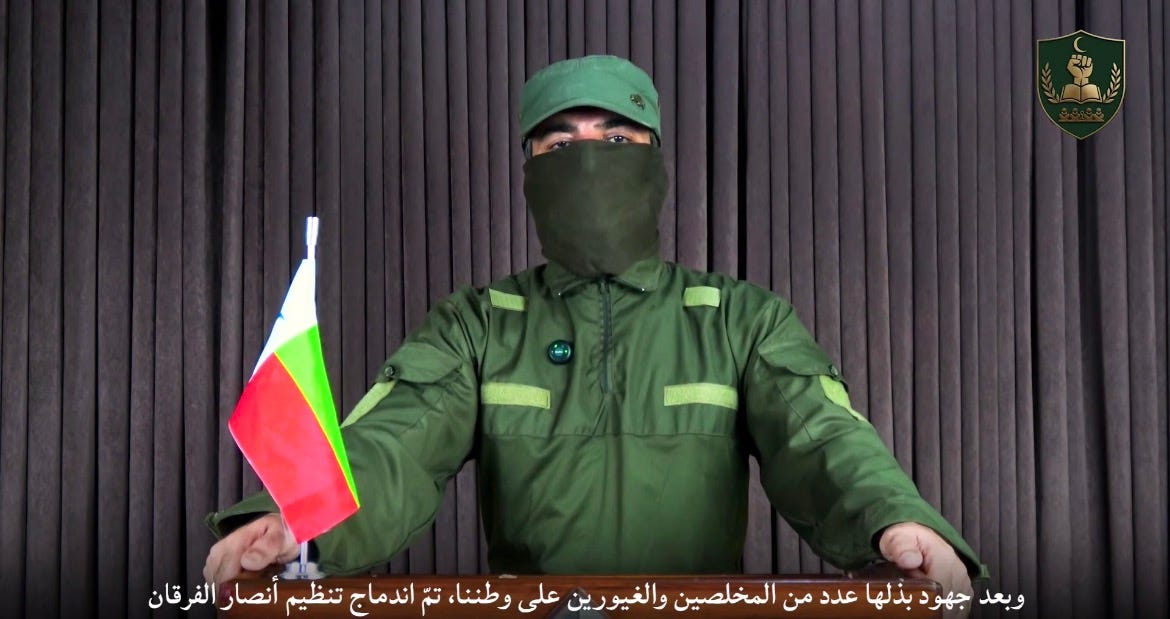
The People’s Fighters Front (PFF), also known as Jebhe-ye Mobarezin-e Mardomi (JMM), released a 3-minute, 24-second video announcing the integration of members of Ansar al-Furqan, a Baluch Sunni jihadist organisation, into its coalition.
The footage features a masked speaker in military-style clothing, standing beside a Baluch flag, delivering a statement about the integration. The announcement forms part of the PFF’s efforts to consolidate armed Baluch factions operating against Iranian authorities in Sistan and Balochistan Province. Iran
However, Ansar al-Furqan disputed the implication of a full organisational merger, saying only part of its membership had agreed to join the PFF. The faction led by Amir Fares Baloch reportedly rejected the merger, indicating that Ansar al-Furqan remains divided over the decision.
🔹Weekly Strategic Assessments
The latest monitoring period highlights three developments of particular significance: the continued geographical reach of JNIM and al-Shabaab, the growing concentration of Islamic State violence in eastern Democratic Republic of the Congo, and the emergence of competing claims concerning the consolidation of Baluch armed factions in southeastern Iran.