


Executive Intelligence Overview
This weekly strategic intelligence report documents and summarises jihadist propaganda and military activities from 1 to 7 October, highlights recent developments in the threat, and provides a structured overview of the situation across various organisations and operational theatres.
This report emphasises operational claims and objectives, especially their focus on military targets, to reinforce the strategic importance for threat recognition and motivate policymakers to prioritise threats.
This report emphasises threat trend analysis to help analysts and policymakers feel confident in their understanding of the active threat environment and support strategic decision-making.
This publication includes threat assessments and analyses that aim to reassure policymakers of the depth of understanding of groups’ tactics and the dynamic threat landscape.
🔹 Scope of Monitoring
This issue covers all identifiable official and semi-official propaganda from a predefined list of jihadist groups, selected based on operational relevance and threat level during the reference period, to improve situational awareness.
This focus on documentation and structured presentation of firsthand material is intended to help analysts and policymakers feel assured of the data’s reliability for threat assessment.
🔹 Sources & Collection Methodology
This analysis relies exclusively on primary-source propaganda, such as official magazines, videos, photos, statements, claims, and audio recordings, to clearly define the source scope and enhance data reliability for threat assessment.
Official magazines,
Videos,
Photo sets,
Statements and claims of responsibility,
Audio statements.
The team collects and categorises material by organisation, media outlet, and content type.
The study relies on OSINT, IMINT, SOCMINT, and Digital HUMINT collection streams.
No secondary reporting, media commentary, or interpretative overlay is applied.
🔹 Analytical Boundaries & Limitations
Fluctuations in volume, language, or format, such as increased messaging in local dialects, should be interpreted within the broader context of operational tempo, recent events, and known threat indicators to support analysts’ confidence in threat assessments and minimise misinterpretation risks.
They shouldn’t be considered in isolation as indicators of strategic shifts, operational escalation, or changes in intent and capability; instead, they should be integrated within broader intelligence products such as Strategic Threat Outlooks and Cognitive Assessments to support comprehensive threat evaluations. Explain how this integration improves overall threat understanding for strategic decision-making.
Strategic shifts,
Operational escalation,
Intent or capability changes.
All higher-order analytical interpretation is conducted separately within:
Intelligence Briefs,
Strategic Threat Outlooks,
Cognitive and Information Domain Assessments.
🔹 Monitored Propaganda Output and Weekly Strategic Assessments
This issue includes all primary propaganda material released during the week by:
Al-Qaeda and affiliates
JNIM
Al-Shabaab
Pro-AQ media channels (Al-Bayan Newspaper - Weekly Issue)
Islamic State
Al-Naba Newspaper (weekly Issue)
Official IS media channels.
Independent Jihadist Groups
Ittehad Mujahidin Pakistan
Tehrik-i-Taliban Pakistan
People’s Fighters Front
The conclusions include the Weekly Strategic Assessments.
Al-Qaeda (AQ)
Az-Zallaqa Media, Jama’at Nasr al-Islam wal Muslimin (JNIM), issued 9 statements and 9 photos, claiming 14 attacks.
The targets included the Malian Army, the Dozo militia, the Russian PMC Africa Corps, the Burkinabé Army, and the VDP militia.
The areas of the attacks were :
1) Burkina Faso = 8
- Mouhoun province, Sanmatenga province, Yatenga province, Boulgou province, Loroum province.
2) Mali = 4
- Koulikoro region, Mopti region, Segou region;
3) Niger = 1
Tillabéri Region.
The Shahada News Agency, Harakat al-Shabaab al-Mujahidin (AS), released 7 statements claiming responsibility for 17 attacks.
The targets of the attacks were:
The targets included the Somali Army, Somali pro-government militias, the Ugandan Army, the Burundian Army, the Ethiopian Army, and the Kenyan Army.
The areas affected by the attacks were:
1) Somalia = 15
Afgooye area, Lower Shabelle region;
Wajid area, Hudur area, Bakool region;
Harardhere–Elhur road, Mudug region;
Tredishi area, Darussalam area, Aylasha area, Mogadishu outskirts, Banaadir region;
Bal’ad area, Middle Shabelle region;
Jalalaqsi area, Hiiraan region;
El Wak area, Gedo region.
2) Kenya = 2
Fafi area, Garissa County.
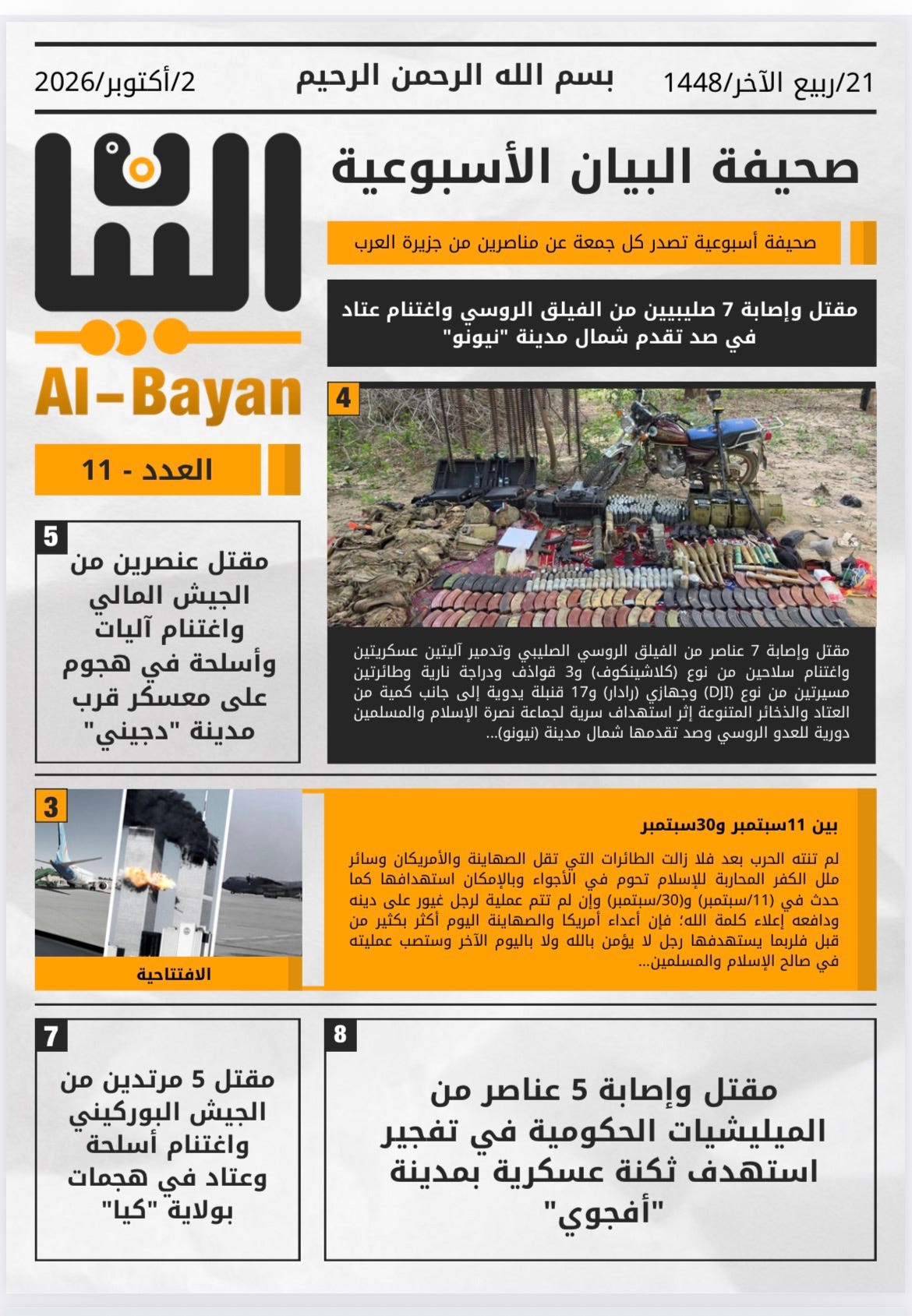
The eleventh issue of the weekly Al-Bayan, published by the pro-Al-Qaeda (AQ) media outlet Al-Yaqin and spanning 17 pages, features the usual infographic summarising the previous week’s attacks, religious messages, and photographic evidence of Al-Shabaab and JNIM activities; however, it also includes editorials that are particularly noteworthy compared to issue No. 10. This issue is of special interest because a significant portion of its analysis focuses on Somalia and the potential scaling back of the international security architecture. In contrast, the editorial revisits the global war against the United States and its allies. The first editorial, titled “Between September 11 and September 30,” draws a parallel between September 11, 2001, and September 30, 2026 (the date of the final withdrawal of US and allied forces from Iraq and and the attempted hijacking of the FlyDubai flight). ). The accompanying image explicitly links three scenes: the United States in September 2001, Iraq in September 2026, and Saudi Arabia in September 2026. The core propaganda argument posits the continuity of the jihadist war against the United States and its partners, twenty-five years after 9/11.
Al-Bayan argues that the United States invaded Iraq and Afghanistan to eliminate jihadism, but achieved the opposite result: jihadist mobilisation expanded in scope, spreading from Afghanistan and Iraq to Africa and other theatres of conflict.
The text explicitly cites historical Al-Qaeda figures such as Abu Musab al-Zarqawi, using them to construct an ideological lineage connecting the post-2003 Iraqi insurgency with contemporary jihadist groups. The fundamental message is therefore one of generational resilience: according to al-Bayan, the United States can eliminate leaders, strike organisations, and wage military campaigns, but it cannot eliminate the ideology and regenerative capacity of jihadism.
This is a significant framing, as the publication attempts to present jihadist activities across different organisations and theatres as components of a single, transgenerational war.
The core of the issue, however, is the second editorial, “The Future of Security in Somalia.” This is the most important section of issue No. 11 and spans several pages. Al-Bayan addresses the future of AUSSOM and the United Nations Support Office in Somalia (UNSOS).
The starting point is the possibility that Washington might reduce or halt its contribution to the UN funding mechanism that provides logistical support for the African mission. UNSOS is not a combat force; rather, it provides essential infrastructure for African forces, including food, fuel, transport, medical care, evacuation, aviation, communications, and technical support. The implications are significant: the crisis concerns not merely the number of African troops remaining in Somalia, but the material capacity to keep them operational. Al-Bayan highlights the progressive scaling back of the international presence: the African contingent has reportedly dropped from approximately 22,000 troops in the middle of the last decade to around 12,000 today, even as financial difficulties mount. The magazine insists that AUSSOM has not achieved full operational capability and that Somali forces, despite growth in both numbers and quality, are not yet capable of rapidly taking over all the functions performed by African forces.
Deficiencies extending beyond mere troop numbers are highlighted: sustained funding, transport, logistics, intelligence, medical evacuation, communications, maintenance, and command-and-control. This is arguably the most analytically significant point in the entire issue: the risk of territorial vacuums that al-Shabaab could exploit. The article argues that an insufficiently coordinated withdrawal could create security vacuums that al-Shabaab could immediately exploit.
Specific attention is drawn to sensitive areas in southern and central Somalia, particularly Lower Shabelle, Middle Shabelle, and Hiraan. Al-Bayan cites past instances where positions abandoned by African forces subsequently fell under al-Shabaab’s control. The issue, therefore, is not merely the loss of bases, but the potential for the group to exploit the withdrawal to increase its freedom of movement, control roads and smaller towns, ramp up pressure on key logistical routes and urban centres, expand taxation systems, and generate new revenue streams. Lower Shabelle is of particular importance, described as an area where a potential vacuum could lead to rapid operational consequences. Al-Bayan naturally emphasises the aspects of the analysis most favourable to al-Shabaab.
The group could benefit from:
1. the abandonment or weakening of certain military positions;
2. reduced logistical capacity among African forces;
3. the difficulty Somali forces face in rapidly replacing them;
4. greater freedom of movement;
5. increased pressure on Lower Shabelle, Middle Shabelle, and Hiraan;
6. the opportunity to expand taxation and control over lines of communication;
7. the fragmentation of the security system among various international partners.
However, the text also implicitly acknowledges a significant limitation: al-Shabaab is not automatically capable of turning every international withdrawal into permanent territorial control. Much will depend on Somali forces’ ability to occupy and hold the positions handed over to them.
Islamic State (IS)
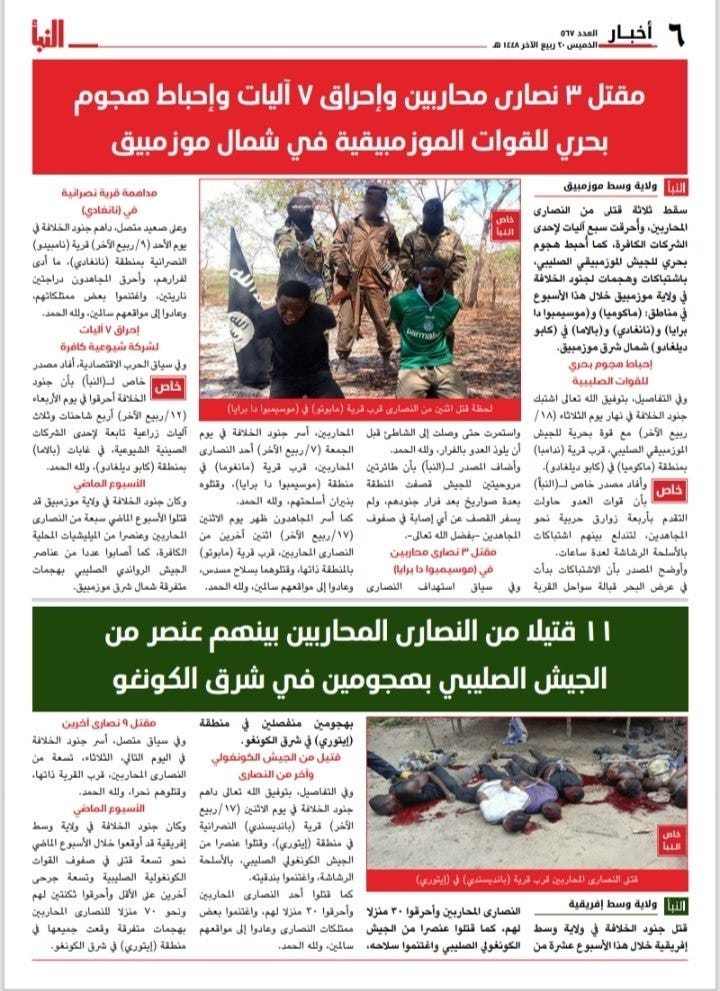
The Islamic State’s official media published the weekly al-Naba this week (566). Issue 566, eight pages long, covers the week of 13–19 Rabi al-Thani 1448 AH (24- 30 September 2026). The main infographic summarises the areas affected by military operations this week, including:
Nigeria, Pakistan, Mozambique, Cameroon and the Democratic Republic of Congo.
IS claims to have conducted 23 operations in all the mentioned areas and to have caused 110 deaths and injuries.
1) West African Province: The weekly al-Naba reports that ISWAP militants carried out 12 attacks: 10 against checkpoints, convoys, patrols, and camps of the Nigerian army and pro-government militias in the states of Borno, Yobe, and Adamawa in Nigeria; 2 attacks against the Cameroonian army in the Maroua area, in the Far North region of Cameroon.
2) Sahel Province: The weekly newspaper al-Naba reports that IS-Sahel militants carried out 2 attacks against a Nigerien army outpost and a convoy in the Tahoua and Tillaberi regions of Niger.
3) Central African Province: The weekly newspaper al-Naba reports that ISCAP militants carried out 2 attacks, one against a Congolese army checkpoint and one against a Christian village, in Ituri Province, in the Democratic Republic of the Congo.
4) Mozambique Province: The weekly al-Naba reports that ISM militants carried out 5 attacks against patrols (including a naval patrol) of the Mozambican Army, patrols of pro-government Christian militias, an attack on a Christian village, and finally an “economic warfare” attack against a Chinese Company (destruction of the company and the burning of four trucks and three pieces of Chinese agricultural machinery). The attacks took place in the districts of Mocímboa da Praia, Balama, Nangade, and Macomia, in the province of Cabo Delgado, Mozambique.
5) Pakistan Province: The weekly al-Naba reports that Pakistani militants carried out 2 attacks against Pakistani intelligence officials and agents in the districts of Bajaur and South Waziristan, in the Khyber Pakhtunkhwa Province, Pakistan.
Independent Jihadist Groups
Ittehad-ul-Mujahideen Pakistan (IMP), a Pakistani jihadist organisation comprising the Hafiz Gul Bahadur Group (HBG), Lashkar-e-Islam and the Harkat Inqilab-e-Islami Pakistan (HIIP), released 8 statements, claiming 10 attacks.
Targets: Pakistan Army, Frontier Corps (FC), Pakistan Police, Gilgit-Baltistan Scouts, Special Security Unit (SSU), and Peace Committee.
Area:
North Waziristan district, Khyber district, Orakzai district, in Khyber Pakhtunkhwa Province, Pakistan.
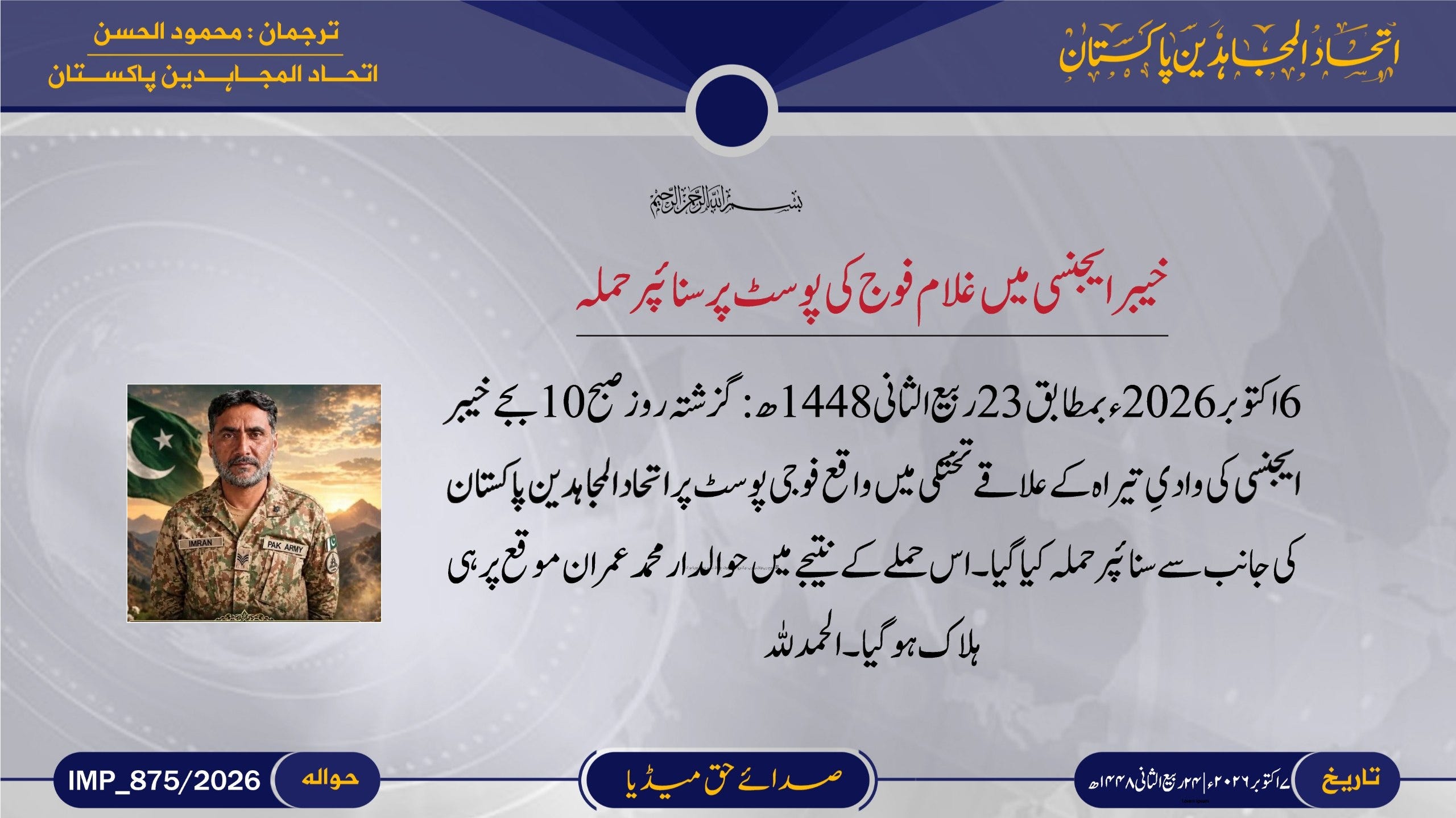
Ittehad-ul-Mujahideen Pakistan (IMP) released a 3:01-minute video showing several ambushes on Pakistani Army patrols and convoys in the North Waziristan district of Pakistan.
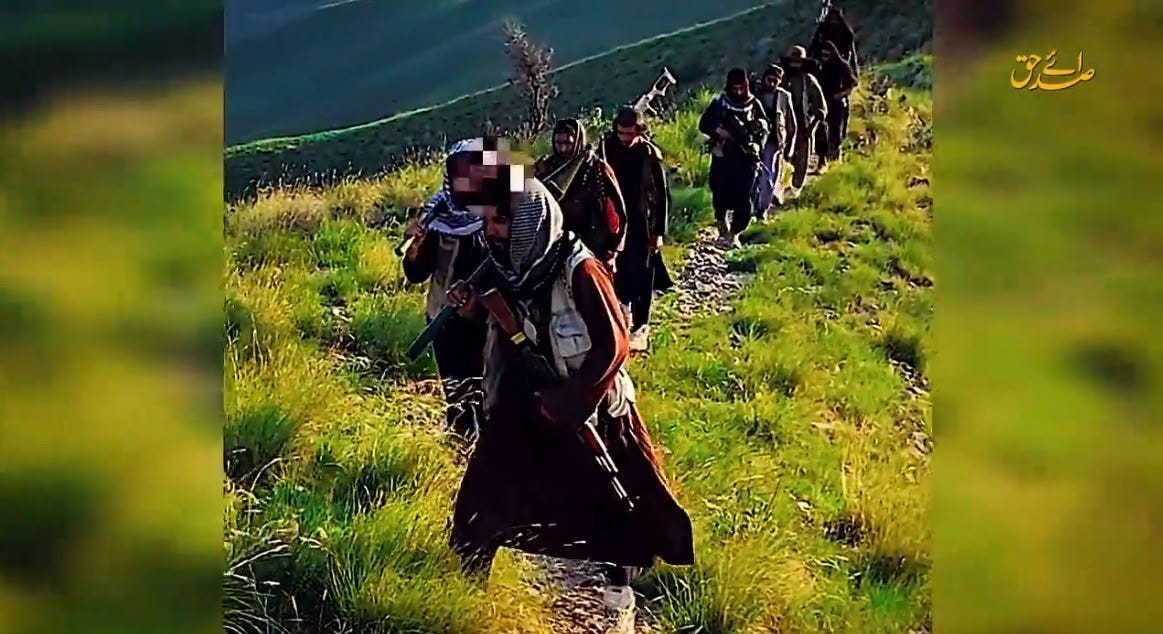
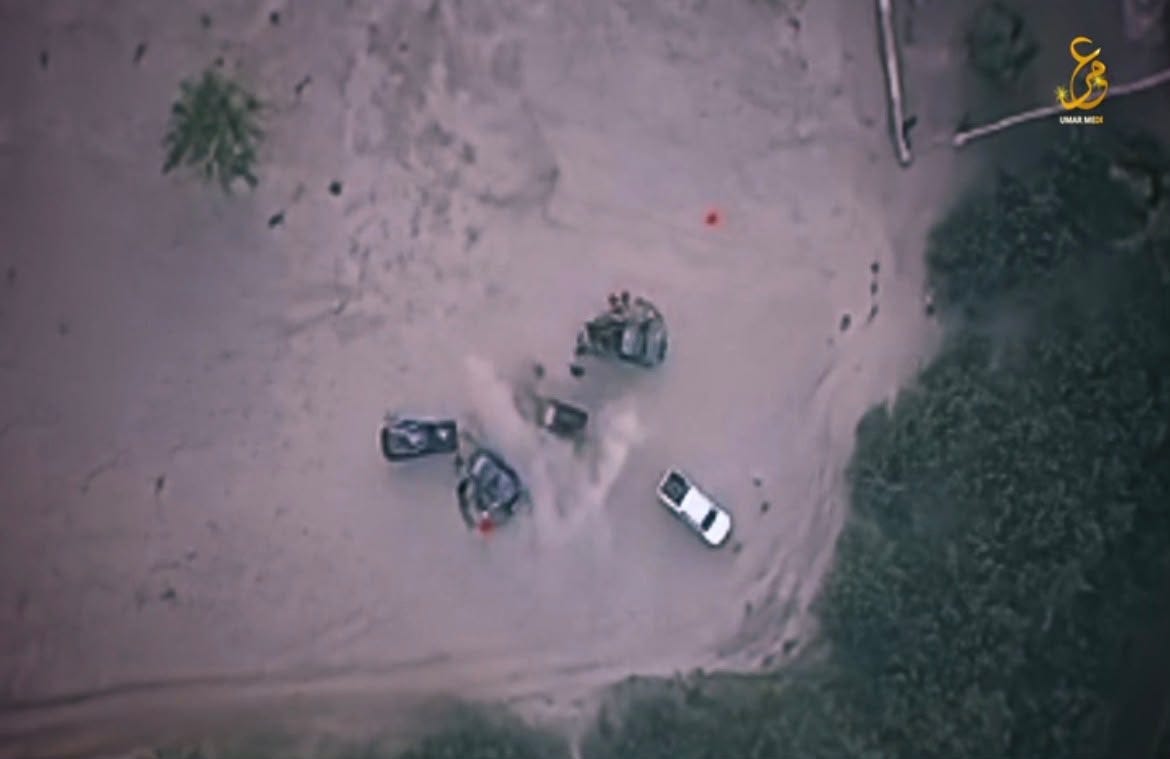
Umar Media, Tehrik-i-Taliban Pakistan (TTP), released a video lasting approximately 3 minutes and 50 seconds showing four drone strikes targeting an SSG command post and Pakistani Army positions, and two car bomb attacks targeting a CTD command centre, in the districts of Peshawar and North Waziristan, Pakistan.
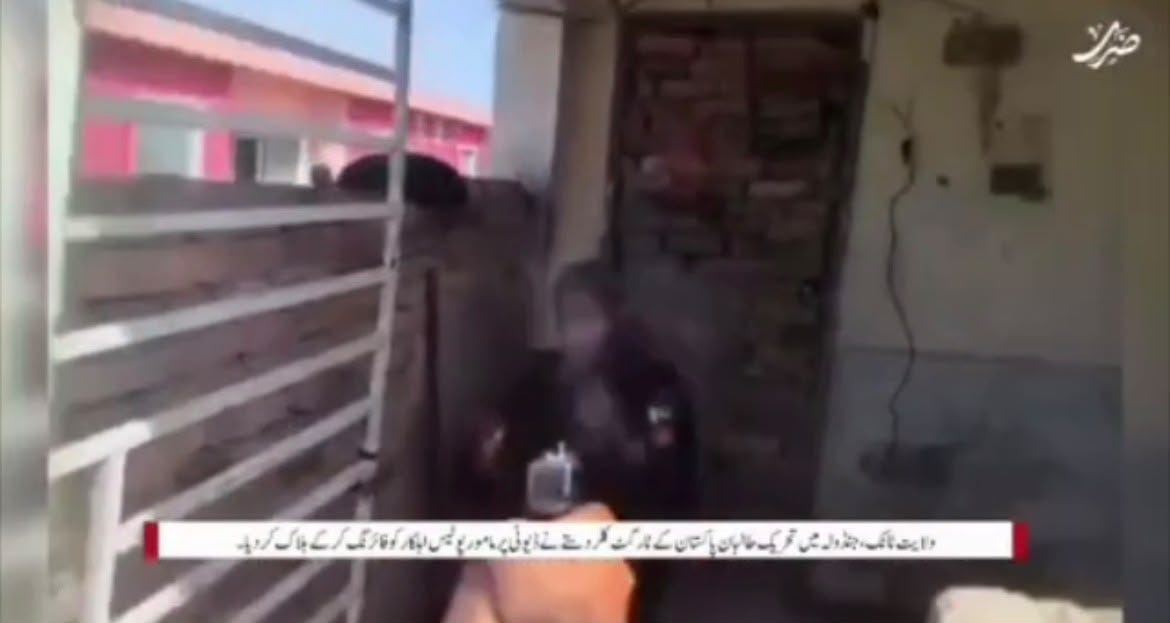
Umar Media, Tehrik-i-Taliban Pakistan (TTP), released a video lasting about 20 seconds showing the killing of a Pakistani police officer in Tank District, Pakistan.
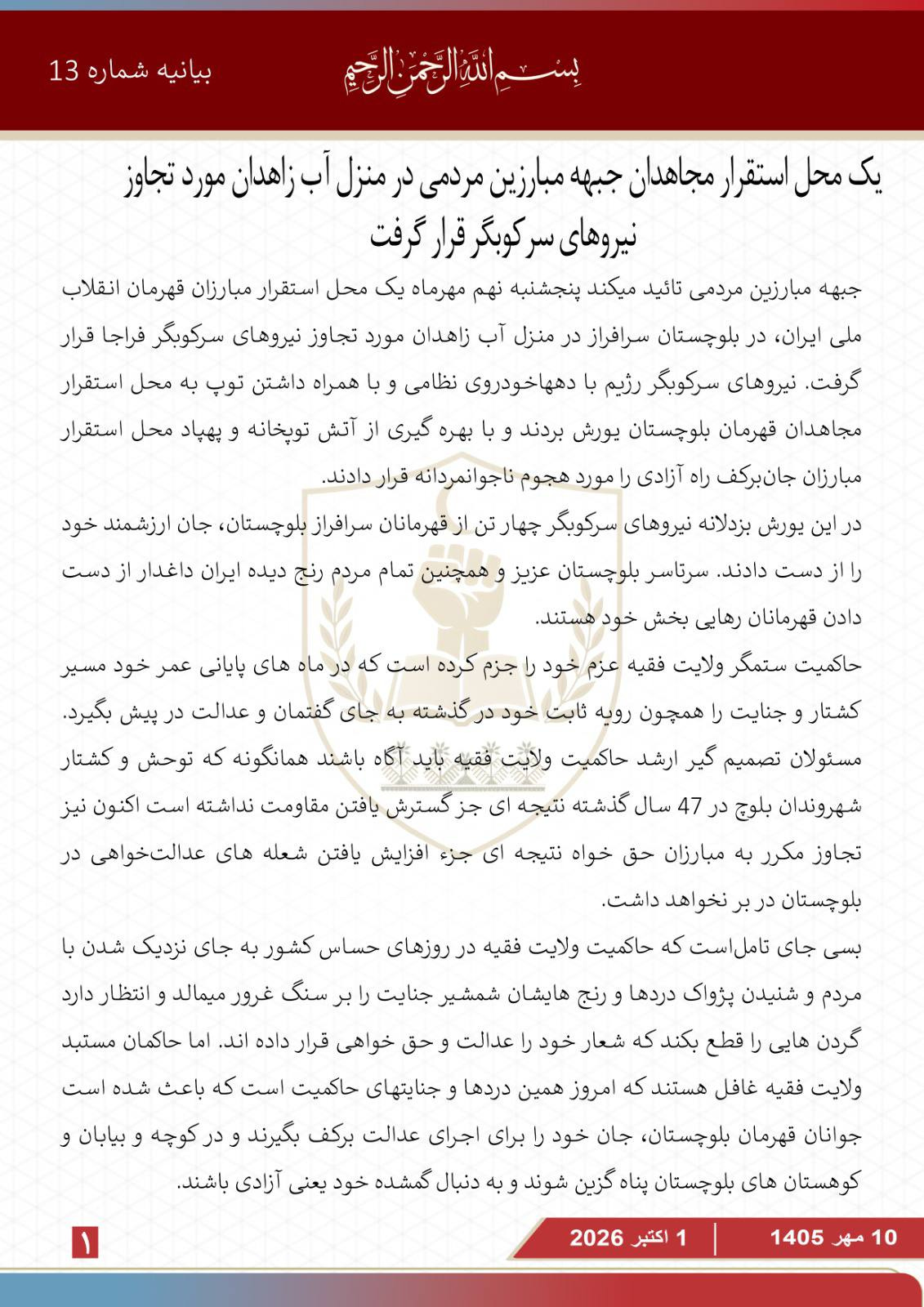
The People’s Fighters Front (PFF), also known as Jebhe-ye Mobarezin-e Mardomi (JMM), an Iranian Baluch jihadist coalition, released 4 statements reporting 4 armed incidents, including 2 attacks initiated by the group and 2 engagements following Iranian security-force assaults, between 1 and 7 October 2026.
The targets included Iran’s Islamic Revolutionary Guard Corps (IRGC), IRGC-affiliated Fatemiyoun militia personnel, and Iranian government security forces.
The areas affected by the incidents were:
1) Iran = 4
Manzelab area, Saravan County;
Rudmahi area, Zahedan County;
Parud area, Rask County;
Bampur–Iranshahr road, Iranshahr County.
All four incidents occurred in Sistan and Baluchestan Province, southeastern Iran.
🔹Weekly Strategic Assessments
The latest monitoring cycle reveals a jihadist operational environment characterised by relative continuity in the principal Al-Qaeda-affiliated insurgencies, renewed geographic concentration within Islamic State’s African provinces, and increasingly differentiated forms of military and political communication among independent jihadist organisations.
