


🔹Abstract
Between late October and early November 2025, the al-Qaeda-linked media ecosystem produced a series of content outlining a growing and coherent hostile narrative toward the United Arab Emirates (UAE). In particular, al-Qaeda in the Arabian Peninsula (AQAP) and al-Qaeda in the Indian Subcontinent (AQIS), through their respective official media outlets Al-Malahem Media and As-Sahab Subcontinent, developed convergent messages presenting the UAE as a central and morally responsible actor in an alleged regional architecture of violence, repression, and international complicity.
The analysis examines how two media products with different languages and audiences—AQAP’s video on the conflict in Sudan and AQIS’s Nawai Ghazwa-e-Hind magazine—converge toward a common strategic objective: the delegitimisation of the UAE by bridging multiple crisis theatres, particularly Sudan (Darfur/El-Fasher), Yemen, and the normalisation process with Israel.
AQAP favours highly emotional communication, grounded in moral shock and the urgency of action, while AQIS adopts a pseudo-analytic register that mimics the language of security and international relations, making the narrative more palatable to educated and diasporic audiences.
The paper argues that this convergence is not a simple propaganda episode, but rather a deliberate process of narrative targeting, aimed at transforming the United Arab Emirates from a legitimate political actor into an ideologically justified target. The resulting threat is predominantly cognitive and reputational in nature in the short term, but it creates the conditions for a possible operational escalation in the medium term, especially in regional contexts characterised by high security fragility. Understanding this dynamic is essential to correctly assess contemporary jihadist risk and to develop effective responses that integrate security, diplomacy, and information management.
Methodology and analytical approach: This work is based on an intelligence-driven methodological approach, founded on the direct analysis of primary sources produced by jihadist organisations themselves, particularly official media materials attributable to al-Qaeda in the Indian Subcontinent (AQIS) and al-Qaeda in the Arabian Peninsula (AQAP). The objective was not to interpret such content through the filter of secondary literature, but rather to examine it as operational objects, intentionally produced to influence the perceptions, orientations, and behaviours of specific audiences.
The methodology adopted integrates elements of continuous monitoring, IMINT (Imagery Intelligence), digital HUMINT, and qualitative discourse analysis, following a logic typical of studies applied to security and counterterrorism. The materials analysed include editorial products (digital magazines), official videos, posters, textual statements, and graphic materials distributed through the official media channels of the organisations examined. These materials were treated as authentic primary sources, attributed based on branding elements, established distribution channels, and stylistic consistency with previous productions.
The absence of traditional bibliographic references or footnote citations is not due to a lack of documentation, but rather to a methodological choice consistent with the nature of the work. This study is not intended as a theoretical review or an analysis mediated by secondary journalistic or academic sources, but rather as an exercise in analytical exploitation of original materials produced by hostile non-state actors. In the field of applied intelligence and security studies, these materials are not “cited” in the traditional academic sense, but are analysed, decomposed, and interpreted as operational evidence.
The IMINT analysis focused specifically on the visual elements of the examined products: image composition, iconographic choice, recurring symbols, time markers, graphic layout, use of colours and contrasts, as well as the relationship between images of suffering, combat, and ideological legitimacy. These elements were considered an integral part of the message and not mere aesthetic supports, in line with the evolution of jihadist propaganda towards highly strategic forms of visual communication.
At the same time, the digital HUMINT approach allowed the materials to be placed within their communication ecosystem: publication frequency, temporal synchronisation between products from different organisations, linguistic adaptation to specific audiences (Arabic and Urdu), and consistency with previously observed narratives. Attention was not focused on individual pieces of content, but on the production and release pattern, considered indicative.
Methodology and Analytical Approach
This study adopts an intelligence-driven analytical approach, grounded in the direct examination of primary-source materials produced by jihadist organisations themselves. The analysis is based exclusively on official media outputs attributable to al-Qaeda in the Indian Subcontinent (AQIS) and al-Qaeda in the Arabian Peninsula (AQAP), treated as operational artefacts intentionally designed to influence perceptions, judgments, and behaviours of specific target audiences.
Rather than interpreting these materials through the lens of secondary academic or journalistic literature, the study approaches them as strategic communication products, embedded within a broader ecosystem of jihadist media production. The objective is not to assess the factual accuracy of the claims advanced by these organisations, but to analyse their narrative construction, communicative intent, and security-relevant implications.
Methodologically, the analysis integrates elements of continuous monitoring, IMINT (Imagery Intelligence), digital HUMINT, and qualitative discourse analysis, in line with established practices in applied security and counterterrorism studies. The corpus includes digital magazines, official videos, posters, textual statements, and graphic materials disseminated through recognised official media outlets. Attribution is based on consistent branding, established distribution channels, and stylistic continuity with previous productions.
Visual analysis (IMINT) focuses on compositional choices, iconography, symbolic references, temporal markers, and the relationship between imagery of suffering, combat, and ideological legitimacy. These visual elements are treated as integral components of the message rather than as secondary or aesthetic features.
The digital HUMINT component situates individual products within their broader communication ecosystem, examining publication timing, synchronisation across different al-Qaeda affiliates, language adaptation to specific audiences (Arabic and Urdu), and narrative continuity over time. Emphasis is placed on patterns of production and release, considered more indicative of strategic intent than isolated content items.
Overall, the methodology reflects the logic of threat assessment, with particular attention to narrative targeting, cognitive influence, and the conditions under which communicative hostility may translate into elevated security risk.
Note on the Use of Extremist Material
This study analyses materials produced by jihadist organisations designated as extremist and violent exclusively for purposes of research, monitoring, and defensive threat assessment. All examined content is treated as an analytical object and is critically contextualised within a security and intelligence framework.
No material is reproduced in full, translated verbatim, or presented in a manner that could contribute to dissemination or amplification. The focus remains on understanding communication strategies, narrative mechanisms, and their security implications, in accordance with established ethical standards in the study of violent extremism and counterterrorism.
Note on Analytical Limitations
The analysis is subject to several intrinsic limitations that warrant explicit acknowledgement. First, the study focuses on official communication outputs of the organisations examined and does not include a systematic assessment of audience reception, engagement metrics, or measurable impact in terms of radicalisation and recruitment.
Second, access to some materials was partial, most notably the absence of the full AQAP video content, which constrains fine-grained stylistic and rhetorical analysis in certain respects. Third, the study adopts a qualitative and interpretative perspective, consistent with an intelligence-oriented approach, and does not seek to provide probabilistic estimates regarding the imminence of specific operational actions.
These limitations do not undermine the validity of the assessment, which is based on converging narrative patterns, cross-product consistency, and the strategic coherence of the messaging analysed.
Terminological Note
In this study, the term propaganda refers to communication products deliberately designed to shape perceptions, attitudes, and behaviours, and should not be understood as synonymous with improvised or strategically unstructured messaging.
The concept of threat is employed in a broad analytical sense, encompassing cognitive, reputational, and strategic dimensions in addition to purely operational or kinetic ones.
The term cognitive warfare is used to describe influence operations aimed at shaping the cognitive environment and decision-making processes of individuals and communities, and is distinguished from narrower or episodic forms of disinformation.
Corpus of Materials Analysed
The analysis is based on the direct examination of the following primary materials, attributed to the official media outlets of the jihadist organisations under consideration:
al-Qaeda in the Indian Subcontinent (AQIS)
Nawai Ghazwa-e-Hind, monthly issue for October 2025, published on 7 November 2025.
Media wing: As-Sahab Subcontinent.
Format: Digital magazine (magazine/dossier).al-Qaeda in the Arabian Peninsula (AQAP)
Video titled “Sudan, the Nation’s Forgotten Wound”, released on 7 November 2025.
Two-page statement titled “Statement on the Systematic Crimes of Arab Zionists Against Our Muslim People in Sudan”, published on 8 November 2025.
Media wing: Al-Malahem Media.
Format: Propaganda video accompanied by official poster and textual statement.
All materials were analysed in their original form and treated as authentic primary sources for monitoring, IMINT, digital HUMINT, and intelligence assessment purposes.
Product Profile and Attribution
The analysis of media products attributable to AQIS and AQAP begins not with content alone, but with communicative form as a strategic choice. In both cases, the medium itself is not neutral: it is an integral component of the message and of its intended operational effect.
Contemporary jihadist media products are designed not only to convey specific claims but to structure how those claims are processed cognitively, emotionally, and politically. Format, visual language, pacing, and editorial architecture all contribute to shaping audience perception and legitimising particular interpretive frames.
Accordingly, the following analysis treats AQIS and AQAP media outputs as purpose-built instruments of influence, whose form, tone, and distribution patterns are as analytically significant as their explicit textual content.
Analytical Assessment: Narrative Targeting and Threat Construction
1. AQIS – Nawai Ghazwa-e-Hind (October 2025, published November 7)
The Nawai Ghazwa-e-Hind magazine, published by AQIS through As-Sahab Subcontinent, follows the now-established tradition of “low emotional intensity and high cognitive density” propaganda. Its communicative signature can be effectively described as a combination of an ideological magazine and a pseudo-analytical dossier. This choice is neither casual nor purely aesthetic: it responds to a precise strategic need to normalise the extremist message.

The magazine’s format is designed to make jihadist content reasonable, in the literal sense of the word. Through the use of language reminiscent of geopolitical analysis and international security, AQIS attempts to shift its narrative from militant preaching to rational explanation. Extremism is presented not as a radical ideological position, but as a logical conclusion derived from a seemingly well-documented reading of international reality.
This effect is achieved through a series of recurring rhetorical devices: the systematic use of lists and chronologies, the construction of linear causal connections, references to surveillance technologies, diplomatic processes, and symbols of global governance. The presence of these elements serves less to inform than to establish epistemic credibility. The reader is led to perceive the text not as propaganda, but as a form of “counter-analysis,” an alternative to Western analysis but structurally similar.
The target audience is clearly identifiable. Nawai Ghazwa-e-Hind addresses an educated Urdu-speaking audience, composed of students, professionals, activists, and members of the South Asian diaspora who consume content on geopolitics and security. This audience is wary of loud rhetoric, but can be sensitive to narratives that mimic the language of academia, think tanks, and policy discourse. In this sense, AQIS seeks not so much to radicalise ex novo as to cognitively legitimise already critical or ambivalent positions, offering them a coherent and seemingly sophisticated interpretive framework.
1.2 AQAP – Video and Statement (November 7–8, 2025)
AQAP’s media products released between November 7 and 8, 2025, are at the opposite end of the communication spectrum. Here, the communicative signature is not rationalisation, but immediate emotional mobilisation. The video “Sudan, the Nation’s Forgotten Wound” and the accompanying statement, distributed through Al-Malahem Media, are designed to act quickly on moral and emotional levels.
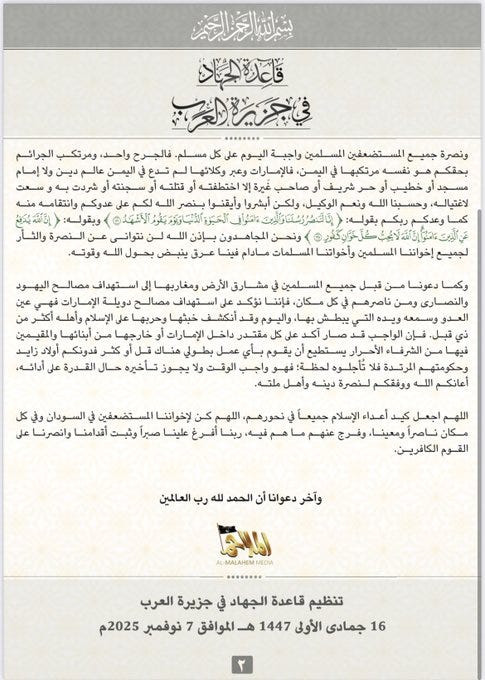
The video’s poster is particularly revealing in this regard. The visual design is explicit and functional: images of civilian suffering, wounded bodies, and faces marked by pain serve to trigger empathy and outrage. These are accompanied by images of combat, which serve a dual function.
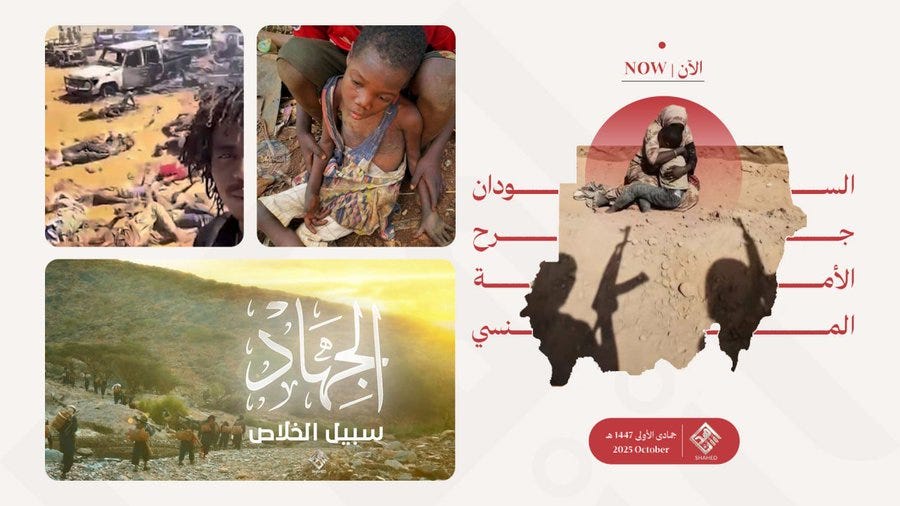
On the one hand, they demonstrate that the organisation is active and capable of action; on the other, they suggest that violence is not a future possibility, but an ongoing response, already legitimised by the facts. There is no room for reflection or political mediation: the message is constructed to transform compassion into urgency and urgency into action. The clear branding and precise timing of the product also indicate a high degree of standardisation, typical of serial campaigns. AQAP does not produce isolated content, but a replicable format, ready to be reactivated whenever a new event can be absorbed into the same narrative framework.
2. Political, geopolitical, and security context of anti-UAE propaganda
The strength of a propaganda narrative depends not only on its internal coherence but also on its ability to connect with real-world contexts characterised by ambiguity, complexity, and suffering. In this case, AQAP and AQIS skillfully exploit a combination of geopolitical factors that makes their framing particularly effective.
2.1 Sudan and El-Fasher as a Catalyst.
The El-Fasher crisis in West Darfur represents an ideal catalyst for jihadist propaganda. First, because of its emotional intensity. The images and stories of civilian casualties, prolonged sieges, starvation, and humanitarian collapse constitute narrative material of enormous symbolic power. Second, the conflict’s intermittent visibility, characterised by peaks of attention followed by long periods of media silence, perfectly fuels the rhetoric of the “forgotten wound.” The argument of international abandonment and indifference thus finds fertile ground, difficult to challenge on an emotional level.
Added to this is the complex information landscape of the Sudanese context. Cross-accusations, alleged external sponsors, official denials, and conflicting reports create an ideal environment for what can be called proof-by-assertion. In such a fragmented framework, propaganda does not need rigorous proof: it simply needs to assert with certainty, fill information gaps, and offer a simple explanation for a complex phenomenon.
AQAP exploits this combination to reduce a multilayered conflict to a linear and morally polarised sequence: there are innocent victims, there are guilty sponsors, there is a complicit international community because it is silent, and therefore there is a moral obligation to act.
2.2 Yemen and STC as an “operational bridge”: from regional narrative to credibility of action
In the propaganda device observed between AQAP and AQIS products, the Yemeni theatre plays a role that goes far beyond simple geographical contextualization. For AQAP, Yemen is an environment that allows for the connection of three essential dimensions of contemporary jihadist communication: moral denunciation, geopolitical plausibility, and demonstration of capability. In this context, the reference to the Southern Transitional Council (STC) and Emirati support becomes an “operational bridge” because it allows the organisation to transform a narrative about a distant conflict, Sudan, into a story that appears immediately verifiable and rooted in a theatre where AQAP still claims a role, at least on a symbolic and media level.
The first aspect to understand is that Yemen represents, for AQAP, a territory of identity continuity. AQAP does not have to “present itself” in Yemen: it has historically constructed itself as an actor in the Yemeni conflict and its fragmentation, and maintains an organisational, real, and propagandistic memory of campaigns, clashes, retreats, and adaptations. In communication terms, this means that Yemen offers a framework in which any content can benefit from a pre-accumulation of credibility: even when the organisation does not permanently control territories or when its operational capacity is compressed by competitors and countermeasures, the AQAP brand continues to be able to represent itself as an actor “in the theatre.” This symbolic permanence is already a resource in itself.
Second, Yemen allows AQAP to build a narrative link between the “macro” and “micro” dimensions. Sudan, in the video, is presented as a humanitarian tragedy and moral proof of a corrupt and indifferent international order. However, to transform indignation into mobilisation, propaganda needs to offer the recipient a signal that action is possible and already underway. This is where Yemen comes in: AQAP can argue that what it denounces in Sudan is reflected in the same pattern of power and interference operating in Yemen. The reference to the STC functions as a narrative translator: it is a local actor, perceived as part of a network of regional alliances and sponsorships, and therefore well-suited to representing the idea of ” proxy” and “indirect intervention.”
This operation has a specific political significance. Discussing the STC allows AQAP to avoid a complex debate on Yemen’s internal dynamics and, above all, to trace the conflict’s fragmentation back to a single organising factor: Emirati influence. In other words, the STC becomes the rhetorical device that allows it to assert that the Emirates are not just a diplomatic actor, but an operational player shaping the conflict through local intermediaries. Thus, blaming the Emirates for events in Sudan no longer appears as a logical leap, but rather as the continuation of a regional pattern already familiar to the target audience.
The third element, and arguably the most important, is that Yemen allows AQAP to build credibility without having to demonstrate large-scale strategic capacity. The video features images of operations against forces associated with the STC, supported by the UAE. At the communicative level, this serves as “narrative evidence”: not necessarily proof in a technical or intelligence-grade sense, but proof in a persuasive sense. The implicit message: The organisation’s motto is: “We don’t just report; we already act against proxies.” In this way, the organisation bridges the gap between word and action, which is a critical factor for mobilisation and recruitment.
This mechanism is particularly effective because Yemen, compared to other contexts, offers a combination of permissiveness and ambiguity. The fragmentation of the territory, the plurality of armed actors, and the complexity of the lines of control make it easier to produce narratives of action and resistance that appear plausible even when the organisation’s actual capacity is limited. In such a fragmented context, the organisation can present selective episodes, clashes, or images as evidence of a broader operational continuity. In terms of propaganda, Yemen is an ideal theatre because it allows action to be shown without having to demonstrate governance.
There is also a further, more subtle but strategically relevant level: Yemen allows for the creation of continuity between the external enemy and the internal enemy. In the AQAP framework, the Emirates represent the external architect or sponsor, while the STC represents the local projection of that architecture. This framework is useful because it allows the organisation to legitimise violent action against a local actor by presenting it as part of a larger conflict. In other words, the violence is not a “civil war” or an intra-Yemeni conflict; it is a form of resistance against a regional project. It is a classic and powerful rhetorical move: it transforms a struggle between local actors into a war of liberation against a structural enemy.
From a threat assessment perspective, this Yemen–STC connection has practical consequences. First, it increases the likelihood that AQAP will continue to prioritise actions and narratives in the Yemeni theatre to demonstrate capabilities and foster recruitment. Second, it makes the expansion of the discourse from “moral guilt” to “necessary punishment” more plausible, because the presence of a local proxy allows the action to be presented as immediately implementable. Third, it allows propaganda to create a bridge to different audiences: on the one hand, sympathisers emotionally involved with Sudan, on the other, audiences already politicised about Yemen and hostile to external interference.
Finally, Yemen’s role as an operational bridge clarifies a fundamental dynamic: AQAP isn’t simply seeking to exploit the Sudanese tragedy for attention. It is seeking to transform that tragedy into a multiplier of legitimacy for its Yemeni agenda and, at the same time, to transform its Yemeni presence into proof of the validity of the transregional narrative against the UAE. Sudan and Yemen are not two separate fronts: in AQAP’s narrative, they become two chapters of the same story, united by the UAE as a sponsor and the STC as a local proxy. It is this connection, more than the single accusation, that makes the frame robust, replicable, and potentially dangerous in terms of radicalisation and mobilisation.
2.3 Normalisation and Symbols: The United Arab Emirates as an “Integrated” Actor in the US-Israel Bloc: The Construction of Guilt According to AQIS
However, it is AQIS that carries out the most profound symbolic work. The cover of Nawai Ghazwa-e-Hind, with the gap in the wall topped by barbed wire and the silhouette of Jerusalem in the background, is a metapolitical message. It communicates that the conflict is unique, that Palestine represents the absolute fulcrum of identity, and that every regional actor must be judged based on its position in relation to that fulcrum.
In this framework, normalisation with Israel becomes a binary criterion of moral classification. Those who normalise are not simply political adversaries, but historical traitors. This framing makes the United Arab Emirates a highly “expendable” narrative target even outside the Gulf, because it places them within a broader, emotionally charged, and transnational story.
In the magazine Nawai Ghazwa-e-Hind, AQIS does not simply assert that the United Arab Emirates “ally” of Israel and the United States. The argument is more sophisticated: AQIS constructs a chain of structural culpability, in which the UAE’s responsibility stems from its alleged integration into a political-security system that the organisation defines as hostile to Islam and Muslims. In other words, the blame is not presented as episodic or tied to a single issue, but as the logical consequence of a choice of sides that, once made, drags the UAE into a series of predictive effects (”if you’re in that bloc, then you’ll do this too”).
The first pillar of this construction is normalisation and the symbolic dimension of the relationship with Israel. AQIS treats normalisation not as a diplomatic act between states, but as an identity fracture: a signal that defines who is inside and who is outside the political and moral community of “authentic Muslims.” This is where propaganda becomes metapolitical. The published magazine features references to symbols and projects presented as icons of normalization and “cultural engineering”: the idea is that the Emirates are not only cooperating with Israel, but are helping to reshape common sense in the Arab-Islamic world, making the relationship with Israel socially acceptable and, by extension, weakening the centrality of Palestine as a source of identity. For AQIS, this isn’t a detail: it’s the original crime that makes everything else plausible.
The second pillar is the UAE-US-Israel partnership as a security architecture, not a simple political triangle. AQIS emphasises elements that recall a “dossier” lexicon: it speaks of technologies, training, intelligence cooperation, and control capabilities, thus making explicit references to surveillance tools and an imagery of advanced security: spyware and interception, biometrics, facial recognition, and monitoring platforms. These references serve not only to denounce internal repression; They serve primarily to demonstrate that the Emirates are a functional partner of the US-Israel bloc, because they have the capabilities and infrastructure to translate the alliance into concrete control.
This point is crucial: AQIS does not want the reader to think of the Emirates as “a state that has made a diplomatic choice.” It wants them to perceive them as an operational node in a system. If an actor becomes an operational node, according to the text’s logic, then it can no longer claim neutrality or invoke pragmatic motivations. It becomes co-responsible by definition, because its function in the system is precisely to enable coercive effects. This is why AQIS insists on technology and surveillance: it is the “material” demonstration that culpability is not only ideological, but infrastructural.
The third pillar is the construction of guilt through proxies and regional projection. In the magazine, the rhetoric tends to stitch together different theatres as if they were chapters of a single project. The Emirates are described as actors capable of intervening indirectly through local partners, militias, allied political forces, and security apparatuses. This representation allows AQIS to create a form of remote accountability: if an action occurs in a peripheral theatre, the UAE can be implicated not by specific evidence but by its “systemic function” (you’re the sponsor, you’re the facilitator, therefore you’re responsible). It’s a powerful narrative attribution technique because it bypasses the need for proof: all that’s needed is for the UAE to have already been defined as a “node.”
At this point, the fourth pillar comes into play: the camouflage of policy language. Nawai Ghazwa-e-Hind uses a register that recalls think tanks, acronyms, and references to Western or pro-Israel institutions and strategic circles. Here, too, the function is not informational in a neutral sense.
From Structural Guilt to Moral Urgency: The Connection Between AQIS and AQAP
The relationship between AQIS and AQAP’s discourse is neither hierarchical nor necessarily operationally coordinated. Rather, it is a functional and complementary one, in which each organisation plays a distinct yet convergent role within the same narrative ecosystem. AQIS constructs guilt, AQAP activates it. AQIS works on the long-term of cognitive legitimation; AQAP operates on the short-term of emotional mobilisation. Together, they transform a political adversary into a morally and symbolically “ready” target.
The starting point is the structural guilt developed by AQIS. In Nawai Ghazwa-e-Hind, AQIS accuses the UAE not for a single act, but for what it represents within a system. The UAE is described as an integrated hub of the US-Israel bloc, a technological and security partner, a regional facilitator, and a promoter of normalisation. This construction has a precise function: to render specific evidence superfluous. Once the UAE is defined as a constituent part of an illegitimate order, any negative event occurring anywhere in the world can logically be traced back to its systemic function.
AQAP enters the picture precisely at this point. The video on Sudan doesn’t need to demonstrate why the Emirates would be involved in the El-Fasher atrocities: that work has already been done elsewhere, on a cognitive level. AQAP can therefore afford an extremely simplified and polarised narrative. The Sudanese conflict, with all its historical, ethnic, and political complexity, is reduced to a morally linear sequence: Muslim civilians suffer, someone supports them or enables them, and the world remains silent. In this scheme, the UAE is already available as a plausible culprit, having been preemptively “prepared” as such by the structural narrative.
This step is crucial: AQAP doesn’t construct guilt; it presupposes it. Its message is not “look at what the Emirates are doing,” but “you already know what the Emirates are, look what’s happening now.” It’s a subtle but crucial difference. Propaganda becomes more efficient because it no longer has to convince, but only activate. Moral responsibility is taken for granted; what remains to be done is to transform it into an obligation to act.
AQAP’s function, in this sense, is to compress time. AQIS works on sedimentation: it reads, rereads, discusses, and normalises the idea that the Emirates are part of an oppressive system. AQAP works on the threshold: it takes that same idea and transforms it into urgency. The marker of urgency, the rhetoric of the “forgotten wound,” the accusation of silence and indifference are not simple rhetorical devices; they are tools of cognitive compression. They serve to eliminate the space between judgment and action, between understanding and participation.
In this mechanism, Sudan plays an ideal role. It’s a distant, complex theatre, little known in detail by most audiences, yet extremely powerful on an emotional level. Precisely for this reason, it can easily be inserted into a pre-existing narrative. AQAP doesn’t need to explain Darfur: it simply needs to show it. The images of suffering, siege, and combat become visual proof that what AQIS has described in structural terms produces real and immediate consequences. Abstract guilt materialises in concrete pain.
The same goes for the reference to Yemen and operations against forces associated with the STC. Here, too, AQAP isn’t simply claiming military action. It’s demonstrating narrative coherence. The implicit message is: “What we denounce isn’t just distant and humanitarian; we’re already fighting it here.” In this way, the organisation presents itself as an actor that doesn’t simply interpret the world, but acts to correct it. Violence is thus normalised as a rational and coherent response to a guilt that has already been demonstrated.
From a mobilisation perspective, this connection is extremely effective because it covers the entire spectrum of radicalisation. AQIS provides the argument for those who want to “understand,” for those seeking a geopolitical explanation, for those wary of purely emotional rhetoric. AQAP provides the shortcut for those who are already convinced or emotionally engaged. Together, they reduce the number of steps needed for an individual to move from frustration to action. It’s not necessary to fully and consciously adhere to ideological principles: simply accept the structural blame and feel the moral urgency.
Another strength of this connection is its replicability. Once the “UAE = guilty node” mechanism is established, any new event—in Sudan, Yemen, Palestine, or elsewhere—can be quickly absorbed into the same pattern. AQIS can update the dossier; AQAP can produce new emotional content.
Threat Assessment and Intelligence Assessment: Intent, Capability, Opportunity, and Risk Profile
Assessing the threat posed by AQIS and AQAP media products requires a clear distinction between three often confused levels: narrative, intent, and actual operational capability. Propaganda is not, in itself, evidence of an imminent attack; however, it is an indicator of priority, cognitive targeting, and potential mobilisation. Within this framework, the most robust approach is to treat content as a signal of strategic orientation and target positioning, and only secondarily as a potential prelude to violent action.
In this specific case, the temporal and thematic convergence between AQIS and AQAP provides clear evidence: the United Arab Emirates is constructed as a central narrative target through a blend of theatres (Sudan, Yemen, Palestine/normalisation) and domains (moral, political, technological, security). This allows for a relatively robust assessment of intent, a more complex assessment of capability, and a biased assessment of opportunity. The analytical value lies precisely in this asymmetry: intent can be estimated with high confidence based on text and images; capabilities and opportunities, on the other hand, require external triangulation (HUMINT/SIGINT, operational trends, security postures, arrest data, and facilitation signals).
Intent, understood as a declared and sustained desire to harm, delegitimise, or strike a target, appears high and consistent. In the AQAP product, the UAE is associated with alleged atrocities in Sudan and support for opposing forces in Yemen; in the AQIS product, the UAE is structurally placed within the US-Israel bloc and portrayed as a technological and security partner of a system perceived as oppressive. In both cases, the narrative doesn’t simply criticise political choices: it tends to deny the actor’s moral legitimacy, shifting the UAE from the status of a political adversary to that of an “illegitimate enemy.” This shift is important because, in jihadist logic, moral delegitimisation is what allows any action to be justified, even in the absence of an immediate casus belli. In intelligence terms, when a target is rendered “morally resolved,” the rhetorical threshold preceding escalation tends to lower: there’s no need to produce new justifications; simply update examples and context.
However, the leap from willingness to capability is not automatic. Capability must be assessed by distinguishing between different types of capabilities: the ability to produce effects in the information domain, the ability to inspire or activate individuals/networks, and the ability to conduct operational actions in specific theatres. From an informational perspective, AQIS and AQAP demonstrate a consolidated capacity for packaging, seriality, and adaptation: AQIS with “dossier” formats and pseudo-analytic vocabulary, AQAP with highly circulated, historically legitimised emotional products. This is a real and already observable capability: producing and disseminating effective narratives is part of these organisations’ strategic arsenal, and in the short term, it is often their most reliable capability.
Kinetic operational capability, however, is more differentiated. In the Yemeni theatre, AQAP can plausibly rely on a more permissive and fragmented environment, where the presence of local actors, the complexity of the lines of control, and the variability of security postures create opportunities that do not exist elsewhere. This does not automatically imply strength or territorial control, but it does imply greater ease in producing actions with local impact and, above all, in transforming them into propaganda “proof.” In this sense, Yemen represents a platform for credibility: even when operational capacity is compressed, the organisation can build an image of continuity of action. Conversely, the operational cost on Emirati soil is presumably higher, due to hardening, internal intelligence capacity, and perimeter control. This results in an asymmetric capability profile: higher in peripheral and permissive theatres, more limited in the homeland.
This asymmetry requires caution and precision in intelligence assessment: saying that “the Emirates are a target” is not the same as saying that “an attack on the UAE is imminent.” It is more accurate to say that the Emirates are constructed as a target on three levels: narrative target (certain), reputational-strategic target (very likely), and direct operational target (less likely in the short term, but not zero).
The most volatile element is opportunity, because it depends on external conditions: operational windows, humanitarian crises, media cycles, theatre dynamics, and, often overlooked, the availability of facilitation. In this context, Sudan, and particularly El-Fasher, represent a source of opportunities.
Nearly continuous informational and moral unity. The humanitarian crisis, civilian suffering, and the perception of international neglect constitute a narrative reservoir that can be repeatedly reactivated. Furthermore, the informational complexity of the Sudanese context, with cross-accusations and controversies over external sponsors, creates an environment in which the organisation can sustain highly assertive claims without having to face immediately emotionally effective rebuttals. This increases opportunity in the cognitive domain: more material, more ambiguity, more traction.
Operationally, opportunity increases in the presence of “soft perimeters”: Emirati interests, personnel, contractors, events, and assets in regional contexts where security is not comparable to domestic security. Here, too, there’s no need to hypothesise complex scenarios: simply recognise that differences in hardening and the variability of protective measures create gradients of risk. From the perspective of jihadist organisations, a low-complexity action in a permissive context can produce a greater propaganda return than a high-complexity attempt in a highly protected context. This is a recurring principle of thumb: violent actors tend to maximise media returns relative to operational costs.
From these elements, a risk assessment must be clearly formulated: the most immediate and most certain risk in the short term is the informational-radicalising one, not the kinetic one. The AQIS/AQAP campaign aims to erode the legitimacy of the Emirates, polarise transnational audiences, and create a mental context in which violence appears morally justified. This type of risk is often underestimated because it doesn’t produce a single, measurable event; instead, it produces a gradual deterioration in security, increasing the likelihood that individuals or small networks will undertake opportunistic actions, or that the simple threat of communication will be used as a psychological and reputational weapon.
In the medium term, operational risk grows especially for Emirati interests outside the region and in the Yemeni theatre, where AQAP can leverage the proxy narrative (STC) to demonstrate continuity of action and transform the complaint into “proof of action.” In this scenario, even limited events can have greater impacts because they are amplified and inserted into a transregional framework: Sudan as trauma, Yemen as evidence, Palestine as symbolic legitimacy. It is this combination that makes the narrative ecosystem potentially dangerous: it doesn’t simply describe, but creates a self-perpetuating cycle of mobilisation.
A direct attack on Emirati territory remains, given the available information, less likely than other risk scenarios. However, precisely because the potential impact would be maximum, it must be treated as a tail risk: unlikely, but consequently high-value. In intelligence terms, this means it should not be managed with generalised alarmism, but with targeted monitoring of qualitative indicators: signs of transnational facilitation, patterns of nominative targeting, the evolution of the discourse from delegitimisation to individual accountability, and the emergence of elements suggesting a shift from serial propaganda to operational preparation. The quality of the assessment lies in distinguishing between information noise and signs of structural change.
In summary, the most robust assessment is the following: the United Arab Emirates is the target of convergent narrative targeting by al-Qaeda; such targeting has a high probability of producing effects in the informational and reputational domain in the short term and increases operational risk in the medium term, especially on external interests and in permissive theatres. Hostile intent is high and stable; operational capability is theatre-dependent and more plausible in Yemen and out-of-area contexts than in the homeland. The opportunity grows with the persistence of the Sudanese trauma and the availability of “soft perimeters” where operational costs and propaganda yield are favourable. The task of the response is not to chase every content, but to promptly identify the signals that indicate a qualitative leap: from legitimised hatred to facilitated action.
From Narrative Threat to Risk Management: Defensive Scenarios, Strategic Postures, and Security Response
In the case of the AQIS/AQAP campaign against the United Arab Emirates, it is important not to mistake propaganda for an automatic signal of imminent operational readiness. The correct approach is instead to treat it as a system of signals that can evolve along multiple trajectories: some remain in the cognitive and reputational domain, others can act as a bridge to more concrete forms of threat. This involves constructing defensive scenarios not as abstract exercises, but as decision-making tools: each scenario must have observable triggers, realistic constraints, and practical posture implications.
In the short term, the most likely scenario is the continuation and intensification of the information campaign. AQAP has already packaged a “serial” product with standardised graphics, timestamps, and an easily replicable emotional framework; AQIS, for its part, produces content that normalises hostility through a pseudo-analytic register and a quasi-documentary apparatus. In a contemporary propaganda ecosystem, seriality is a form of power: it creates familiarity, lowers the exposure threshold, and makes the narrative part of the background noise, thus making it more difficult to counter. The defensive value here lies not in “disproving” every single piece of content, but in detecting if and when the format changes. An increase in frequency, linguistic diversification (for example, more structured reposts between Arabic and Urdu), the emergence of “bridge” channels, and the standardisation of graphic templates are early indicators of a campaign moving from a communication initiative to a stable mobilisation infrastructure.
A second scenario, also short-term but less certain, involves the shift from generic targeting to nominative and symbolic targeting. Jihadist organisations often begin with broad delegitimisation, then gradually narrow the focus to symbols with high propaganda value: places, institutions, iconic projects, public figures, or professional categories presented as “complicit.” In the case of the Emirates, this trajectory is particularly plausible because the anti-UAE narrative feeds on symbols: normalisation, surveillance technology, identity-building projects, and brand-state projects. The most important precursor in this scenario is not the emergence of an explicit threat, but the obsessive repetition of specific symbols or places: when propaganda stops talking about “the Emirates” and starts talking about “that place, that institution, that project,” it means it’s constructing a highly concentrated narrative object. This produces two defensively relevant effects: it increases the risk of emulation and increases the effectiveness of the communicative threat even in the absence of action, because a symbol is vulnerable even to its mere representation as a target.
In the medium term, two scenarios become more salient. The first is the use of the Yemeni theatre as a platform for operational continuity and credibility. In the video analysed and cited, Yemen serves as a demonstration that the organisation doesn’t just report: it acts against proxies associated with the Emirates. Even small-scale actions, if coherently inserted into a transregional narrative, can produce impacts that exceed their tactical value. The key precursor indicator in this scenario is the synchronisation between events on the ground and media output: when propaganda begins to more closely follow local developments and transform them into narrative evidence (”we strike,” “we resist”), it means the organisation is investing in the theatre as a strategic stage. Defensively, this translates into a priority: not so much predicting the specific episode, but anticipating the phase in which Yemen becomes the privileged space for legitimising the anti-UAE campaign.
The second medium-term scenario concerns the threat to Emirati interests outside the region, in contexts characterised by looser security perimeters and greater political volatility. It is an empirical fact that violent actors tend to maximise the ratio between media output and operational cost. Where hardening is high, the action is more complex; where it is less, an incident can become a propaganda multiplier. In this trajectory, the precursor indicators are not necessarily “technical” signals of preparation, but shifts in the narrative: when propaganda begins to geolocalize or thematize the Emirati presence in third countries, when a more insistent rhetoric appears on the “complicity” of partners, contractors, or external infrastructure, then the likelihood increases that the campaign is trying to transform the target from abstract to concrete. It’s not about identifying specific targets, but about understanding the A shift in scale: from the Emirates as a symbol to the Emirates as a network of exposed interests.
These scenarios have policy implications that cannot be addressed with security tools alone. The AQIS/AQAP campaign aims to erode the Emirates’ reputation and legitimacy on three levels: moral (atrocities and complicity), identity (normalisation as betrayal), and technical-security (surveillance as systemic repression). The first consequence is that the diplomatic and communicative response must avoid two traps. The trap of generic defence, because propaganda is constructed to neutralise vague denials, and the trap of emotional reaction, because it fuels polarisation and reinforces the “justify themselves” frame. In such a context, the most effective strategic posture is not “deny and shut down,” but rather build coherence over time: clearly separating the humanitarian, diplomatic, and security dimensions; making statements verifiable through credible third parties; and above all, not allowing the jihadist narrative to become the only available vocabulary for interpreting events. In practice, the policy must occupy information space before the adversaries do. A second policy impact concerns alliance management. Since AQIS is constructing the Emirates as a hub of the US-Israel bloc, every dynamic of strategic cooperation can be incorporated into the framework. The answer cannot be abandoning alliances, which would be an unrealistic assumption, but rather intelligent management of perception: clarity on objectives, transparency where possible, and reducing the communicative ambiguities that propaganda exploits. The point is not to convince militants, but to reduce the “fluctuating” audience that can be captured by a narrative presented in a pseudo-analytical format.
From a security operations and intelligence perspective, the most practical and important measure is to treat the campaign as an early warning problem and not as an event. This requires concrete monitoring that goes beyond simply collecting content, but transforms it into signals. Specifically, this means building a time series of AQAP/AQIS releases with minimal but standardised attributes: dominant theme, explicit target, rhetorical intensity, language, format, relaunch channels, and degree of customisation. The value of this time series is not descriptive: it is predictive. If frequency and standardisation increase, if linguistic interoperability grows, if bridge channels between Arabic and Urdu appear, if release cycles synchronised with events emerge, then a qualitative leap in the campaign is observed and therefore a potential increase in risk.
A second operational pillar concerns precursor indicators useful for distinguishing between “background” and “transitional” propaganda. The most important signals, in terms of intelligence, are changes in form and focus: the shift from generic accusations to repeated nominative or symbolic references; increased detail regarding categories of “accomplices”; the transformation of the narrative from denunciation to accountability; and the emergence of messages that tend to mobilise external audiences, not just local ones. These indicators are valuable because they are observable in OSINT and because they often precede any operational phenomenon. When they appear in combination, the defensive posture should automatically scale: more resources on monitoring, more attention to soft contexts, more inter-agency coordination.
The third pillar is the protection of out-of-area interests, which in this context should be considered not as an ancillary measure, but as a central component of mitigation. If the most plausible threat in the medium term is concentrated where the perimeter is softest, then security audits of personnel, contractors, supply chains, and high-visibility events must be a priority. Protection should not be conceived as “locking down everything,” but as selective, risk-driven hardening: elevating posture where symbolic visibility and operational vulnerability converge. Managing communication threats is also part of security: a symbolic location can be vulnerable not only to an attack, but also to its representation as a target. Deterrence in these cases is not only physical; it is also informational, procedural, and reputational.
Finally, on the intelligence front, it is essential not to confuse the lack of operational signals with the absence of risk. Informational and reputational risk can, over time, create favourable conditions for facilitation: small networks, opportunistic contacts, radicalised individuals. For this reason, the response must integrate narrative monitoring and network indicators, without expecting propaganda to always “transform” into an attack. The point is not to predict a specific event; it is to prevent the campaign from silently deteriorating strategic posture and resilience.
In short, the most credible scenarios describe a trajectory that almost certainly begins in the cognitive domain and, under certain conditions, can extend to the operational one. The most useful precursor indicators are those that signal a phase change: increased seriality, linguistic interconnection, repeated symbolic targeting, synchronisation with events, and a shift from denunciation to accountability. The policy implications require coherence and control of the information space, not episodic reactions. Practical security operations measures must prioritise early warning, selective protection of out-of-area interests, management of soft perimeters, and integration between narrative analysis and operational postures.
Jihadist Cognitive Warfare: The AQIS/AQAP Campaign as a Hostile Influence Operation
The communications campaign developed by AQIS and AQAP against the United Arab Emirates can be interpreted more profoundly if placed within the concept of cognitive warfare, understood as the set of actions aimed at influencing, degrading, or reconfiguring the cognitive processes of individuals and communities, shaping perceptions, moral judgments, and decision-making patterns even before producing kinetic effects. From this perspective, jihadist propaganda is not an ideological byproduct of conflict, but a primary strategic tool operating in the cognitive domain, with coherent and measurable objectives.
In this case, the goal of the campaign is not simply to convince the public that the United Arab Emirates is the “enemy,” but to redefine the way the UAE is thought of. AQIS and AQAP do not demand immediate participation in violent action; They demand, first and foremost, acceptance of an interpretative framework in which the Emiratis’ guilt becomes an implicit premise, no longer a matter of discussion. This is a hallmark of cognitive warfare: shifting conflict from the level of opinions to that of cognitive premises, where dissent becomes more difficult because it requires questioning what is perceived as “evident.”
AQIS operates explicitly on this level. Through Nawai Ghazwa-e-Hind, the organisation constructs a cognitive environment in which concepts such as normalisation, security cooperation, surveillance technology, and strategic alliances are reinterpreted as automatic indicators of moral illegitimacy. The language used is not that of militancy, but that of analysis: chronologies, lists, references to geopolitical processes and technological infrastructures. This choice allows the narrative to penetrate discursive spaces normally impervious to explicit propaganda, such as informal academic environments, political activist circles, the educated diaspora, and online communities that perceive themselves as “critical” but not extremist. The result is a form of influence that presents itself not as radicalisation, but as awareness.
AQAP, for its part, acts on the next phase of the cognitive cycle. If AQIS prepares the ground, AQAP activates it. The video on Sudan and related statements function as tools of cognitive compression: they reduce the distance between perception and decision, between moral judgment and the impulse to act. The images of suffering, the emphasis on urgency, the accusation of silence and international complicity serve to saturate the recipient’s emotional space, making complex reflective processes less accessible. In the language of cognitive warfare, this equates to reducing the adversary’s cognitive resilience, lowering the threshold for accepting drastic solutions.
A central element of this operation is the merging of theatres. Sudan, Yemen, and Palestine are not presented as distinct crises, but as manifestations of a single systemic conflict. This narrative unification has a powerful cognitive effect: it simplifies reality, reduces ambiguity, and provides a clear moral map in which each actor is firmly positioned. The United Arab Emirates, once inserted into this map as a node in the US-Israel bloc, becomes a permanent narrative target. Any future event can be interpreted in light of that positioning, without the need for new proof. This is a typical mechanism of successful influence operations: creating self-reinforcing interpretative categories.
From a defensive perspective, recognising this dynamic is crucial because cognitive warfare produces effects before traditional operational signals emerge. Widespread radicalisation, normalisation of hostility, erosion of legitimacy, and polarisation of debate are indicators of cognitive success that precede, and sometimes replace, violent action. In this sense, a cognitive warfare campaign can be considered effective even in the absence of attacks, if it manages to shift the perceptual climate and reduce the adversary’s freedom of manoeuvre politically and communicatively.
For the United Arab Emirates, the primary risk lies not only in the possibility of operational escalation but in the progressive deterioration of the cognitive space in which diplomacy, regional cooperation, and the projection of soft power operate. If the jihadist narrative manages to establish itself as the dominant interpretative key among certain transnational audiences, every Emirati action, whether humanitarian, diplomatic, or security, risks being automatically reinterpreted as evidence of guilt, fueling a vicious cycle of delegitimisation.
In conclusion, the AQIS/AQAP campaign demonstrates how contemporary jihadism has internalised its own logic of cognitive warfare: audience segmentation, language adaptation, exploitation of real-world crises, manipulation of cognitive time, and the construction of self-sustaining interpretive frameworks. Effectively countering this type of threat means not only neutralising channels or content, but also strengthening the cognitive resilience of information ecosystems, maintaining a plurality of interpretations, communicative transparency, and the ability to occupy narrative space before it is colonised by hostile actors. In this domain, those who control meaning precede those who control territory.
Conclusions
The analysis of media products by al-Qaeda in the Indian Subcontinent (AQIS) and al-Qaeda in the Arabian Peninsula (AQAP) published between October and November 2025 highlights a dynamic that goes beyond simple rhetorical hostility toward the United Arab Emirates. What emerges is not a sequence of episodic messages, but the coherent construction of a transregional narrative device aimed at transforming a state into a morally delegitimised target, cognitively “resolved,” and therefore permanently open to attribution of blame.
The main contribution of this work lies in having shown how AQIS and AQAP operate according to a functional division of narrative labour, despite the absence of evidence of direct operational coordination. AQIS operates in the deep cognitive domain, constructing structural culpability through the normalisation of a pseudo-analytic frame that associates the United Arab Emirates with the US-Israel bloc, technological repression, and the indirect management of regional conflicts. AQAP, on the other hand, intervenes in the realm of mobilisation, translating already entrenched guilt into moral urgency, emotional shock, and the legitimation of violence as a necessary response. This complementarity makes the mechanism particularly efficient: propaganda no longer needs to demonstrate, but only reactivate.
From a security perspective, the case analysed confirms that the contemporary jihadist threat cannot be assessed solely in terms of operational imminence or kinetic capacity. Hostile intent toward the United Arab Emirates is high and stable, but manifests itself primarily as narrative and cognitive targeting, with the aim of eroding legitimacy, polarising transnational audiences, and reducing political and diplomatic room for manoeuvre. In this sense, the AQIS/AQAP campaign is already producing measurable security effects, even in the absence of attacks: increased widespread radicalisation, normalisation of hostility, and strengthening ecosystems of sympathy and facilitation.
Based on available information, direct operational risk on Emirati soil appears more constrained and less likely in the short term, partly due to the high level of hardening and internal security capabilities. However, the study shows that this assessment should not lead to complacency. The risk increases in the medium term for Emirati interests outside the region and in theatres characterised by greater permissiveness, where even limited-scale events can generate disproportionate propaganda returns. Yemen, in particular, emerges as a platform for operational credibility and a narrative bridge that allows AQAP to demonstrate continuity of action against local proxies, retroactively reinforcing the narrative of structural guilt developed by AQIS.
Another key element concerns the dominance of cognitive warfare. The analysed campaign demonstrates how contemporary jihadism has internalised the typical logic of hostile influence operations: audience segmentation, language adaptation, exploitation of real, highly emotionally charged crises, compression of cognitive time, and the construction of self-reinforcing interpretative frameworks. In this context, success is not necessarily measured in attacks, but in the ability to impose a dominant interpretation through which every adversary’s action is reinterpreted as evidence of guilt. For the United Arab Emirates, the most insidious strategic risk is precisely this: the progressive deterioration of the cognitive and reputational space in which diplomacy, regional cooperation, and soft power operate.
The resulting policy implications are significant. A purely security-focused or reactive response risks being insufficient or even counterproductive. The propaganda analysed is designed to neutralise generic denials and exploit ambiguities in communication. Consequently, the most effective posture requires consistency over time, a clear separation between humanitarian, diplomatic, and security dimensions, and the ability to occupy the information space before it is colonised by hostile actors. In other words, managing the jihadist threat increasingly depends on managing meaning, not just the physical perimeter.
From an intelligence perspective, the case reinforces the importance of early warning-oriented approaches. The most useful early warning indicators are not necessarily technical signals of operational readiness, but qualitative changes in the narrative: increased seriality, linguistic interconnection between different ecosystems, a shift from generic accusations to repeated symbolic targeting, and synchronisation between events on the ground and media output. Recognising these signals allows us to anticipate phase shifts and adapt defensive postures before the risk translates into an event.
From an academic perspective, the AQIS/AQAP case contributes to a more mature understanding of jihadist propaganda as a strategic process, rather than simply an ideological expression. It shows how violence is prepared well in advance on a cognitive level and how the moral delegitimisation of a state can become a goal in itself, regardless of the execution of attacks. In this sense, the study suggests the need to more systematically integrate studies on terrorism, strategic communication, and cognitive warfare.
In conclusion, the case study demonstrates that the contemporary jihadist threat must be viewed first as a cognitive-strategic process and only secondarily as an operational risk. Understanding this process and intervening before it produces irreversible effects on perception and legitimacy represents one of the central challenges for security, politics, and the analysis of violent extremism today.
🔒 Executive Intelligence Cycle
This assessment is part of a broader analytical cycle.
Founding subscribers receive the Executive Intelligence Briefing, which integrates all threat assessments, cognitive domain analysis, and a rolling 30–90 day forecast into a single monthly strategic synthesis.
© Daniele Garofalo Monitoring - All rights reserved.
Daniele Garofalo is an independent researcher and analyst specialising in jihadist terrorism, Islamist insurgencies, and armed non-state actors.
His work focuses on continuous intelligence monitoring, threat assessment, and analysis of propaganda and cognitive/information dynamics, with an emphasis on decision-oriented outputs, early warning, and strategic trend evaluation.
Daniele Garofalo Monitoring is registered with the Italian National ISSN Centre and the International Centre for the Registration of Serial Publications (CIEPS) in Paris.ISSN (International Standard Serial Number): 3103-3520ORCID Code: 0009-0006-5289-2874Support my research, analysis and monitoring with a donation here, PayPal.Me/DanieleGarofalo88