


Executive Intelligence Overview
This weekly intelligence brief documents and structures official jihadist propaganda output released between 17 and 24 July, providing structured situational awareness across multiple organisations and theatres.
This brief highlights operational claims and targets, emphasising their importance for threat recognition and strategic focus, aiding analysts and policymakers in understanding ongoing threats and their strategic implications.
The purpose of this product is to support systematic monitoring, reassuring analysts and policymakers that threat trends are being tracked thoroughly and that their efforts are crucial to understanding threats.
This publication does not include threat assessments, intent evaluation, or operational forecasting. Those components are addressed separately in dedicated analytical outputs.
🔹 Scope of Monitoring
This issue covers all identifiable official propaganda from a predefined list of jihadist groups, selected for operational relevance and threat level, during the reporting period, enhancing situational awareness.
The focus on documentation, classification, and structured presentation of primary-source material aims to instil confidence in analysts and policymakers about the reliability of the data used for threat assessment.
🔹 Sources & Collection Methodology
The analysis relies solely on primary-source propaganda, such as official magazines, videos, photos, statements, claims, and audio recordings, to clarify the scope of sources and bolster the reliability of the data for threat assessment.
Official magazines,
Videos,
Photo sets,
Statements and claims of responsibility,
Audio statements.
Material is collected and categorised by organisation, media outlet, and content type.
The study relies on OSINT, IMINT, SOCMINT, and Digital HUMINT collection streams.
No secondary reporting, media commentary, or interpretative overlay is applied.
🔹 Analytical Boundaries & Limitations
Fluctuations in volume, language, or format serve as signals of activity trends that analysts should interpret in a broader context to support accurate threat assessment and avoid overestimating their significance.
They shouldn’t be considered in isolation as indicators of strategic shifts, operational escalation, or changes in intent and capability; instead, they should be analysed within broader intelligence products.
Strategic shifts,
Operational escalation,
Intent or capability changes.
All higher-order analytical interpretation is conducted separately within:
Intelligence Briefs,
Strategic Threat Outlooks,
Cognitive and Information Domain Assessments.
🔹 Monitored Propaganda Output and Weekly Monitoring Notes
This issue includes all primary propaganda material released during the week by:
Al-Qaeda and affiliates
JNIM
Al-Shabaab
Pro-AQ media channels (Al-Bayan Newspaper - Weekly Issue)
Islamic State
al-Naba Newspaper (weekly Issue)
Official IS media channels.
Independent Jihadist Groups
Ittehad Mujahidin Pakistan
Tehreek-e-Taliban Pakistan
The conclusions are included in the Weekly Monitoring Notes.
Al-Qaeda (AQ)
Az-Zallaqa Media, Jama'at Nasr al-Islam wal Muslimin (JNIM), has issued a statement claiming to have carried out a large-scale ambush in the Gao region against the Malian army and the Russian private military company Africa Corps, in collaboration with the Azawad Liberation Front (FLA). Mali

Az-Zallaqa Media, Jama’at Nasr al-Islam wal Muslimin (JNIM), issued 32 statements and 13 photos, claiming 39 attacks.
The targets of the attacks were: Malian Army, Dozo militia, Russian PMC Africa Corps, Burkinabé Army, VDP militia.
The areas of the attacks were :
1) Burkina Faso = 19
- Yatenga province, Séno province, Loroum province, Boulgou province, Séno province, Gourma province, Bam province.
2) Mali = 20
- Gao region, Sikasso region, Mopti region, Tombouctou region, Segou region.

The Shahada News Agency, Harakat al-Shabaab al-Mujahidin (AS), released 14 statements claiming responsibility for 20 attacks.
The targets of the attacks were:
Somali Army, Somali Police, Somali pro-government militia, Ugandan Army, Ethiopian Army, Kenyan Army.
The areas affected by the attacks were:
1) Somalia = 16
- Afgooye area, Bulunagi area, Janale area, Mubarak area, Shalanbud area, Merca area, Lower Shabelle region; Afmadow area, Lower Juba; Qansahdhere area, Baidoa area, Bay region; Buloburde area, Beledweyne area, Tedan area, Hiiran region; Wajid area, Bakool region; El Wak area, Luuq area, Garbaharey area, Gedo region; Jowhar area, Middle Shabelle region; Masagaway area, Galguduud region, Mogadiscio area.
2) Kenya = 4
- Dadaab area, Garissa County;
- Lafey area, Mandera County.

In the third issue of the weekly Al-Bayan, published by the pro-AQ media outlet al-Yaqin (which has since also launched a dedicated al-Bayan channel on Telegram), which this time runs to 13 pages, features the usual infographic summarising the attacks of the past week, religious messages, reports on the activities of al-Shabaab and JNIM, and an editorial addressing the ongoing conflict between the US and Iran.
In the editorial, al-Qaeda reaffirms the need to wage armed struggle as the only means of defeating its enemies.

Islamic State (IS)
The official media of the Islamic State published 2 issues of the weekly al-Naba this week (556 and 557). Issue 556, eight pages long, covers the week of 24 Muharram to 1 Safar 1448, from 9 to 15 July 2026. The main infographic summarises the areas affected by military operations this week, including:
Nigeria, Niger, Mozambique, Iraq, and the Democratic Republic of Congo.
IS claims to have conducted 21 operations in all the mentioned areas and to have caused 34 deaths and injuries.

Issue 557, eight pages long, covers the week of 2 to 8 Safar 1448, from 16 to 22 July 2026. The main infographic summarises the areas affected by military operations this week, including:
Nigeria, Mozambique, and the Democratic Republic of Congo.
IS claims to have conducted 22 operations in all the mentioned areas and to have caused 100 deaths and injuries.
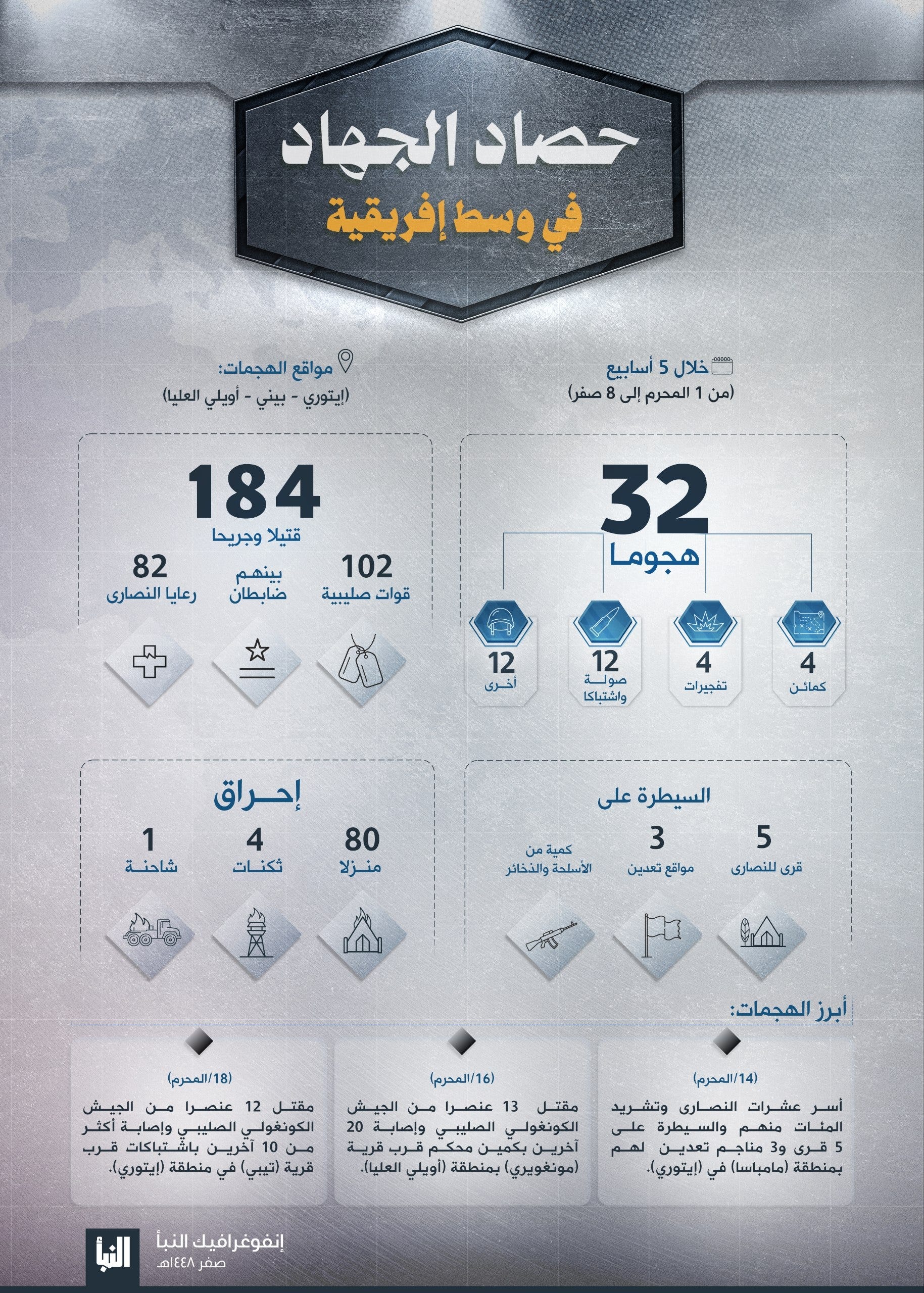
In issue 557, the Islamic State published an infographic regarding its province in Central Africa. ISCAP reportedly carried out 32 attacks, resulting in 184 deaths and injuries, over the past 5 weeks.
Among the targets, in addition to the Congolese army, pro-government militias, and Christian villages, ISCAP claims to have attacked and taken control of three mining sites (thus in line with its economic warfare strategy). The affected areas are the provinces of Haute Uele, North Kivu, and Ituri. DR Congo
Independent Jihadist Groups
Ittehad-ul-Mujahideen Pakistan (IMP), a Pakistani jihadist organisation comprising the Hafiz Gul Bahadur Group (HBG), Lashkar-e-Islam and the Harkat Inqilab-e-Islami Pakistan (HIIP), released 13 statements, claiming 19 attacks.
The group continues to make extensive use of SVBIED, drones and suicide attacks.
Target: Pakistan Army, Pakistan Police, Counter Terrorism Department Police (CTD), Secret/Peace Committee.
Area:
- North Waziristan district, Khyber district, Hangu district;
Khyber Pakhtunkhwa Province, Pakistan

As-Saif Media, Ittehad-ul-Mujahideen Pakistan (IMP), a Pakistani jihadist organisation comprising Hafiz Gul Bahadur’s (HBG) group, Lashkar-e-Islam and Harkat Inqilab-e-Islami Pakistan (HIIP), published a video showing a series of drone attacks carried out by militants from Jaish al-Harith, a branch of the IMP, against Pakistani army barracks and bases in the South Waziristan district of Pakistan.

Umar Media, Tehrik-i-Taliban Pakistan (TTP), has released a 4:39-minute video showing attacks by its militants on Pakistani police and CTD convoy in the Lower Dir district, in the province of Khyber Pakhtunkhwa, Pakistan.

Umar Media, Tehrik-i-Taliban Pakistan (TTP), has published a photo report showing the training of its militants. Pakistan

🔹Weekly Monitoring Notes
The reporting period from 17 to 24 July reflects a sustained high-volume propaganda cycle across the principal jihadist ecosystems, although the balance of activity shifted slightly from the previous week.
JNIM remained the most prolific Al-Qaeda affiliate, Al-Shabaab preserved a broad operational footprint across Somalia and northeastern Kenya, Islamic State used the publication of two consecutive al-Naba issues to reinforce its African focus, and Pakistani jihadist organisations continued to combine regular attack claims with increasingly systematic visual coverage of training and drone-enabled operations.
Within the Al-Qaeda ecosystem, Jama’at Nusrat al-Islam wal-Muslimin maintained a high operational reporting tempo, issuing 32 statements and 13 photo reports covering 39 attacks across Mali and Burkina Faso. The volume remained substantial, although lower than the exceptional level recorded during the previous reporting cycle. Activity was almost evenly divided between the two countries, with JNIM continuing to target Malian and Burkinabé security forces, Africa Corps personnel, Dozo militias and VDP formations across a wide geographic arc.
The most notable JNIM development was the claim of a large-scale ambush in Gao conducted in cooperation with the Azawad Liberation Front. From a propaganda perspective, the reference to operational collaboration is significant because it allows JNIM to present itself not only as an autonomous insurgent actor, but also as a force capable of exploiting converging interests with other armed formations against shared adversaries. The claim also broadens the group’s weekly narrative beyond its established pressure in central Mali and Burkina Faso, restoring greater visibility to the northern theatre and to operations directed against both the Malian Army and Russian personnel.
Al-Shabaab maintained a stable and geographically dispersed reporting cycle, claiming 20 attacks through 14 official statements. Sixteen operations were attributed to Somalia and four to Kenya, with activity extending across Lower Shabelle, Lower Juba, Bay, Hiiran, Bakool, Gedo, Middle Shabelle, Galguduud and Mogadishu. The group’s target set remained broad, encompassing Somali military and police forces, local militias, and Ethiopian, Ugandan and Kenyan personnel. No major strategic video or leadership statement accompanied the claims, indicating that the week’s output remained centred on documenting persistence and geographic reach rather than introducing a new narrative theme.
The third issue of al-Bayan indicates that Al-Yaqin is moving beyond an experimental publication cycle toward a more structured pro-Al-Qaeda media project. The launch of a dedicated Telegram channel, the expansion to 13 pages and the continued integration of operational infographics, affiliate reporting, religious content and editorial commentary suggest an effort to establish a recurring cross-theatre product. The editorial on the conflict between the United States and Iran also demonstrates the publication’s intended function as more than an aggregator of battlefield claims. It seeks to interpret current geopolitical developments through an Al-Qaeda ideological framework and to reaffirm armed struggle as the movement’s central strategic prescription.
Islamic State propaganda activity was shaped by the publication of two al-Naba issues. Issue 556 reported 21 operations and 34 deaths and injuries across Nigeria, Niger, Mozambique, Iraq and the Democratic Republic of the Congo. Issue 557 reported 22 operations and 100 deaths and injuries across Nigeria, Mozambique and the Democratic Republic of the Congo. Taken together, the two editions present a media cycle defined less by geographic breadth than by the renewed prominence of Central Africa and the higher casualty figure attributed to the second reporting week.
The ISCAP infographic published in issue 557 was the most important Islamic State media product of the period. By claiming 32 attacks and 184 deaths and injuries over five weeks, the organisation sought to portray Central Africa Province as one of its most active and consequential branches. The reference to the capture of three mining sites is particularly relevant within the group’s own propaganda framing. It extends the narrative beyond attacks on military forces, militias and Christian communities, presenting ISCAP as capable of interfering with local economic assets and temporarily imposing control over resource-producing locations. The product therefore combines operational statistics, territorial signalling and economic warfare messaging within a single provincial narrative.
Independent jihadist propaganda in Pakistan remained consistent. Ittehad-ul-Mujahideen Pakistan claimed 19 attacks across North Waziristan, Khyber and Hangu, while continuing to emphasise the use of SVBIEDs, suicide operations and unmanned systems. The video released by As-Saif Media showing drone attacks by Jaish al-Harith against Pakistani military installations in South Waziristan reinforces the degree to which drone use has become a recurring element of IMP’s public military identity rather than an occasional innovation.
Tehreek-e-Taliban Pakistan complemented this output with a short operational video documenting attacks on Pakistani Police and CTD personnel in Lower Dir, together with a new training photo report. As in recent weeks, TTP’s media strategy combined battlefield documentation with imagery designed to project force generation, preparedness and organisational continuity. The Lower Dir footage also helps sustain the narrative that the movement’s operational reach extends beyond its most frequently highlighted districts in the former tribal areas.
Overall, the reporting period was characterised by sustained propaganda intensity rather than a major increase in volume. JNIM remained the dominant Al-Qaeda operational communicator, while the Gao claim introduced an additional cooperation narrative into its media output. Al-Shabaab preserved a broad and stable claims cycle, al-Bayan continued to develop as a cross-network pro-Al-Qaeda publication, and Islamic State concentrated attention on the operational and economic relevance of ISCAP. In Pakistan, IMP and TTP continued to normalise drone warfare, specialist training and repeated attacks on security infrastructure as central components of their propaganda presentation.
Distribution patterns remained stable across established encrypted and semi-encrypted platforms (Element, Telegram, Rocket Chat, Chirpwire, Signal, UpScrolled), with no observable shifts in dissemination channels or media architecture.
🔒 Executive Intelligence Cycle
This assessment is part of a broader analytical cycle.
Founding subscribers receive the Executive Intelligence Briefing, which integrates all threat assessments, cognitive domain analysis, and a rolling 30–90-day forecast into a single monthly strategic synthesis.
© Daniele Garofalo Monitoring - All rights reserved.
Daniele Garofalo is an independent researcher and analyst specialising in jihadist terrorism, Islamist insurgencies, and armed non-state actors.
His work focuses on continuous intelligence monitoring, threat assessment, and analysis of propaganda and cognitive/information dynamics, with an emphasis on decision-oriented outputs, early warning, and strategic trend evaluation.
ISSN (International Standard Serial Number): 3103-3520
NATO NCAGE: AX664 (NATO Commercial and Governmental Entity)
UNITED NATIONS Global Marketplace ID: 1210727
ORCID Code: 0009-0006-5289-2874