

Executive Intelligence Overview
This weekly intelligence brief documents and structures official jihadist propaganda output released between 8 and 15 March, providing structured situational awareness across multiple organisations and theatres.
The brief focuses on:
volume and distribution of official propaganda output,
organisational and geographic dispersion across theatres,
continuity and variation in operational claims and visual documentation,
appearance of new branding, campaign framing, or affiliate-level media differentiation.
The purpose of this product is to support systematic monitoring, structured comparison across reporting cycles, and longitudinal trend tracking. It provides an evidentiary baseline for subsequent analytical products and deeper theatre-specific assessments.
This publication does not include threat assessments, intent evaluation, or operational forecasting. Those components are addressed separately in dedicated analytical outputs.
🔹 Scope of Monitoring
This issue covers all identifiable official propaganda released by a predefined list of jihadist organisations and affiliated groups, selected based on operational relevance and threat level, during the reporting period.
The focus is strictly on documentation, classification, and structured presentation of primary-source material, enabling analytical reuse and historical comparison over time.
🔹 Sources & Collection Methodology
The analysis is based exclusively on primary-source propaganda material, including:
Official magazines,
Videos,
Photo sets,
Statements and claims of responsibility,
Audio statements.
Material is collected and categorised by organisation, media outlet, and content type.
The study relies on OSINT, IMINT, SOCMINT, and Digital HUMINT collection streams.
No secondary reporting, media commentary, or interpretative overlay is applied.
🔹 Analytical Boundaries & Limitations
Fluctuations in volume, language, or format are monitoring signals indicating activity trends, not definitive indicators of strategic or operational shifts. This helps analysts interpret the data correctly.
They shouldn’t be considered in isolation as indicators of strategic shifts, operational escalation, or changes in intent and capability; instead, they should be analyzed within broader intelligence products.
Strategic shifts,
Operational escalation,
Intent or capability changes.
All higher-order analytical interpretation is conducted separately within:
Intelligence Briefs,
Strategic Threat Outlooks,
Cognitive and Information Domain Assessments.
🔹 Monitored Propaganda Output and Weekly Monitoring Notes
This issue includes all primary propaganda material released during the week by:
Al-Qaeda and affiliates
AQAP
AQIS
JNIM
Al-Shabaab
Islamic State
al-Naba Newspaper (weekly issue)
Official IS media channels.
Independent Jihadist Groups
Ittehad Mujahidin Pakistan
Tehrik-e-Taliban Pakistan
The conclusions are included in the Weekly Monitoring Notes.
Al-Qaeda (AQ)
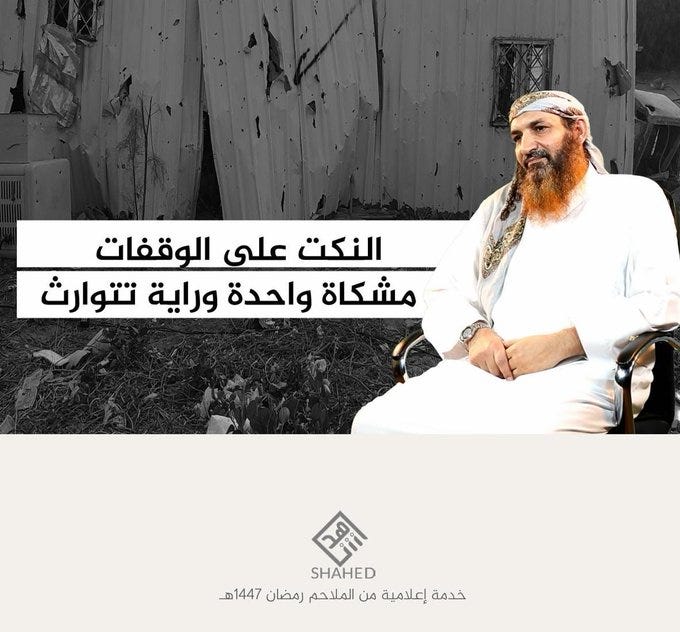
Shahed Media, Ansar al-Sharia (AQAP) published a five-page editorial entitled "Lesson on Events".
The editorial states that the Muslim community must react collectively to attacks against any part of it and cites as examples the situation of Muslims in Xinjiang and that of Palestinians in Gaza. The text encourages al-Qaeda supporters and sympathisers to study both religious sciences and scientific and technical disciplines.
The editorial explicitly mentions online educational platforms such as Coursera, edX, and Udemy as tools for acquiring technical and scientific skills to strengthen the jihadist community’s capabilities. The editorial concludes that popular support is essential for the continuity of the jihadist armed struggle.
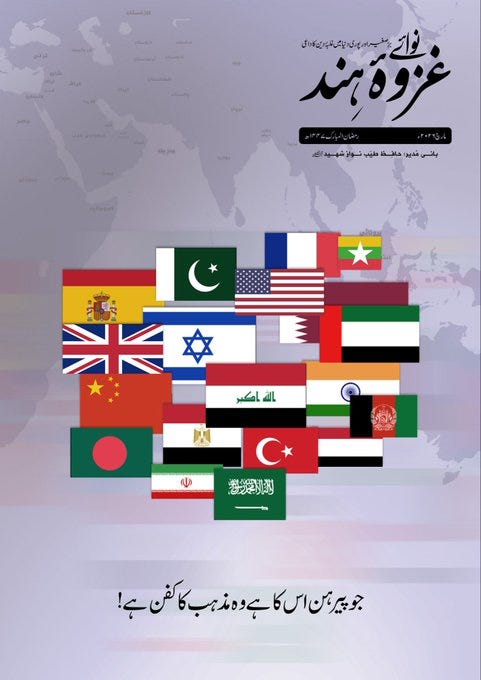
Al-Qaeda in the Indian Subcontinent (AQIS) published the March 2026 issue of its magazine “Nawa’i Ghazwat al-Hind”.
The main text states that the countries listed on the cover are part of a front hostile to Islam and responsible for actions against Muslim communities in various regions of the world. The editorial also links regional dynamics on the subcontinent with conflicts in the Middle East and Afghanistan, presenting them as interconnected fronts in the same war. Among the topics covered are the situation in Afghanistan following the Taliban’s return to power, the Kashmir issue, relations between Pakistan and militant groups, and the role of the United States in the region. The publication includes articles encouraging ideological and operational support for the jihadist cause in the subcontinent. These texts call on readers to support jihad through propaganda, logistical support, or direct participation in the conflict.
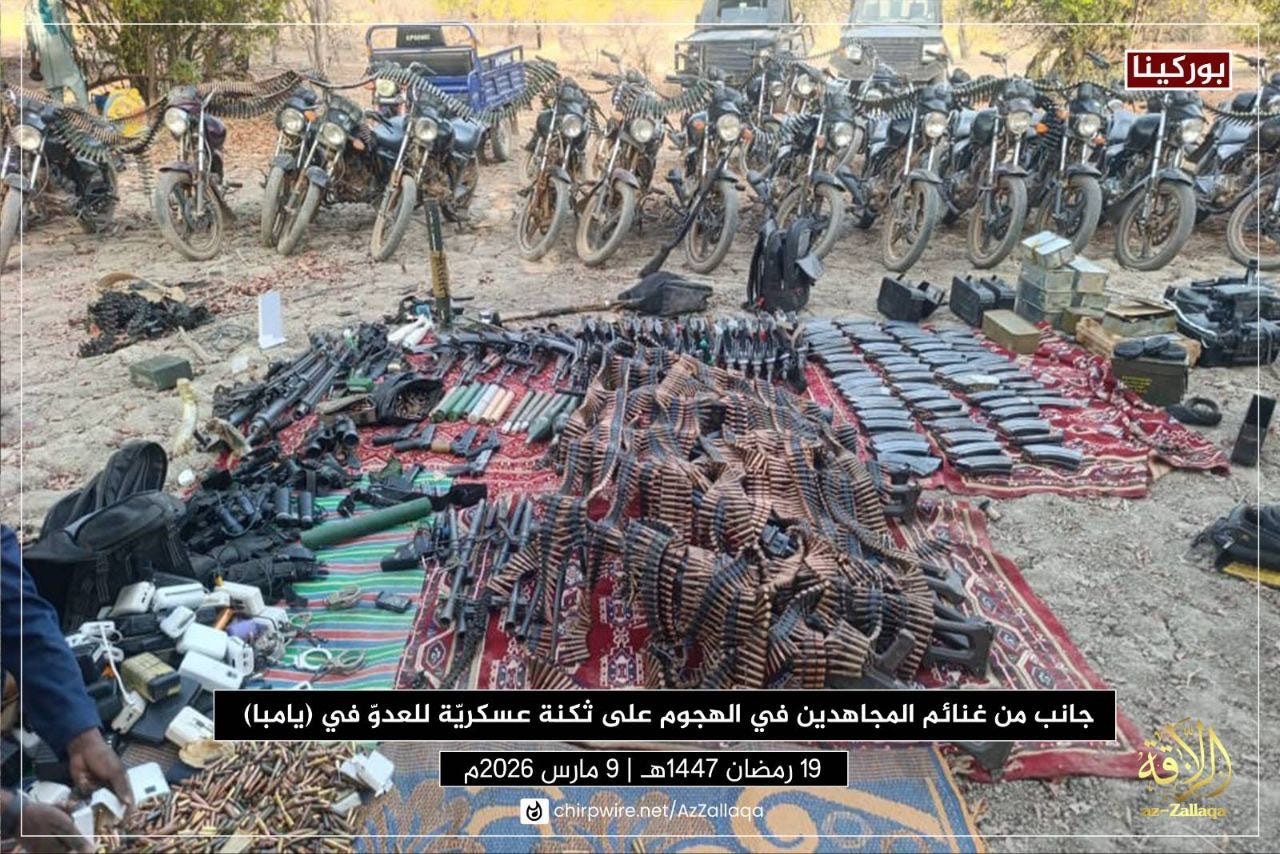
Az-Zallaqa Media, Jama’at Nasr al-Islam wal Muslimin (JNIM), issued 24 statements and 18 photos, claiming 28 attacks.
The targets of the attacks were: the Malian Army, the Russian PMC Africa Corps, the Burkinabé Army, the VDP militia, and the Niger Army.
The areas of the attacks were :
1) Burkina Faso = 15
- Mouhoun province, Yatenga province, Gourma province, Sissili province;
2) Mali = 12
- Ségou region, Sikasso region, Mopti region;
3) Niger = 1
- Tillaberi region.
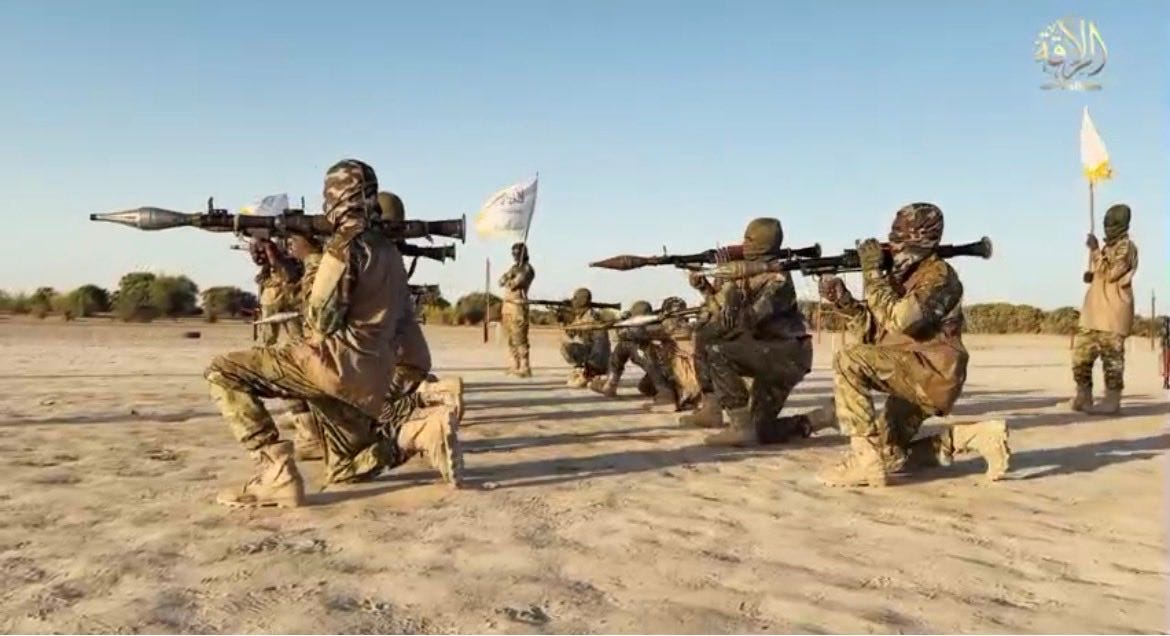
Az-Zallaqa Media, Jama’at Nasr al-Islam wal Muslimin (JNIM), released a 13:02-minute video showing various stages of training for its militants at a training camp in Mali.
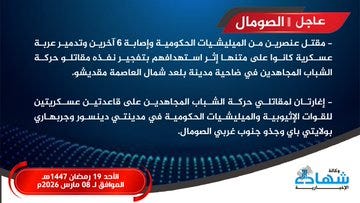
The Shahada News Agency, Harakat al-Shabaab al-Mujahidin (AS), released 20 statements claiming responsibility for 31 attacks.
The targets of the attacks were: the Somali Army, pro-government Somali militias, Somali intelligence, Somali Special Forces, the Ethiopian Army, Ugandan Army, Kenyan Army, Jubbaland Dervish Force, and AUSSOM forces.
The areas affected by the attacks were:
1) Somalia = 30
- Qoryoley area, Wanlaweyn area, Bulo-Mareer area, Konya Barrow area, Merca area, Lower Shabelle region; Dinsor area, Baidoa area, Bardale area, Bay region; Balad area, Mahaday area, Middle Shabelle; Saakow area, Gelib area, Afmadù area, Lower Jubba region; Bardhere area, Gedo area; Beledweyne area, Hiiran region; Tiyeglow area, Bakool region; Mogadishu area.
2) Kenya = 1
- Mandera County.
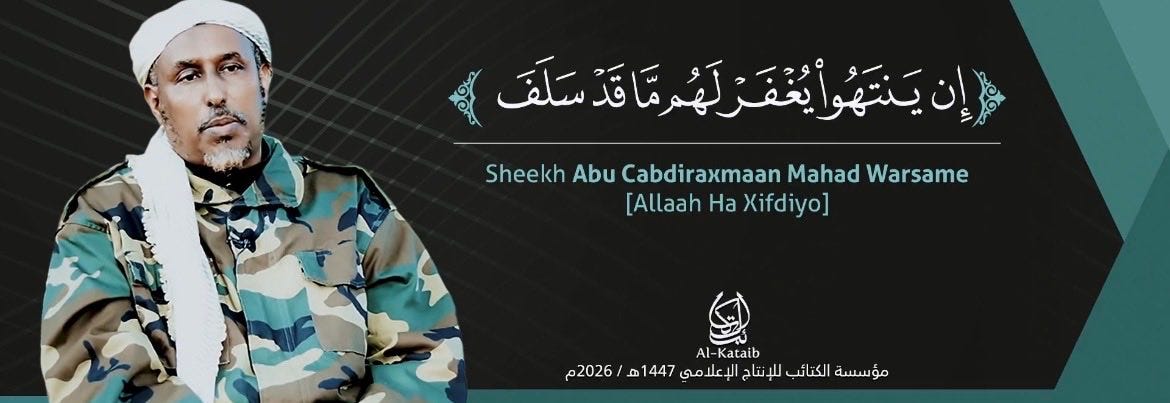
Al-Kataib Media and Harakat al-Shabaab al-Mujahidin (AS) released a 15-minute audio recording of the deputy emir and head of Amnyat, Abu Abdur-Rahman Warsame, titled "If they desist, they will be forgiven." In the audio, Warsame warned spies within the organisation, accusing them of treason and collaboration with the enemies of Islam. He stressed that spies, by helping the enemies, are causing enormous harm to Muslims, contributing to the conquest of their lands and the killing of innocent people. The appeal also emphasises that espionage is apostasy from Islam and that collaborating with unbelievers, passing information to enemies, or revealing the secrets of Muslims is a grave sin. The sheikh urged spies to repent, stating that their actions could be forgiven if they repented and surrendered. He warned that those who continue their actions will be punished both in this world and in the hereafter, according to the laws of Allah. Somalia
Islamic State (IS)
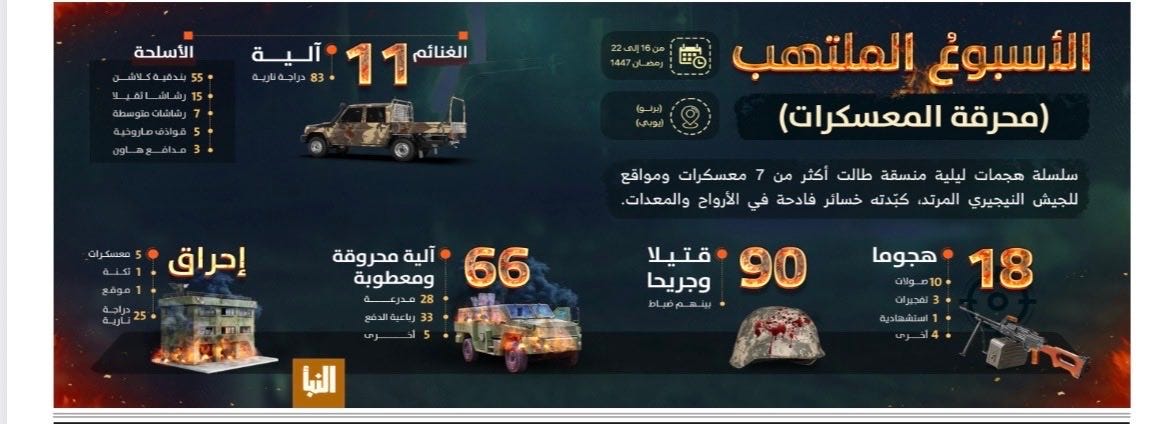
The official media of the Islamic State published an issue of the weekly al-Naba this week (538). The main infographic summarises the areas affected by military operations this week, including Nigeria, Niger, Syria, Somalia, Pakistan, and the Democratic Republic of Congo.
IS claims to have conducted 26 operations in all the mentioned areas and to have caused 110 deaths and injuries.
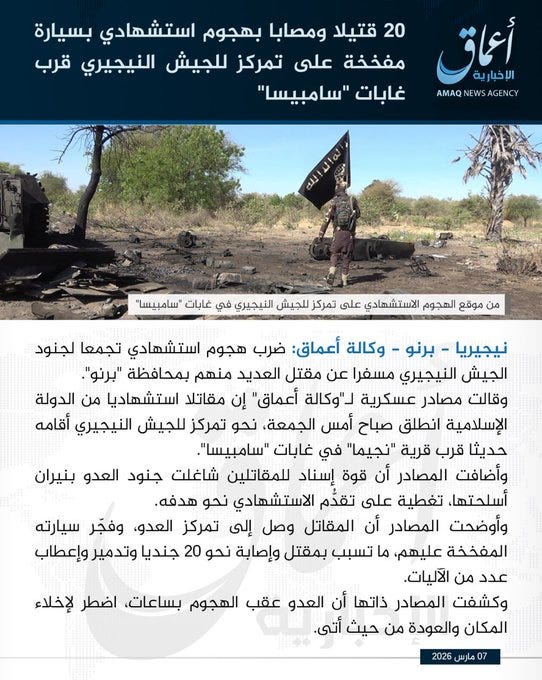
The Amaq News Agency, the official mouthpiece of Islamic State, has published a lengthy statement claiming responsibility for a serious SVBIED attack carried out by the West Africa Province (ISWAP) against a Nigerian army convoy in the Sambisa area of Borno State. Nigeria
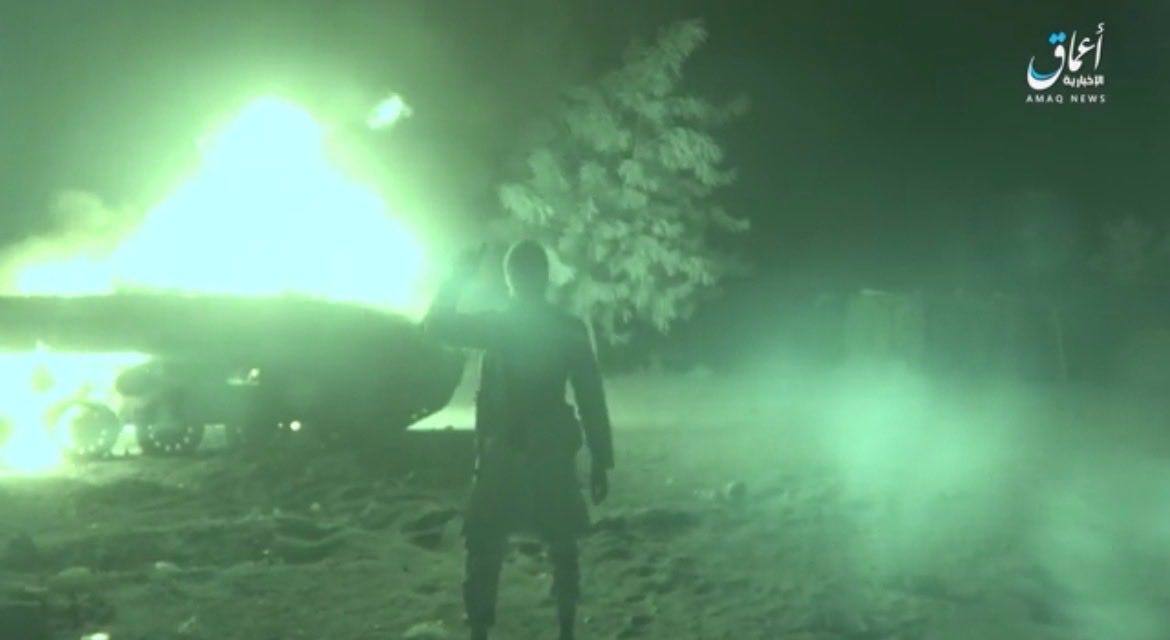
Amaq News Agency, the official media of the Islamic State, published a video lasting about 54 seconds to show an attack by militants from West Africa Province (ISWAP) on a Nigerian army camp in the Marte area of Borno State. Nigeria
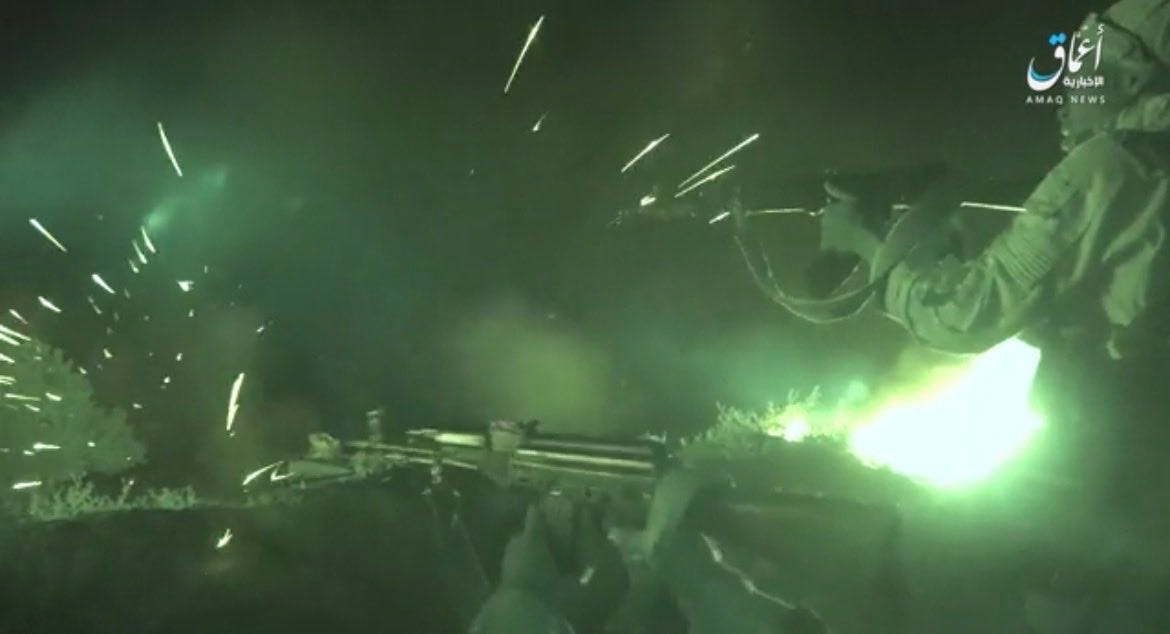
Amaq News Agency, the official media of the Islamic State, published a video lasting about 0:31 minutes to show an attack by militants from West Africa Province (ISWAP) on a Nigerian army camp in the Gajiram area of Borno State. Nigeria
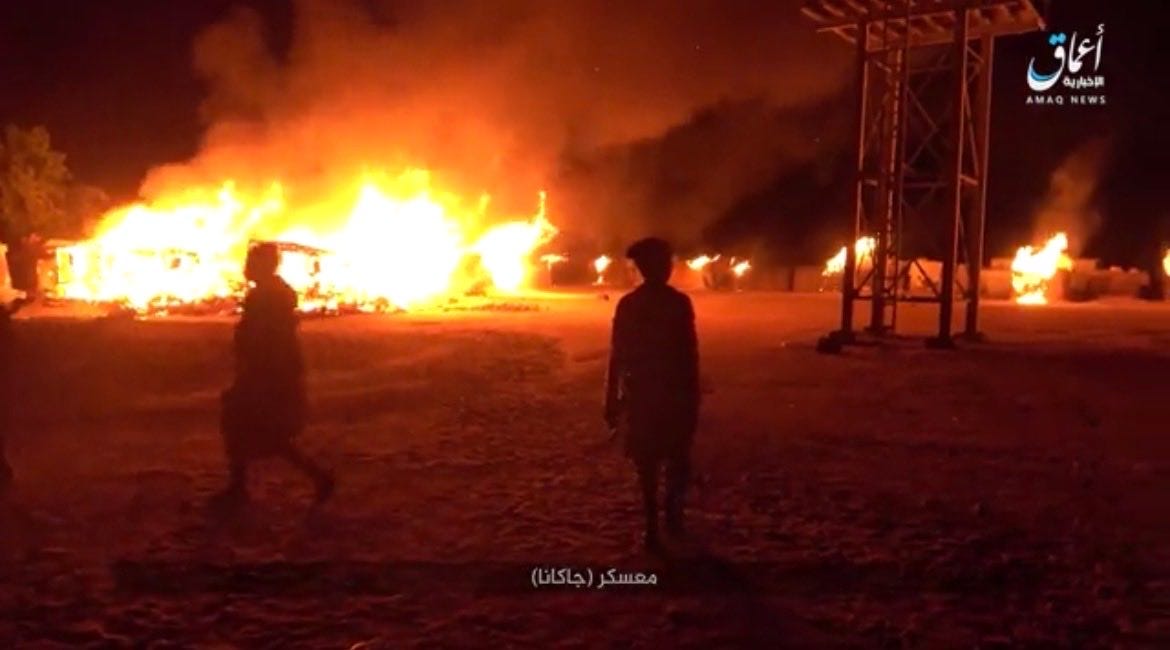
The Amaq news agency, the official mouthpiece of Islamic State, has published a 2:34-minute video showing four attacks by militants from the Islamic State West Africa Province (ISWAP) against four Nigerian army camps in the Marte, Mainok, Jakana, and Konduga areas of Borno State. Nigeria
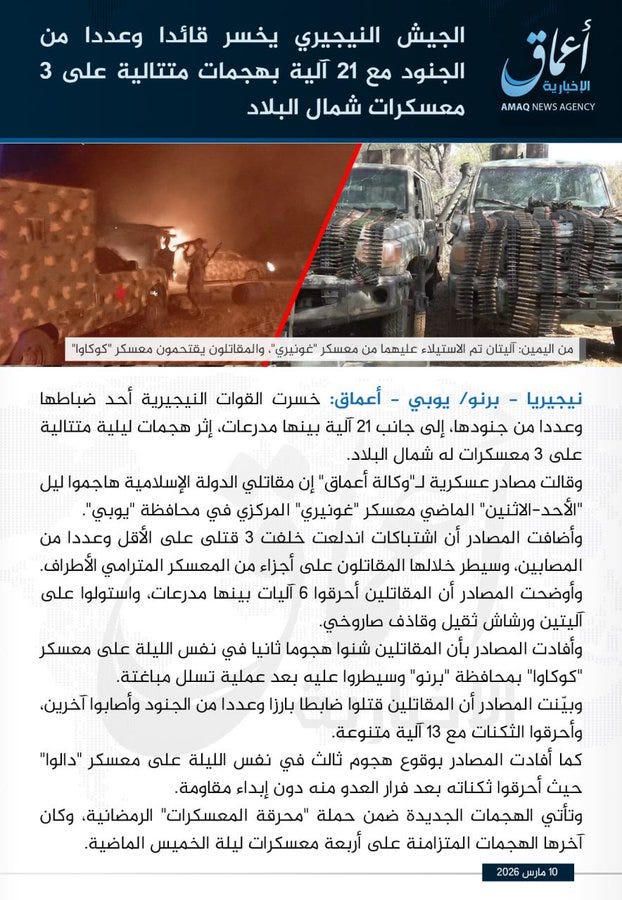
The Amaq news agency, the official media of Islamic State, has published a lengthy statement claiming responsibility for three major night-time attacks carried out by militants from the West Africa Province (ISWAP) against three Nigerian army camps in the Goneri area of #Yobe State and in the Kukawa and Dalwa areas of Borno State. Nigeria
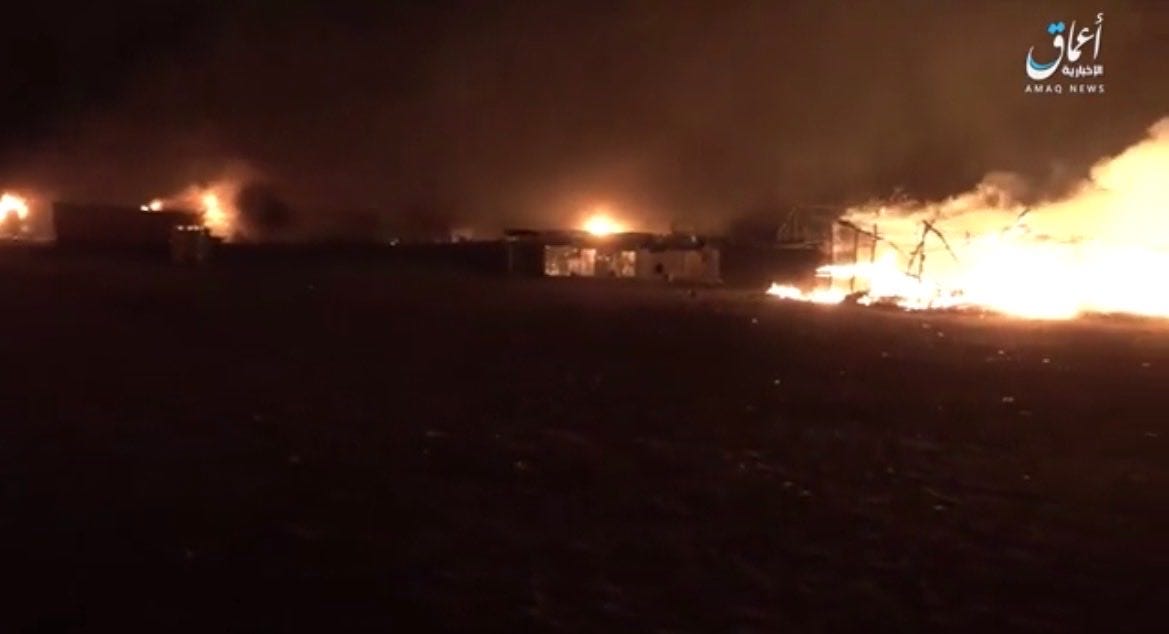
The Amaq news agency, the official media of the Islamic State, published a 1:53-minute video showing 3 attacks by militants from the Islamic State West Africa Province (ISWAP) against 3 Nigerian Army camps in the areas of Borno and Yobe State. Nigeria
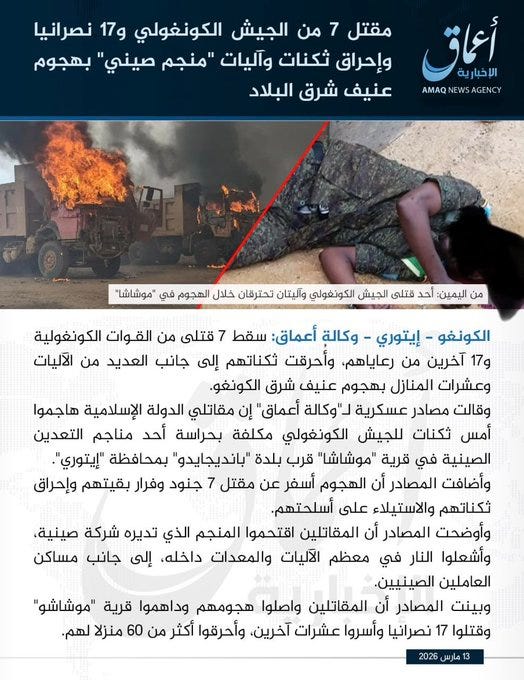
The Amaq news agency, the official mouthpiece of Islamic State, has issued a lengthy statement claiming responsibility for an ambush carried out by ISCAP against a convoy of the Congolese army and pro-government Christian militias that was protecting a mining site operated by a Chinese company.
The statement claims that ISCAP militants killed seven Congolese soldiers and 16 militiamen before destroying the mining site, vehicles, and equipment. The attack took place in the province of Ituri, in the Democratic Republic of the Congo.
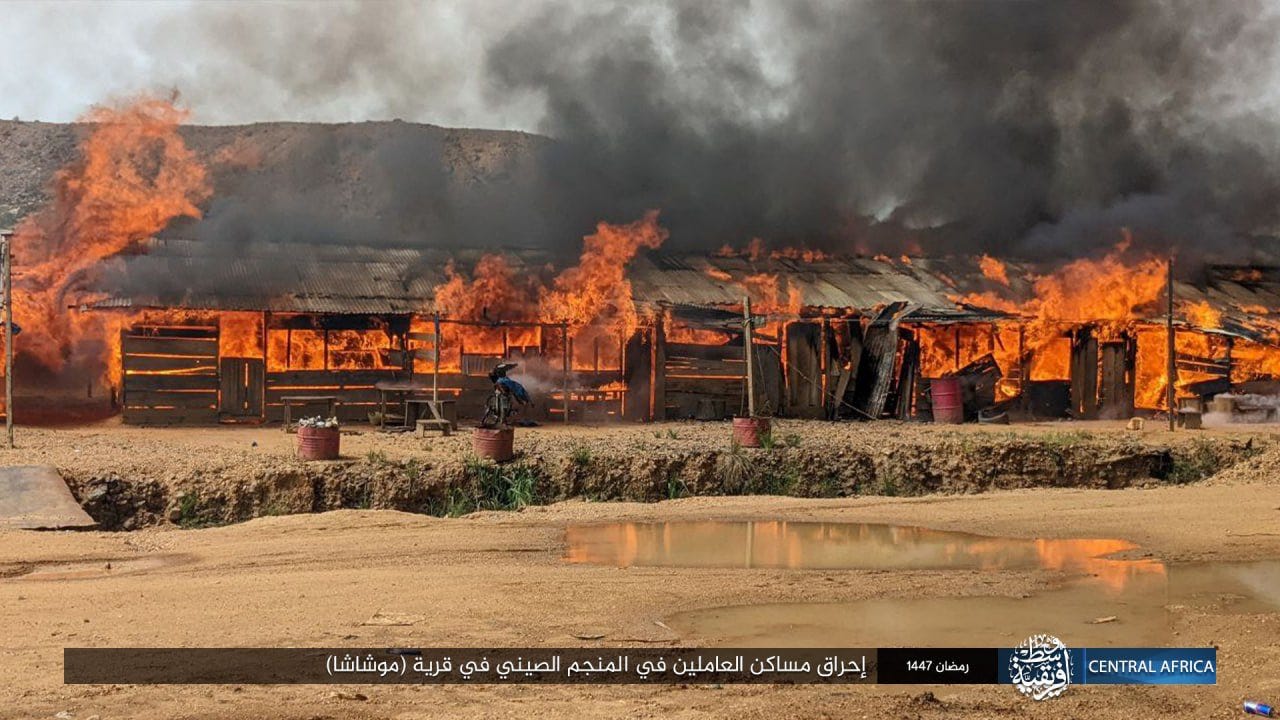
The Islamic State’s official media outlets have released photos of the ISCAP attack on a Chinese mining company in the Mambasa area, Ituri province, in which Congolese army soldiers were killed, and mining infrastructure was destroyed. DR Congo
Independent Jihadist Groups
Ittehad-ul-Mujahideen Pakistan (IMP), a Pakistani jihadist organisation comprising the Hafiz Gul Bahadur Group (HBG), Lashkar-e-Islam, and the Harkat Inqilab-e-Islami Pakistan (HIIP), released 16 statements, claiming 16 attacks.
Target: Pakistan Army, Frontier Corps,
Area:
- North Waziristan district, Lakki Marwat district, Bannu district; South Waziristan, Khyber district, Bajaur district, Mohmand district. Khyber Pakhtunkhwa Province, Pakistan.
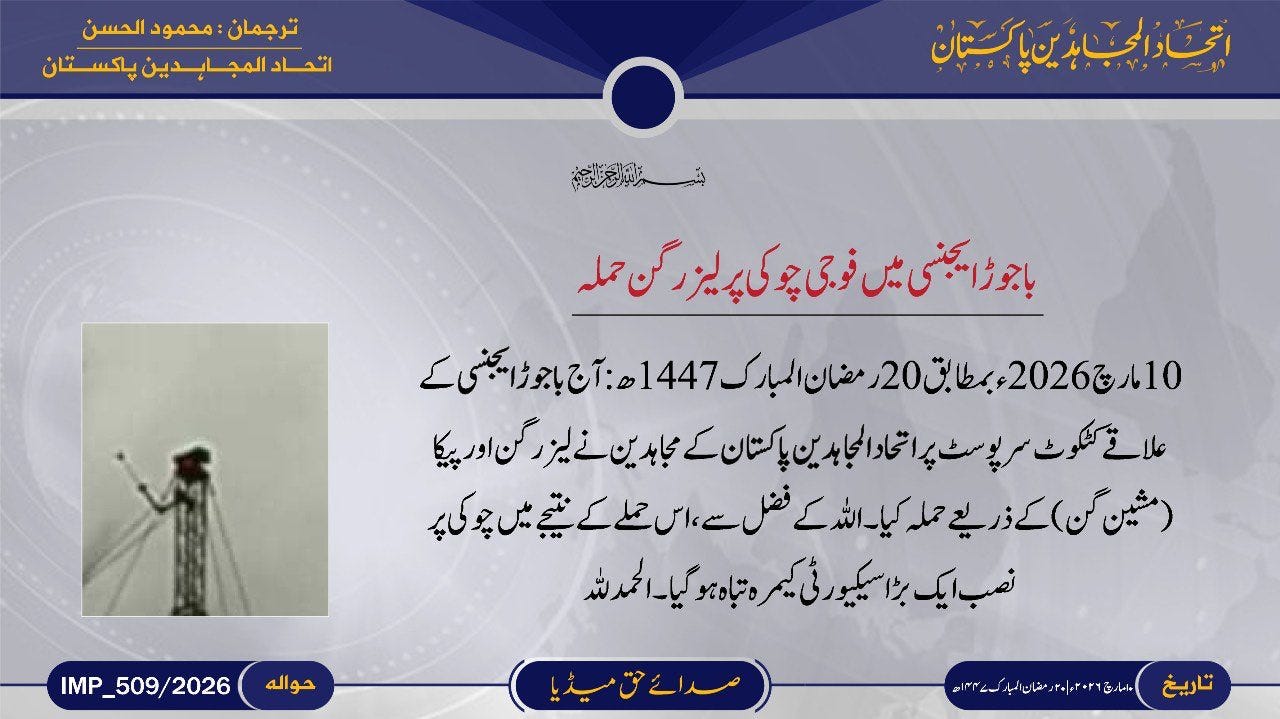
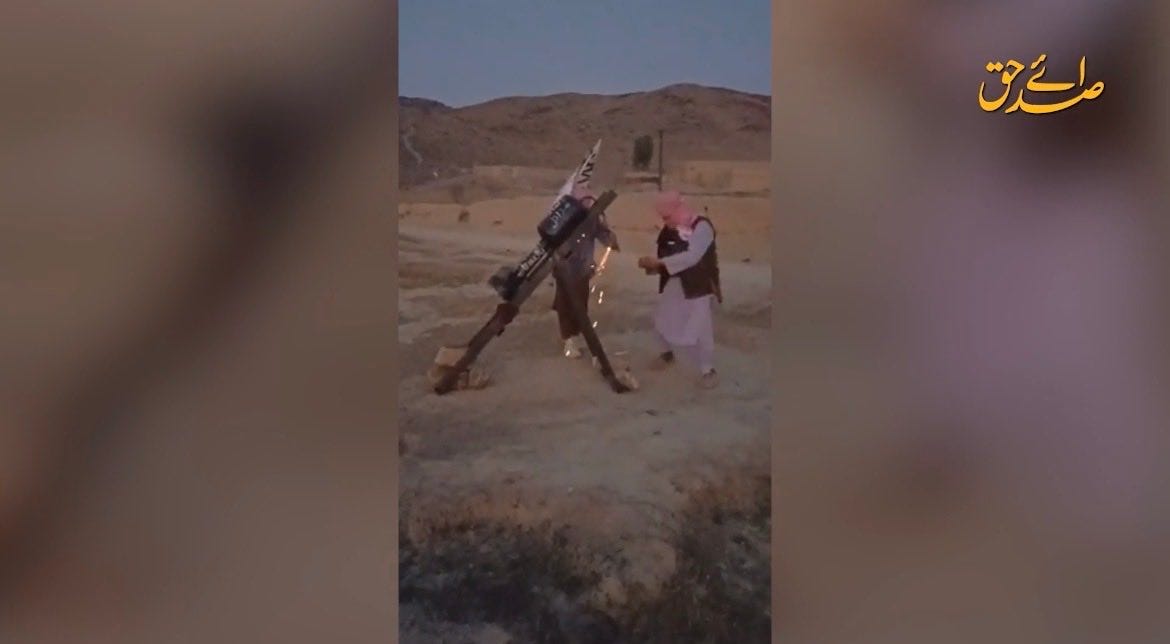
Al-Mansur Media, Ittehad-ul-Mujahideen Pakistan (IMP), a Pakistani jihadist organisation comprising the Hafiz Gul Bahadur (HBG) group, Lashkar-e-Islam, and Harkat Inqilab-e-Islami Pakistan (HIIP), has released two videos lasting approximately 1:30 minutes showing missile and mortar attacks against the Pakistani army in the districts of Bannu and Orakzai, in the province of Khyber Pakhtunkhwa, Pakistan.
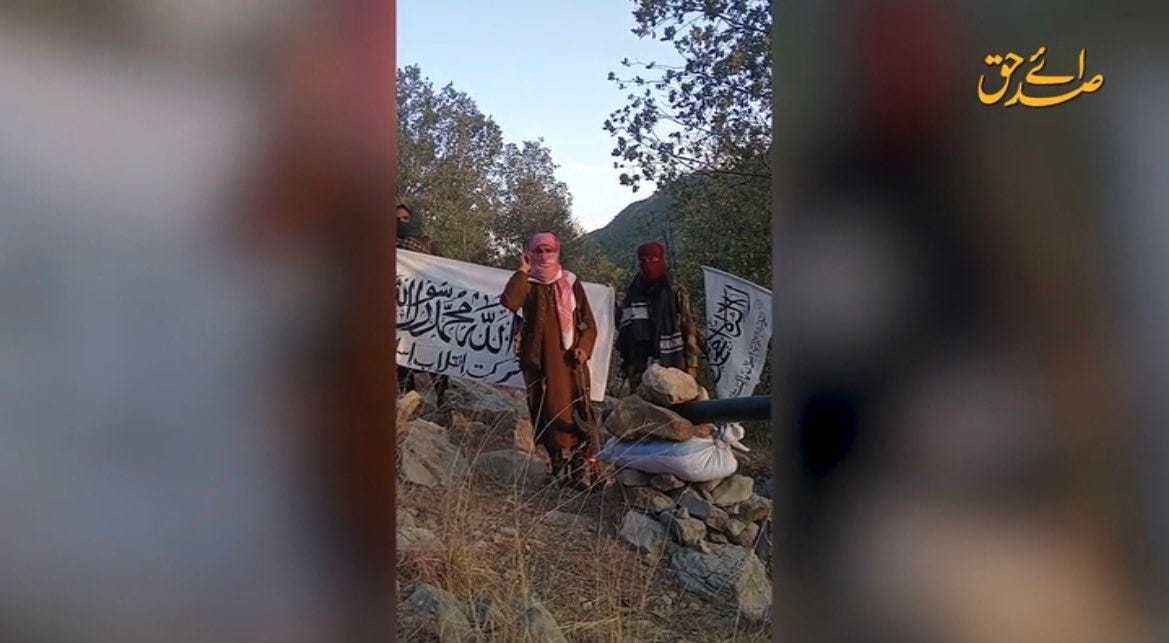
Al-Mansur Media, Ittehad-ul-Mujahideen Pakistan (IMP), a Pakistani jihadist organisation comprising the Hafiz Gul Bahadur (HBG) group, Lashkar-e-Islam, and Harkat Inqilab-e-Islami Pakistan (HIIP), has released a 0:55-minute video showing missile attacks against the Pakistani Army in the districts of South Waziristan, in the province of Khyber Pakhtunkhwa, Pakistan.
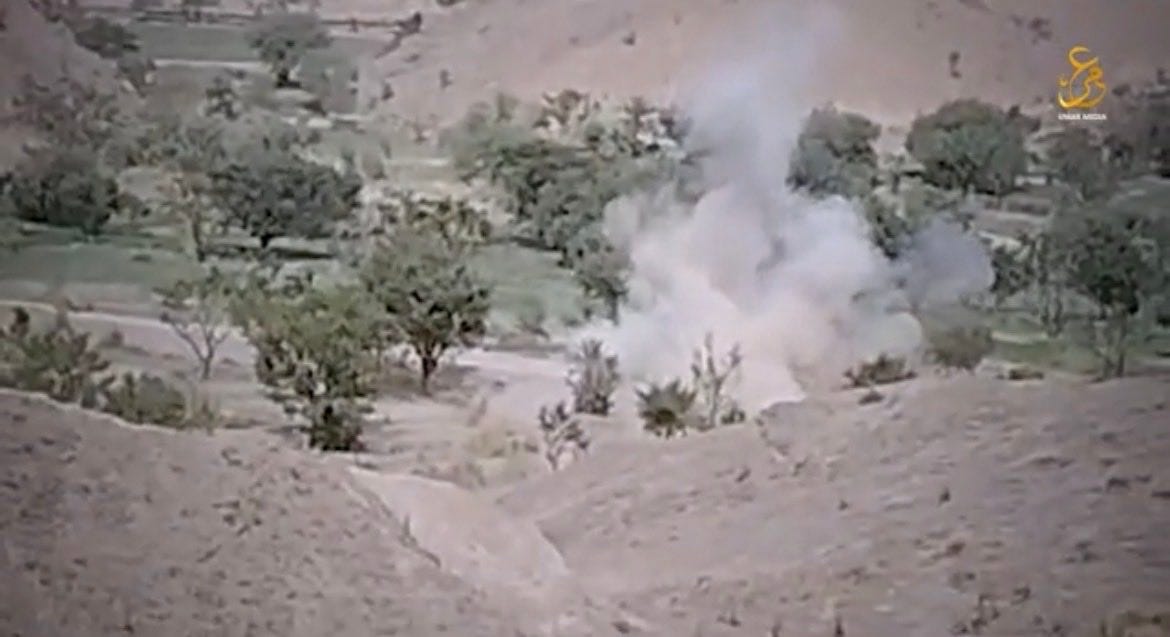
Umar Media, Tehreek-e-Taliban Pakistan (TTP) has released a 1-minute and 53-second video showing its militants ambushing a Pakistani Police patrol with IEDs in the Peshawar area in Pakistan.
🔹Weekly Monitoring Notes
During the reporting period from 8 to 15 March, jihadist propaganda output remained high and operationally diverse, with particularly strong activity from Al-Qaeda affiliates in the Sahel and Somalia, sustained Islamic State media concentration on West Africa and Central Africa, and continued visibility from Pakistan-based independent jihadist coalitions. A dense combination of claims-based reporting, training, and attack videos, long-form ideological publications, and internal security messaging marked the week.
Al-Qaeda-linked output showed broad geographic dispersion and significant format diversity. JNIM remained one of the most active actors of the week, maintaining a high volume of statements and photo documentation across Burkina Faso, Mali, and Niger. Its media posture combined routine operational claims with a longer training-camp video from Mali, reinforcing both battlefield relevance and force-generation imagery. The distribution of claims confirmed continued concentration in Burkina Faso, while Mali remained a substantial secondary theatre. Al-Shabaab also recorded one of the heaviest reporting cycles of the week. Through Shahada News Agency, the group claimed a large number of attacks across multiple Somali regions, with additional cross-border activity in Kenya. This was accompanied by a 15-minute audio address by Abu Abdur-Rahman Warsame focused on espionage, repentance, and internal discipline. That message added an internal security and counter-infiltration layer to the week’s propaganda profile, complementing the group’s routine operational reporting.
Beyond direct battlefield propaganda, AQAP and AQIS both expanded the ideological dimension of Al-Qaeda-aligned media. AQAP’s new editorial explicitly encouraged supporters to acquire scientific and technical skills, including through mainstream online learning platforms, framing technical education as a support function for the jihadist cause. AQIS, through the March 2026 issue of Nawa’i Ghazwat al-Hind, continued its established long-form publishing model, linking regional theatres in South Asia, Afghanistan, Kashmir, and the Middle East into a single conceptual conflict space. Together, these products reinforced the broader Al-Qaeda ecosystem’s emphasis on ideological continuity, organisational resilience, and support functions beyond direct combat.
The Islamic State’s official media maintained a structured, aggressive reporting rhythm. Al-Naba issue 538 provided the standard weekly summary of operations across Nigeria, Niger, Syria, Somalia, Pakistan, and the Democratic Republic of Congo. Supporting releases from Amaq and official provincial outlets were heavily concentrated on West Africa, especially Borno and Yobe states, where ISWAP claims dominated the week’s visual and textual output. The volume of attack videos and detailed statements from Nigeria stood out, particularly around repeated attacks on army camps and convoy targets. ISCAP also received notable media attention through a coordinated claim-and-photo package documenting an attack on a Chinese-linked mining site in Ituri. Overall, Islamic State media this week remained highly standardised in structure but intensive in release volume and geographically coherent in its prioritisation of West and Central Africa.
Independent jihadist groups remained active, especially in Pakistan. Ittehad-ul-Mujahideen Pakistan sustained a high operational claims tempo across several districts in Khyber Pakhtunkhwa and reinforced this with multiple short videos showing missile and mortar attacks. The group’s output remained consistent with its recent pattern of combining frequent statements with short, tactical visual products. TTP maintained a more limited but still visible presence through a short ambush video documenting an IED attack on a police patrol in Peshawar. Compared with previous weeks, independent actor output remained substantial, though still secondary in strategic weight to the larger Al-Qaeda and Islamic State media ecosystems.
Across the reporting period, dissemination patterns remained stable across established encrypted and semi-encrypted platforms. No significant shift in media architecture or platform preference was observed.
Overall, Week 8–15 March was characterised by high propaganda density, strong operational visibility from JNIM and al-Shabaab, sustained Islamic State media pressure centred on West Africa, and continuing consolidation of Pakistan-based coalition messaging. The week’s output also showed a notable overlap among battlefield documentation, long-form ideological publishing, and internal security messaging, indicating a mature, diversified propaganda environment rather than a purely claims-driven cycle.
🔒 Executive Intelligence Cycle
This assessment is part of a broader analytical cycle.
Founding subscribers receive the Executive Intelligence Briefing, which integrates all threat assessments, cognitive domain analysis, and a rolling 30–90 day forecast into a single monthly strategic synthesis.
© Daniele Garofalo Monitoring - All rights reserved.
Daniele Garofalo is an independent researcher and analyst specialising in jihadist terrorism, Islamist insurgencies, and armed non-state actors.
His work focuses on continuous intelligence monitoring, threat assessment, and analysis of propaganda and cognitive/information dynamics, with an emphasis on decision-oriented outputs, early warning, and strategic trend evaluation.
ISSN (International Standard Serial Number): 3103-3520
NATO NCAGE: AX664 (NATO Commercial and Governmental Entity)
ORCID Code: 0009-0006-5289-2874