


Executive Intelligence Summary
The Islamic State’s weekly magazine, al-Naba, remains a critical source for assessing the organization’s operational tempo, geographic dispersion, and signaling posture across theatres.
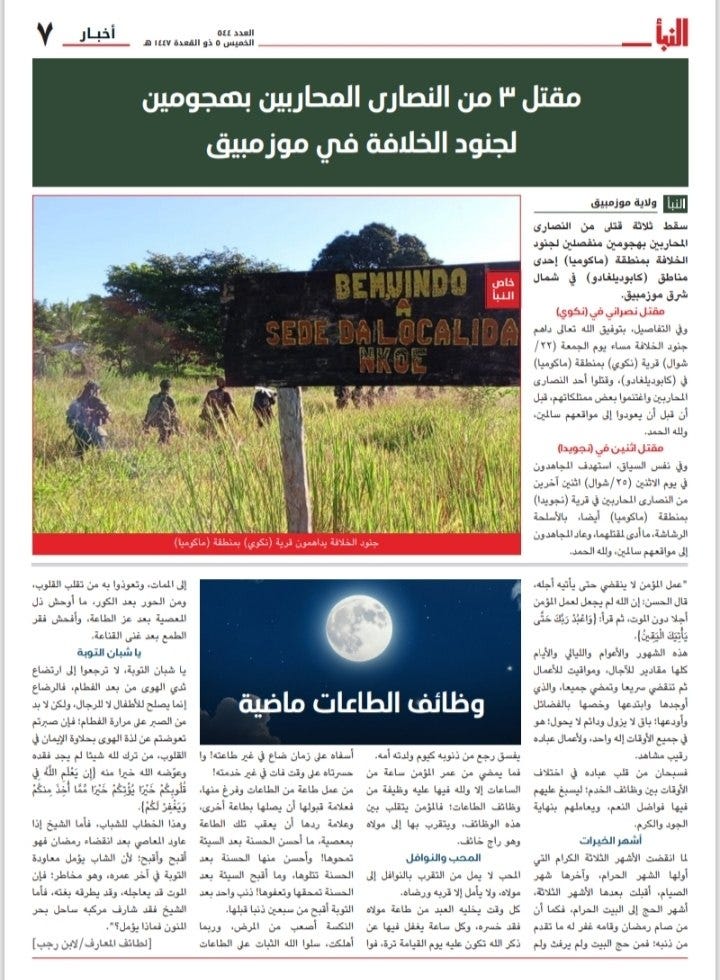
The weekly newsletter reached number 544 last Thursday.
Threat level: Medium–High, stable with episodic operational spikes
Trend: → stable with increased West Africa concentration
Time horizon: 30–90 days
Confidence level: Medium
📌 Inside This Assessment
This intelligence brief provides a structured analysis of the Islamic State’s operational activity, focusing on West Africa, Syria, and Africa theatres, based on al-Naba Issue No. 544, to inform decisions on threat dynamics and strategic planning.
Examines claimed Islamic State operations by province and theatre, highlighting geographic concentration, targeting priorities, and operational tempo to guide regional focus.
Analyses tactical patterns and methods, noting increased lethality, to motivate analysts and policymakers to maintain heightened vigilance.
The analysis identifies specific indicators and warning signs and is essential for early warning, enabling analysts and military planners to anticipate changes in threat activity.
This analysis provides threat assessments, intelligence evaluations, and forecasts up to 90 days in advance, giving policymakers, military officials, and analysts a comprehensive picture of the threats.
Key Judgments
Al-Naba continues to function as a reliable indicator of Islamic State operational intent and activity, with persistent alignment between reported operations and observed geographic concentration, despite known inflation in casualty reporting.
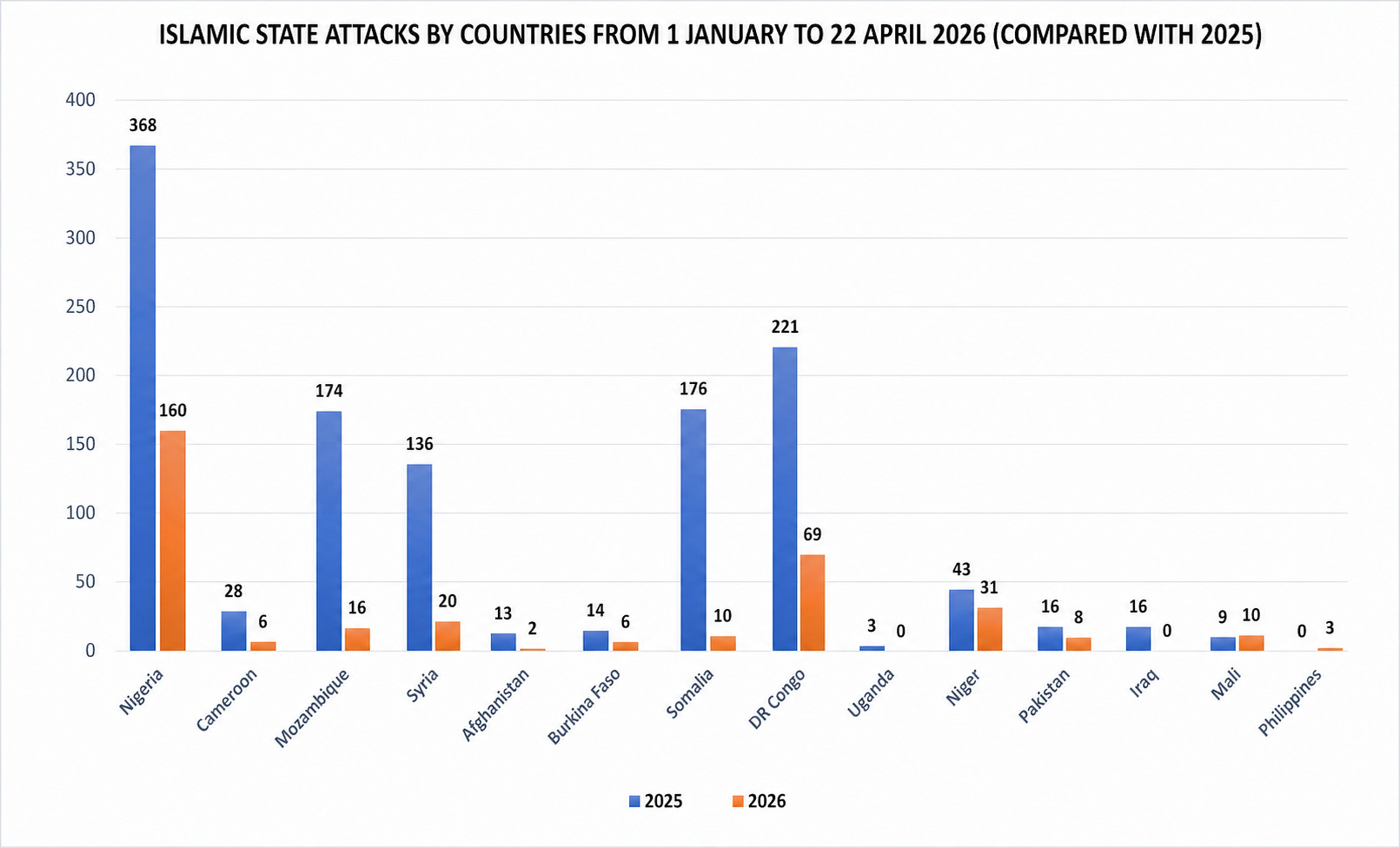
Operational activity remains structurally concentrated in West Africa, with secondary but consistent pressure in the Sahel, Syria, and South Asia, confirming an Africa-centric center of gravity with peripheral persistence.
The Islamic State maintains a stable attritional model based on repeated low to moderate complexity attacks against security forces, infrastructure, and local collaborators, with no evidence of systemic tactical innovation.
Targeting patterns show continued prioritization of military and security actors, alongside selective use of coercive violence against civilians accused of collaboration, reinforcing local control mechanisms rather than expanding target categories.
The media output remains focused on continuity, legitimacy, and persistence, which should reassure policymakers and military officials that there is no sign of imminent escalation or large-scale offensive, fostering confidence in current threat assessments.
Quantitative fluctuations in weekly activity reflect cyclical operational tempo rather than structural degradation or expansion, emphasizing the organization’s resilience and helping analysts and policymakers feel assured of its stability.
Source Basis & Methodology
This assessment is based on a direct analysis of primary propaganda material in al-Naba Issue No. 544, including photographs, statements, and alleged military activities.
The analysis integrates:
OSINT,
IMINT,
SOCMINT,
Digital HUMINT,
to contextualize reported attacks and assess credibility and operational relevance.
Limitations & Analytical Notes
Reported casualty and damage figures may be exaggerated.
Some attacks are presented without independent verification.
Where claims cannot be corroborated, this is explicitly noted in the analysis.
Claims published in al-Naba are assessed as generally reliable regarding the occurrence of attacks, while casualty figures and material damage are likely to be inflated for propaganda purposes. Analytical judgments in this assessment prioritize event verification and pattern analysis over reported impact.
Historically, Islamic State attack claims in al-Naba have mainly proven accurate in terms of occurrence, with inflation primarily affecting reported impact rather than event existence.
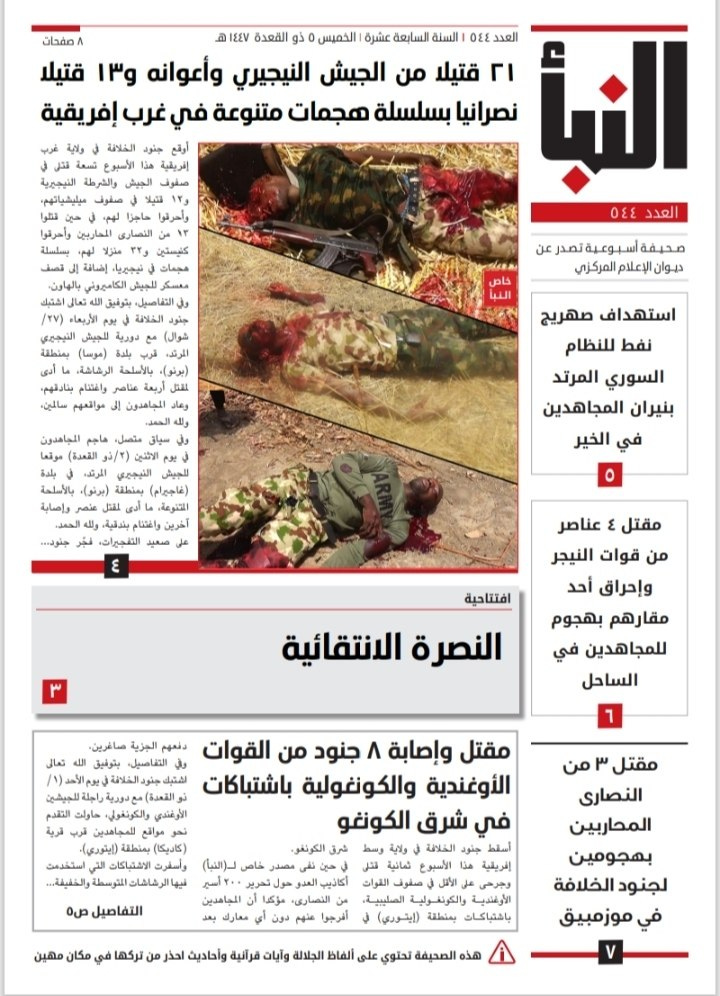
Issue 544, eight pages long, covers the week of 28 Shawwal to 4 Dhul Qi'dah 1447, from 16 to 22 April 2026.

Al-Naba generally includes most of the statements and photos published daily over the past week on its official channels, although often with new elements or additional details, both written and photographic. However, al-Naba won’t include unpublished statements or messages.
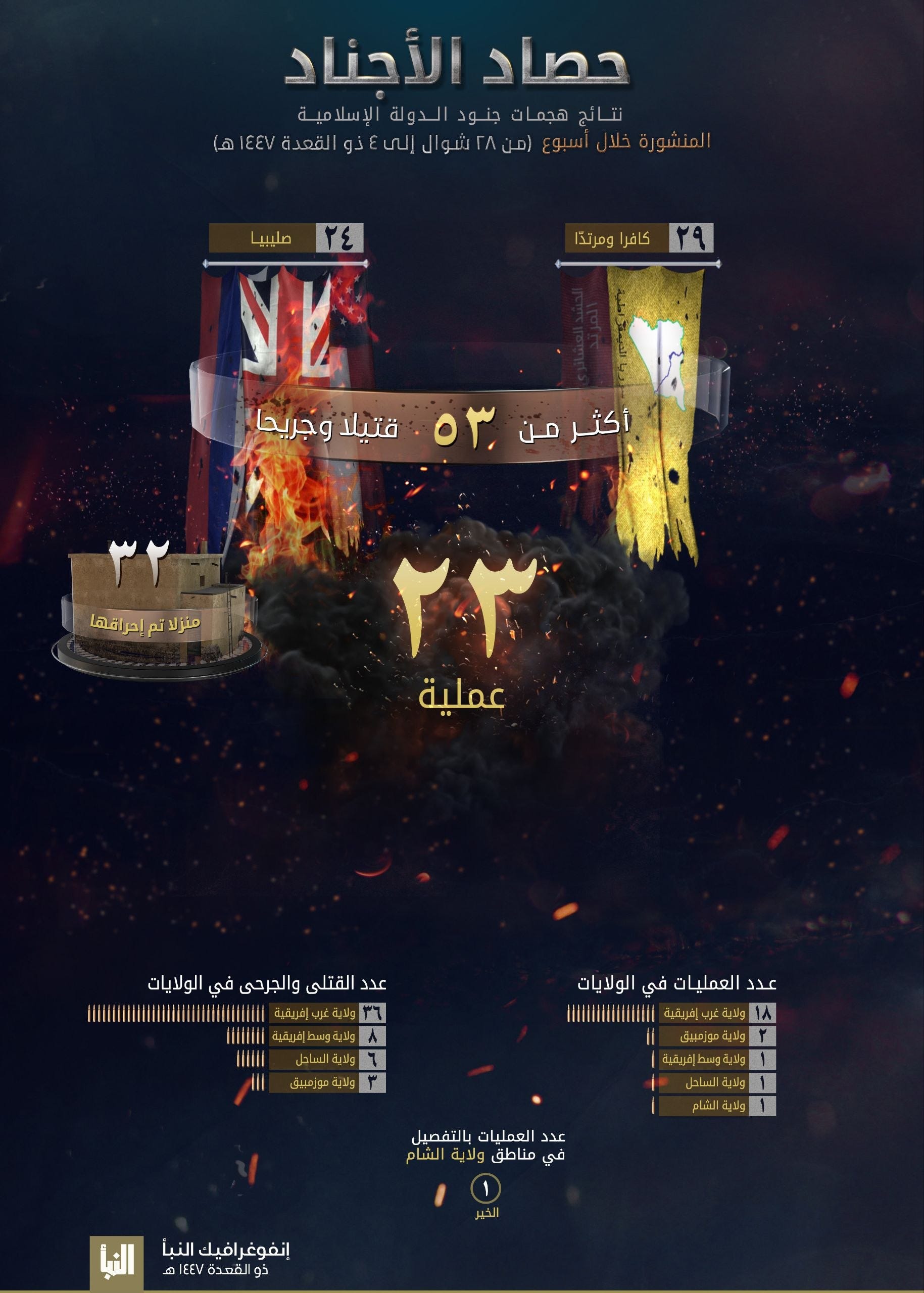
The main infographic summarises the areas affected by military operations this week, including: Nigeria, Niger, Cameroon, Syria, Mozambique, and the Democratic Republic of Congo.
IS claims to have conducted 23 operations in all the mentioned areas and to have caused 53 deaths and injuries.
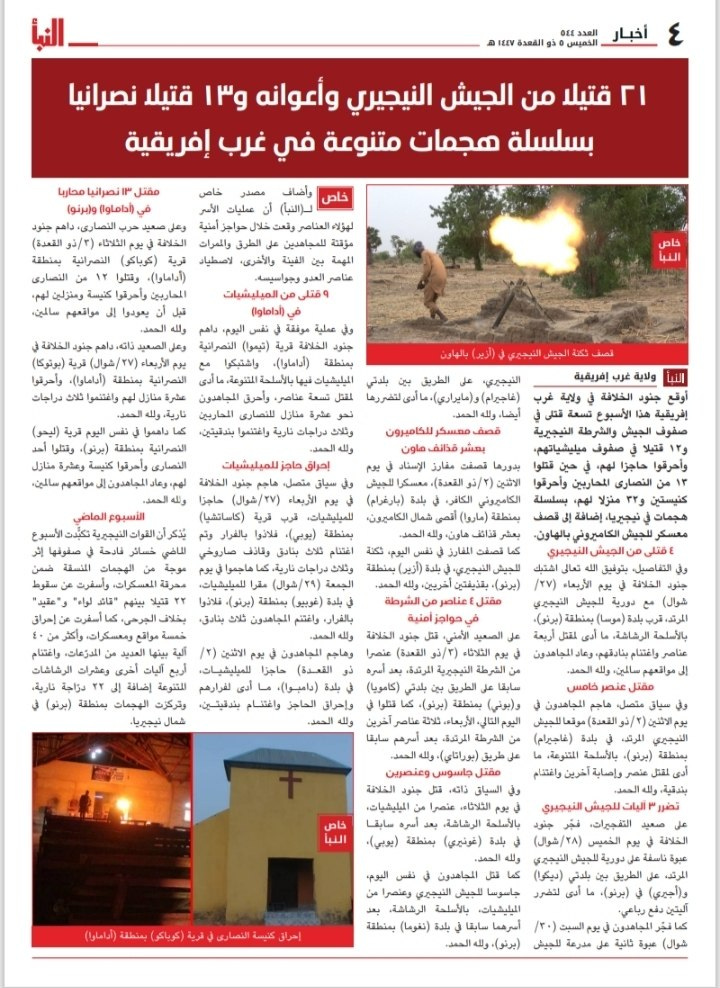
On the fourth page, the weekly magazine goes into detail about the types of attacks, operations, and targets of Islamic State fighters, who follow two main strategies: “war of attrition” and “economic warfare”, as well as other methods aimed at targeting Christians and Shiites. Since 20 March 2025, the Islamic State has embarked on a new military campaign, particularly in Africa (in the areas of Nigeria, Niger, Cameroon, and Mozambique) called “Burning Camps”.
Below is a detailed account of the attacks by province/area:
1) West Africa Province: The weekly al-Naba reports 18 operations carried out by ISWAP militants: 17 attacks against camps, barracks, checkpoints, convoys, and patrols belonging to the Nigerian Army, the Nigerian Police, and pro-government militias in the states of Borno, Yobe, and Adamawa, Nigeria; 1 attack against a Cameroonian army camp in the Maroua area, in the Far North region of Cameroon.
2) Central Africa Province: The weekly al-Naba reports on 1 attack carried out by ISCAP militants against a joint Congolese and Ugandan army patrol in Ituri Province, in the Democratic Republic of the Congo.
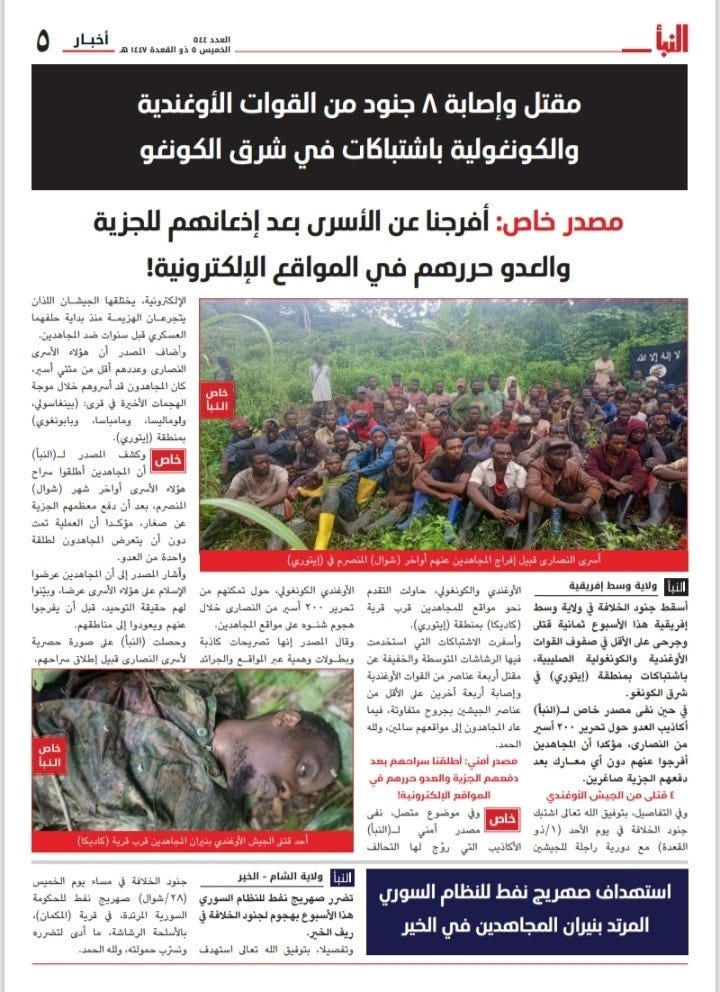
3) Sham Province: The weekly al-Naba reports on 1 operation carried out by Syrian militants against a government oil tanker convoy in the Deir ez-Zor governorate in Syria.
4) Sahel Province: The weekly al-Naba reports on 1 operation carried out by IS-Sahel militants against the headquarters of the Nigerien National Gendarmerie in the Tillaberi region of Niger.
5) Mozambique Province: The weekly al-Naba reports on 2 operations carried out by ISM militants against two positions held by pro-government militias in the Macomia district of Cabo Delgado Province.
CONCLUSION 1 — Strategic Impact and Operational Implications
Issue 544 confirms the persistence of an Africa-centric operational architecture, with West Africa Province acting as the primary engine of activity and shaping the overall threat posture. The concentration of 18 out of 23 operations in Nigeria and the Lake Chad Basin reinforces the assessment that ISWAP retains both operational depth and tactical continuity, sustaining pressure on military forces, police units, and pro-government militias across multiple states. This level of concentration is not incidental but reflects a mature insurgent ecosystem, characterized by mobility, local support, and adaptive targeting cycles.
The continued emphasis on attacks against camps, convoys, and checkpoints indicates a deliberate strategy aimed at degrading state presence in rural and semi-urban areas, eroding confidence in security provision, and maintaining freedom of maneuver. The extension of activity into Cameroon, albeit limited, signals cross-border elasticity and the ability to exploit weakly coordinated regional security frameworks.
Outside West Africa, activity remains calibrated and opportunistic. In Syria, the targeting of an oil tanker convoy reflects a sustained focus on economic warfare, aimed at disrupting regime-linked logistical and energy networks. In the Sahel, the attack on a gendarmerie headquarters confirms continued pressure on state security infrastructure and demonstrates the group’s intent to challenge authority nodes rather than only tactical units. In Mozambique and the Democratic Republic of Congo, operations remain limited in number but consistent in pattern, reinforcing localized insurgent persistence rather than expansion.
Overall, the operational picture reflects a stable attritional campaign, with no indication of systemic escalation but clear evidence of sustained capability to degrade state control in key theatres.
CONCLUSION 2 — Intelligence Evaluation and Outlook
The current reporting cycle reinforces the assessment that the Islamic State remains in a consolidation phase, prioritizing resilience, continuity, and incremental pressure over high-risk escalation. The distribution of 23 operations with relatively low reported lethality suggests a return to standard operational rhythm, characterized by dispersed attacks and controlled exposure.
West Africa continues to function as the strategic center of gravity, supported by resilient logistics, recruitment pipelines, and permissive terrain. The absence of complex or mass-casualty attacks indicates a deliberate avoidance of actions that would trigger concentrated counterterrorism responses, favoring a long-term erosion strategy instead.
Secondary theatres, including Syria, the Sahel, Central Africa, and Mozambique, display stable but limited activity, consistent with decentralized operational autonomy. The attack on economic assets in Syria and institutional targets in Niger indicates that the group retains the capability to target strategic nodes when conditions permit, selectively.
No evidence of doctrinal innovation, external operations planning, or coordinated multi-theatre escalation emerges. The organization’s posture remains defensive in strategic terms, but tactically active and locally disruptive.
Short-term outlook, 30 to 90 days, points toward continued attritional pressure in West Africa, with intermittent tactical spikes in the Sahel and Syria. The risk environment remains stable but structurally persistent, with volatility driven by local conditions rather than central strategic shifts.
Implications for Policy and Counterterrorism
Operational pressure should remain concentrated on West Africa, where the scale and frequency of attacks indicate the highest risk to regional stability. Priority should be given to disrupting ISWAP’s mobility corridors, logistics chains, and cross-border facilitation networks, particularly along the Nigeria-Niger-Cameroon interface.
Force protection measures require immediate reinforcement, especially for fixed positions, patrol routes, and convoy movements. Recurrent targeting patterns indicate exploitable vulnerabilities in perimeter defense, route predictability, and checkpoint resilience.
In the Sahel, targeted operations against institutional nodes such as the gendarmerie and administrative centers highlight the need to secure governance infrastructure, not just military assets. Coordination among regional forces remains insufficient and continues to present exploitable gaps.
In Syria, protection of economic infrastructure, including energy transport and supply routes, should be prioritized, as these assets remain attractive targets within the Islamic State’s economic warfare framework.
Civilian protection remains critical in Central Africa and Mozambique, where attacks against local militias and communities serve both operational and psychological functions. Strengthening local intelligence networks and early warning mechanisms is essential to mitigate coercive control dynamics.
Across all theatres, intelligence fusion, ISR coverage, and rapid response capabilities remain decisive factors in countering dispersed insurgent operations.
Tripwires — Assessment-Changing Indicators (Next 30–60 Days)
A shift from dispersed attacks to coordinated multi-target operations within a single theatre, particularly in West Africa, indicates increased command synchronization.
A significant increase in attack complexity, including SVBIED use, coordinated assaults on fortified bases, or mass-casualty urban operations, signaling elevated risk acceptance.
Expansion of operational activity into new geographic areas or sustained reactivation of dormant theatres, particularly outside Africa.
Repeated targeting of high-value economic infrastructure in Syria or elsewhere suggests a broader economic warfare campaign.
Increased frequency of cross-border operations between Nigeria, Niger, and Cameroon, indicating enhanced regional operational integration.
Evidence of external operations planning, including targeting of international interests or Western-linked assets.
A sustained rise in lethality levels over consecutive weeks indicates a transition from attritional pressure to escalation dynamics.
Indicators of strengthened alliances or operational coordination with other jihadist actors, particularly in the Sahel, could alter the current competitive landscape.
🔒 Executive Intelligence Cycle
This assessment is part of a broader analytical cycle.
Founding subscribers receive the Executive Intelligence Briefing, which integrates all threat assessments, cognitive domain analysis, and a rolling 30–90 day forecast into a single monthly strategic synthesis.
© Daniele Garofalo Monitoring - All rights reserved.
Daniele Garofalo is an independent researcher and analyst specializing in jihadist terrorism, Islamist insurgencies, and armed non-state actors.
His work focuses on continuous intelligence monitoring, threat assessment, and analysis of propaganda and cognitive/information dynamics, with an emphasis on decision-oriented outputs, early warning, and strategic trend evaluation.
ISSN (International Standard Serial Number): 3103-3520
NATO NCAGE: AX664 (NATO Commercial and Governmental Entity)
UNITED NATIONS Global Marketplace ID: 1210727
ORCID Code: 0009-0006-5289-2874