


Executive Intelligence Summary
The Islamic State’s weekly magazine, al-Naba, remains a critical source for assessing the organisation’s operational tempo, geographic dispersion, and signalling posture across theatres.
The weekly newsletter reached number 555 last Thursday.
The weekly newsletter’s increased focus on West Africa aims to underscore its critical role, encouraging the audience to recognise the region’s strategic significance and feel motivated to prioritise region-specific countermeasures.
Time horizon: 30–90 days
Confidence level: Medium.
Source Basis & Methodology
This assessment is based on a direct analysis of primary propaganda material from al-Naba Issue No. 555, including photographs, statements, and alleged military activities, which provides a comprehensive view of current operations.
The analysis integrates:
OSINT
IMINT
SOCMINT
to contextualise reported attacks and assess credibility and operational relevance.
Limitations & Analytical Notes
Reported casualty and damage figures may be exaggerated.
Some attacks are presented without independent verification.
The claims published in al-Naba are generally reliable regarding the occurrence of attacks; however, casualty and damage figures may be inflated for propaganda purposes, a fact that should be considered when assessing operational impact.
Claims published in al-Naba are assessed as generally reliable regarding the occurrence of attacks, while casualty figures and material damage are likely to be inflated for propaganda purposes. Analytical judgments in this assessment prioritise event verification and pattern analysis over reported impact.
Historically, Islamic State attack claims in al-Naba have mainly proven accurate in terms of occurrence, with inflation primarily affecting reported impact rather than event existence.
📌 Inside this Assessment
Activity and Operations Analysis
Number, Targets, and Areas of Attacks
Charts and Statistics
Strategic Impact and Operational Implications
Implications for Policy and Counterterrorism: Counterterrorism efforts should prioritise intelligence, rural security, and stabilisation, empowering the audience to take targeted action.
Issue 555, eight pages long, covers the week of 17 to 23 Muharram 1448, from 2 Jul8 to 8 July 2026.

Al-Naba generally includes most of the statements and photos published daily over the past week on its official channels, although often with new elements or additional details, both written and photographic. However, al-Naba won’t include unpublished statements or messages.
The main infographic summarises the areas affected by military operations this week, including:
Nigeria, Niger, Mozambique, Pakistan, Somalia, and the Democratic Republic of Congo.
IS claims to have conducted 32 operations in all the mentioned areas and to have caused 113 deaths and injuries.
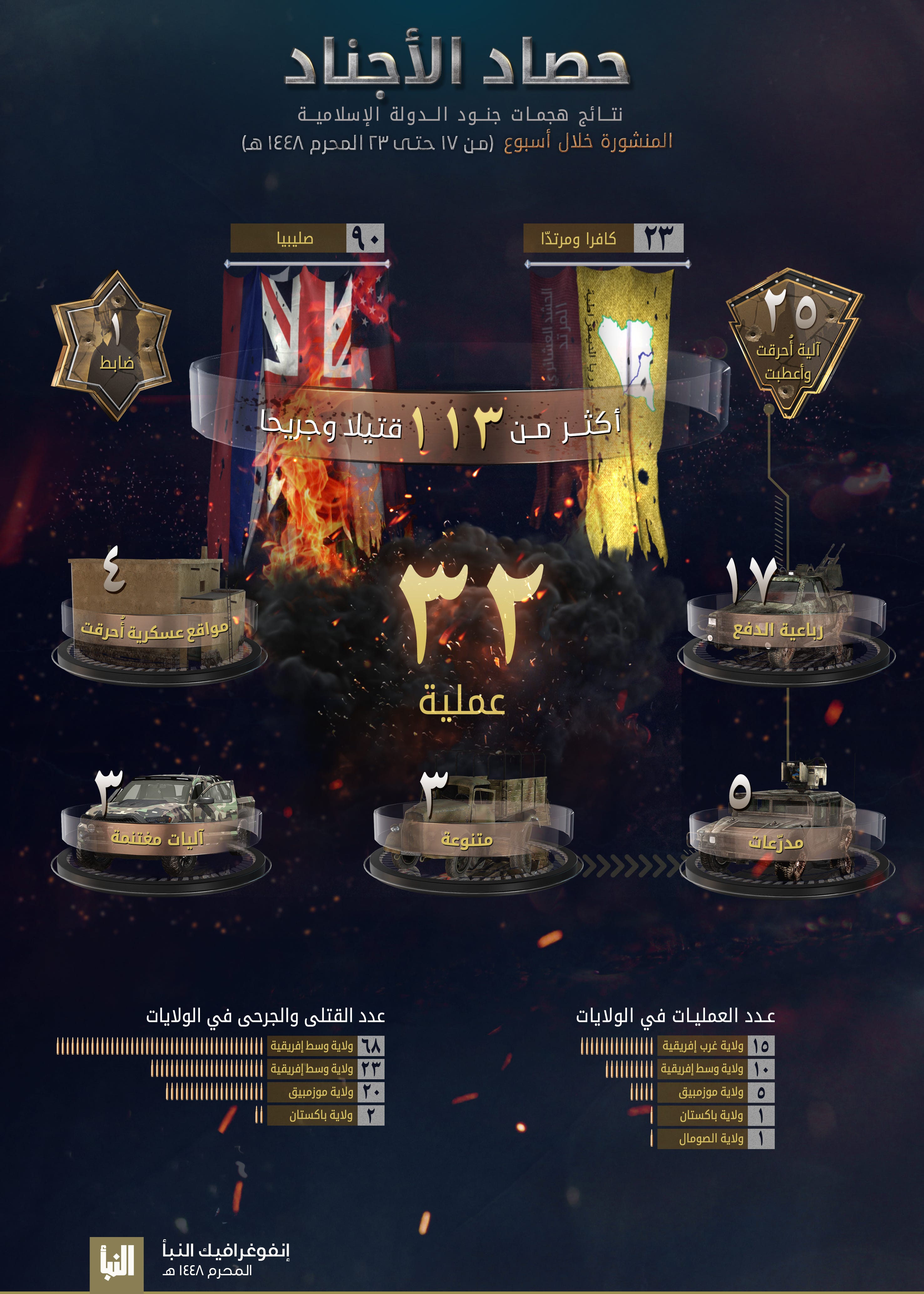
On the fourth page, the weekly magazine goes into detail about the types of attacks, operations, and targets of Islamic State fighters, who follow two main strategies: “war of attrition” and “economic warfare”, as well as other methods aimed at targeting Christians and Shiites. Since 20 March 2025, the Islamic State has embarked on a new military campaign, particularly in Africa (in the areas of Nigeria, Niger, Cameroon, and Mozambique), called “Burning Camps”.
Below is a detailed account of the attacks by province/area:
1) Central Africa Province: The weekly al-Naba reports that ISCAP militants carried out 10 attacks against checkpoints, patrols, and barracks belonging to the Congolese military in the provinces of Ituri and Haute Uele, in the Democratic Republic of the Congo.
2) West Africa Province: The weekly al-Naba reports that ISWAP militants carried out 15 attacks against checkpoints, convoys, and camps belonging to the Nigerian army and pro-government militias (as well as against civilians accused of being spies) in the states of Borno, Yobe, and Adamawa in Nigeria.
3) Province of Pakistan: The weekly al-Naba reports on one attack carried out by ISPP militants against pro-government militia fighters in the province of Balochistan, Pakistan.
4) Somali Province: The weekly al-Naba reports on one act of economic warfare carried out by Somali militants against two telecommunications towers (used by the Puntland Security Forces for counterterrorism operations) in the Bari region of the Federal State of Puntland, Somalia.
5) Mozambique Province: The weekly newspaper al-Naba reports on five operations carried out by ISM militants against the Mozambican and Rwandan armies in the districts of Muidumbe, Macomia, and Mocimboa da Praia, in the province of Cabo Delgado, Mozambique.
CONCLUSION 1 — Strategic Impact and Operational Implications
Issue 555 marks a significant increase in Islamic State operational tempo following the lower activity observed in the previous reporting period. The organisation claimed 32 attacks across six operational theatres, resulting in 113 reported deaths and injuries. The sharp increase in the number of operations confirms that the reduction recorded in Issue 554 represented a temporary fluctuation rather than a sustained decline. Islamic State affiliates continue to demonstrate the ability to regenerate operational activity while maintaining pressure across multiple regions rapidly.
West Africa Province once again emerged as the most active affiliate, accounting for nearly half of all reported attacks. The fifteen operations conducted across Borno, Yobe, and Adamawa targeted military camps, checkpoints, convoys, pro-government militias, and civilians accused of collaborating with state authorities. This pattern reflects ISWAP’s continued emphasis on degrading military mobility while simultaneously consolidating local influence through coercion and counterintelligence measures. The repeated targeting of suspected informants remains a critical component of the group’s effort to deny government forces actionable intelligence.
Central Africa Province maintained its position as the second most active theatre with ten attacks against Congolese military positions in Ituri and Haute Uele. Unlike previous weeks, civilian targets received less emphasis in al-Naba’s reporting, with the operational narrative focusing primarily on sustained attrition against security forces. This suggests a continued effort by ISCAP to preserve pressure on state military structures while maintaining freedom of movement across eastern Democratic Republic of the Congo.
Mozambique Province also demonstrated renewed operational activity through five attacks directed against Mozambican and Rwandan security forces in Cabo Delgado. The continued ability to engage two separate military actors illustrates that Islamic State Mozambique remains capable of operating despite sustained multinational counterinsurgency pressure. The attacks indicate that the affiliate retains sufficient operational depth to exploit local terrain and preserve dispersed insurgent cells.
The attacks reported in Pakistan and Somalia, although limited in number, remain strategically relevant. The operation claimed by Islamic State Pakistan Province in Balochistan highlights the diversification of Islamic State’s South Asian network beyond the traditional Khorasan theatre. Likewise, the deliberate destruction of telecommunications infrastructure in Puntland reflects the growing importance of economic warfare and infrastructure disruption within the organisation’s broader operational doctrine. Rather than producing immediate casualties, these attacks seek to degrade state command, communications, and counterterrorism capabilities over time.
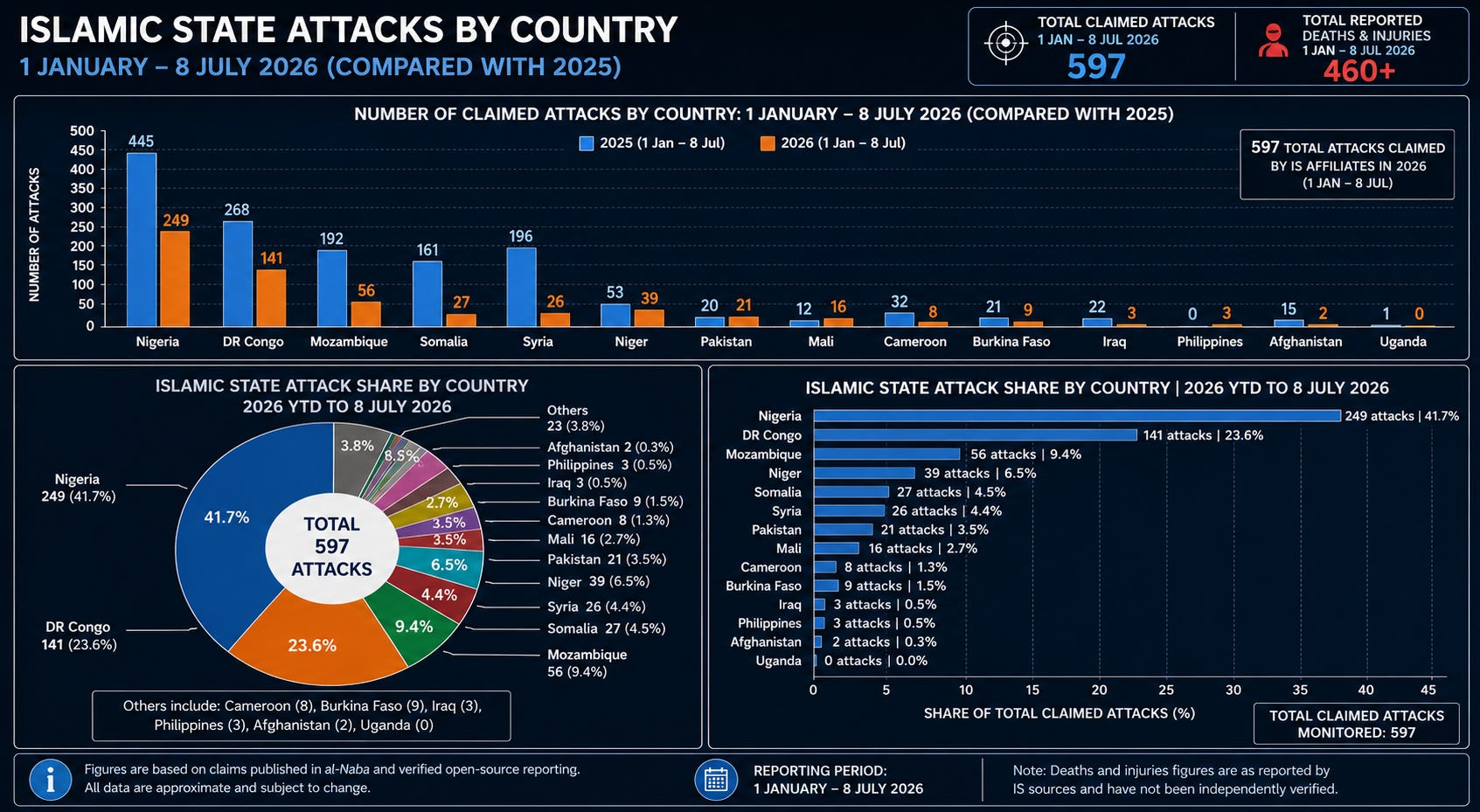
Taken together, Issue 555 reinforces the assessment that Islamic State continues to favour a model of geographically dispersed, locally adaptive insurgency. The organisation remains capable of simultaneously sustaining multiple regional campaigns while calibrating operational intensity according to local opportunities, security conditions, and affiliate capabilities. Africa continues to represent the principal centre of gravity of the movement, both in terms of operational volume and strategic significance.
CONCLUSION 2 — Implications for Policy and Counterterrorism
The operational developments presented in Issue 555 underline the necessity of maintaining sustained counterterrorism pressure despite periodic fluctuations in weekly attack numbers. The rapid increase from 16 attacks in Issue 554 to 32 attacks in Issue 555 demonstrates that Islamic State affiliates retain considerable operational resilience and can quickly restore offensive momentum after temporary periods of reduced activity.
For governments operating in the Lake Chad Basin, the continued predominance of ISWAP confirms that military containment alone remains insufficient to degrade the organisation’s long-term capabilities significantly. The persistent targeting of logistical assets, checkpoints, and local collaborators highlights the need to strengthen intelligence protection, improve convoy security, enhance surveillance along supply routes, and reinforce cooperation between military forces and local communities. Preventing the erosion of government intelligence networks should remain a strategic priority.
The sustained operational activity of ISCAP reinforces the need for a regional approach involving the Democratic Republic of the Congo, Uganda, and neighbouring states. Military operations should be accompanied by improved intelligence sharing, cross-border coordination, civilian protection measures, and initiatives aimed at reducing the permissive environment exploited by armed groups. Continued insurgent resilience in eastern Congo demonstrates that tactical successes have yet to translate into lasting strategic containment.
The growing diversification of Islamic State’s operational methods also deserves increased attention. The economic warfare attack against telecommunications infrastructure in Puntland illustrates an expanding emphasis on disrupting critical infrastructure supporting state security operations. Such attacks require comparatively limited resources but can generate significant operational effects by degrading communications, delaying military responses, and reducing situational awareness. Protection of communications infrastructure, energy networks, and logistical hubs should therefore become an increasingly integrated component of counterterrorism planning.
The appearance of Islamic State Pakistan Province alongside Islamic State Khorasan also warrants continued monitoring. Although current operational activity remains limited, the emergence of distinct provincial identities may reflect organisational adaptation rather than fragmentation. Intelligence services should closely monitor whether these provincial designations evolve into more autonomous operational structures with differentiated recruitment, command, or propaganda functions.
For NATO, European governments, and international security partners, Issue 555 further confirms that the principal strategic challenge posed by Islamic State lies in the durability of its regional affiliates rather than in any immediate prospect of rebuilding a territorial caliphate. The organisation continues to exploit fragile governance environments, porous borders, and protracted local conflicts to sustain long-term insurgencies. Counterterrorism policy should therefore prioritise persistent intelligence collection, regional partnerships, institutional resilience, protection of critical infrastructure, disruption of financial and logistical networks, and long-term capacity building for partner security forces. The current trajectory suggests that Islamic State remains strategically constrained at the global level but operationally resilient across several interconnected theatres, particularly in Africa, where its affiliates continue to generate the greatest level of sustained instability.
🔒 Executive Intelligence Cycle
This assessment is part of a broader analytical cycle.
Founding subscribers receive the Executive Intelligence Briefing, which integrates all threat assessments, cognitive domain analysis, and a rolling 30–90-day forecast into a single monthly strategic synthesis.
© Daniele Garofalo Monitoring - All rights reserved.
Daniele Garofalo is an independent researcher and analyst specialising in jihadist terrorism, Islamist insurgencies, and armed non-state actors.
His work focuses on continuous intelligence monitoring, threat assessment, and analysis of propaganda and cognitive/information dynamics, with an emphasis on decision-oriented outputs, early warning, and strategic trend evaluation.
ISSN (International Standard Serial Number): 3103-3520
NATO NCAGE: AX664 (NATO Commercial and Governmental Entity)
UNITED NATIONS Global Marketplace ID: 1210727
ORCID Code: 0009-0006-5289-2874