


Executive Intelligence Summary
The Islamic State’s weekly magazine, al-Naba, remains a critical source for assessing the organisation’s operational tempo, geographic dispersion, and signalling posture across theatres.
Issue No. 538 indicates:
Sustained multi-theatre operational activity across six primary theatres, with a pronounced concentration in West Africa, alongside lower intensity activity in Syria, the Sahel, Central Africa, Somalia, and Pakistan.
A notable increase in operational tempo, especially in West Africa, with 26 claimed attacks and 110 reported casualties, underscores the region’s growing strategic importance and ongoing threat.
A clear operational concentration in West Africa Province, where 18 attacks targeted Nigerian army camps, barracks, and convoys in Borno and Yobe, confirming ISWAP as the most operationally active and capable affiliate within the Islamic State network.
Continued reliance on low to moderate complexity tactics, including raids on military camps, attacks against convoys and patrols, harassment of checkpoints, and small-scale targeted killings, indicates a consistent operational approach that supports reliable threat forecasting.
Stable insurgent activity in Syria, where attacks against Syrian army units, police, and Kurdish SDF elements in Aleppo, Deir ez-Zor, and al-Hasaka indicate the continued presence of clandestine cells.
Limited but persistent activity in secondary theatres, including the eastern Democratic Republic of Congo, Somalia, the Sahel, and Pakistan, reflects ongoing regional challenges and the need for continued vigilance, even without signs of coordinated escalation.
Propaganda messaging remains centred on the “war of attrition” and “economic warfare” narratives, reinforced by the infographic highlighting attacks on Nigerian army camps under the “Burning Camps” campaign framework.
Security force mobility, camp protection, and convoy security remain structural vulnerabilities in Nigeria, Niger, and eastern Democratic Republic of Congo, areas where Islamic State affiliates continue to impose sustained operational pressure.
Threat level: Medium–High, stable with episodic operational spikes
Trend: → stable with increased West Africa concentration
Time horizon: 30–90 days
Confidence level: Medium
Inside This Assessment
This intelligence brief provides a structured analysis of the Islamic State’s operational activity, based on al-Naba Issue No. 538, to inform decisions on threat dynamics, operational patterns, and strategic intent.
Specifically, this assessment:
Examines claimed Islamic State operations by province and theatre, highlighting geographic concentration, targeting priorities, and operational tempo to guide regional focus.
Analyses tactical patterns and methods, including attrition-focused attacks, economic warfare activities, selective high-impact strikes, and coercive violence against civilian populations, particularly religious minorities.
Evaluates the strategic messaging and signalling function of al-Naba, distinguishing between propaganda intent and assessed operational relevance.
Identifies specific indicators-tripwires-that would signal a shift from sustained pressure to escalation, supporting early warning and strategic decision-making.
Derives policy-relevant implications for counterterrorism, partner-force support, civilian protection, and early warning.
This document is intended for intelligence analysts, military planners, counterterrorism practitioners, and policy decision-makers who require a concise yet analytically rigorous overview of the Islamic State’s current operational posture and short-term outlook. remains a reliable indicator of the Islamic State’s operational intent and activity, making it essential for analysts tracking threat trends despite known exaggerations
Key Intelligence Question (KIQ): Is the Islamic State’s current operational activity indicative of a strategic shift toward escalation, or does it reflect a deliberate phase of consolidation aimed at preserving long-term operational resilience? Focusing on this question guides strategic analysis and decision-making.
Is the Islamic State’s current operational activity indicative of a strategic shift toward escalation, or does it reflect a deliberate phase of consolidation aimed at preserving long-term operational resilience?
This assessment evaluates operational reporting, geographic dispersion, targeting patterns, and propaganda signalling to address the question above.
Key Judgments
Al-Naba continues to function as a reliable indicator of operational intent and activity, despite known exaggerations in damage claims.
The geographic dispersion of reported attacks confirms the Islamic State’s ability to sustain multi-theatre operational pressure.
No systemic innovation in tactics is evident, though limited expansion in target selection suggests selective experimentation rather than doctrinal change.
Media output prioritises continuity and legitimacy rather than signalling escalation.
Quantitative trends remain consistent with previous weekly patterns.
Key Assumptions
• Reporting published in al-Naba remains a consistent indicator of Islamic State operational activity, despite systematic exaggeration of casualty figures and material impact.
• Weekly patterns of attack claims are assessed as reflective of near-term strategic intent rather than random or purely opportunistic fluctuations.
• The geographic dispersion of reported operations implies the continued functionality of a decentralised but coherent command-and-control structure across multiple wilayat.
• African provinces retain sufficient tactical autonomy to conduct operations independently while remaining strategically aligned with central Islamic State guidance.
• Local support networks, recruitment pipelines, and logistical facilitation in African theatres remain sufficiently intact to sustain low-intensity operations in the short to medium term.
• High-impact attacks against strategic infrastructure are assessed as opportunistic or theatre-specific rather than indicative of a coordinated escalation strategy at the global level.
Source Basis & Methodology
This assessment is based on a direct analysis of primary propaganda material in al-Naba Issue No. 538, including photographs, statements, and alleged military activities.
The analysis integrates:
OSINT,
IMINT,
SOCMINT,
Digital HUMINT,
to contextualise reported attacks and assess credibility and operational relevance.
Limitations & Analytical Notes
Reported casualty and damage figures may be exaggerated.
Some attacks are presented without independent verification.
Where claims cannot be corroborated, this is explicitly noted in the analysis.
Claims published in al-Naba are assessed as generally reliable regarding the occurrence of attacks, while casualty figures and material damage are likely to be inflated for propaganda purposes. Analytical judgments in this assessment prioritise event verification and pattern analysis over reported impact.
Historically, Islamic State attack claims in al-Naba have mainly proven accurate in terms of occurrence, with inflation primarily affecting reported impact rather than event existence.
The weekly newsletter reached number 538 last Thursday.
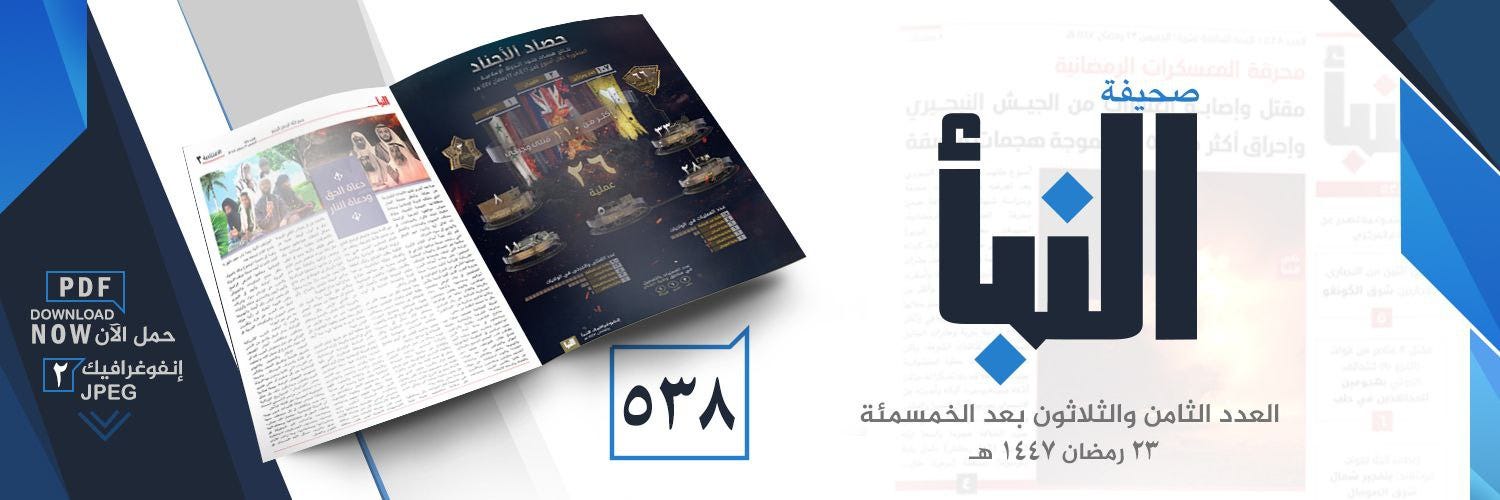
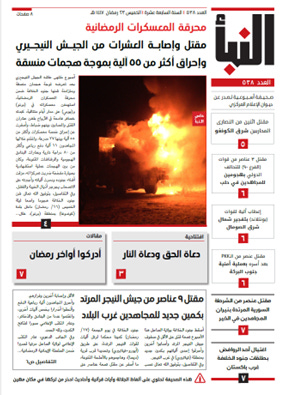
Issue 538, eight pages long, covers the week of 9 to 15 Ramadan 1447, from 5 to 11 March 2026.
Al-Naba generally includes most of the statements and photos published daily over the past week on its official channels, although often with new elements or additional details, both written and photographic. However, al-Naba won’t include unpublished statements or messages.
The main infographic summarises the areas affected by military operations this week, including Nigeria, Niger, Syria, Somalia, Pakistan, and the Democratic Republic of Congo.