


Violence in the eastern Democratic Republic of the Congo is often described as isolated events. Villages are attacked, civilians are killed, and communities are forced to flee. However, when viewed over time, a more consistent pattern emerges.
Since early 2026, the Islamic State Central Africa Province (ISCAP) has maintained a steady level of activity across North Kivu and Ituri. Attacks have targeted both civilian populations and security forces, including ambushes on military patrols and incidents affecting economic infrastructure such as mining sites. At the same time, repeated assaults on rural communities, particularly Christian villages, have contributed to ongoing displacement and instability.
These attacks follow recognizable patterns that highlight ISCAP’s tactics and influence, occurring in areas with limited state presence and targeting vulnerable moments like religious gatherings and isolated settlements, which over time weaken local communities and hinder recovery.
Rather than seeking to control territory in a conventional sense, ISCAP relies on repeated disruption. Violence influences local behavior and perceptions, creating a sense of urgency for policymakers to address these social impacts.
The result is a security environment in which instability persists even in the absence of a continuous insurgent presence. Understanding this pattern is essential for assessing current developments and for identifying the limits of existing responses.
ISCAP in Eastern Congo: Organizational Evolution
The organizational evolution from the Allied Democratic Forces to ISCAP reflects a strategic shift that consolidates ideology, gains external validation, and enhances operational adaptability, all of which are crucial for understanding its current resilience and tactics.
The ADF has historically functioned as a localized insurgent actor with hybrid motivations, including political grievances, criminal revenue generation, and religious radicalization. Its pledge of allegiance to the Islamic State marked a transition toward integration within a transnational jihadist ecosystem. This integration did not imply direct command and control from the Islamic State core, but rather alignment within a franchise architecture characterized by branding, media amplification, and selective doctrinal diffusion.
The resulting entity operates as a semi-autonomous node within the broader Islamic State’s global structure. The Congolese theater provides strategic utility by demonstrating geographic reach, sustaining propaganda output, and maintaining the perception of organizational vitality despite territorial losses in Iraq and Syria. Within the eastern DRC, ISCAP retains a dispersed operational footprint concentrated in forested areas of North Kivu and Ituri, leveraging terrain complexity to sustain mobility and concealment.
The organization’s structure appears decentralized at the tactical level, relying on small assault elements capable of rapid movement. Leadership cohesion is maintained through ideological indoctrination, coercive discipline, and the circulation of operational directives that emphasize both lethality and unpredictability.
Recent Trends in ISCAP Activity: A Sustained Increase in Attacks
From late January through April 2026, ISCAP’s sustained and increasing activity across North Kivu and Ituri demonstrates its operational resilience, with continued ambushes, attacks on infrastructure, and assaults on rural communities, emphasizing the ongoing threat in eastern Congo.
This continuity matters. It suggests that the group is not experiencing temporary fluctuations in activity, but rather operating with a degree of consistency that allows it to strike across multiple locations over time. Maintaining such a tempo requires more than tactical initiative. It implies reliable movement routes, access to fighters, and the ability to coordinate attacks without significant disruption.
Patterns observed in recent weeks reinforce this assessment. ISCAP has targeted both civilian and military objectives, including attacks on Christian villages in the Mambasa area and ambushes against Congolese and allied forces. In one instance, the group claimed responsibility for an attack on a convoy protecting a mining site, reporting multiple casualties among soldiers and pro-government militias, as well as the destruction of equipment and infrastructure.
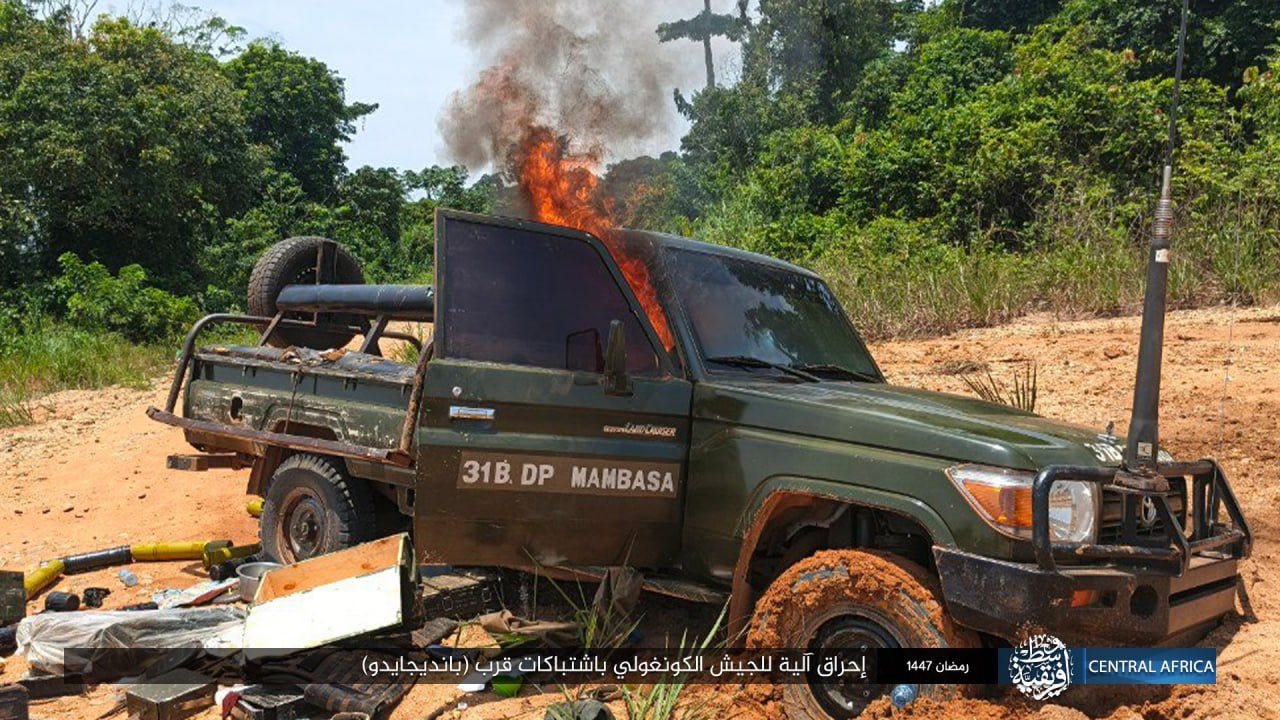
Groups under pressure tend to reduce activity or regroup, but ISCAP continues to operate across different areas without a visible reduction in tempo. This resilience underscores the importance of sustained strategic efforts.
When viewed in a broader context, eastern Congo remains one of the most active environments for Islamic State-linked violence globally. The persistence of attacks over several months indicates that the group is not only present but also able to sustain pressure over time. This has direct implications for local security dynamics and for the broader assessment of Islamic State activity in Africa.
Patterns of Violence: How ISCAP Conducts Its Attacks
Recent attacks attributed to ISCAP show a consistent pattern rather than isolated episodes of violence. The group tends to target rural communities that are difficult to defend, often located along secondary routes or near forested areas that provide cover and easy escape.
This pattern has continued in recent months, with repeated incidents in areas such as Mambasa in Ituri province, where both civilian communities and security forces have been targeted. The choice of location is not random. These are areas where state presence is limited and where response times are slow, allowing attackers to operate with relative freedom.
