

Executive Intelligence Summary
The Islamic State’s weekly magazine, al-Naba, continues to serve as a vital source for assessing the organisation’s operational tempo, geographic attack distribution, and strategic messaging, ensuring analysts remain focused on key indicators.
Issue No. 530 indicates:
sustained operational activity across multiple provinces,
continuity in attack patterns rather than escalation,
Stable propaganda framing focused on operational legitimacy and territorial persistence.
Disruption of logistics and governance remains key to countering IS, highlighting opportunities for strategic action to weaken their operational capabilities.
Threat level: Medium–High
Trend: → (stable)
Time horizon: 30–60 days
Confidence level: Medium.
Inside This Assessment
This intelligence brief provides a structured analytical assessment of the Islamic State’s operational activity, as reported in al-Naba Issue No. 530, covering the period under review and focusing on threat dynamics, operational patterns, and strategic intent.
Specifically, this assessment:
Examines claimed Islamic State operations by province and theatre, identifying geographic concentration, targeting priorities, and operational tempo.
Analyses tactical patterns and methods, including attrition-focused attacks, economic warfare activities, and coercive violence against civilian populations, particularly religious minorities.
Evaluates the strategic messaging and signalling function of al-Naba, distinguishing between propaganda intent and assessed operational relevance.
Assesses the Central Africa Province (ISCAP) retrospective infographic as an indicator of sustained campaign activity and population-control tactics.
Identifies specific indicators-tripwires-that would signal a shift from sustained pressure to escalation, supporting early warning and strategic decision-making.
Derives policy-relevant implications for counterterrorism, partner-force support, civilian protection, and early warning.
This document is intended for intelligence analysts, military planners, counterterrorism practitioners, and policy decision-makers who require a concise yet analytically rigorous overview of the Islamic State’s current operational posture and short-term outlook.
Key Intelligence Question (KIQ)
Is the Islamic State’s current operational activity indicative of a strategic shift toward escalation, or does it reflect a deliberate phase of consolidation aimed at preserving long-term operational resilience?
This assessment evaluates operational reporting, geographic dispersion, targeting patterns, and propaganda signalling to address the question above.
Key Judgments
Al-Naba continues to function as a reliable indicator of operational intent and activity, despite known exaggerations in damage claims.
The geographic dispersion of reported attacks confirms the Islamic State’s ability to sustain multi-theatre operational pressure.
No significant innovation in tactics or target selection is evident in this issue.
Media output prioritises continuity and legitimacy rather than signalling escalation.
Quantitative trends remain consistent with previous weekly patterns.
Key Assumptions
• Reporting published in al-Naba remains a consistent indicator of Islamic State operational activity, despite systematic exaggeration of casualty figures and material impact.
• Weekly patterns of attack claims are assessed as reflective of near-term strategic intent rather than random or purely opportunistic fluctuations.
• The geographic dispersion of reported operations implies the continued functionality of a decentralised but coherent command-and-control structure across multiple wilayat.
• African provinces retain sufficient tactical autonomy to conduct operations independently while remaining strategically aligned with central Islamic State guidance.
• Local support networks, recruitment pipelines, and logistical facilitation in African theatres remain sufficiently intact to sustain low-intensity operations in the short to medium term.
Source Basis & Methodology
This assessment is based on direct analysis of primary propaganda material contained in al-Naba Issue No. 530, including photographs, statements, and claimed military activities.
The analysis integrates:
OSINT,
IMINT,
SOCMINT,
Digital HUMINT,
to contextualise reported attacks and assess credibility and operational relevance.
Limitations & Analytical Notes
Reported casualty and damage figures may be exaggerated.
Some attacks are presented without independent verification.
Where claims cannot be corroborated, this is explicitly noted in the analysis.
Claims published in al-Naba are assessed as generally reliable regarding the occurrence of attacks, while casualty figures and material damage are likely to be inflated for propaganda purposes. Analytical judgments in this assessment prioritise event verification and pattern analysis over reported impact.
Historically, Islamic State attack claims in al-Naba have mainly proven accurate in terms of occurrence, with inflation primarily affecting reported impact rather than event existence.
The weekly newsletter reached number 530 last Thursday.
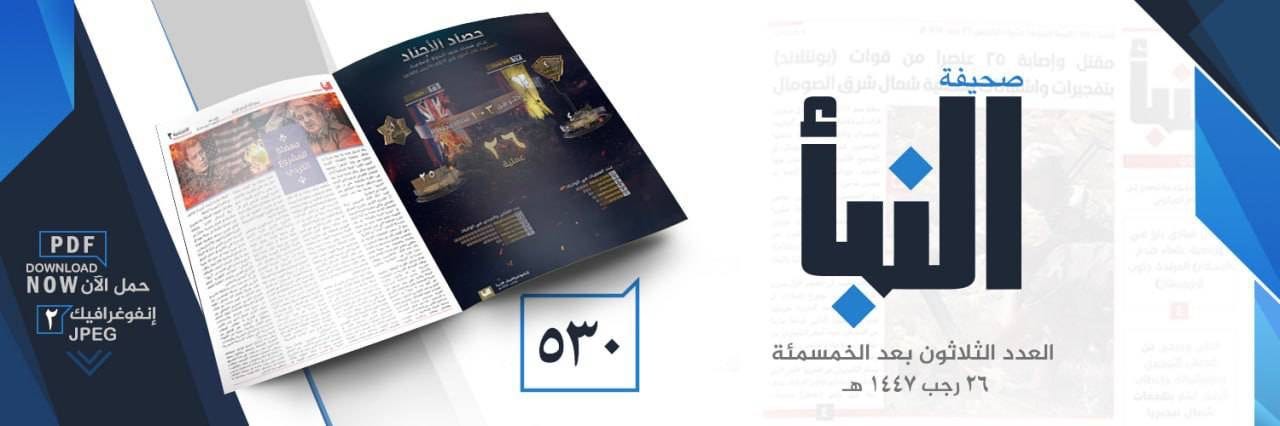
Issue 530, eight pages long, covers the week of 19 to 25 Rajab 1447, from 8 to 15 January 2026.
