


Executive Summary
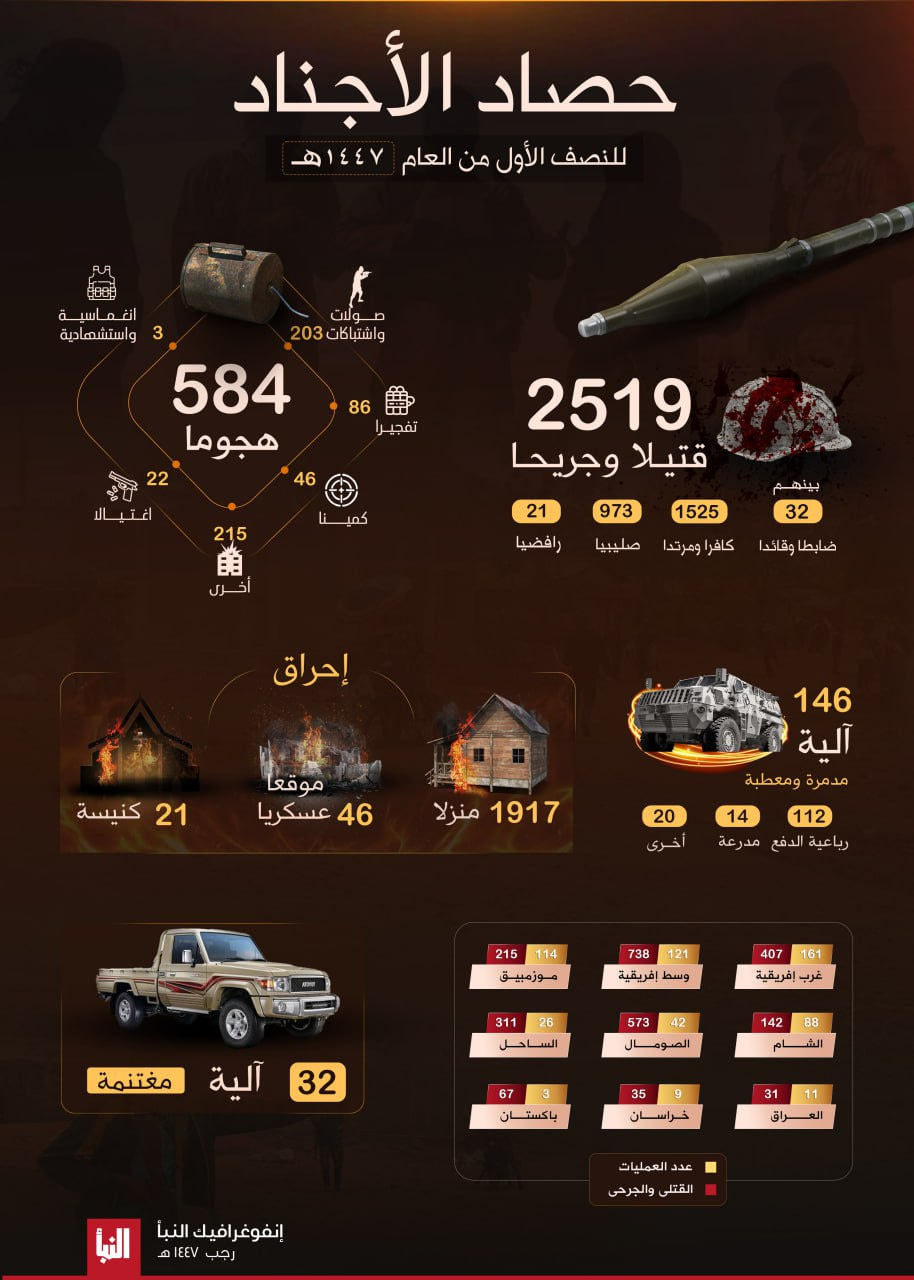
This analysis examines the infographic published in al-Naba’ issue 527 as a deliberate cognitive warfare artefact rather than as a mere propaganda or informational product. The document is designed to operate within the cognitive domain by shaping perception, sustaining organisational morale, and normalising a strategy of long-term persistence under conditions of material constraint.
Drawing on established operational trends and comparative data, this assessment treats the infographic as a case study in perception management, narrative engineering, and symbolic aggregation. The focus is not on the factual accuracy of the figures presented, but on how quantitative claims, visual framing, and selective categorisation are employed to construct a coherent cognitive environment favourable to the Islamic State’s strategic needs.
The analysis finds that al-Naba’ 527 functions primarily as a morale-sustaining and legitimacy-preserving mechanism, aimed at internal cadres and committed sympathisers rather than mass recruitment. The infographic reframes operational limitations as indicators of resilience, geographic dispersion as strategic reach, and declining lethality as continuity of jihad.
In this sense, the product exemplifies a mature phase of Islamic State cognitive warfare: one that does not attempt to project imminent victory, but instead seeks to normalise endurance, mitigate perceptions of decline, and maintain relevance across multiple audiences despite the absence of strategic momentum.
Key Cognitive Judgements
KCJ-1. The infographic published in al-Naba’ 527 represents a standardised and institutionalised cognitive warfare practice, consistent with Islamic State visual and narrative production over the past decade, rather than an ad hoc or innovative communication effort. (High confidence)
KCJ-2. The visual structure, iconography, and graphic logic of the infographic deliberately replicate earlier Islamic State products, reinforcing familiarity, continuity, and organisational stability within its cognitive ecosystem. (High confidence)
KCJ-3. This long-term graphic standardisation functions as a cognitive anchoring mechanism, enabling audiences to interpret new data through established frames, thereby reducing uncertainty and mitigating perceptions of decline. (High confidence)
KCJ-4. Quantitative aggregation and geographic diffusion are employed not to demonstrate operational superiority, but to normalise persistence and survivability as strategic success criteria. (High confidence)
KCJ-5. The infographic’s primary cognitive function is internal signalling—sustaining morale, discipline, and legitimacy among cadres and committed supporters—rather than external recruitment or intimidation. (High confidence)
KCJ-6. The consistency of this format over time indicates an organisation that treats cognitive warfare as a routine operational domain, not as an auxiliary or reactive function. (High confidence)
KCJ-7. The cognitive effect sought is the stabilisation of expectations: a long-term, low-intensity jihad is framed as normal, acceptable, and strategically meaningful. (Medium–High confidence).
Analytical Scope and Approach
This assessment focuses exclusively on the cognitive domain, defined as the space in which meaning, perception, legitimacy, and behavioural normalisation are constructed and contested.
The analysis examines:
visual framing and graphic design choices,
narrative aggregation of quantitative data,
symbolic categorisation of targets and enemies,
intended audience segmentation,
Alignment between material constraints and cognitive messaging.
Operational data and comparative trends are used only as contextual grounding, not as the object of analysis. The purpose is to understand how reality is cognitively re-engineered, not to reassess the reality itself.
Methodology
This assessment applies a qualitative cognitive warfare framework to the infographic published in al-Naba’ issue 527, treating it as a deliberate cognitive artefact rather than a neutral informational product.
The methodology combines:
Longitudinal comparison of Islamic State visual products, leveraging a decade-long corpus of similar infographics to identify patterns of standardisation, continuity, and doctrinal consistency.
Narrative and framing analysis, examining how quantitative data, categories, and labels are structured to generate specific cognitive effects, including normalisation, legitimacy reinforcement, and expectation management.
Visual semiotic analysis, focusing on layout, repetition of graphic elements, iconography, and the deliberate absence of contextual or countervailing information.
Audience-oriented assessment, evaluating how different target audiences (internal cadres, committed supporters, external observers) are cognitively positioned through the product’s design and messaging.
Operational data and strategic assessments derived from prior analyses are used solely as contextual grounding to identify dissonance or alignment between material realities and cognitive representation. The factual accuracy of the reported figures is not assessed, as the analytical focus lies on perceptual impact rather than empirical verification.
Limitations and Analytical Caveats
This cognitive domain analysis is subject to several inherent limitations.
First, the interpretation of cognitive intent is inferential by nature. While the Islamic State’s long-term consistency in visual and narrative production supports high-confidence judgments regarding deliberate design, direct access to internal decision-making processes remains unavailable.
Second, the analysis does not measure actual audience reception or behavioural impact. The cognitive effects identified represent intended and plausible outcomes, not empirically validated responses among specific audience segments.
Third, the focus on a single infographic, albeit contextualised within a decade-long pattern, may underrepresent short-term tactical variations or internal debates within the organisation’s media apparatus.
Finally, this assessment does not account for countervailing cognitive pressures, including counter-messaging, platform moderation, or audience fatigue, which may attenuate the effectiveness of Islamic State cognitive warfare over time.
These limitations do not invalidate the analysis but underscore that its findings concern cognitive design and intent, not guaranteed cognitive success.
The Infographic as a Cognitive Weapon
The infographic published in al-Naba’ 527 must be interpreted as a low-intensity cognitive weapon medium, designed not to produce informational shocks but to generate perceptual stability. The choice of graphic format is not random: infographics allow us to condense operational complexities into an immediately intelligible language, reducing the cognitive burden on the reader and minimising the space for critical doubt.
Unlike videos or text releases, infographics do not require intense emotional involvement or advanced ideological literacy. It functions as an object of consultation, rather than as a message to be interpreted. This makes it particularly suited to supporting a long-term strategy, where the goal is not to mobilise, but to maintain alignment and continuity.
Over time, the Islamic State has transformed this format into a true cognitive technology, integrated into its communication routine. The weapon is not the content itself, but the repeatability of the content.
Standardisation, Repetition, and Cognitive Anchoring
One of the most relevant elements of infographics is its almost perfect graphic overlap with similar products that have become widespread over the last ten years. Colours, icons, layout, section structure, and even the visual hierarchy of information follow a well-established pattern.
This standardisation produces a cognitive anchoring effect: each new piece of data is automatically interpreted in light of already internalised mental patterns. Graphical familiarity reduces the perception of historical discontinuity and attenuates the psychological impact of any operational regressions. Even in the presence of declining numbers, formal continuity implicitly suggests strategic continuity.
Repetition does not signal communicative stagnation, but organisational discipline. In cognitive terms, IS behaves like an institution that defends its identity through visual rituals, similar to what established state or military actors do.
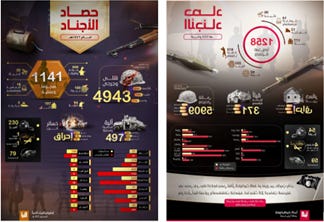
Fig. 1 - Some of the previous annual infographics
Quantification as Cognitive Legitimisation
The centrality of numbers in infographics responds to a precise logic: quantifying means legitimising. In the absence of obvious strategic victories, numbers become a surrogate for success. Volume replaces quality; the sum of events replaces the assessment of their impact.
This dynamic is well documented in the propaganda literature of non-state armed organisations: numerical aggregation allows for the depoliticisation of defeat, transforming war into an arithmetic sequence devoid of context. It doesn’t matter what was hit, where, or with what strategic effect: what matters is that “something” happened, and that it continues to happen.
In this sense, quantification serves to build performative legitimacy: the organisation exists because it acts; it acts because it exists.
Geographic Diffusion and the Illusion of Ubiquity
The emphasis on geographic spread is another central cognitive pillar. The implicit map that emerges from the infographic does not communicate concentration, but omnipresence. This message is cognitively powerful: dispersion is perceived as force, not fragmentation.
In fact, as numerous studies on the post-2018 jihadist insurgency demonstrate, geographic dispersion is often related to weakness in central command and reduced coordination capacity. However, in the cognitive domain, this relationship is reversed: being “anywhere” becomes evidence of resilience.
Africa, in particular, is presented as a space of continuity and vitality, not as a peripheral theatre. In this way, IS manages to shift its narrative centre of gravity without having to make it explicit, avoiding the implicit recognition of the loss of centrality of Syria and Iraq.
Target Categorisation and Moral Framing
Target classification is not neutral. The categories used, “apostates”, “crusaders”, “Rafidi”, perform a function of radical moral simplification. The world is divided into clear, unambiguous ethical blocks, facilitating cognitive adherence and reducing the risk of internal dissonance.
This categorisation also has a disciplinary function. Labelling enemies in a moralised way allows us to neutralise internal doubts and justify violence as necessary, regardless of the context or actual victims. It is a framing strategy that prioritises ideological coherence over empirical plausibility.
In the long run, this language helps maintain a closed cognitive community, resistant to competing external or narrative information.
Audience Targeting and Internal Signalling
Despite the apparent global openness, the infographic is clearly geared towards a narrow audience. The language, categories, and format presuppose ideological familiarity and an already high level of commitment. This is not a mass recruitment product.
The primary function is internal signalling: to demonstrate that the organisation is active, consistent, and disciplined. For middle managers and peripheral cells, infographics serve as a cognitive alignment tool, reducing the risk of disillusionment or fragmentation.
Cognitive Effects and Strategic Implications
The overall cognitive effect of infographics is the normalisation of a low-intensity balance. Violence is no longer presented as a means of gaining power, but as a permanent condition of existence. This has relevant strategic implications.
In the short to medium term, such framing reduces the likelihood of sudden escalations but increases the resilience of the organisation. In the long term, it helps stabilise IS as a chronic player of instability, difficult to eradicate precisely because it no longer aims for ambitious and visible goals.
From a contrast perspective, this requires cognitive strategies oriented not towards refuting numbers, but towards delegitimising the paradigm of persistence as success.
Conclusions
Analysis of the al-Naba’ 527 infographic shows that the Islamic State’s cognitive warfare has reached a stage of adaptive maturity. It is no longer a question of convincing, mobilising, or intimidating on a large scale, but of supporting a self-sufficient cognitive ecosystem, capable of surviving even in conditions of operational decline.
Graphic standardisation, ritualised quantification, and symbolic geographic diffusion are not signs of growing strength but indicators of an organisation that has accepted its limitations and transformed them into a narrative of resilience.
Underestimating this dimension would be to confuse the absence of escalation with the absence of threat. In reality, IS’s true residual strength today lies not in its ability to strike, but in its ability to make its own failure acceptable as a normal state.
© Daniele Garofalo Monitoring - All rights reserved.
Daniele Garofalo is an independent researcher and analyst specialising in jihadist terrorism, Islamist insurgencies, and armed non-state actors.
His work focuses on continuous intelligence monitoring, threat assessment, and analysis of propaganda and cognitive/information dynamics, with an emphasis on decision-oriented outputs, early warning, and strategic trend evaluation.
Daniele Garofalo Monitoring is registered with the Italian National ISSN Centre and the International Centre for the Registration of Serial Publications (CIEPS) in Paris.ISSN (International Standard Serial Number): 3103-3520ORCID Code: 0009-0006-5289-2874.Support my research, analysis and monitoring with a donation here, PayPal.Me/DanieleGarofalo88