


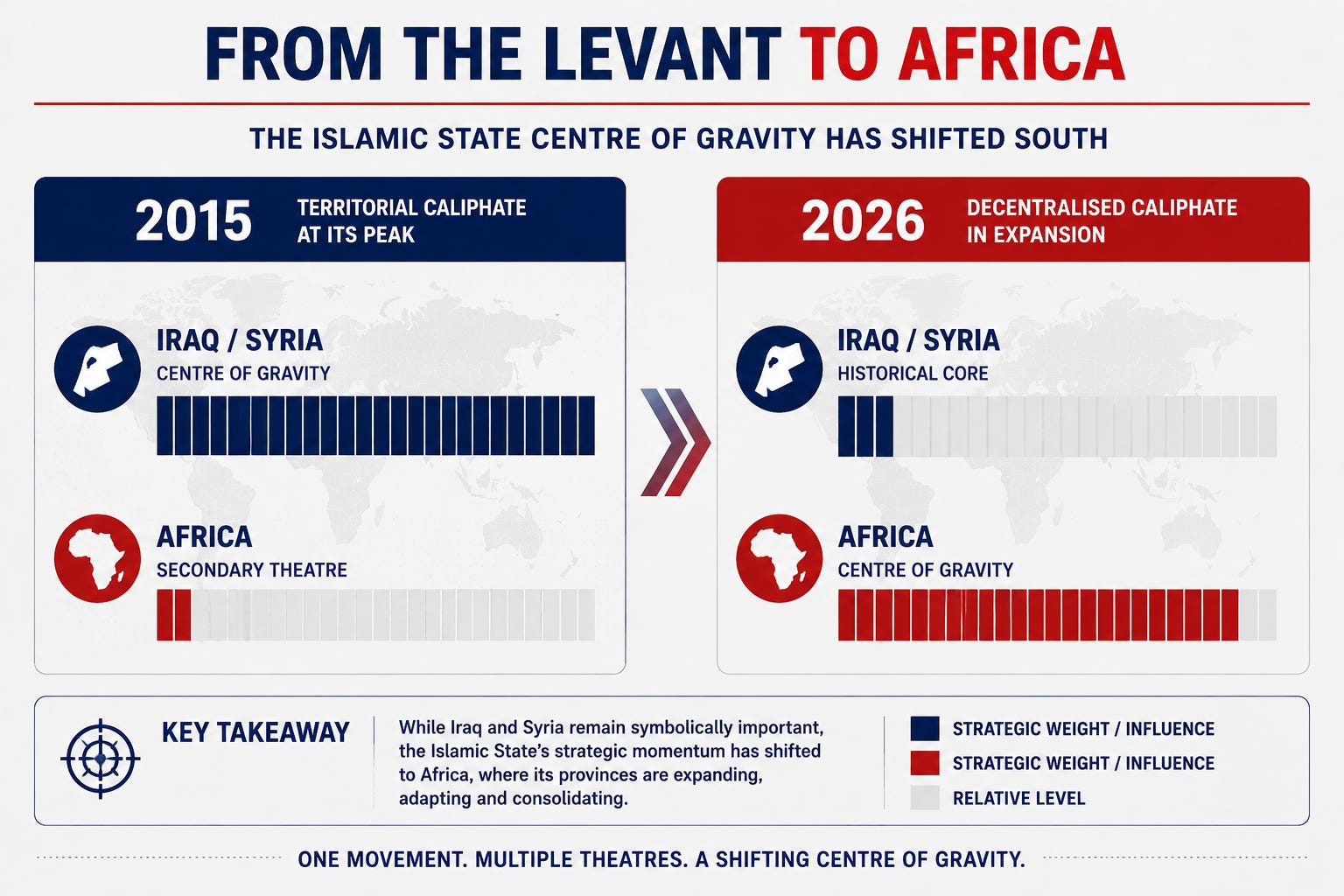
May 2026 reinforced a strategic trend that has been steadily developing over the past several years: the Islamic State’s operational centre of gravity continues to shift away from its historical core territories in Iraq and Syria and increasingly toward Africa.
This shift should not be interpreted as the transfer of a central headquarters or command structure. Rather, it reflects a broader transformation in how the organisation generates operational momentum, territorial expansion, propaganda output, recruitment opportunities, and long-term strategic resilience.
Throughout May, Islamic State media highlighted sustained operational activity across Nigeria, the Democratic Republic of Congo, Mozambique, and the Sahel. At the same time, al-Naba devoted unusual attention to Africa, portraying the continent not as a peripheral theatre but as a central pillar of the organisation’s future trajectory. The editorial “Africa Between Yesterday and Today” presented Africa as a successful case study in the Islamic State’s expansion and endurance, underscoring its growing significance within the movement’s strategic narrative.
Meanwhile, on-the-ground developments suggest that African provinces are no longer merely sustaining insurgencies. They are expanding geographically, increasing tactical sophistication, and demonstrating an ability to operate independently while remaining integrated into the broader Islamic State ecosystem.
The significance of this development extends beyond Africa itself. What is emerging is a decentralised jihadist model capable of surviving leadership losses, territorial setbacks, and regional counterterrorism campaigns by distributing operational capability across multiple theatres while preserving ideological coherence and strategic direction.
The Islamic State that existed in 2015 relied heavily on territorial control in Iraq and Syria. The Islamic State in 2026 increasingly relies on a network of semi-autonomous provinces that can generate local momentum while contributing to a global project.
Africa has become the most visible manifestation of this evolution.
📌 Analysis Index
The Big Picture: The Africanisation of the Islamic State
How the Islamic State Fights Today
Inside the System: Leadership, Control, and Cohesion
External Operations: The Islamic State Beyond Its Provinces
Why Africa Matters Now
What to Watch
Implications
The Big Picture: The Africanisation of the Islamic State
The most important development observed during May was not a single attack, leadership statement, or propaganda release. It was the cumulative picture emerging from multiple provinces operating across different regions of Africa.
Taken individually, attacks in Nigeria, Congo, Mozambique, and the Sahel appear as local insurgent activity. Taken collectively, they reveal something more significant: Africa has become the organisation’s principal arena for strategic growth.
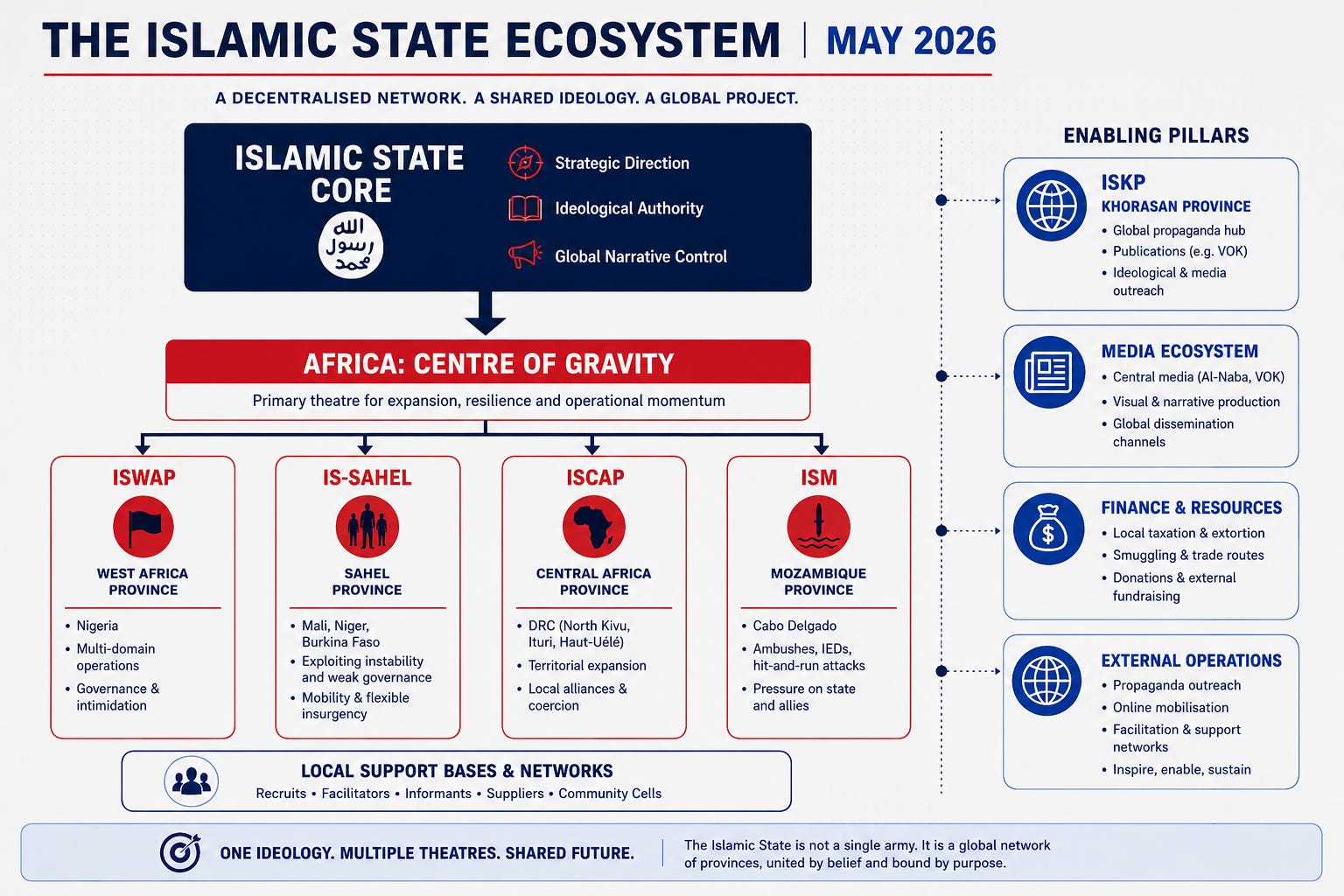
The clearest example emerged in the Democratic Republic of Congo. Islamic State Central Africa Province (ISCAP) expanded operational activity into Haut-Uélé Province, an area not previously associated with significant Islamic State operations. Al-Naba explicitly described Haut-Uélé as a new battlefield, presenting the expansion as an important milestone for the organisation.
This development matters because it demonstrates that ISCAP is not merely preserving existing areas of influence. It is attempting to expand its operational reach into new geographic areas despite ongoing military pressure from Congolese and Ugandan security forces.
At the same time, Islamic State West Africa Province (ISWAP) maintained a sustained operational tempo across Borno, Yobe, and Adamawa States. Attacks targeted military positions, intelligence informants, local militias, and Christian communities, demonstrating the group’s continued ability to conduct multi-dimensional campaigns across a broad geographic area.
In Mozambique, Islamic State Mozambique (ISM) continued to pressure both Mozambican and Rwandan forces through ambushes, IED attacks, and harassment operations across Cabo Delgado Province. The group’s attacks remain smaller in scale than those observed during the peak insurgency period, but they continue to demonstrate resilience and operational adaptability.
The Sahel presents a slightly different dynamic. While the province receives less media attention than ISWAP, it continues to exploit instability across Mali, Niger, and Burkina Faso, operating within one of the world’s fastest-growing jihadist ecosystems.
Importantly, Islamic State central media increasingly treats these theatres as components of a single strategic narrative. Rather than highlighting Africa as a collection of disconnected insurgencies, official media presents the continent as a unified front within a broader global struggle. This represents a notable departure from the organisation’s earlier focus on Iraq and Syria. The result is a gradual but observable Africanisation of the Islamic State’s strategic identity.
How the Islamic State Fights Today
The Islamic State’s contemporary operational model differs substantially from the territorial warfare that characterised the organisation between 2014 and 2017. The organisation now relies on a hybrid insurgent approach combining guerrilla warfare, intelligence operations, psychological pressure, and selective governance activities.
Several recurring patterns appeared across May operations.
