


Executive Summary
This report analyses the magazine “America Evil State,” an English-language propaganda product distributed by al-Qaeda in the Arabian Peninsula (AQAP) through al-Malahem Media and included in the Inspire – Open Source Jihad editorial line. The paper evaluates the product not as mere ideological material, but as a strategic influence tool operating in the cognitive domain, designed to impact the perceptions, identities, and decision-making processes of the English-speaking public, with a particular focus on Muslims living in the United States and the West.
The analysis highlights how the magazine constructs a coherent narrative of total delegitimisation of the US state, presenting it as an intrinsically evil, repressive, and hostile entity to Islam. By integrating real events, protests, immigration policies, the security management of dissent, and international conflicts, the publication transforms political and social grievances into an existential and religious framework, in which conflict is redefined as inevitable and sacralized. This shift drastically reduces the perceived legitimacy of political, institutional, or nonviolent solutions.
From an intelligence perspective, “America Evil State” is positioned at an intermediate stage of the radicalisation cycle. The magazine neither provides operational instructions nor directly incites violence, but serves a cognitive preparation function, normalising violence as a morally justifiable option and paving the way for more advanced forms of mobilisation. The primary risk lies not in the product’s immediate impact but rather in its ability to circulate in fragmented form within polarised digital ecosystems, acting as a bridge to more explicit content or intermediate radicalising actors.
The scenario-based threat assessment indicates that the most likely scenario is a widespread but medium-intensity impact, characterised by the strengthening of narratives of victimisation, institutional distrust, and identity polarisation. Higher-impact scenarios, including the facilitation of individual self-radicalisation, are less likely but potentially significant in terms of security.
Framed in the cognitive domain, the magazine represents a low-intensity hostile influence action with high cumulative potential. Its effectiveness stems from its ability to progressively reshape the public’s cognitive terrain, eroding critical resilience and institutional trust, rather than from the use of verifiable disinformation or direct incitement.
For decision makers, the report highlights that exclusively reactive or security-focused responses risk being ineffective or counterproductive. An effective approach requires integrated policies that combine security, strategic communication, and preventative interventions geared toward cognitive resilience, with particular attention to intermediate amplification networks and the identity dynamics exploited by jihadist propaganda. Without such measures, products like “America Evil State” will continue to represent a risk multiplier in the medium to long term, even in the absence of an immediate operational threat.
Key Judgments
The following judgments reflect moderate to high confidence assessments based on qualitative analysis of primary-source jihadist propaganda.
“America Evil State” constitutes a cognitive-domain influence product rather than a direct incitement-to-violence tool. The magazine does not provide operational guidance nor explicitly call for attacks; instead, it deliberately reshapes perceptions, identities, and interpretive frameworks, contributing to the normalisation of violence as a morally legitimate response to perceived systemic oppression.
The product indicates a deliberate positioning within an intermediate phase of the radicalisation cycle. By delegitimising democratic institutions and sacralising political conflict, the magazine progressively reduces the perceived credibility of non-violent and institutional alternatives, thereby preparing the cognitive ground for subsequent and more explicit forms of mobilisation.
The primary threat associated with “America Evil State” is cumulative and medium- to long-term in nature, rather than immediate or operational. The most significant risk stems from the fragmented circulation and reinterpretation of its narratives within polarised digital ecosystems, where intermediary actors can amplify and adapt the message, facilitating self-radicalisation pathways.
The content targets, with moderate confidence, Muslim Anglophone audiences in Western contexts, with particular emphasis on “Muslims in America.” The narrative exploits perceived victimisation, identity under threat, and institutional distrust to promote identity fusion dynamics, increasing psychological receptivity to extremist worldviews without requiring prior ideological commitment.
Predominantly reactive or exclusively security-driven responses are assessed to risk, reinforcing the very narratives promoted by the magazine. Effective mitigation requires integrated approaches combining security measures, strategic communication, and cognitive resilience-building, with particular attention to early-stage prevention, prebunking strategies, and the disruption of amplification networks.
Abstract
This report analyses the magazine “America Evil State”, an English-language propaganda product released on November 26, 2025, by AQAP via al-Malahem Media and included in the Inspire – Open Source Jihad editorial line. The analysis evaluates narrative structure, persuasive techniques, strategic objectives, and implications for radicalisation and security, focusing on English-speaking audiences and Muslims living in the United States. The document interprets the product as a tool for cognitive preparation and ideological legitimisation of violence, rather than as direct operational incitement, and proposes a comparative framework (coding scheme) and a scenario-based threat assessment to support monitoring and prevention.
Methodology
The analysis adopts a multidimensional qualitative approach, combining propaganda analysis, discourse analysis, and intelligence assessment. The text was examined in its entirety (textual and visual components), with attention to narrative sequence, ideological frames, persuasive techniques, implicit targets, and call-to-action levels. Threat assessment follows a scenario-based logic, distinguishing probability and impact, to avoid over- or underestimations of risk.
Methodological note on the nature of the sources and the analytical approach
This analysis is based exclusively on the direct examination of a jihadist primary source, specifically the magazine “America Evil State” produced by AQAP through al-Malahem Media. The document is treated as an object of analysis in itself, and not as a vehicle for factual claims to be verified through secondary sources. The lack of bibliographic references, therefore, does not constitute a gap but a choice consistent with the objective of the study. The analysis does not aim to establish the veracity of the claims, but to understand narrative strategies, propaganda techniques, ideological frames, and potential radicalisation effects. From this perspective, the magazine is considered a source of qualitative data, whose value lies in the construction of meaning and the language used. This approach is consistent with established practices in intelligence and terrorism studies. The absence of external sources does not imply a lack of conceptual anchoring: the interpretative categories employed (radicalisation, identity mobilisation, delegitimisation of the state, sacralization of conflict) derive from consolidated analytical literature and practices, used here as interpretative tools and not as a citation apparatus.
Analysis of the AQAP Magazine “America Evil State”
The magazine “America Evil State” is clearly part of AQAP’s communications strategy aimed at expanding its reach into the English-speaking world and penetrating Western sociopolitical contexts. Unlike more explicitly violent propaganda products, this issue adopts an editorial format that draws on political analysis and the denunciation of civil rights, exploiting real events and tensions in the US to construct a narrative of total delegitimisation of the state.
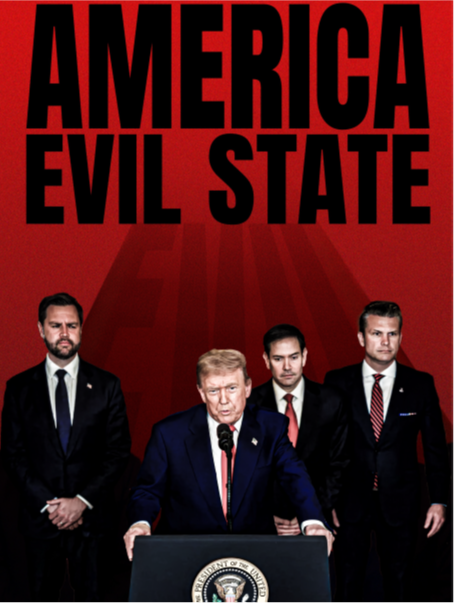
The initial narrative presents the United States as an entity undergoing internal collapse. The images and references to protests, police repression, and political polarisation serve to suggest the idea of a state that has lost all claim to moral legitimacy. This step is crucial because the propaganda does not simply criticise individual policies but suggests that the US system is intrinsically corrupt and violent, lowering the threshold for accepting radical solutions. Analytically, this is a “state collapse” frame, recurrent in contemporary jihadist propaganda.
The text then focuses on the security and immigration apparatus, particularly U.S. Immigration and Customs Enforcement (ICE), which is presented as an instrument of systemic persecution. Immigration policies are portrayed not as administrative measures, but as manifestations of a repressive and dehumanising will. This shift reinforces a second central frame: that of collective victimisation, in which Muslims and immigrants become targets of a hostile state. From a propaganda perspective, this dynamic produces a strong moral shock, serving to open the mind to extremist narratives.
The decisive shift occurs when the political dimension is progressively reinterpreted from a religious perspective. US foreign policy actions, particularly in Palestine, Gaza, Yemen, and Iraq, are linked to internal dynamics and presented as part of a global crusade against Islam. This sacralization of conflict represents a fundamental ideological turning point: if the conflict is no longer political but theological, then any non-jihadist response is implicitly delegitimised. Violence thus becomes not only justifiable but necessary.
The section dedicated to “Muslims in America” fits coherently within this narrative structure, constituting the main point of contact with the potential target audience. Here, the text almost entirely abandons political analysis to take on a tone of identity mobilisation. Muslims are portrayed as a large but vulnerable community, trapped in a hostile and hypocritical environment, where the promises of freedom and rights are presented as illusory. The implicit message is that integration and compromise offer neither security nor dignity, while rejecting the system and embracing a jihadist vision restores belonging and meaning.

In terms of propaganda techniques, the magazine employs a sophisticated combination of symbolic appropriation and moral polarisation. Typical languages of Western civil protest are deliberately reused to build credibility and weaken the audience’s cognitive defences. The interrogative rhetoric and the targeted selection of images and events contribute to creating a binary representation of reality, in which the Western state is completely delegitimized and violence appears as the only coherent response. These elements, taken together, not only produce an informative or emotional effect but also help reshape the cognitive framework within which the reader interprets political and social reality.
Audience Vulnerability Assessment
The effectiveness of the magazine “America Evil State” is not uniform across the entire English-speaking audience, but varies significantly depending on specific cognitive, identity, and contextual vulnerabilities. The analysis suggests that the product is designed to maximise impact on audience segments already exposed to a set of predisposing factors, rather than to convince a general audience.
The most vulnerable segment is represented by young English-speaking Muslims living in Western contexts, particularly in the United States, who experience a combination of identity frustration, perceived exclusion, and intensive consumption of politicised content online. In these profiles, the jihadist message does not necessarily introduce new grievances, but reorganises and sacralises those already present, offering an all-encompassing narrative that provides meaning, belonging, and agency. Particularly relevant is the vulnerability of politically active individuals on issues such as Palestine, Gaza, and migration policies, for whom the transition from civil protest to an existential reading of the conflict is cognitively less costly.
A second at-risk segment consists of individuals who are not necessarily ideologised, but are prolongedly exposed to polarising content within homogeneous digital ecosystems. In these cases, the repetition of frames of victimisation and delegitimisation of the state can foster processes of incremental radicalisation, even in the absence of immediate adherence to jihadist ideology. On the contrary, the magazine’s impact appears significantly reduced on more mature audiences, socially integrated or equipped with alternative support networks, for whom the proposed narrative is less credible or less relevant on an identity level.
Overall, audience vulnerability does not arise from a single variable, but from the convergence of individual, social, and informational factors. This convergence constitutes the main risk multiplier and represents a critical point for targeted prevention interventions.
Intelligence Assessment
From an intelligence perspective, “America Evil State” systematically contributes to the normalisation of violence as a legitimate option, progressively reducing the credibility of nonviolent alternatives and strengthening polarising ideological frameworks. Its primary function is not to provide tactical instructions or guidance, but rather to construct an ideological framework that makes violence acceptable, understandable, and ultimately necessary. In terms of the radicalisation cycle, the magazine is in an intermediate phase, where the goal is to consolidate identities, polarise perceptions, and reduce the legitimacy of nonviolent alternatives.
This type of product is particularly relevant in fragmented digital ecosystems, where textual and visual excerpts can circulate independently of the original context, amplifying the message and adapting it to local narratives. The main risk, therefore, lies not in the dissemination of the PDF as such, but in its ability to fuel radicalised discourses and act as a bridge to more explicit content or to charismatic figures who play an ideological mediating role.
Temporal Assessment
The timing of the release of “America Evil State” appears consistent with an opportunistic and reactive, rather than random, logic. The magazine is part of a phase characterised by high visibility of internal protests in the United States, growing political polarisation, and strong media attention on the conflicts in the Middle East, particularly the Israeli-Palestinian issue. This context offers an informative environment conducive to the overlapping of domestic and global grievances, a central element of the jihadist narrative.
From the AQAP perspective, the chosen time allows us to exploit a peak in emotional attention and cognitive uncertainty, conditions that facilitate the acceptance of simplified and totalizing explanations. The magazine does not introduce a new agenda, but capitalises on an already ongoing narrative cycle, amplifying and reorienting it ideologically. In this sense, the publication can be interpreted as an attempt to re-enter the global English-speaking debate, reaffirming AQAP’s relevance in a competitive and fragmented media ecosystem.
Timing also suggests a strategic positioning intent: rather than mobilising immediately, the product aims to sediment an interpretative framework that will remain valid even beyond the cycle of contingent events. This strengthens the hypothesis of a medium- to long-term oriented communication strategy, consistent with the cognitive preparation function already identified.
Capability Projection
AQAP’s ability to produce and disseminate content such as “America Evil State” indicates significant communication resilience, despite military and counterterrorist pressure. Maintaining the Inspire brand and the Open Source Jihad line demonstrates strategic continuity in investing in English-speaking products with high symbolic value, even in the absence of a robust centralised structure.
From a technical perspective, the magazine highlights established skills in narrative construction, the use of highly emotionally charged imagery, and the adaptation of language to Western contexts. Although AQAP’s direct delivery capacity is limited, the real impact multiplier lies in the content’s ability to be reused, fragmented, and relaunched by third-party actors within informal digital networks. In this sense, the relevant capability is not so much logistical, but rather that of designing intrinsically “portable” and adaptable messages.
In the medium term, no indicators emerge of an immediate operational escalation capacity linked to this specific product. However, the persistence of communication skills and the ability to read context suggest that AQAP remains an ideologically relevant actor, capable of influencing the cognitive domain even with relatively limited resources.
Integration of the coding scheme into the analysis
The comparative analysis of “America Evil State” with other products of the Inspire line and, more generally, of the Salafi-jihadist galaxy allows us to identify recurring patterns that can be systematised through an analytical coding scheme. Within this framework, the magazine combines frames of state collapse, persecution of Muslims, and religious warfare, weaving grievances of a domestic political, foreign policy, and identity nature into a coherent and cumulative narrative. The usefulness of the coding scheme lies not in the descriptive classification of the content, but in the ability to monitor evolutions in the message, variations in the implicit target, and shifts in the level of call to action. In particular, the prevalence of persuasive techniques oriented towards identity and moral mobilisation, despite the absence of operational instructions, confirms the function of the product as a tool for gradual radicalisation. From an intelligence perspective, this scheme allows you to compare “America Evil State” with previous and subsequent productions, identifying signs of escalation or strategic reorientation in AQAP communication.
Threat assessment by scenario
The threat assessment associated with “America Evil State” suggests three possible trajectories. In the most favourable case, the product remains confined to already radicalised circuits, with a limited and predominantly identity-based impact. The most likely scenario instead sees circular content in a fragmented form within polarised online communities, reinforcing narratives of victimisation and mistrust of the state, with a widespread but medium-intensity impact. In the worst-case scenario, the magazine can act as a catalyst in individual self-radicalisation, facilitating the shift toward more explicit content or inspired acts of violence; in this scenario, the likelihood remains lower, but the potential impact is high.
Overall, the risk associated with “America Evil State” can be assessed as medium-high in terms of radicalisation and medium in terms of direct violent threat, making it an object of priority interest for monitoring and prevention activities.
Indicators & Early Warning
The evolution of the impact of “America’s Evil State” can be monitored through a set of observable qualitative indicators, useful for early warning activities. A first significant sign is the recurring appearance of excerpts, slogans, or images from the magazine in the form of memes, graphic quotes, or comments within politically polarised social media platforms and forums. Decontextualization of the original content is an indicator of message amplification and adaptation.
Additional signs include the adoption of the magazine’s key language (e.g., frames of “evil state”, “crusade”, “systemic persecution”) by micro-influencers or activists not directly affiliated with jihadist groups. This passage indicates a penetration of the message beyond traditional extremist circuits. A further indicator of escalation is the explicit connection between local protest narratives and the moral justification for violence, even in the absence of direct references to AQAP.
In the long term, an increase in content that reduces or denies the legitimacy of any form of political or civil participation can signal a progressive closure of cognitive space, a condition favourable to further phases of radicalisation.
Cognitive Domain Assessment
Within the conceptual framework of the cognitive domain, understood as the space in which perceptions, beliefs, identities, and decision-making processes are formed and influenced, the magazine “America Evil State” can be analysed as a relevant case of jihadist cognitive warfare dynamics, in which propaganda tools are employed to exert hostile and intentional influence on the target audience. In this sense, AQAP’s communicative efforts do not aim for specific disinformation but rather to progressively reshape the cognitive terrain, reducing critical resilience and narrowing the perceived decision-making space.
The core of the cognitive operation consists of the systematic alteration of interpretative frameworks. Real and recognisable events, protests, immigration policies, internal security interventions, and armed conflicts abroad are deliberately decontextualised and recomposed into a coherent narrative of systemic oppression. This recomposition does not necessarily introduce false information, but rather reorganises existing information to produce a distorted perception of the causality and intentionality of state actors. In the cognitive domain, this technique is particularly effective because it operates below the threshold of verifiable disinformation, making a response based on simple factual refutation difficult.
A second line of attack concerns the erosion of institutional trust. The magazine does not limit itself to criticising specific policies or government decisions, but aims to delegitimise the very concepts of democracy, legality, and rights, presenting them as rhetorical tools for repression. In terms of cognitive warfare, this process reduces the public’s cognitive resilience, weakening the ability to distinguish between real critical issues in the system and totalizing narratives that deny its legitimacy. The loss of trust is not a side effect, but a primary objective of the operation.
The shift from the political to the existential and religious dimension represents a further level of cognitive sophistication. By redefining the conflict as a “crusade” and ontological war against Islam, the text transforms the realm of political choice into that of absolute moral obligation. This shift is central to the cognitive domain: once conflict is perceived as sacred and existential, the cognitive mechanisms associated with compromise, negotiation, and institutional conflict resolution are neutralised. The result is a drastic reduction in the individual’s perceived decision-making space.
The section aimed at “Muslims in America” represents the point of maximum cognitive penetration of the entire product. Here, the operation focuses on identity fusion, favouring an overlap between personal identity, group identity, and the conflict narrative. In cognitive domain terms, this process reduces the psychological distance between beliefs and behaviours, increasing the likelihood that future decisions, even radical ones, will be perceived as coherent and necessary. The individual is no longer called upon to evaluate options, but to respond to a shared existential threat.
From a security perspective, the main criticality of this form of cognitive warfare lies in its persistence and accumulation over time. Unlike one-off information operations, the content does not aim for an immediate effect, but rather a progressive reshaping of the audience’s cognitive space. The impact manifests itself through repeated exposure, online social reinforcement, and reworking of the message in informal digital environments. This makes the phenomenon difficult to detect with traditional indicators and ill-suited to reactive responses based on conventional alert thresholds.
Consistent with the NATO/EU approach to the cognitive domain, “America Evil State” must therefore be interpreted as a hostile influence action aimed at degrading the cognitive resilience of democratic societies, rather than as a simple product of extremist propaganda. Its strategic objective is not to determine specific behaviours in the short term, but to shape the mental environment within which such behaviours become plausible, justifiable, and ultimately legitimate.
For policymakers and the intelligence community, this implies the need to recognise that countering such operations cannot be limited to removing content or repressing individual messages. It is instead essential to develop cognitive resilience by addressing the processes of meaning-making, institutional trust, and the availability of credible alternative interpretations. In the absence of such measures, the cognitive domain remains vulnerable to low-intensity but high-strategic-impact operations, such as that represented by the magazine “America Evil State”.
Policy Implications and Recommendations for Decision Makers
From a public policy and national security perspective, “America Evil State” highlights a structural criticality that goes beyond a single propaganda product. The magazine exploits real fractures, coercive immigration policies, the security management of dissent, identity polarisation, and emotionally charged international conflicts, transforming them into an all-encompassing narrative of persecution and existential war.
A policy response based exclusively on security or repressive tools risks being counterproductive. The text analysed thrives on the perception of a state that denies rights, represses dissent, and treats entire communities as suspect. In this sense, any intervention perceived as indiscriminate or symbolically punitive unwittingly contributes to strengthening the jihadist narrative. It is therefore essential for decision makers to distinguish between necessary security measures and strategic communication: the absence of a credible institutional narrative leaves room for extremist narratives.
In terms of the cognitive domain, initiatives based exclusively on fact-checking or specific denials are largely ineffective. In terms of prevention, the report suggests that counteraction policies must shift their focus from mere content removal to understanding and neutralising ideological frames. “America Evil State” does not convince through verifiable data or arguments, but through a narrative mechanism that transforms political grievances into moral obligations. Decision-makers should instead invest in prebunking strategies capable of exposing mechanisms of manipulation before they take root, demonstrating how the sacralization of conflict is an ideological construct and not an inevitable reality.
Another relevant factor concerns the role of intermediary actors. The magazine, taken in isolation, has limited circulation; its impact increases exponentially when it is reinterpreted, simplified, and relaunched by radical influencers, ideologically driven activists, or online micro-communities. For policymakers, this implies that counteraction policies should focus less on “leading” content and more on the amplification networks that act as message multipliers. Disrupting these intermediate nodes is often more effective than directly targeting the original product.
Finally, from a strategic perspective, the report highlights the need to complement security policies with credible social and community interventions. In the absence of alternative channels perceived as legitimate, legal support, political representation, and unstigmatized advocacy, the jihadist narrative continues to offer a simple, radical, and all-encompassing solution.
Limitation & Confidence Statement
This evaluation is based on the direct analysis of a single primary source and on a qualitative approach oriented towards the interpretation of narrative and cognitive strategies. Consequently, conclusions regarding impact and threat must be understood as probabilistic and non-deterministic assessments. The absence of quantitative data on diffusion, audience reach, and online interactions limits the ability to accurately estimate the magnitude of the product effect.
The confidence level of the judgments expressed is moderate with regard to the interpretation of communicative intentions and potential effects in the cognitive domain, and low-moderate with regard to scenarios of escalation towards direct operational threats. Evaluations remain amenable to review in the light of new data or developments in the information and operational context.
Conclusions
“America Evil State” does not pose an isolated ideological threat, but it is an indicator of a broader vulnerability: the ability of jihadist actors to adapt their propaganda to the language, conflicts, and contradictions of contemporary democratic societies. An effective response requires integrated policies that combine security tools, strategic communication, and targeted preventive interventions, avoiding merely reactive approaches that risk reinforcing the very narrative these products intend to impose.
The magazine represents a mature example of jihadist propaganda adapted to the contemporary Western context. Its effectiveness lies not in direct incitement to violence, but in the ability to integrate real events, protest languages, and religious rhetoric into a coherent narrative that delegitimises all forms of political and social compromise. Operating as a tool of cognitive erosion, “America Evil State” helps shape the cognitive domain within which more advanced forms of radicalisation become plausible and justifiable.
© Daniele Garofalo Monitoring - All rights reserved.
Daniele Garofalo is an independent researcher and analyst specialising in jihadist terrorism, Islamist insurgencies, and armed non-state actors.
His work focuses on continuous intelligence monitoring, threat assessment, and analysis of propaganda and cognitive/information dynamics, with an emphasis on decision-oriented outputs, early warning, and strategic trend evaluation.
Daniele Garofalo Monitoring is registered with the Italian National ISSN Centre and the International Centre for the Registration of Serial Publications (CIEPS) in Paris.ISSN (International Standard Serial Number): 3103-3520ORCID Code: 0009-0006-5289-2874Support my research, analysis and monitoring with a donation here, PayPal.Me/DanieleGarofalo88