


Az-Zallaqa’s interview with Abu Mahmoud reveals a jihadist organisation increasingly concerned not only with controlling territory, but with controlling how authority, legitimacy and the conflict itself are perceived.
Source Document Box
Source: Az-Zallaqa Media
Organisation: Jama’at Nusrat al-Islam wal-Muslimin (JNIM)
Type of document: Video (31-minute)
Language: Arabic
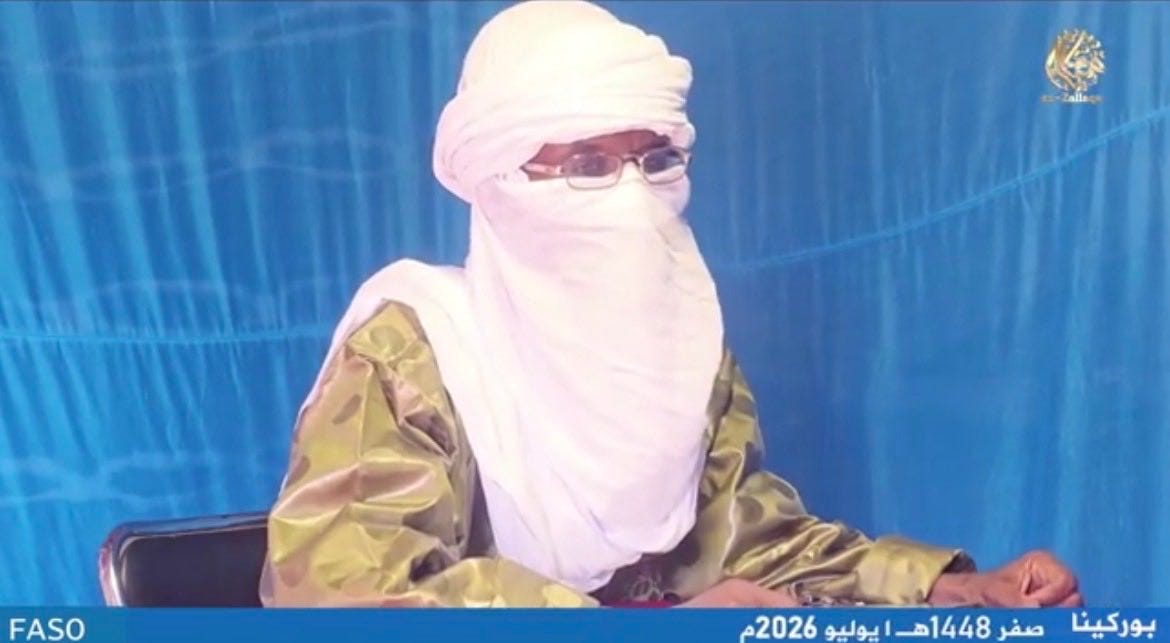
The message behind the interview
In jihadist propaganda, format is part of the message. A claim of responsibility demonstrates operational capability. Battlefield footage demonstrates military effectiveness. A martyrdom video sanctifies sacrifice. A sermon provides ideological instruction. A lengthy interview with a territorial commander serves a different purpose: it allows an organisation to explain how it wants the conflict, itself and its adversaries to be understood.
The 31-minute interview released by Jama’at Nusrat al-Islam wal-Muslimin’s (JNIM) Az-Zallaqa Media with Sheikh Abu Mahmoud, presented as the emir of the group’s branch in Burkina Faso, is a strategic communication exercise aimed at shaping regional security perceptions and legitimacy amidst contested power dynamics across the central Sahel.
Abu Mahmoud does not primarily appear as a battlefield commander. He speaks as a religious authority, political representative and interpreter of the conflict. The discussion moves from military operations to foreign assistance, ethnicity and nationalism, repression by the Burkinabè authorities, media narratives, humanitarian organisations, civilian populations and the broader relationship between JNIM and Muslim communities. The cumulative effect is deliberate: JNIM attempts to present itself not simply as the armed organisation attacking the state, but as an alternative authority entitled to explain what is happening, identify who is responsible and define what constitutes legitimate political and social order.
The timing matters. JNIM enters the second half of 2026 from a substantially stronger regional position than several years ago. Its geographical reach now extends across much of the central Sahel and increasingly toward coastal West Africa. JNIM has become the most active armed actor in the Sahelian conflict system, combining sustained military pressure with taxation, economic coercion, population control, dispute resolution, and rudimentary forms of governance. In early 2026, the organisation launched a region-wide offensive across the central Sahel and into Benin, while its rivalry with Islamic State Sahel Province has increasingly become a transnational competition for territory, influence, and operational space.
The interview therefore accompanies, rather than substitutes for, kinetic expansion. This distinction is central to understanding its cognitive significance.
From battlefield success to political meaning
JNIM’s communication, which visualises military effectiveness through raids, ambushes, and captured equipment, aims to reinforce a narrative of resilience and ideological righteousness, fostering confidence in its broader political objectives.
When asked whether JNIM receives support from another state or external actor, Abu Mahmoud explicitly dismisses the proposition, emphasising the organisation’s strategic autonomy and resilience, which is critical for regional threat assessments and policy planning.
First, it protects the organisation’s image of strategic autonomy. Second, it reinforces an internal narrative in which battlefield performance confirms ideological righteousness. Third, it counters government narratives that portray jihadist expansion as the consequence of external manipulation or foreign support. The military event is therefore cognitively reconstructed: an attack is no longer merely an attack, but evidence that JNIM is autonomous, resilient and capable of overcoming materially superior opponents.
This is an important characteristic of insurgent information warfare. Tactical outcomes acquire strategic value when they alter perceptions concerning who is winning, who can provide security and whether the existing political authority can ultimately prevail.
That contest is particularly consequential in Burkina Faso. The state has invested considerable political capital in demonstrating that military mobilisation can reverse jihadist expansion. Yet independent conflict monitoring continues to indicate severe pressure on government forces and the Volunteers for the Defence of the Homeland. JNIM temporarily seized provincial capitals such as Djibo and Diapaga during 2025, and years of attrition have left government forces and auxiliary formations overstretched. The cognitive battlefield therefore intersects directly with the physical one. Every military position overrun by JNIM potentially communicates two messages: the organisation can reach the state, and the state cannot necessarily protect those who depend upon it. Abu Mahmoud’s interview attempts to determine how those facts should be interpreted.
The struggle for legitimacy
The most consequential aspect of the interview is the effort to reposition the relationship between JNIM, the population and the state. Insurgencies rarely survive through coercion alone. They require varying combinations of concealment, acquiescence, collaboration, intimidation, taxation, mediation and social penetration. Consequently, decisive political competition is often not over whether populations ideologically embrace an insurgent organisation, but whether they progressively accommodate its presence and recognise its authority as unavoidable, useful, or preferable to available alternatives.
JNIM appears acutely aware of this distinction. Abu Mahmoud repeatedly presents the conflict through a moral binary in which government institutions become sources of persecution while JNIM assumes the role of defender. He accuses the Burkinabè authorities of arrests, imprisonment, torture and campaigns against Muslims, and frames armed resistance as a response to state aggression rather than the origin of the conflict. This is not an incidental rhetorical device. It is the central inversion upon which the political narrative depends.
JNIM cannot credibly deny that it employs violence. Instead, it attempts to redefine the moral sequence of that violence. The state becomes the aggressor; JNIM becomes the respondent. Counterterrorism becomes persecution. Mobilisation becomes defence. Territorial expansion becomes liberation. Such framing is particularly potent where communities have experienced abuses by security forces, communal militias or jihadist actors themselves. Human Rights Watch documented serious abuses by multiple parties to the conflict in Burkina Faso in 2026, illustrating the environment in which competing narratives of victimhood and protection operate. JNIM can exploit genuine grievances while selectively excluding its own coercion and violence from the narrative.
That distinction is essential. Propaganda does not require every underlying grievance to be fabricated. The more effective strategy is often to appropriate existing grievances, remove inconvenient context, identify a responsible enemy and integrate the resulting interpretation into an ideological framework. JNIM is doing precisely that.
The ethnic question: escaping the Fulani trap
One of the interview’s most revealing passages concerns ethnicity. Abu Mahmoud rejects the proposition that the insurgency represents a Fulani cause or should be fought under a Fulani nationalist identity. He argues instead that Islam constitutes the relevant basis for collective identity and criticises ethnic and nationalist fragmentation. The message has strategic implications extending well beyond religious doctrine. A movement perceived as ethnically bounded encounters an inherent ceiling on expansion. It can mobilise grievances efficiently within one community while simultaneously strengthening resistance among others. A movement presenting itself as supra-ethnic can theoretically penetrate multiple social environments.
JNIM has progressively attempted to do exactly this. Its recruitment and influence have expanded beyond Fulani constituencies to communities including Dogon, Minyanka, Bissa, Djerma, Gourmantche and Mossi populations across different areas of Mali, Burkina Faso and Niger. The cognitive objective is therefore clear: decouple jihadist mobilisation from a single ethnic identity and replace it with an ideological identity capable of crossing communal boundaries. This matters geopolitically because JNIM’s geographical trajectory increasingly requires such adaptation. The organisation no longer operates primarily within familiar social environments in northern and central Mali. Its operational footprint now stretches toward Benin, Togo and the Nigerian borderlands. Geographical expansion consequently requires cognitive expansion. The narrative must travel before governance can consolidate.
JNIM’s cognitive battlespace
The interview reveals at least four mutually reinforcing lines of cognitive effort. The first is delegitimisation. The state is represented as incapable of protecting its population, dependent upon foreign assistance and responsible for repression. Military defeats reinforce this narrative because they transform ideological accusations into apparently observable evidence of government weakness.
The second is legitimisation. JNIM presents its fighters as disciplined Muslims acting within a religiously sanctioned framework. Military victories become validation. Relations with communities become evidence of social embeddedness. The organisation is progressively represented as an actor with rules, leadership, and political purpose rather than as a clandestine terrorist network.
The third is identity construction. The rejection of ethnic nationalism places religious affiliation above Fulani, Mossi or other communal identities. This allows JNIM to offer a political identity that can theoretically incorporate populations across national borders.
The fourth is narrative competition. Abu Mahmoud explicitly attacks official reporting about territorial control and battlefield outcomes. His argument is essentially empirical: governments can announce victories, but events on the ground eventually expose false claims.
This is perhaps the most modern component of the interview. JNIM is not simply transmitting propaganda. It is attempting to undermine the credibility of competing information systems. That distinction places the communication squarely within the cognitive domain. The desired effect is not merely belief in JNIM’s message. It is declining confidence in alternative sources of authority. Once official statements, military communiqués and government media are perceived as systematically unreliable, insurgent narratives do not need to become universally trusted. They only need to become competitive.
Different messages for different audiences
The interview should also be understood as a multi-audience communication product. For JNIM fighters and supporters, Abu Mahmoud offers ideological reassurance. Military success demonstrates divine favour, endurance becomes a religious obligation, and sacrifice acquires transcendent meaning. For Muslim populations living inside contested areas, the message is different. JNIM presents itself as protector, mediator and defender against government abuses. The objective is not necessarily immediate ideological conversion. Passive accommodation can be strategically sufficient. For communities outside the organisation’s traditional recruitment base, rejecting ethnic exclusivity is particularly important. JNIM offers an identity that claims to transcend ethnicity and borders. For Sahelian governments, the interview communicates confidence. Abu Mahmoud openly challenges their accounts of territorial recovery and military success.
Finally, the international community receives an unusually explicit message. Abu Mahmoud discusses humanitarian organisations and argues that NGOs should assist populations irrespective of which actor controls their territory. He criticises arrangements that, in his portrayal, restrict assistance to government-controlled areas. That passage deserves attention. JNIM is implicitly demanding recognition of a political reality: populations exist under its influence, those populations require services, and external organisations may eventually need to interact with the environment it controls. This does not constitute international legitimacy. It represents an attempt to normalise JNIM as an unavoidable actor within the humanitarian and political geography of the Sahel. That is a substantially more ambitious objective than recruitment propaganda.
Governance as cognitive warfare
The distinction between physical control and perceived authority is becoming increasingly important in the Sahel. JNIM does not need to administer territory through a bureaucratic structure resembling a conventional state. Its governance model can remain comparatively thin. What matters is whether it can regulate behaviour, adjudicate disputes, extract resources, control movement, impose sanctions, and establish predictable rules.
Available evidence indicates that this process is already occurring. JNIM is a competing governance actor that taxes populations, regulates social behaviour, provides limited justice and security functions, resolves disputes and manages access by nongovernmental organisations in some areas under its influence. Economic warfare complements this model. Blockades, attacks against infrastructure and pressure on transportation routes do more than generate economic costs. They expose the state’s inability to guarantee movement and services while demonstrating JNIM’s capacity to determine who and what can circulate; this economic coercion is an increasingly important component of JNIM’s strategy to undermine government authority. The relationship between coercion, governance and communication is therefore circular: military power creates access, coercion modifies behaviour, governance institutionalises influence, propaganda explains why that influence should be considered legitimate. The cognitive campaign connects all four.
What Abu Mahmoud does not say
The omissions are almost as informative as the statements. The interview does not revolve around spectacular terrorism. Abu Mahmoud does not build his message principally around suicide operations, global jihad, martyrdom or indiscriminate violence. Al-Qaeda’s global leadership is not the central protagonist. The discussion remains overwhelmingly anchored to local political realities, Muslim communities, state conduct and the conflict in the Sahel. This should not be interpreted as ideological moderation; it is strategic localisation.
JNIM remains an al-Qaeda-affiliated jihadist organisation. What changes is the communication required to sustain an insurgency seeking durable territorial and social penetration. An organisation attempting to govern populations cannot communicate exclusively with committed jihadists. It must also communicate with people who do not share its ideology but whose behaviour it seeks to influence.
That creates an important distinction between ideological constituency and strategic audience. The first can remain relatively narrow; the second must expand with the insurgency.
The geopolitical dimension
JNIM’s communication strategy cannot be separated from the broader transformation of the Sahel. Burkina Faso, Mali and Niger have experienced profound changes in their international alignments and security architectures. At the same time, the insurgency has continued expanding geographically.
JNIM consequently operates in a geopolitical environment characterised by weakening regional counterterrorism coordination, contested state legitimacy, military-led governments, and growing pressure along the Sahel’s southern frontier. The movement’s expansion into the littoral states changes the strategic problem. Benin, Togo, Côte d’Ivoire, Ghana, and increasingly Nigeria are no longer peripheral to the Sahelian conflict. They constitute the next layer of strategic depth. Mapping of militant networks shows that borderlands connecting Burkina Faso, Mali and coastal West Africa increasingly function as transit areas, staging grounds and contested spaces. This means JNIM’s competition with states is simultaneously territorial, military, economic and cognitive.
Analytical Assessment
The interview suggests that JNIM increasingly understands legitimacy as a centre of gravity in the Sahelian conflict. This does not mean that kinetic operations are becoming less important. The opposite is more likely. Military pressure creates the conditions under which the cognitive campaign becomes credible. An insurgent organisation cannot convincingly present itself as an alternative authority if it cannot survive confrontation with the state. JNIM’s evolution therefore appears additive rather than substitutive. It is retaining terrorism and insurgent warfare while expanding economic coercion, governance mechanisms and strategic communication.
The resulting model is more dangerous than a purely clandestine terrorist organisation because its objective is not simply to inflict casualties. It seeks to modify political relationships between populations and governments. The key cognitive effect is normalisation. JNIM does not need every inhabitant of Burkina Faso to support al-Qaeda. It benefits whenever a community begins to consider its presence permanent, resistance futile, government protection unreliable and accommodation rational. At that point, legitimacy does not necessarily mean ideological approval; it can mean acceptance of reality. That distinction should shape how counterterrorism institutions evaluate the organisation’s expansion.
Alternative Assessment: propaganda may be running ahead of reality
There is an important alternative interpretation. The interview could represent an attempt to project political maturity that exceeds JNIM’s actual governance capabilities. The organisation may be exploiting military successes to project territorial authority without the administrative capacity to transform coercive influence into durable governance.
There is evidence supporting caution. JNIM’s administrative structures remain considerably less developed than those of a conventional state, and its relationship with populations cannot be reduced to voluntary acceptance. Violence, intimidation, taxation, blockades and punishment remain fundamental instruments of control. The propaganda should therefore not be mistaken for an objective description of conditions on the ground, but neither should it be dismissed because it is propaganda. Its intelligence value lies precisely in revealing how JNIM wants those conditions to be perceived and, consequently, what political environment it is attempting to create.
Intelligence Outlook
Several indicators will determine whether the Abu Mahmoud interview represents an isolated communication initiative or the beginning of a more systematic evolution in JNIM’s information strategy.
The first will be replication. Additional long-form interviews with regional emirs would indicate an effort to build recognisable territorial leadership rather than keeping communication overwhelmingly centred on the central leadership.
The second will be the growing visibility of governance themes: justice, taxation, dispute resolution, humanitarian access, economic regulation and relations with local communities.
The third will be audience diversification. Increasing communication directed toward specific ethnic groups, religious authorities, traders, humanitarian actors or populations in coastal states would suggest that JNIM is adapting its information architecture to territorial expansion.
The fourth will be geographical localisation. If Az-Zallaqa increasingly allows regional leaders to discuss local grievances and political conditions, this would indicate a sophisticated communication model in which a common jihadist ideology is translated into locally resonant narratives.
The fifth will be the relationship between propaganda and territorial pressure. Communication should be monitored alongside blockades, temporary seizure of towns, destruction of state infrastructure, negotiations with communities and the establishment of informal justice mechanisms.
Together, these indicators would point toward something more consequential than an improvement in jihadist media production. They would indicate the progressive construction of an insurgent political communication system. The strategic contest with JNIM is therefore no longer adequately understood through attack numbers alone. The organisation is simultaneously competing over territory, mobility, economic access, community compliance and the interpretation of the war itself.
Az-Zallaqa’s interview with Abu Mahmoud captures that evolution unusually clearly. The commander sitting before the camera is not primarily explaining how JNIM fights. He is explaining why its audience should understand the conflict on JNIM’s terms.
For counterterrorism and policy communities, that distinction matters. Military pressure can degrade an armed organisation. It cannot, by itself, restore confidence in institutions, resolve local grievances, establish credible governance, or defeat a narrative that derives its plausibility from observable state weakness.
The cognitive contest will therefore be decided less by producing more counter-messaging than by reducing the gap between what governments claim and what populations experience. Where the state can provide security, justice, mobility and predictable governance, JNIM’s narrative becomes harder to sustain. Where it cannot, Az-Zallaqa has increasingly fertile ground on which to operate.
🔒 Executive Intelligence Cycle
This assessment is part of a broader analytical cycle.
Founding subscribers receive the Executive Intelligence Briefing, which integrates all threat assessments, cognitive domain analysis, and a rolling 30–90-day forecast into a single monthly strategic synthesis.
© Daniele Garofalo Monitoring - All rights reserved.
Daniele Garofalo is an independent researcher and analyst specialising in jihadist terrorism, Islamist insurgencies, and armed non-state actors.
His work focuses on continuous intelligence monitoring, threat assessment, and analysis of propaganda and cognitive/information dynamics, with an emphasis on decision-oriented outputs, early warning, and strategic trend evaluation.
ISSN (International Standard Serial Number): 3103-3520
NATO NCAGE: AX664 (NATO Commercial and Governmental Entity)
UNITED NATIONS Global Marketplace ID: 1210727
ORCID Code: 0009-0006-5289-2874