


Executive Intelligence Summary
The 25 April 2026 Jamaʿat Nuṣrat al-Islām wa-l Muslimīn (JNIM) and Azawad Liberation Front (FLA) coordinated offensive marks a significant escalation, raising serious regional security concerns that require urgent attention from stakeholders.
The most significant development is the declared convergence of JNIM and FLA, which underscores their tactical alliance driven by shared opposition to the Malian junta and encourages stakeholders to remain alert to the threat’s evolving and unpredictable nature.
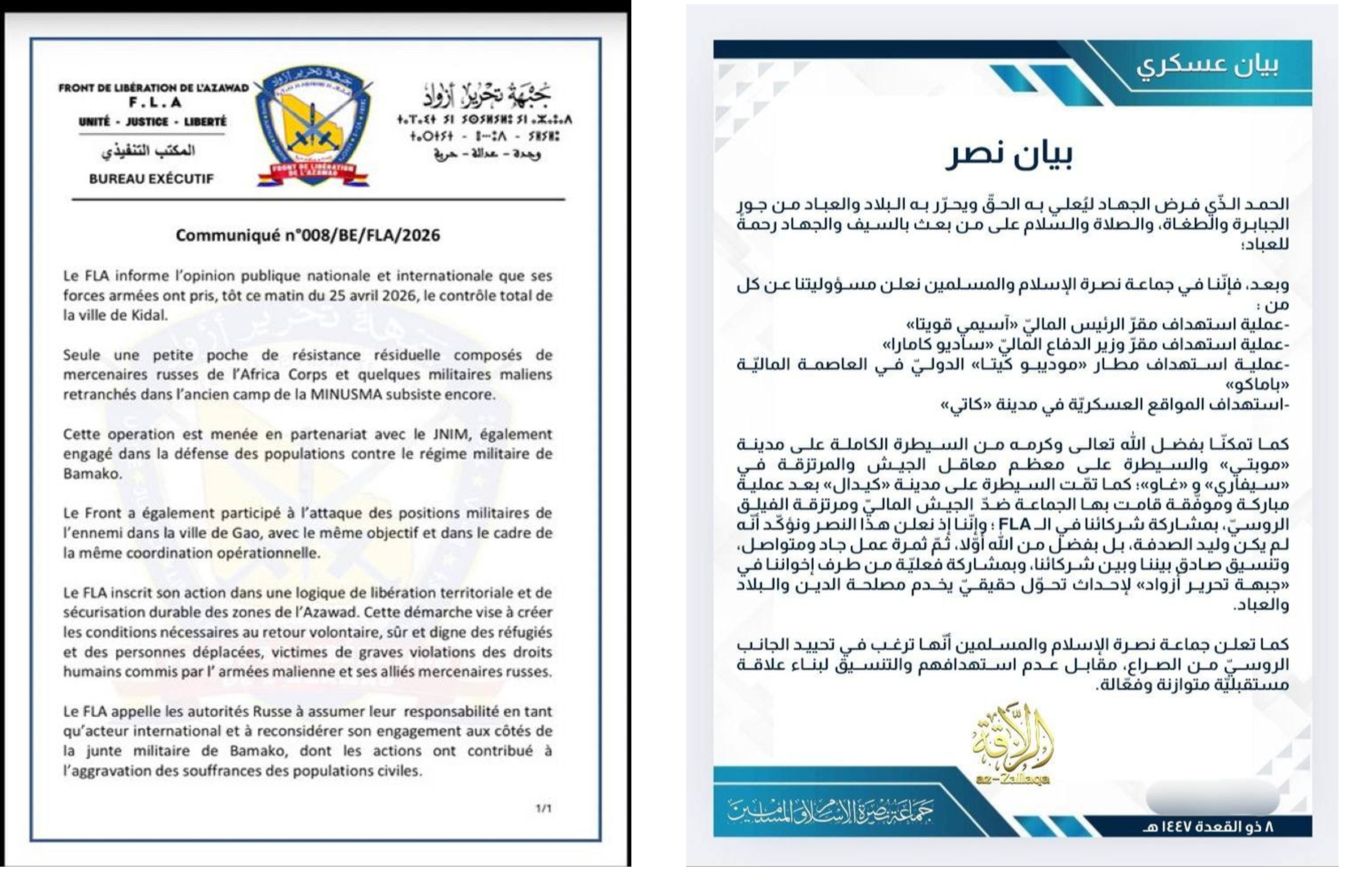
The offensive directly challenges the Malian junta’s narrative, especially with strikes near Bamako and Kati, underscoring the need for heightened vigilance and proactive measures at these critical locations to reinforce regime resilience.
JNIM’s message to Russian forces is strategically important. The statement does not simply frame Russian personnel as battlefield targets. It seeks to separate Russian actors from the Malian state by signaling that future relations may be possible if Russia ceases to support Bamako. This is coercive signaling, not moderation. JNIM is attempting to impose costs on Africa Corps and personnel aligned with Russia while offering them an exit narrative. The objective is to weaken the perceived reliability of external protection for the junta.
The attack should be treated as a strategic warning for the wider Sahel, highlighting the regional security implications and the critical need for coordinated countermeasures among stakeholders to maintain stability.
What Happened, 25 April 2026
On 25 April 2026, a coordinated multi-location offensive attributed to Jama’at Nusrat al Islam wal Muslimin, in declared coordination with the Front de Libération de l’Azawad, targeted military and strategic nodes across Mali. The operational pattern indicates a deliberate attempt to generate simultaneous pressure across the capital area, central regions, and northern theatres, combining symbolic, military, and infrastructural targeting.
In the capital area, armed activity was reported in Bamako with a concentration around sensitive military and security installations. In parallel, Kati, which hosts one of the country’s most critical military complexes and is directly associated with regime protection, was targeted through armed incursions and indirect fire activity. Kati’s choice reflects an intent to challenge the core of the junta’s command-and-control architecture rather than peripheral military assets.
In central Mali, attacks were reported in Sévaré and Mopti, areas that function as logistical and operational gateways between the southern political core and the contested northern and central belts. Engagements in these zones indicate an effort to disrupt military movement corridors, degrade operational continuity, and demonstrate the ability to interfere with internal lines of communication.
In the northern theatres, activity was reported in Gao and Kidal. These areas remain central to the question of Azawad and to the presence of both state and non-state armed actors. Claims of expanded control or territorial penetration were circulated, although full verification remains incomplete. The inclusion of northern targets alongside capital adjacent strikes suggests a synchronized operational design rather than independent local actions.
Aviation-related infrastructure was also reportedly targeted, including areas linked to airport operations. Even limited disruption in this domain carries disproportionate strategic impact, as it signals vulnerability in mobility, logistics, and external support pathways.
The overall attack pattern reflects multi-axis execution, temporal coordination, and diversified target selection. The operation did not aim at immediate territorial seizure at the national level, but rather to demonstrate reach, resilience, and the ability to impose simultaneous security stress across geographically distant nodes.
Following the attacks, the Malian authorities reported that several assaults were contained and that key positions remained under state control. Casualty figures and damage assessments remain incomplete and subject to verification constraints. JNIM’s claim of responsibility explicitly referenced coordination with the FLA, framing the operation as a joint effort against the Malian state and its external partners.
Information flows following the event show rapid dissemination of claims, imagery, and narrative framing designed to emphasize simultaneity, geographic breadth, and proximity to the capital. This indicates that the operational phase was tightly coupled with an immediate cognitive-exploitation phase, aimed at amplifying perceptions of state vulnerability and insurgent capabilities.
Taken together, the events of 25 April should be assessed as a coordinated disruption operation with national scope, designed to challenge regime security, test response capacity, and signal a new level of alignment among anti-state armed actors.
Operational Assessment
The 25 April offensive reflects a coordinated multi-axis operation with characteristics that exceed routine insurgent activity in Mali. The pattern indicates deliberate synchronization across geographically distant theatres, suggesting centralized planning with decentralized execution. The ability to generate near-simultaneous pressure in the capital area, central regions, and northern zones implies a functioning command architecture capable of tasking multiple operational cells while maintaining timing discipline.
Coordination appears to have been achieved through pre-planned attack windows rather than real-time battlefield control. This reduces vulnerability to interception and allows dispersed units to act within defined temporal parameters. The level of synchronization observed indicates prior reconnaissance, pre-positioning of personnel and materiel, and established communication channels, likely combining human couriers, low-signature digital tools, and local relay nodes. The operation does not require a rigid hierarchical command structure, but it does require a coherent operational concept and shared intent across units.
National reach is the central operational message. The offensive demonstrates that JNIM and aligned elements can operate across the full depth of the Malian theatre, from capital proximity zones to northern strongholds. This reach is not only geographic but also functional. The attackers targeted military installations, transport and logistics nodes, and aviation-related infrastructure, indicating awareness of system vulnerabilities rather than opportunistic targeting. The dispersion of attacks forces the state to stretch limited response assets, reduces the effectiveness of force concentration, and exposes gaps in rapid reaction capability.
Target selection reflects a layered logic. First, regime security nodes, particularly in the Bamako and Kati area, were chosen for their symbolic and operational value. Second, central transit hubs such as Sévaré and Mopti were targeted to disrupt internal lines of communication and operational mobility. Third, northern theatres, including Gao and Kidal, were activated to maintain pressure in long-contested zones and to align with separatist dynamics. Fourth, aviation-related infrastructure was included to signal vulnerabilities in strategic mobility and external support channels. This combination indicates a campaign designed to stress the system at multiple levels rather than achieve a single decisive tactical outcome.
Command and control is assessed as a hybrid. Strategic intent and operational design are likely set at a higher leadership level within JNIM, with local commanders retaining autonomy in execution. The integration of FLA elements suggests coordination mechanisms that allow parallel chains of command to operate under a shared operational framework. This does not imply a unified command but rather synchronized intent, facilitated by prior liaison, agreed-upon objectives, and deconfliction measures. Such arrangements are more resilient than formal integration, as they reduce friction and preserve each actor’s internal cohesion.
Timing is a critical indicator of planning maturity. The clustering of attacks within a compressed time window maximizes the shock effect and complicates state response. It also amplifies psychological impact by creating the perception of ubiquity and control. The choice of timing likely took into account routine patterns of military activity, guard rotations, and urban rhythms, indicating the presence of local intelligence support. The absence of immediate, large-scale territorial follow-up suggests that the primary objective was to demonstrate capability and system disruption rather than territorial consolidation at this stage.
Overall, the operation demonstrates an evolution toward coordinated disruption warfare. It combines distributed execution, selective targeting of critical nodes, and temporal synchronization to impose cumulative pressure on a state with limited adaptive capacity. The model is scalable and repeatable, particularly if supported by local networks and tactical partnerships.
Strategic Significance of the JNIM–FLA Convergence
The declared coordination between JNIM and the FLA constitutes the most consequential element of the 25 April offensive. It reflects a pragmatic alignment between actors with divergent ideological foundations but convergent operational interests. This is a tactical alliance, not an ideological merger. The absence of doctrinal integration is precisely what makes it operationally viable, as it allows both actors to cooperate selectively without incurring internal fragmentation or loss of legitimacy within their respective constituencies.
For JNIM, the convergence provides expanded access to northern terrain, local intelligence networks, mobility corridors, and community interfaces that are not uniformly available to jihadist structures alone. Tuareg-led networks maintain an embedded presence across key areas of the Azawad space, including zones where state control is limited and local legitimacy is fragmented. This creates opportunities for JNIM to extend its operational depth, reduce friction in movement and staging, and enhance situational awareness across northern and central theatres.
For the FLA, coordination with JNIM offers immediate military amplification. It provides access to experienced combat units, asymmetric warfare capabilities, and a broader operational network that can sustain pressure on Malian forces beyond localized engagements. The FLA gains the ability to participate in multi-theatre operations that would be difficult to execute independently, while maintaining its political positioning as a non-jihadist separatist actor.
The convergence is driven by overlapping short-term objectives, namely opposition to the Malian junta, rejection of the current security order, and resistance to Russian-backed military operations. These shared objectives create a functional space for cooperation without requiring alignment on long-term political end states. JNIM pursues an Islamist governance project, while the FLA is rooted in territorial and identity-based claims linked to Azawad. The divergence remains structural and unresolved, reducing the likelihood of full integration but not limiting the effectiveness of coordinated action.
Operationally, this alignment enables a division of labor. JNIM elements can focus on high-impact asymmetric attacks, complex assaults, and coordinated disruption. At the same time, FLA components can facilitate access, provide local intelligence, secure movement routes, and support operations in areas where they retain influence. This distributed model increases resilience and complicates counterinsurgency responses by blurring the distinction between jihadist and non-jihadist actors on the ground.
The convergence also has a significant political and cognitive dimension. It signals to local populations that resistance to Bamako is not confined to a single ideological current but can take multiple forms capable of cooperation. This may reduce barriers to collaboration at the local level, increase passive support networks, and weaken the state’s ability to isolate jihadist actors from other opposition groups.
At the strategic level, the alignment challenges the assumption that counterinsurgency efforts can compartmentalize threats along ideological lines. A security approach that treats jihadist groups and separatist movements as distinct and non-interacting risks underestimates the potential for tactical convergence. The current development suggests that under sufficient pressure, actors with divergent end states can coordinate effectively against a common adversary.
The durability of this convergence remains uncertain. It is likely to remain conditional, episodic, and geographically variable. Friction points include competition for influence, divergent governance models, and differing external relationships. However, even a temporary or localized alignment is sufficient to generate disproportionate operational effects, particularly when combined with synchronized attacks across multiple theatres.
In practical terms, the JNIM-FLA convergence represents a shift toward a more complex conflict ecosystem in Mali. It increases the adaptive capacity of anti-state actors, expands the battlespace, and reduces the effectiveness of strategies that rely on adversaries’ fragmentation and isolation. For decision makers, this requires reassessing threat categorization, force allocation, and engagement strategies across both the northern and central regions.
Russian Factor: Africa Corps, PMC exposure, coercive signaling, future bargaining space.
The 25 April offensive places Russian personnel and assets at the center of the operational and political equation in Mali. The exposure of Africa Corps and associated private military structures is no longer an indirect consequence of support to Bamako; it is becoming an explicit feature of the conflict environment. The attack pattern and subsequent messaging indicate that Russian-aligned forces are being treated as both a military target set and a strategic variable to be manipulated.
From an operational perspective, Russian elements are vulnerable along several axes. Their deployment is concentrated around regime protection, training functions, and selected operational support roles, with limited force density across the broader territory. This creates predictable patterns of presence, movement, and dependency on fixed sites such as bases, airfields, and logistics hubs. The 25 April events demonstrate that coordinated insurgent pressure can stress these nodes indirectly by targeting the surrounding security architecture, degrading perimeter control, and complicating reinforcement timelines.
The reliance on local forces for area security increases exposure. Russian personnel depend on Malian units for outer-layer protection, intelligence collection, and terrain control. Where Malian forces are stretched or disrupted, the protective envelope around Russian assets becomes thinner. This layered dependency creates exploitable seams, particularly in central regions and in corridors linking the capital to contested zones. It also limits the ability of Russian elements to operate independently at scale without increasing their own visibility and risk profile.
The messaging directed at Russian forces reflects coercive signaling rather than purely kinetic intent. JNIM is attempting to shape Russian decision calculus by presenting a conditional threat environment. The implicit proposition is that continued support for Bamako entails increasing operational costs, while disengagement or reduced involvement could reduce direct targeting. This is not an offer of accommodation; it is an attempt to introduce uncertainty into Russian risk assessment and to weaken the perceived credibility of their security guarantee.
This signaling has a broader informational dimension. By highlighting Russia’s exposure and linking it to Mali’s inability to secure key areas, JNIM seeks to erode the narrative of effective external protection. The objective is to undermine confidence among local populations, regional observers, and potentially within the Malian security apparatus itself. If Russian presence is perceived as unable to prevent high-profile coordinated attacks, its deterrent value declines.
At the same time, the creation of a notional future bargaining space is deliberate. By avoiding absolute language and by framing Russian forces as actors that could, under certain conditions, be separated from the Malian state, JNIM preserves optionality. This does not indicate a readiness for formal negotiation, but it does signal an awareness that external actors can be influenced through calibrated pressure and selective messaging. The group is positioning itself as a rational actor capable of both escalation and conditional restraint.
For the Russian strategy, this creates a dilemma. Increasing force protection measures and expanding the operational footprint can mitigate immediate risks but also raise costs, reduce visibility, and increase the potential for confrontation. Maintaining the current posture risks a gradual erosion of deterrence and incremental exposure to coordinated attacks. A reduction in engagement would weaken support for the Malian junta and potentially alter regional perceptions of Russia as a reliable security partner.
In the near term, Russian elements are likely to prioritize base security, movement discipline, and intelligence enhancement, while avoiding large-scale independent operations that could increase exposure. However, the structural vulnerabilities linked to limited force density, reliance on host-nation forces, and contested terrain will persist. The 25 April offensive demonstrates that insurgent actors can exploit these constraints through synchronized operations targeting the system rather than isolated units.
Overall, the Russian factor is transitioning from a background enabler of state security to a contested component of the battlefield. JNIM is not only engaging Malian forces but also actively shaping the environment in which Russian actors operate, seeking to impose costs, create doubt, and expand its own strategic room for maneuver.
Implications for Bamako and the Malian Junta
The 25 April offensive exposes structural vulnerabilities in regime security and challenges the credibility of the junta’s control narrative. The ability of coordinated hostile elements to generate pressure in the capital area and around Kati indicates that protective layers around the political and military core are permeable. Even where physical control was maintained, the fact that attacks reached these zones carries a disproportionate strategic effect.
Kati is central to regime continuity. It hosts key command functions, elite units, and elements directly linked to the leadership’s security. Activity in or near Kati signals that adversaries can contest spaces assumed to be secure. This forces the junta to reallocate forces toward regime protection, reducing availability for operations in central and northern theatres. The resulting trade-off degrades offensive capacity and increases reliance on static defense.
Bamako’s vulnerability is not defined by occupation risk in the near term, but by disruption risk. The offensive demonstrates that insurgent networks can penetrate or influence capital adjacent environments, conduct attacks or support actions, and withdraw without decisive engagement. This erodes public confidence, affects elite perceptions of safety, and introduces uncertainty into routine governance and military planning cycles.
Symbolic degradation is a core outcome. The junta’s legitimacy rests in part on claims of restored sovereignty and improved security following the departure of Western forces and the integration of Russian support. Coordinated attacks across multiple regions, including proximity to the capital, undermine this narrative. The regime is compelled to emphasize tactical containment, while adversaries shape the perception of strategic initiative.
The convergence between JNIM and FLA amplifies pressure on Bamako by expanding the range of actors capable of coordinating against the state. This complicates the negotiation space and reduces the effectiveness of divide-and-contain approaches. It also increases the probability of simultaneous crises across different regions, forcing the regime into a reactive posture and limiting its ability to set operational tempo.
In the near term, the junta is likely to prioritize capital and regime security, intensify internal control measures, and rely more heavily on Russian support for force protection and targeted operations. This may stabilize key nodes, but it will not address the underlying dispersion of threat networks or the emerging pattern of coordinated disruption.
Implications for the Sahel
The offensive has direct implications for the broader Sahelian security environment, particularly within the Alliance of Sahel States framework. The demonstration of coordinated multi-theatre attacks combined with cross-actor convergence suggests a shift toward more complex threat configurations that can transcend national boundaries.
If the JNIM-FLA model proves repeatable, it introduces a template for selective cooperation between jihadist and non-jihadist actors across the region. Similar dynamics could emerge in Burkina Faso and Niger, where local grievances, armed groups, and weak state control create conditions for pragmatic alignments. This would complicate regional counterinsurgency strategies that rely on isolating jihadist actors from other opposition forces.
Spillover risk is elevated. Northern Mali remains interconnected with southern Algeria, northern Niger, and parts of Burkina Faso. Enhanced mobility and coordination in these areas can facilitate the transfer of tactics, personnel, and resources. Central Mali’s role as a corridor linking southern political centers to northern conflict zones means that disruption there has cascading effects on regional stability.
The perception of success reinforces regional jihadist momentum. Coordinated attacks with national visibility, combined with messaging that highlights state vulnerability, can serve as a model for other affiliates and aligned groups. This does not necessarily translate into immediate replication, but it contributes to a shared operational logic that emphasizes synchronization, diversified targeting, and cognitive impact.
For Alliance of Sahel States (AES) states, the event underscores limitations in current security architectures. Reliance on centralized military responses, external support, and territorial control strategies may be insufficient against distributed, adaptive, and occasionally convergent adversaries. The need for improved intelligence integration, rapid-response capabilities, and local engagement mechanisms becomes more acute.
Implications for Europe and NATO
The developments in Mali carry implications beyond the immediate theatre, particularly for European security interests and NATO strategic assessment. While the offensive does not indicate an immediate external attack trajectory, it contributes to a broader pattern of instability that can generate secondary effects relevant to Europe.
First, the consolidation of jihadist operational capacity in the Sahel increases the resilience of networks that have historically maintained links, direct or indirect, to external facilitation structures. A more stable or expanding insurgent ecosystem in Mali and neighboring states can provide space for training, resource generation, and ideological propagation, even if external operations are not the primary focus.
Second, migration and displacement dynamics are likely to be affected. Increased insecurity, disruption of local economies, and erosion of state authority can drive population movements toward coastal West Africa and, potentially, toward North Africa and Europe. These flows are complex and multi-causal, but security deterioration in the Sahel is a recognized contributing factor.
Third, the erosion of state control in Mali and potential spillover into neighboring countries affects European interests in regional stability, counterterrorism cooperation, and maritime security in the Gulf of Guinea. Inland instability can translate into pressure on coastal states that are partners in European security frameworks.
Fourth, the growing role of Russian actors in the Sahel, combined with their exposure to insurgent pressure, introduces an additional layer of strategic competition. The effectiveness or perceived failure of Russian security support influences regional alignments and can affect European influence, access, and partnerships. The current trajectory suggests a contested environment in which external actors are both participants and targets.
For NATO, the key implication lies in the need for continuous monitoring of the Sahel as a source of indirect security challenges. The combination of adaptive insurgent groups, fragile state structures, and competing external actors creates a dynamic environment with potential long-term implications for European security, even in the absence of immediate, direct threats.
Propaganda and Cognitive Warfare Assessment
The 25 April operation was designed for immediate cognitive exploitation alongside its military effects. The information phase was not sequential; it was integrated into the operational plan. The speed of claim dissemination, the framing of simultaneity across multiple locations, and the emphasis on capital proximity indicate pre-prepared messaging packages aligned with the attack timeline. The objective is to shape perception before the state can consolidate a coherent counter-narrative.
The core narrative being constructed is threefold. First, the state cannot protect the capital or its key military nodes. Second, insurgent forces can operate across the full national depth with coordination and intent. Third, external support, specifically Russian presence, does not guarantee regime security. These messages are simple, repeatable, and compatible with existing grievance frameworks, which increases their absorption across different audiences.
Audience segmentation is evident. Local populations are targeted with messages emphasizing state weakness, the selective inevitability of insurgent presence, and the costs of cooperation with authorities. Security forces are targeted indirectly through demonstrations of reach and timing, intended to induce uncertainty about force protection and response reliability. Regional observers and external actors are targeted with messaging that frames the conflict as moving toward a new balance of power, in which insurgent actors can impose national-level disruption.
The inclusion of FLA in the narrative serves an additional cognitive function. It broadens the perceived coalition against Bamako, signaling that opposition is not limited to jihadist actors. This reduces the effectiveness of state messaging that frames the conflict purely in counterterrorism terms. It also lowers psychological barriers for local actors who may reject jihadist ideology but share opposition to the central government.
Visual and textual elements associated with the claims emphasize dispersion and simultaneity rather than detailed tactical success. The focus is on where attacks occurred, not necessarily on precise outcomes. This supports a perception of ubiquity. Even where damage or control is limited, the cognitive effect is achieved by demonstrating presence and intent across multiple nodes within a compressed timeframe.
The messaging directed toward Russian forces is calibrated. It combines threat and conditional positioning, suggesting that continued involvement carries risk while disengagement could alter targeting logic. This introduces ambiguity into the operating environment of external actors and aims to influence decision-making beyond the battlefield. It also reinforces the narrative that foreign support is neither decisive nor without cost.
State counter-messaging is structurally at a disadvantage in the immediate phase. It must rely on confirmation, casualty reporting, and reassurance, which are slower processes and less adaptable to rapid narrative shifts. Even accurate statements of control can be perceived as reactive if issued after widespread insurgent claims. This creates a temporal asymmetry in which insurgent narratives dominate the initial perception window.
Over time, repeated operations of this type can accumulate into a persistent perception of state fragility, even if individual attacks are contained. The cognitive objective is not a single decisive shift, but a gradual normalization of the idea that the state cannot ensure security across its territory. This has implications for local cooperation, recruitment dynamics, and the willingness of external actors to commit resources.
The current assessment is that JNIM and aligned elements are applying a structured cognitive warfare approach, integrating operational activity with narrative shaping, audience targeting, and disciplined timing. The effectiveness of this approach does not depend on territorial gains, but on the ability to continuously influence perceptions of control, legitimacy, and inevitability.
Executive Intelligence Conclusion
The 25 April offensive marks a transition point in the Malian conflict. The significance lies not in territorial gains but in demonstrated capability, coordination, and intent. JNIM has shown that it can operate across the national depth, synchronize attacks, and align tactically with non-jihadist actors when operationally advantageous. This combination increases pressure on a state already constrained by limited resources and reliance on external support.
The convergence with FLA introduces a more complex threat environment in which ideological distinctions do not prevent operational cooperation. This reduces the effectiveness of strategies that rely on isolating jihadist actors and increases the adaptive capacity of anti-state forces.
The Russian factor is becoming increasingly central. External support is no longer a stabilizing background element, but a contested and exposed component of the battlefield. JNIM is actively shaping this dimension through both kinetic and cognitive means.
In the near to medium term, the conflict is likely to evolve toward sustained coordinated disruption rather than decisive confrontation. The Malian state will retain control of key urban centers, but will face growing difficulty in projecting authority across its territory. The balance is shifting from localized insurgency toward systemic pressure, with implications that extend beyond Mali into the wider Sahel and European strategic environment.
🔒 Executive Intelligence Cycle
This assessment is part of a broader analytical cycle.
Founding subscribers receive the Executive Intelligence Briefing, which integrates all threat assessments, cognitive domain analysis, and a rolling 30–90 day forecast into a single monthly strategic synthesis.
© Daniele Garofalo Monitoring - All rights reserved.
Daniele Garofalo is an independent researcher and analyst specializing in jihadist terrorism, Islamist insurgencies, and armed non-state actors.
His work focuses on continuous intelligence monitoring, threat assessment, and analysis of propaganda and cognitive/information dynamics, with an emphasis on decision-oriented outputs, early warning, and strategic trend evaluation.
ISSN (International Standard Serial Number): 3103-3520
NATO NCAGE: AX664 (NATO Commercial and Governmental Entity)
UNITED NATIONS Global Marketplace ID: 1210727
ORCID Code: 0009-0006-5289-2874