


EXECUTIVE INTELLIGENCE SUMMARY
Inside This Assessment
This intelligence brief examines the pro–Islamic State publication series “Modern Warfare”, distributed through non-official jihadist communication environments and focused on the technical use of commercial and improvised UAV systems. Based exclusively on primary-source analysis, the assessment evaluates the nature, intent, target audience, and operational implications of the material, with specific attention to its relevance for Western security environments.
The analysis concludes that ‘Modern Warfare’ signals a shift toward technical capacity-building for decentralized actors, lowering the operational threshold for UAV-enabled attacks and posing a direct threat to Western security environments.
The brief identifies key early warning indicators, assesses implications for law enforcement and counterterrorism actors, and underscores the importance of vigilance, highlighting why traditional ideology-focused monitoring frameworks are insufficient to address this emerging threat vector.
KEY INTELLIGENCE QUESTION (KIQ)
To what extent does the “Modern Warfare” publication series constitute an intentional capacity-building tool aimed at enabling decentralized, tech-enabled jihadist actors, particularly in Western or Western-connected environments, and what are the resulting implications for counterterrorism and security monitoring?
KEY JUDGMENTS
The “Modern Warfare” series is not a propaganda product in the traditional sense but a technical enablement tool designed to transfer operational knowledge related to UAV use.
The material is primarily aimed at decentralized actors, including sympathizers, supporters, lone actors, and micro-cells, rather than militants already operating within Islamic State provinces.
The consistent use of English, reliance on commercial off-the-shelf technology, and step-by-step instructional structure indicate a target audience embedded in Western or Western-connected civilian technological ecosystems.
The principal security risk lies not in technological novelty but in the systematic reduction of skill and access barriers required to conduct UAV-enabled attacks.
Existing counterterrorism approaches centered on ideological indicators and organizational affiliation are insufficient to detect and disrupt this threat pathway, underscoring the need for proactive adaptation to maintain adequate security measures.
KEY ASSUMPTIONS
The publication is intended for readers already ideologically aligned or sympathetic to jihadist narratives, without the need for further ideological persuasion.
The authors assume sustained access to civilian markets, maker ecosystems, and online technical communities.
The material is designed to be used autonomously, without direct command-and-control or formal organizational integration.
Operational impact is expected to be probabilistic and decentralized rather than centrally coordinated or strategically decisive.
KEY FINDINGS
“Modern Warfare” systematically reframes UAV use as a civilian-accessible, modular capability rather than a military specialty, emphasizing assembly, configuration, troubleshooting, and payload integration.
The publication sequence follows a deliberate learning progression, moving from platform selection to FPV construction, firmware configuration, and payload deployment mechanisms.
Technical language is deliberately neutral and procedural, contributing to the normalization of violence through engineering discourse rather than ideological exhortation.
The content implicitly bypasses existing Islamic State provincial structures, suggesting a parallel model of capability diffusion outside formal wilayat frameworks.
The most plausible threat scenario involves small-scale, UAV-enabled attacks or reconnaissance actions conducted by autonomous actors against soft or symbolic targets, prioritizing psychological impact over mass casualties.
SOURCE DOCUMENT BOX
Primary Source Analysed
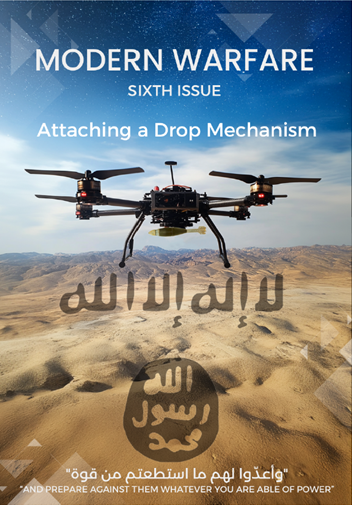
Title: “Modern Warfare” (publication series, Issues 1 through 6)
Language: English
Distribution environment: Pro–Islamic State non-official digital platforms, including encrypted and semi-encrypted communication spaces, on the app Rocket.Chat.
Content focus: Commercial UAV systems, FPV construction, camera integration, firmware configuration, payload release mechanisms.
SOURCE BASIS AND METHODOLOGY
This assessment is based exclusively on primary-source analysis of jihadist-origin material. No secondary reporting, media sources, or external analytical products were used.
The analytical process integrated OSINT analysis of jihadist publications, IMINT assessment of visual and technical schematics contained within the material, SOCMINT analysis of distribution environments and community interaction patterns, and Digital HUMINT techniques focused on inferred audience targeting, instructional design, and operational intent.
The exclusive reliance on primary-source jihadist material was a deliberate methodological choice, aimed at minimizing analytical contamination and preserving fidelity to the originating strategic logic of the product.
LIMITATIONS AND ANALYTICAL NOTES
This assessment does not evaluate actual operational uptake or confirmed attack attribution linked to the publication, as such data may not be observable through open-source means.
The presence of dual-use technologies introduces significant background noise, requiring caution to avoid conflating legitimate civilian technical activity with hostile intent.
The analysis assesses intent and potential impact rather than demonstrated effectiveness, acknowledging that end-user technical competence may vary significantly.
Findings should therefore be interpreted as indicative of emerging risk pathways rather than deterministic threat forecasts.
Nature of the Product: Operational Manuals, Not Propaganda
Modern Warfare should not be interpreted as a magazine in the conventional media sense. It is best assessed as a structured series of operational training manuals characterized by three defining features: a strictly technical, procedural language; the near-total absence of emotional or ideological narrative; and a persistent focus on components, processes, and troubleshooting.
These characteristics place the publication firmly within the category of decentralized military knowledge transfer. This approach is consistent with the post-territorial evolution of the Islamic State, shifting from a proto-state model toward a distributed insurgent network reliant on autonomous initiative rather than centralized control.
The material does not attempt to persuade or radicalize. Ideological adherence is assumed. The operational objective is not conviction but utility, transforming an already aligned individual into a technically capable actor.
Target Audience: Technical Low-to-Mid Skill Profiles Rather Than “Lone Wolves”
The intended audience is neither the unskilled fighter nor the highly trained engineer. Instead, the material targets an intermediate profile: technically literate individuals with access to civilian markets such as commercial drones, FPV kits, and consumer-grade 3D printing, combined with basic DIY competencies including soldering, firmware configuration, and entry-level CAD.
This targeting logic is deliberate. The Islamic State does not seek technical excellence but scalable replication. The competence level promoted throughout the series is deliberately sufficient rather than advanced, prioritizing accessibility and repeatability over sophistication.
Drones as a Strategic Equalizer
Across the entire series, a consistent operational logic emerges: the commercial drone is treated as the twenty-first-century equivalent of the improvised explosive device.
Three primary operational functions are emphasized. First, low-risk tactical intelligence, surveillance, and reconnaissance. Second, a low-cost stand-off attack capability. Third, psychological saturation and disruption of the adversary.
Precision is not the objective. Cost-effectiveness is. An FPV platform costing a few hundred dollars that compels the adversary to deploy electronic warfare assets, radar systems, or counter-UAS measures already constitutes a strategic success within an attrition-based model.
Intentional and Modular Learning Progression
The sequencing of the Modern Warfare issues reflects a deliberate pedagogical design rather than ad hoc publication.
Initial issues focus on UAV literacy and component familiarization. Subsequent material addresses control systems, communications, GPS management, and geofencing limitations. This is followed by FPV construction and visual systems integration, culminating in the integration of payload release mechanisms and explosives.
This modular learning chain is designed for asynchronous, fragmented consumption, making it particularly suited to clandestine environments and diaspora-based audiences lacking access to structured training.
Normalization of Explosives Use
A critical aspect of the publication is the treatment of explosives as a neutral payload, presented as one technical component among others.
This framing produces two cognitive effects. First, moral desensitization through technical abstraction. Second, a lowered psychological threshold for operational action.
From a cognitive warfare perspective, this approach is textbook: the exceptional nature of violent action is deliberately removed through procedural normalization.
Exploitation of the Open-Source Ecosystem
The series systematically exploits the open-source and civilian technology ecosystem. This includes widespread use of open-source flight control software and custom firmware, reliance on commercially available hardware platforms, and extensive use of 3D printing as a logistical force multiplier.
The result is a dramatic reduction in dependence on traditional terrorist supply chains. This adaptive lesson remains insufficiently internalized by many state security architectures.
Communication and Operational Security
The communication layer referenced in the ecosystem surrounding “Modern Warfare” should be interpreted as an enabling architecture rather than merely a dissemination channel. The inclusion of contact points and the use of platforms such as Rocket. Chat, alongside Telegram and Threema handles, indicates an intent to provide continuity of technical support, mentoring, and troubleshooting, functions that are operationally decisive for decentralized actors who lack access to physical training environments.
This design choice reflects a pragmatic understanding of the weakest link in autonomous capability development: the point at which self-trained users fail due to integration problems, configuration errors, or unreliable performance under testing conditions. By offering pathways into semi-closed technical assistance networks, the publication reduces abandonment rates and accelerates the transition from theoretical knowledge to functional capability.
From an operational security perspective, the platform choice signals resilience rather than perfect anonymity. The implicit model is redundancy, distributed hosting, and continuity through multiple channels. This is consistent with a post-territorial threat environment in which security pressure is expected, nodes are disposable, and the objective is not to preserve a single headquarters but to preserve know-how and support functions across an adaptive network.
For Western counterterrorism actors, this is a relevant shift. Traditional monitoring often prioritizes ideological broadcast channels, while operational value increasingly resides in technical microcommunities and support nodes that do not present as overt propaganda ecosystems. The threat, therefore, migrates from mass communication to narrow-capability enabling spaces, where intent is expressed through problem-solving rather than slogans.
Implications for Counterterrorism and Security
The principal implication for Western law enforcement and counterterrorism is that ideological monitoring alone is no longer sufficient for detection. The capability pathway promoted by “Modern Warfare” is primarily technical, modular, and dual-use, meaning it can advance under a civilian footprint until very late stages, often without overt ideological signaling in public spaces.
Effective disruption, therefore, requires integrated monitoring models that combine behavioral, technical, and procurement signals. The most actionable approach is pattern-based, focusing on clusters and progression, rather than item-based triggers. UAV ownership is not a signal, but coherent trajectories involving FPV construction, firmware configuration, payload-related components, and repeated testing behavior can become relevant when observed in combination and within compressed timelines.
At the policy and operational levels, countermeasures should prioritize distributed counter-UAS readiness rather than relying exclusively on centralized, high-end systems. Many likely targets of opportunity, including soft targets and symbolic venues, will never be protected by strategic-grade counter-drone architectures. What can be scaled is procedural readiness, detection reporting chains, local response drills, and the integration of private security and venue management into reporting and mitigation workflows.
A second implication concerns supply chain engagement. Because the publication intentionally leverages commercial-off-the-shelf components, timely disruption often depends on lawful cooperation frameworks with retailers, marketplaces, logistics providers, and service platforms. The objective is not broad restriction, which is rarely feasible, but targeted alerting for high-risk clusters and temporal patterns, combined with investigative triage that distinguishes hobbyist behavior from capability-focused progression.
Finally, the communication layer requires specific attention. Where legally and operationally feasible, mapping and monitoring technical support hubs can yield earlier warning than ideological channels, because they capture the moment when an actor moves from consumption to capability troubleshooting.
Assessment: Impact on the Tech-Enabled Lone Actor
The core issue is straightforward. The Modern Warfare series significantly lowers the entry barrier for tech-enabled lone actors by decomposing a complex capability, UAV operations combined with FPV systems and payload delivery, into a sequence of micro-skills that are replicable, purchasable, and testable under a civilian footprint.
The progression from platform selection to militarized integration removes the need for a coordinated team. Time and access to civilian markets become the primary requirements.
Operational militarization occurs through accessories rather than platforms. Risk escalation is driven by layering FPV control, dedicated video transmission, and standardized payload-release mechanisms, often enabled by 3D-printed components and shared CAD files. This modularity is ideally suited to individual actors.
Language throughout the material remains neutral and technical, reinforcing psychological distancing from violence. The integration of payload systems is presented as a routine engineering step rather than a moral threshold.
The ecosystem dimension is equally critical. Communication channels embedded in the material enable mentoring and troubleshooting, addressing the primary failure point for autonomous actors.
Almost all components involved retain plausible deniability as legitimate hobbies. Consequently, early warning frameworks must be pattern-based and combinatorial rather than item-based.
Early Warning Indicator Framework
Effective monitoring requires a domain-based approach, assessing clusters of behavior rather than isolated signals.
Indicators include systematic consumption and archiving of the Modern Warfare series, operationally focused technical discussions, migration toward closed support channels, coherent acquisition trajectories involving FPV build components and payload-related hardware, advanced firmware configuration activity, deliberate circumvention of safety features, repeated testing behavior in isolated environments, and evidence of networking with technical enablers.
Single indicators are insufficient. Risk escalation occurs when coherent clusters emerge, particularly where payload mechanisms, firmware configuration, and testing converge within compressed timelines.
Temporal progression is decisive. Hobbyist behavior is typically exploratory and inconsistent. Hostile intent is characterized by linear, goal-oriented progression from content consumption through acquisition, configuration, testing, and networking.
Operational Actions for LE and CT Actors
Immediate measures should include concise field briefings for territorial units on anomalous UAV testing behaviors, establishment of pattern-based alerting mechanisms with commercial retailers and logistics providers where legally permissible, targeted OSINT tasking focused on technical communities rather than propaganda channels, and the development of lightweight counter-UAS playbooks for soft target environments emphasizing detection, reporting, and behavioral indicators.
Analytical Conclusion
“Modern Warfare” is best assessed as a capacity-building artifact for a post-territorial jihadist threat environment. It operationalizes a strategic shift from centrally managed violence toward distributed capability diffusion, built on civilian-accessible technology, modular learning, and resilient support networks. Its operational significance lies in the systematic reduction of barriers to entry for tech-enabled actors who can develop functional UAV capabilities without travel, formal training, or direct organizational integration.
The publication does not need to produce large numbers of successful attacks to be strategically relevant. Within an attrition-based logic, repeated low-cost attempts can impose disproportionate defensive burdens, disrupt public confidence, and generate media amplification even when tactical effectiveness is limited. This dynamic is particularly salient in Western environments where symbolic disruption often produces strategic effects that exceed physical damage.
Interpreting “Modern Warfare” as conventional propaganda is analytically insufficient. It should be treated as insurgent manualization, designed to convert ideological alignment into operational utility through reproducible technical processes, leveraging the open source and maker ecosystem as an enabling substrate.
Intelligence Assessment and Outlook
The “Modern Warfare” series indicates a deliberate intent to enable decentralized actors outside formal Islamic State provincial structures, with a primary audience likely embedded in Western or Western-connected technological ecosystems. The consistent emphasis on commercial platforms, FPV build processes, firmware configuration, and payload delivery mechanisms suggests a focus on practical capability development rather than messaging.
Over the next three to six months, the most plausible trajectory is increased circulation, mirroring and repackaging of the content, including partial excerpts and translated adaptations tailored to specific platforms and procurement realities. Technical support nodes are likely to become more important than the documents themselves, as user demand increasingly focuses on troubleshooting and integration issues. This increases the operational value of monitoring technical micro communities and closed support channels, where the shift from interest to capability is most visible.
In terms of threat manifestation, the highest probability scenario is not sophisticated attacks against hardened targets. Still, opportunistic reconnaissance, harassment, attempted payload delivery, and disruptive demonstrations targeting soft or symbolic venues, including locations with high psychological payoff and uneven defensive readiness. The operational logic will favor low-cost platforms, short planning cycles, and plausible deniability until late-stage testing.
Confidence statement, moderate confidence. The intent and design characteristics of the material strongly support the assessment; however, observable evidence of uptake, end-user competence, and operational execution cannot be established solely from the primary documents.
Confidence and Reliability Statement
This assessment is issued with moderate confidence.
Confidence is derived from the direct examination of primary-source jihadist material, including the complete “Modern Warfare” publication series, and from internal consistency across content structure, instructional sequencing, and technical emphasis. The intent, target audience, and operational logic of the material are assessed with moderate confidence based on repeated design choices, language use, and capability framing observed across multiple issues.
Reliability of the source material is assessed as high with respect to intent and instructional design, as the documents represent original, first-order content produced for dissemination rather than secondary reporting or commentary. The technical procedures, learning progression, and capability assumptions reflected in the material are internally coherent and consistent with known patterns of post-territorial jihadist adaptation.
Confidence is lower regarding actual uptake, user competence, and real-world operational execution, as these factors cannot be directly validated through primary-source document analysis alone. Observable impact may vary significantly depending on individual skill levels, access constraints, and local security environments.
Overall confidence is constrained by the absence of corroborating evidence for downstream implementation, including confirmed testing, operational deployment, or attack attribution explicitly linked to the publication. As such, the assessment should be interpreted as an evaluation of capability enablement and risk pathways, not as a predictive statement of imminent or inevitable operational outcomes.
Collection Requirements and Priority Intelligence Requirements
Practical assessment and disruption of the threat pathway associated with the “Modern Warfare” publication require a shift in collection priorities away from purely ideological indicators toward technical, behavioral, and network-enabling signals. Collection efforts should focus on validating whether the instructional material is translating into real-world capability development rather than remaining aspirational or symbolic.
Priority collection should seek to determine the extent to which the publication is being actively consumed, mirrored, translated, or repackaged across technical and jihadist-adjacent online environments. Particular attention should be paid to the emergence of recurring dissemination hubs, including file-sharing repositories, private chat groups, and community nodes that facilitate access to the whole sequence of issues rather than isolated documents.
A second priority requirement concerns evidence of capability progression among end users. This includes observable indicators of UAV build activity transitioning from consumer out-of-the-box use to FPV construction, firmware customization, payload-related experimentation, and repeated testing cycles. Signals of interest include technical troubleshooting discussions, configuration exchanges, and requests for performance validation rather than generic curiosity.
Third, the collection should focus on identifying and mapping technical support and mentoring networks. These nodes are operationally significant because they represent the point at which autonomous actors overcome failure thresholds and convert theoretical knowledge into functional capability. Monitoring such networks can provide earlier warning than ideological channels, as they capture intent through problem-solving behavior.
Fourth, intelligence collection should aim to identify procurement patterns that correlate with capability development rather than hobbyist activity. This includes clustered acquisition of FPV components, payload-related hardware, 3D printing materials, and replacement parts within compressed timeframes. Where legally permissible, cooperation with commercial actors can support this effort through anonymized pattern recognition rather than individual profiling.
Finally, the collection should assess whether adaptations of the material are emerging that indicate localization, operational refinement, or tactical innovation. This includes simplified guides, platform-specific variants, or context-adapted payload solutions that suggest learning and iteration beyond the original publication.
Priority Intelligence Requirements should therefore include the following. Is the “Modern Warfare” series being actively used as a training reference rather than passive propaganda? Which online environments function as capability-enabling hubs rather than ideological forums? Are there observable clusters of technical progression that correlate with increased testing activity? Do mentoring and troubleshooting networks persist over time and attract recurring users? Are adaptations emerging that indicate operational learning or environmental tailoring?
Implications for Force Protection and Soft Target Security
The operational implications of the “Modern Warfare” threat model for force protection and soft target security are primarily structural rather than technological. The most likely risk does not stem from competent UAV systems employed against hardened facilities. Still, from low-cost, low-signature platforms used opportunistically against targets with uneven defensive postures and high symbolic or psychological value.
Force protection frameworks should therefore prioritize distributed awareness and procedural readiness over reliance on centralized, high-end counter-UAS systems. Many potential targets, including diplomatic venues, public events, transportation nodes, and civilian infrastructure, will never be covered by strategic-grade counter-drone capabilities. What can be scaled is detection awareness, reporting discipline, and rapid response coordination at the local level.
Personnel assigned to force protection, perimeter security, and venue management should receive focused awareness training on indicators associated with FPV-style UAV threats. These include low-altitude, high-speed flight profiles, short dwell times, non-linear approach paths, and the possible presence of spotters or observers conducting line-of-sight monitoring. Emphasis should be placed on behavioral recognition rather than technical identification.
Reporting chains must be simplified and rehearsed. The objective is not immediate interdiction by security personnel, but rapid notification, escalation, and situational awareness. Even limited response measures, such as temporary sheltering, tightening access controls, and crowd dispersion, can significantly reduce the effectiveness of opportunistic UAV attempts.
For military installations and diplomatic facilities, force protection planners should reassess assumptions regarding threat directionality and standoff distances. Small FPV platforms reduce traditional warning times and can exploit vertical and lateral coverage gaps. Layered defenses should therefore integrate visual observation, acoustic cues, and procedural alerts alongside electronic measures.
Soft target security planning should explicitly account for the psychological dimension of UAV incidents. Even failed or intercepted attempts can generate disproportionate public impact. Crisis communication, incident management, and coordination with local authorities should be pre-planned to avoid escalation due to confusion, misinformation, or delayed responses.
Finally, force protection strategies should incorporate partnerships with private security providers, event organizers, and infrastructure operators. These actors are often the first to observe anomalous behavior, test activity, or suspicious UAV usage. Integrating them into reporting and awareness frameworks extends the defensive perimeter beyond formal security actors and increases the likelihood of early detection.
🔒 Executive Intelligence Cycle
This assessment is part of a broader analytical cycle.
Founding subscribers receive the Executive Intelligence Briefing, which integrates all threat assessments, cognitive domain analysis, and a rolling 30–90 day forecast into a single monthly strategic synthesis.
© Daniele Garofalo Monitoring - All rights reserved.
Daniele Garofalo is an independent researcher and analyst specialising in jihadist terrorism, Islamist insurgencies, and armed non-state actors.
His work focuses on continuous intelligence monitoring, threat assessment, and analysis of propaganda and cognitive/information dynamics, with an emphasis on decision-oriented outputs, early warning, and strategic trend evaluation.
Daniele Garofalo Monitoring is registered with the Italian National ISSN Centre and the International Centre for the Registration of Serial Publications (CIEPS) in Paris.ISSN (International Standard Serial Number): 3103-3520ORCID Code: 0009-0006-5289-2874