


Russia’s Africa Corps is confronting a persistent operational challenge in Mali as insurgent and separatist forces continue to contest the mobility, security and territorial reach of Russian-backed military operations. The concentration of attacks reported between July and October 2026, particularly those involving Russian personnel, reinforcement convoys, military positions and air infrastructure, provides an opportunity to assess the performance of Moscow’s security model following the formal replacement of Wagner by Africa Corps.
The available evidence does not establish that Russia is losing its military position in Mali or that Africa Corps has become operationally ineffective. Russian forces retain substantial combat capabilities, including aviation, fire support and the ability to reinforce Malian operations. The central limitation appears to lie elsewhere: the difficulty of converting those capabilities into sustained territorial control and reliable security across dispersed operational areas.
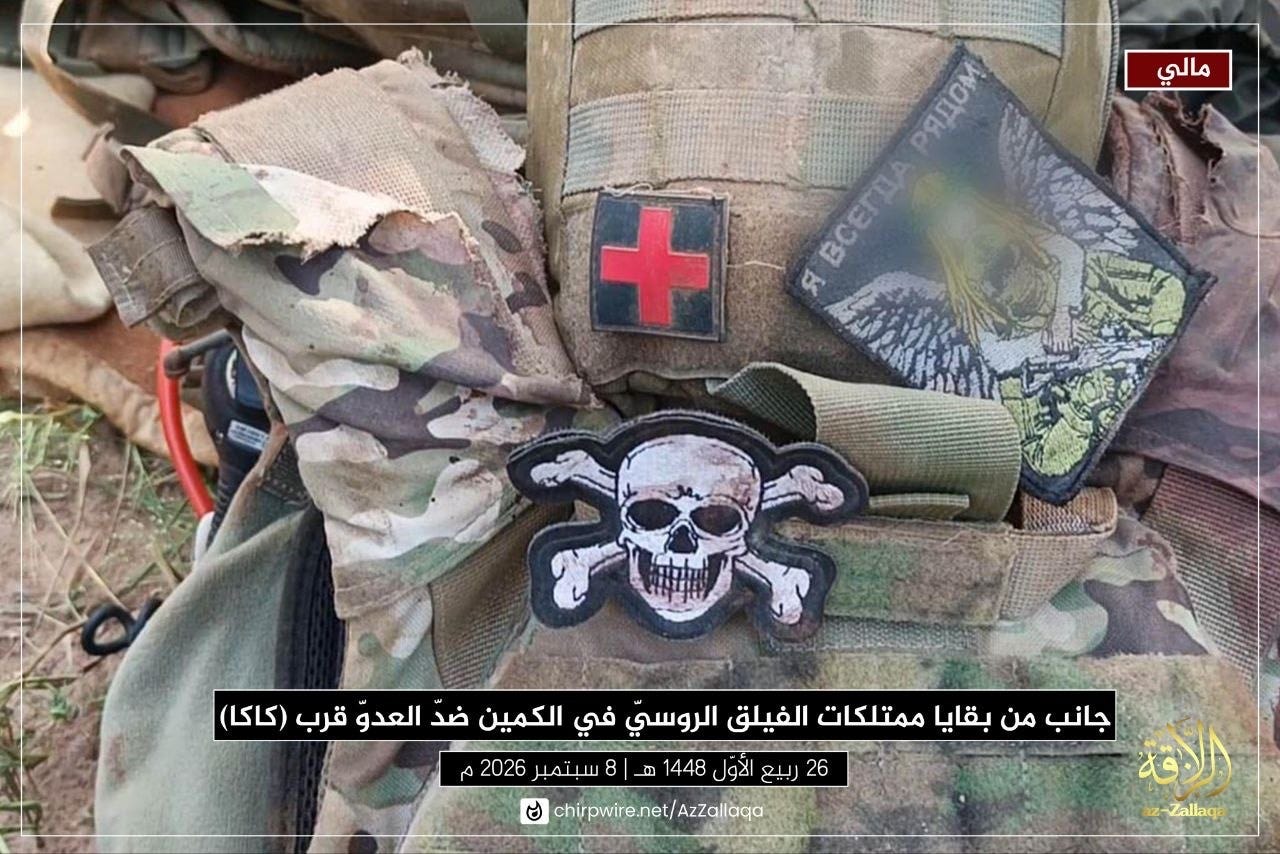
Primary-source monitoring of JNIM communications indicates that Russian personnel have repeatedly been identified as direct targets, rather than merely as supporting elements accompanying Malian forces. The accompanying imagery provides additional evidence of captured equipment, damaged vehicles and Russian-associated insignia, although individual casualty figures and the circumstances of particular engagements frequently remain unverified.
The significance of these developments extends beyond immediate battlefield losses. Africa Corps represents a more directly state-controlled instrument of Russian foreign and security policy than Wagner, making its performance relevant to Moscow’s wider credibility as a security partner in the Sahel. At the same time, the combination of military pressure and JNIM’s earlier political overture toward the Russian contingent raises questions about whether insurgent actors are attempting to influence not only the conduct of Russian operations, but also Moscow’s longer-term commitment to the conflict.
From Wagner to Africa Corps: Russia’s Changing Military Role in Mali
Russia’s military engagement in Mali has evolved from a relationship built around the Wagner Group into a more directly institutionalized security partnership. Following Wagner’s announcement of its withdrawal in June 2025, Africa Corps assumed the principal role of supporting Malian forces, retaining significant elements of the earlier Russian deployment while operating under closer Kremlin control. This transition changed the formal command and political structure of Russia’s involvement without necessarily transforming the operational environment in which its personnel were deployed. Human Rights Watch reported in August 2026 that Africa Corps retained approximately the same troop strength as its predecessor, including numerous former Wagner personnel and elements of its leadership.
The distinction matters because the effectiveness of Africa Corps cannot be assessed exclusively through the number of insurgents killed, the volume of airstrikes conducted or the ability to respond to individual attacks. Moscow’s security partnership with Bamako performs several functions simultaneously: supporting the military government, reinforcing Malian combat operations, protecting strategically important installations and contributing to the state’s capacity to contest insurgent-held territory. These objectives overlap, but they require different operational capabilities and should not be treated as interchangeable measures of success.
The events of 2026 demonstrate that Africa Corps retains the ability to conduct significant military operations. Russian aircraft have supported ground operations in central Mali, while Russian personnel have participated in offensive deployments and reinforcement efforts across contested regions. Human Rights Watch documented a June 15 air operation involving an aircraft identified by Malian military sources as a Russian-operated Su-24, providing independent evidence of the aviation capabilities available to Africa Corps. The same investigation documented eight civilian deaths in strikes that the organization assessed as apparently unlawful, illustrating the distinction between possessing strike capabilities and employing them effectively within a counterinsurgency campaign.
The central question is therefore not whether Russian forces possess sufficient firepower to engage insurgent formations. It is whether their operational model can sustain secure movement, maintain isolated positions, protect military infrastructure and contribute to durable territorial control. The distinction becomes increasingly important when evaluating a security partnership whose political credibility depends on the expectation that Russian support will produce improvements beyond the immediate survival of the Malian government.
September 2026: Repeated Attacks Against Russian-Malian Forces
September provided an unusually concentrated body of primary-source reporting on attacks involving Russian personnel. Statements and visual material released by JNIM’s Az-Zallaqa media outlet identified Russian forces as targets in several operations across central Mali, including attacks near Kaka, Dioura, Konna, Sévaré, Djabali and Niono. These incidents differed in scale, tactics and documented effects, but collectively illustrate the range of circumstances in which Russian personnel and their Malian partners remained exposed.
On September 8, JNIM claimed an ambush against a joint Russian-Malian patrol near Kaka in the Mopti region. Its statement alleged 13 fatalities among Russian personnel, Malian soldiers and allied fighters, alongside the capture of weapons and motorcycles. Subsequent propaganda material included images of military equipment displaying Russian-language inscriptions and national insignia. Such imagery is consistent with Russian involvement in the targeted formation, although it cannot independently establish the nationality of individual casualties or verify the number of fatalities claimed.
The September 10 attack on the military camp at Dioura represented a more consequential test of the wider Malian security architecture. Reporting by AFP, drawing on military, security and local sources, indicated that at least 100 Malian soldiers and five Africa Corps personnel were killed. Reuters subsequently reported more than 100 Malian military deaths, while noting that the army described evacuation and retaliatory operations. The disparity between the scale of the reported losses and the continued ability of government forces to mount a response illustrates the difference between tactical survivability and the capacity to recover after a major attack.
