


Executive Intelligence Summary
This assessment analyses the editorial published on page 3 of al-Naba’ issue 527 as a deliberate cognitive-domain operation that combines routine seasonal incitement with strategic perception management. While Islamic State (IS) has issued comparable holiday-period calls to violence for more than a decade, the current editorial reflects a heightened sensitivity to Western media narratives and political discourse surrounding a perceived resurgence of the group.
The text portrays the Christmas and New Year period as a “season of terrorism and anxiety,” framing Western societies as already besieged by fear, security measures, and social disruption. Through this framing, IS seeks to claim indirect strategic success, attributing increased security spending, public anxiety, and event cancellations to its own pressure, regardless of its actual operational capacity.
The editorial is not designed to announce imminent centrally directed attacks. Rather, it aims to normalise chronic insecurity, lower the psychological threshold for opportunistic violence, and reinforce the perception that even minimal or inspired actions can impose disproportionate costs on adversaries. The most credible near-term threat remains low-complexity, inspired attacks by lone or loosely connected actors, especially against soft and symbolic targets during high-visibility periods.
Key Judgements
The editorial represents institutionalised seasonal incitement, consistent with IS messaging patterns over the past decade, rather than an exceptional escalation. (High confidence)
The language and argumentative structure demonstrate active monitoring and mirroring of Western media and political debates regarding an alleged IS resurgence. (High confidence)
IS deliberately frames heightened Western security measures as evidence of its strategic effectiveness, inflating perceived impact while masking material constraints. (High confidence)
The primary near-term threat vector is inspired, low-complexity violence (vehicles, knives, blunt weapons, arson), not coordinated mass-casualty plots. (High confidence)
The editorial’s core cognitive objective is the normalisation of fear and vigilance as a permanent condition in Western societies. (Medium–High confidence)
Methodology
This assessment is based on direct primary-source analysis of the al-Naba’ 527 editorial (page 3), applying a cognitive warfare framework that integrates:
Rhetorical and framing analysis, focusing on how threat, fear, and responsibility are constructed;
Cognitive effects assessment, identifying intended psychological and behavioural outcomes across audiences;
Audience segmentation analysis, distinguishing between internal cadres, committed sympathisers, unaffiliated supporters, and Western publics;
Longitudinal comparison, situating the editorial within a decade-long pattern of IS seasonal messaging.
Operational and strategic data from prior analyses are used solely as contextual grounding, not as the analytical focus.
Sources
No secondary sources are required for textual interpretation; the analysis is grounded entirely in the primary jihadist publication.
Limitations
The assessment evaluates intent and plausible cognitive effects, not empirically verified audience reception.
Claims made in the editorial regarding Western security spending or societal impact are propagandistic assertions, not independently validated facts.
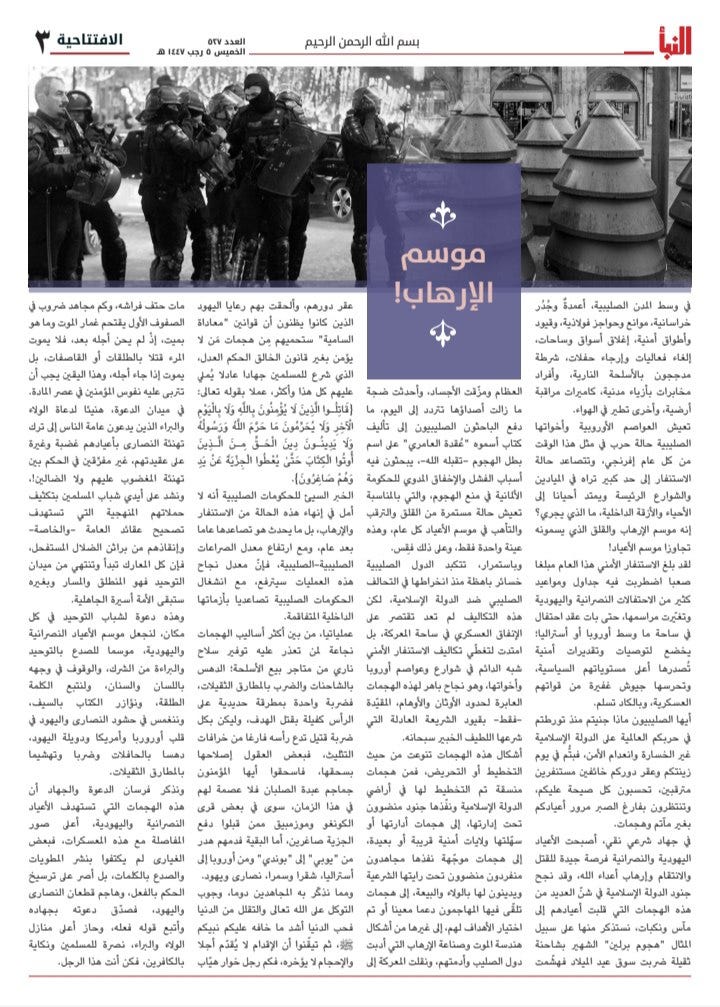
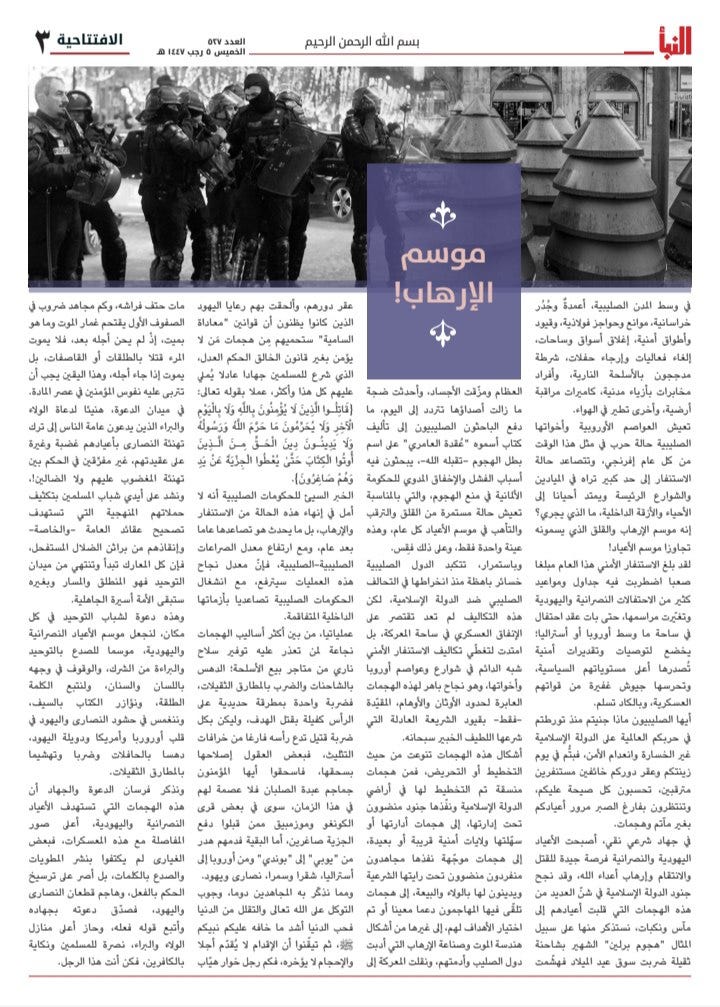
Full translation of al-Naba editorial #527
“The season of terrorism!
In the heart of Crusader cities: checkpoints, concrete barriers and bollards, armed patrols, closed gates, guarded markets, blocked roads, and cancelled celebrations. Security forces in uniform and civilian clothes, surveillance cameras everywhere, and even the sky is monitored.
European capitals and their ilk are experiencing a condition these days that resembles a state of war. A situation that repeats itself every year and grows until it becomes visible in major public spaces, neighbourhoods, and internal security systems. What’s happening? It is the season of terrorism and fear, what they call the “holiday season.
This year, however, the situation of security instability has reached a higher and more continuous level. Christian and Jewish celebrations have been disturbed, postponed, or modified, so much so that even celebrating in the heart of Europe or Australia requires recommendations and security assessments issued by the highest political levels, in addition to the presence of armed forces and means.
What have you achieved from your financial war against the Islamic State other than insecurity, fear, and loss? You live in fear, you wake up every morning worried, you look forward to the passage of your holidays with anxiety, without serenity or joy.
In a pure and legitimate jihad, the festivals of Christians and Jews represent a suitable occasion to kill, take revenge and terrorise the enemies of God. Many Islamic State soldiers have been successful in numerous attacks that have turned these celebrations into mourning and mourning. We need only recall the famous attack in Berlin, when a truck hit the Christmas market, or other similar incidents in various cities. Today, while crusaders live in a state of paranoia and fear, the likelihood of successful attacks increases. Security measures, barriers and controls do not guarantee protection, but only demonstrate their weakness and fear. The Islamic State soldier does not need large means or complex planning: a vehicle, a knife, or an improvised weapon is sufficient.
There is only one death, and it strikes in every case. It better be for God’s cause. Hitting during these holidays is easier, more effective and more painful for enemies. Each attack increases their fear, disturbs their lives, and proves that no security can protect them.
O Muslims, do not let this opportunity pass. The streets are full, the markets crowded, the celebrations on display. Hit where you can, when you can, how you can. This is the season of terrorism for them, and of victory for the believers”.
Editorial analysis
This editorial is not a simple call to action. It is a cognitive framing operation that transforms the Christmas period into a permanent, hostile psychological environment. The text does not announce an offensive: it states that the offensive is already underway because fear already exists.
The central element is the reversal of cause–and–effect: Western security measures are presented not as prevention, but as proof of the effectiveness of the Islamic State. Barriers, police and cancellations become “evidence” of jihadist success, regardless of whether real attacks occur.
The text constructs a narrative of structural paranoia: Western societies are portrayed as incapable of living normally without feeling threatened. This is the heart of cognitive warfare: turning prevention into perceived vulnerability.
While not indicating centralised operational planning, the step that defines the holiday season as an “easier, more effective and more painful” window to attack constitutes a cognitive activation signal that, historically, is associated with an increased risk of inspired and low-complexity attacks.
Threat Assessment
In the short term, and particularly in the window between the publication of this editorial and the weeks immediately following, until the end of the holiday period, the most concrete risk is not represented by complex or coordinated operations, but by inspired and low-complexity attacks. The language used in the text, which emphasises the ease, effectiveness, and psychological impact of violent action, is consistent with dynamics observed in previous cycles of seasonal incitement and tends to favour the activation of already radicalised or accelerating individuals. In this context, the most likely targets remain those with high symbolic density and low structural protection: markets, public events, spaces for celebration, places of civil gathering, and visible presences of law enforcement in urban settings. The most plausible modes of operation are those that require minimal resources and reduced preparation time, vehicles used as weapons, knives, arson, or sudden assaults, and that allow the actor to act opportunistically, exploiting predictable crowding and routines. In the medium term, once the immediate holiday window is exhausted, the threat tends to shift from the plane of direct action to that of perception and attribution. It is likely that the Islamic State, through its media channels, continues to attempt to attribute to itself episodes of violence, unrest, or criminal acts even marginally compatible with its own narrative, regardless of whether there is a real connection. This dynamic, already observed in previous phases, produces an increase in so-called “threat noise”: unverified reports, generic threats, imitations and false alarms which, while not necessarily translating into attacks, impose operational and cognitive costs on security institutions and contribute to maintaining a high level of public attention. At this stage, the main risk is not so much the lethal impact of events, but their cumulative capacity to fuel insecurity and uncertainty.
In the long run, beyond the six-month horizon, the threat takes on a predominantly strategic dimension. The most significant danger lies not in a structured operational recovery of the organisation, but in the normalisation of fear as an ordinary component of social life. When exceptional measures, emergency languages, and alert postures become permanent, the result is a progressive acceptance of a latent state of emergency, which ends up eroding social resilience and, paradoxically, amplifying the effectiveness of adversarial cognitive warfare. In this scenario, even in the absence of a real increase in violence, the perception of a constant threat in itself represents a strategic success for the organisation, as it consolidates the idea of a vulnerable society, forced to live under pressure and react rather than govern risk.
Time window and cognitive activation: a targeted risk assessment
A passage in the editorial deserves specific attention because it introduces an element that goes beyond habitual rhetoric and takes on an operational value on a cognitive level. When the text states that striking during the holiday season is “easier, more effective, and more painful” and explicitly urges people not to let the opportunity pass, pointing to crowded streets, markets, and celebrations as exposed spaces, the organisation doesn’t simply reiterate a generic incitement. This language constructs a clearly delimited time window and presents it as an immediate opportunity, significantly lowering psychological and operational barriers to violent action.
From a threat perspective, such wording does not amount to a centralised order or suggest the existence of a coordinated campaign. However, historically, messages of this type have served a specific function: to activate individuals already radicalised or in an advanced stage of mobilisation, providing them with temporal and moral legitimacy to action. The emphasis on ease, effectiveness, and pain inflicted on the enemy reduces individual risk perception and also transforms an improvised act, devoid of complex planning, into a significant contribution to the cause. In this sense, the text operates as a cognitive accelerator, not as an operational plan.
It is precisely this combination, temporal opportunity, simplification of modalities, promise of immediate impact, that makes the transition relevant in the short term. Even in the absence of a real increase in the organisation’s capabilities, the likelihood of inspired and low-complexity acts tends historically to increase when such messages are disseminated in contexts of high public visibility and strong symbolic charge. The risk, therefore, lies not so much in the prospect of structured escalation but in the possibility that individuals will interpret the appeal as a signal of urgency and permission, acting opportunistically against easily accessible targets. This makes the holiday window a time that requires increased attention, not because it heralds a new phase of the jihadist threat, but because it concentrates in a few days a series of cognitive factors that can translate into sudden and difficult-to-predict violence.
Cognitive Domain & Cognitive Warfare Assessment
The editorial operates fully in the cognitive domain and can be read as a mature exercise in cognitive warfare oriented toward persistence, rather than escalation. The first axis it acts on is the normalisation of fear. The text does not present insecurity as an exceptional or temporary condition, but as a structural and recurring state of Western life during the holidays. Checkpoints, cancellations, armed patrols, and surveillance are described not as extraordinary responses to a contingent threat, but as ordinary elements of the urban and social landscape. In this way, fear is removed from the emergency dimension and transformed into routine, reducing the ability of affected societies to perceive it as an anomaly to be overcome.
The second axis concerns the attribution of power. The editorial suggests that the Islamic State does not need to strike directly to exert influence: it is enough for the West to react. Every barrier, every deployment of forces, every preventive measure becomes evidence of the pressure exerted by the organisation. The opponent’s reaction is thus reinterpreted as confirmation of strategic effectiveness, regardless of the existence of a real causal link. In cognitive terms, this mechanism allows the Islamic State to convert prevention into symbolic victory, reversing the meaning of security measures and appropriating their psychological and political impact.
The third axis is represented by the lowering of the individual action threshold. The editorial’s message legitimises and simplifies the use of violence, presenting it as accessible, justified, and potentially decisive even when lacking planning or sophisticated means. The emphasis on simple modalities and the opportunity offered by holidays reduces moral and operational barriers, fostering the idea that individual initiative is not only legitimate, but desirable and strategically relevant. Within this framework, even isolated or improvised action can be internalised as a significant contribution to a broader cause.
Taken together, these three axes outline a form of cognitive warfare that aims not to produce immediate shocks or demonstrate military superiority, but to sustain over time an ecosystem of perceptions favourable to the organisation. The goal is not the visible escalation of conflict, but rather the stabilisation of a low-intensity balance in which individual fear, reaction, and action become self-reinforcing elements. It is a strategy that reflects a high degree of adaptation and awareness of one’s material limitations, and that aims to maintain relevance and influence even in the absence of expansive operational capabilities.
Intelligence Assessment
From an intelligence perspective, the editorial reflects an organisation that appears fully aware of its current operational limitations and has adapted its way of operating in the informational and cognitive domains accordingly. The Islamic State does not communicate as an offensive actor, nor as an organisation capable of directing or coordinating large-scale complex campaigns. On the contrary, the text suggests a clear understanding that the main lever available today lies not in command ability, but in the management of perception and time.
Within this framework, the organisation appears to maximise the cognitive performance of three external factors over which it does not exercise direct control but which it can effectively exploit: media attention, political debate on security, and the visibility of preventive measures adopted by Western states. Alarmist headlines, public discussions about the “jihadist threat”, and visible security devices are absorbed into the organisation’s narrative and repurposed as indirect evidence of its strategic relevance. In doing so, IS does not have to demonstrate superior operational capabilities: it is sufficient for the information and policy environment to produce signals that can be interpreted as a reaction.
The value of the message, therefore, lies not in providing detailed operational command or tactical direction, but in combining timing and legitimacy. The editorial identifies a favourable time window, emphasises its symbolic and social exposition, and provides a moral framework that makes individual action immediately justifiable. This approach is consistent with a strategy that favours inspired, opportunistic, low-complexity attacks, minimising coordination requirements and increasing the likelihood of autonomous initiatives. In strategic terms, the attack itself becomes secondary to its cumulative impact. Even limited events, or even the mere fear that they might occur, contribute to generating widespread anxiety, security costs, and political pressure, all of which the organisation interprets and communicates as successes. The Islamic State’s remaining strength, at this stage, therefore lies not in its ability to inflict decisive damage, but in its ability to transform the adversary’s reaction into an effectiveness multiplier, maintaining a level of perceived instability disproportionate to its own real resources.
Policy Assessment
For military decision-makers and security apparatus, the editorial’s analysis suggests the need for careful calibration of postures adopted in the period immediately following the dissemination of incitement messages. The main risk stems not from insufficient security measures but rather from their excessive visibility and dramatisation, which can unintentionally reinforce the opposing narrative. Strongly spectacular postures, characterised by a massive and highly visible deployment of forces and means, tend in fact to be easily absorbed into the Islamic State’s message as evidence of effectiveness and pressure exerted on the adversary.
In this context, it is more effective to favour forms of discreet deterrence, based on a less conspicuous but better distributed presence, accompanied by a strengthening of preventive and proximity intelligence (fostering collaboration between civilian or freelance analysis and monitoring experts with security forces and command structures). The goal is not to show strength, but to reduce operational opportunities for individual or opportunistic actors by intervening upstream on signs of mobilisation and preparedness. An approach centred on silent prevention, early interdiction, and targeted protection of soft targets allows for maintaining a high level of security without amplifying the cognitive impact of the jihadist message.
For civil policy makers, the most sensitive dimension concerns the management of public communication. The editorial demonstrates how the Islamic State is able to exploit headlines, political statements, and public debates to build a perception of centrality and strength disproportionate to its actual capabilities. Narratives that evoke scenarios of “siege”, “internal war, or imminent “jihadist resurgence, if not supported by solid evidence, risk producing a counterproductive effect, directly contributing to the organisation’s cognitive strategy.
From this perspective, institutional communication should aim to normalise risk management, avoiding both superficial minimisations and rhetorical amplifications (here too, a collaboration between industry professionals, analysts, researchers, and monitors would be desirable to allow for the best understanding of threat assessment and how to understand and address it). Presenting security measures as part of a protection and resilience routine, rather than as an emergency response to an exceptional threat, reduces the potential for cognitive exploitation by the adversary. The political objective should not be to reassure through alarm, but to strengthen confidence in the State’s ability to govern risk without permanently altering the functioning of public life.
Taken together, these considerations indicate that an effective response to the threat outlined in the editorial does not require an indiscriminate increase in the intensity of security policies, but a more sophisticated management of the relationship between security, perception, and communication. It is in this balance, more than in the mere accumulation of visible measures, that the ability to reduce the real and symbolic impact of the cognitive war waged by the Islamic State is played out.
Conclusions: strategic implications and alert indicators
The editorial published in al-Naba’ 527 does not introduce a new phase of the jihadist threat, nor does it signal a qualitative leap in the Islamic State’s operational capabilities. On the contrary, it represents a particularly clear example of strategic adaptation under conditions of material limitation, in which the cognitive dimension becomes the main available room for manoeuvre. The value of the text lies not in what it promises on an operational level, but in what it attempts to produce on a perceptual level: the feeling that fear is inevitable, recurring and structural.
In this sense, the editorial should be read as an attempt to stabilise a low-intensity balance, in which even the absence of attacks or the presence of isolated incidents can be reinterpreted as successes. Strategy is not about winning, but about lasting; not about conquering, but about wearing down. Making tension ordinary, transforming prevention into a sign of vulnerability, and legitimising individual action as a strategic contribution are the elements that allow the organisation to maintain relevance even in a phase of operational decline.
Some relevant operational and strategic implications emerge from this framework. First, the most effective response does not necessarily coincide with a visible increase in security measures, but rather with a more sophisticated management of the relationship between protection, communication, and public perception. Deterrence works best when it is credible but discreet, when it reduces opportunities without offering the adversary easily exploitable images and narratives. Likewise, institutional communication represents a crucial terrain: describing risk proportionately, avoiding both minimisation and hyperbole, helps remove space from the narrative of siege that the organisation seeks to impose.
In the short term, it remains necessary to maintain a strengthened level of attention towards indicators of individual mobilisation, especially in contexts with high symbolic visibility. Signs such as an increasing focus on specific dates, crowded locations, or simple modes of action, as well as improvised reconnaissance activities or sudden behavioural changes, deserve priority monitoring. At the same time, on a media and political level, it is appropriate to pay attention to the cycles of narrative amplification that attribute to the Islamic State a central role or a capacity for influence disproportionate to the facts, since these dynamics themselves constitute a cognitive multiplier of the threat.
In the medium and long term, the most significant risk is not represented by a sudden escalation, but by the progressive internalisation of fear as a normal element of public life. It is in this normalisation that the Islamic State’s cognitive warfare finds its main potential success. Countering it requires continuity, coherence, and a strategic vision that recognises how managing perception is as relevant today as managing physical security.
Ultimately, al-Naba’ 527’s editorial should not be overestimated on a military level, but neither should it be underestimated on a cognitive level. Understanding its logic allows us to reduce its real and symbolic impact. Ignoring it, or reacting disproportionately to it, instead risks confirming exactly what the text is intended to demonstrate: that fear, more than attack, remains the most effective weapon available to the organisation.
© Daniele Garofalo Monitoring - All rights reserved.
Daniele Garofalo is an independent researcher and analyst specialising in jihadist terrorism, Islamist insurgencies, and armed non-state actors.
His work focuses on continuous intelligence monitoring, threat assessment, and analysis of propaganda and cognitive/information dynamics, with an emphasis on decision-oriented outputs, early warning, and strategic trend evaluation.
Daniele Garofalo Monitoring is registered with the Italian National ISSN Centre and the International Centre for the Registration of Serial Publications (CIEPS) in Paris.ISSN (International Standard Serial Number): 3103-3520ORCID Code: 0009-0006-5289-2874.Support my research, analysis and monitoring with a donation here, PayPal.Me/DanieleGarofalo88
"Presenting security measures as part of a protection and resilience routine, rather than as an emergency response to an exceptional threat, reduces the potential for cognitive exploitation by the adversary. The political objective should not be to reassure through alarm, but to strengthen confidence in the State’s ability to govern risk without permanently altering the functioning of public life." That's the point...Even though mass journalism tends to use alarmism as a means to sell and generate clickbait. Now what is really needed is joint, collaborative work between governments and the media, which play a central role in this dynamic. Sometimes talking about an issue too much can be more counterproductive than not talking about it at all.
It is nevertheless interesting to observe the change in communication style: less direct, but more impactful, especially in psychological terms. I also believe it is no coincidence that the focus has been directed at those living in Europe—not only because of the holiday period, but also because there are no socio-political conditions to target other, much “hotter” and more reactive actors (such as those in North Africa, for example), who at this specific historical moment are more united from an ideological and emotional standpoint than those living in Europe. The Palestinian cause, in particular, has brought many people together, creating a strong sense of belonging, which in Europe—given religious and cultural differences—is felt to a lesser extent, thus making it a much more fertile ground.