


Executive Intelligence Summary
As of June 2026, the Islamic State remains a resilient and decentralised insurgent actor operating across the Middle East and South Asia, capable of sustaining operational relevance despite a contained overall attack volume.
The organisation continues to operate within a post-territorial insurgent model defined by decentralised cells, localised autonomy, and the selective use of violence. Understanding how this decentralisation affects regional threat levels and operational coordination is essential for strategic planning and resource allocation.
Scope and Methodology
This Strategic Threat Outlook is based on:
systematic monitoring of Islamic State propaganda (videos, photos, statements, claims);
reporting from sources in the field;
Integration of OSINT, SOCMINT, IMINT, and Digital HUMINT.
Sources include primary Islamic State media channels, open-source reporting, official statements, and local sources across affected regions.
Limitations
Incomplete or delayed reporting from conflict zones;
Exaggeration or omission in group claims;
Propaganda bias and potential disinformation.
Where verification is not possible, this is explicitly noted. However, incomplete or delayed reporting from conflict zones, propaganda bias, and disinformation may affect the precision of threat assessments and require cautious interpretation of available data.
Provincial Snapshots
Islamic State Sham;
Islamic State of Iraq;
Islamic State Khorasan;
Islamic State Pakistan;
Islamic State East Asia.
📌 Inside this Assessment
Overview and Security Threat Assessment
Activity and Operations Analysis — August 2026
Number, Targets, and Areas of Attacks in August 2026
Charts and Statistics
Analytical and Intelligence Assessments
Implications for Decision Makers
Early Warning Indicators
Threat Forecast, 30 to 90 Days
Executive Intelligence Conclusion
Overview and Security Threat Assessment
Entering 2026, the Islamic State should no longer be analysed through the lens of territorial revival scenarios. While current evidence indicates a focus on survival and network preservation, IS’s potential to reconstitute territorial control or adapt tactics remains a concern that warrants ongoing monitoring.
The structural features identified in 2025 remain intact. IS continues to operate as a decentralised ecosystem of locally embedded nodes, loosely connected by ideological cohesion and brand identity rather than a rigid command hierarchy. Central leadership functions primarily as a symbolic and narrative anchor, while operational initiative remains provincial and context-driven.
What January 2026 clarifies is not a transformation but a consolidation. The organisation has demonstrated that it can sustain a calibrated level of violence across multiple theatres without requiring territorial control, reconstituting governance structures, or relying on large-scale operations. This model is inherently sustainable under conditions of fragmented governance, uneven security-sector capacity, and prolonged socioeconomic stress.
Strategically, Syria remains the core geographic anchor, while Afghanistan, through ISKP, and Pakistan, as a sensitive extension zone, are critical for regional stability. Focusing on these areas reinforces the need for targeted, region-specific efforts to manage the threat effectively.
From a strategic standpoint, the most significant conclusion entering 2026 is that IS has achieved operational equilibrium. It is not expanding, but it is not eroding, demonstrating the value of sustained, patient efforts to manage this persistent threat.
For political and military decision-makers, the implication is clear. At the start of 2026, the Islamic State is not a collapsing remnant, nor an imminent territorial challenger. It is a persistent insurgent actor embedded within fragile security ecosystems. Managing this threat will require sustained intelligence integration, partner capacity development, and governance stabilisation measures rather than episodic kinetic surges.
Islamic State Activities — August 2026
Islamic State activity across the Middle East and South Asia in August 2026 continued to reflect a highly differentiated operational environment, with no indication of a common regional trajectory. The organisation remained under sustained counterterrorism pressure across its principal theatres, but the resulting reduction in visible activity did not translate uniformly into the dismantlement of local networks. Instead, the regional picture increasingly reflected different levels of operational maturity, with ISKP retaining the strongest transnational potential across the Afghanistan-Pakistan space, Islamic State cells in Iraq operating under significantly tighter constraints, and Syria presenting an increasingly important divergence between officially acknowledged operations and violence attributed to the organisation at the local level.
In Pakistan, the broader security environment remained particularly permissive for militant activity. Violence intensified during August across several parts of the country, especially Khyber Pakhtunkhwa and Balochistan, although Islamic State represents only one component of a considerably wider militant ecosystem. Within this environment, ISKP continued to retain networks and operational access on the Pakistani side of its regional theatre, despite sustained counterterrorism pressure. The importance of Pakistan for ISKP increasingly lies not simply in the frequency of attacks, but in the availability of frontier districts, sectarian fault lines, urban facilitation networks and a dense militant environment that complicates attribution and intelligence collection. The deterioration of relations between Islamabad and Kabul adds another layer of complexity, as resources devoted to interstate confrontation and competing militant threats risk creating additional seams that clandestine ISKP structures can exploit.
In Afghanistan, ISKP continued to operate from a considerably more constrained position than during the first years following the Taliban takeover. Taliban counterterrorism operations have degraded parts of the organisation’s domestic infrastructure and contributed to a substantial reduction in its visible operational tempo. This pressure, however, has not eliminated the group’s capacity to exploit local instability or operate within peripheral environments. Northern Afghanistan deserves particular attention. Political violence and localised instability increased in Badakhshan during August, illustrating the persistence of security vulnerabilities beyond ISKP’s traditional eastern areas of activity. More broadly, the group retains the strategic advantage of operating within a regional system in which Afghanistan and Pakistan increasingly treat cross-border militancy as part of their bilateral confrontation. ISKP can benefit from this fragmentation without controlling territory or maintaining a consistently high attack tempo.
In Iraq, the Islamic State remained substantially weaker and more operationally contained, but residual activity continued to demonstrate the survival of small cells in historically permissive rural and desert environments. Security incidents during August were concentrated particularly around Kirkuk, Diyala, Salah al Din and Anbar, where improvised explosive devices and attacks against security-related targets remained compatible with the organisation’s established low-cost insurgent methodology. Attribution remains uncertain for several incidents, and they should not automatically be treated as confirmed IS operations. Nevertheless, the continued occurrence of IED attacks in areas historically associated with Islamic State networks indicates that the Iraqi insurgent infrastructure has been suppressed rather than eliminated. The current threat is therefore less one of renewed territorial expansion than of persistent residual cells that can exploit gaps in rural surveillance and maintain limited operational continuity.
Syria presents the most analytically significant anomaly. For the second consecutive month, Islamic State did not officially claim attacks in the country, despite local field reporting documenting multiple security incidents considered potentially attributable to its cells. These included assassinations, shootings, explosive attacks and activity against military and security personnel, particularly across eastern and central Syria. This discrepancy matters because official propaganda output and operational activity may no longer provide equivalent measures of the organisation’s presence. Field monitoring continues to identify suspected IS activity in areas connecting the Badia, the Euphrates Valley and the Iraqi border. At the same time, smaller clandestine cells can still operate outside these traditional zones.
The Syrian pattern must nevertheless be treated conservatively. Not every unclaimed attack can be attributed to Islamic State, particularly within a fragmented environment populated by criminal actors, former regime networks, local armed groups and autonomous jihadist elements. At the same time, the possibility of deliberate non-attribution should not be dismissed. Islamic State has previously demonstrated periods in which attacks were conducted without immediate or subsequent acknowledgement, particularly when maintaining operational ambiguity reduced pressure on local networks. Withholding claims can limit the intelligence generated by propaganda reporting, complicate assessment of cell geography and preserve a lower profile during periods of organisational adaptation. Whether this represents a deliberate policy in Syria during July and August cannot yet be established, but two consecutive months without official claims alongside continued potentially IS-linked violence make the discrepancy itself an increasingly relevant intelligence indicator.
Overall, August reinforces a picture of regional fragmentation rather than uniform Islamic State decline. ISKP remains the most strategically dynamic component across Afghanistan and Pakistan; Iraq retains a residual and heavily constrained insurgent layer. At the same time, Syria combines exceptionally low official visibility with indications of continuing clandestine activity. The central analytical issue is therefore no longer simply how many attacks Islamic State publicly acknowledges, but the extent to which reduced propaganda visibility corresponds to genuine network degradation. In Syria in particular, the available evidence increasingly warrants maintaining two separate analytical layers: confirmed IS operations for quantitative measurement, and probable or suspected IS activity for assessing the underlying insurgent threat.
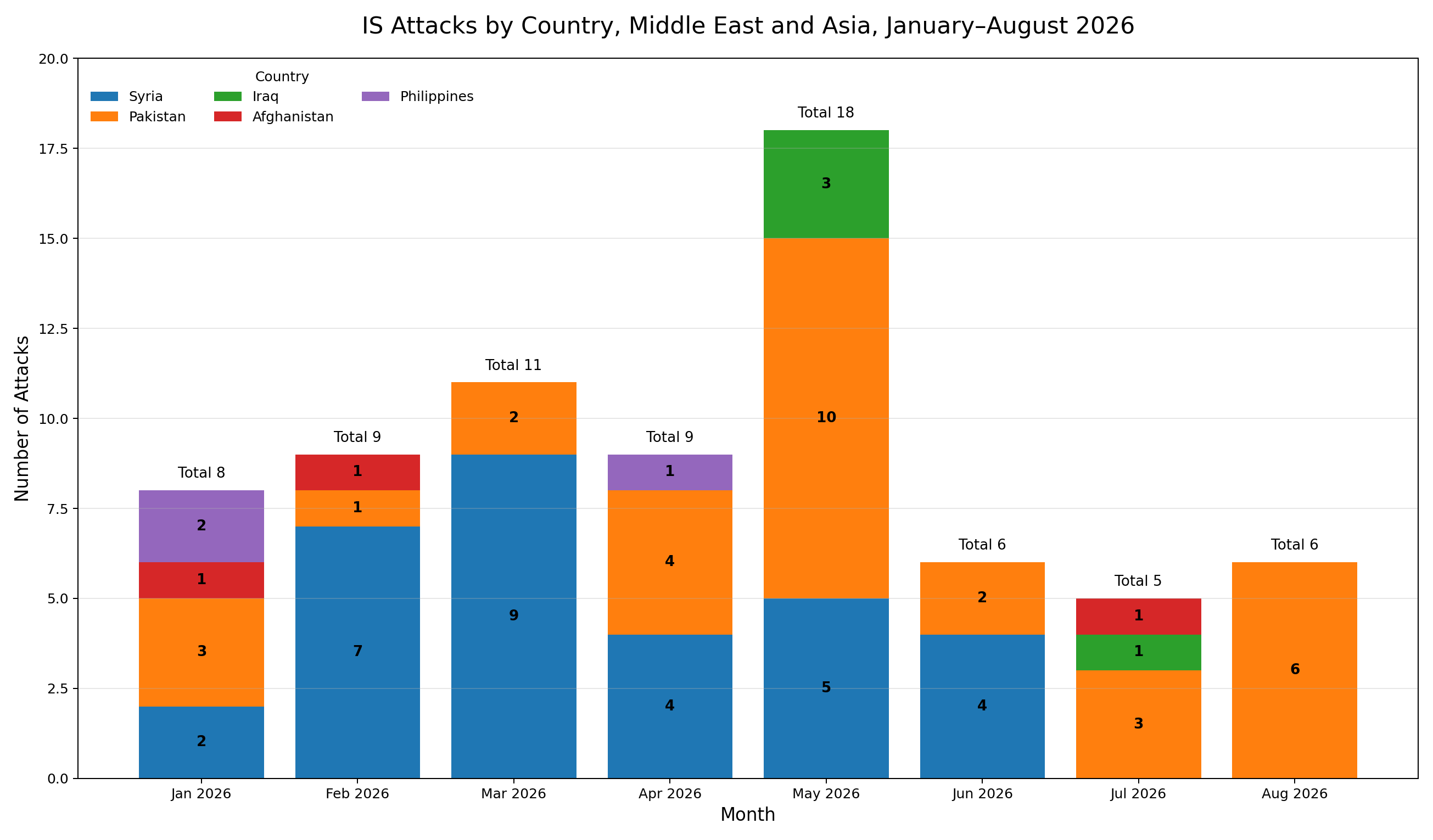
Number of IS attacks in the Middle East and Asia in August 2026: 6
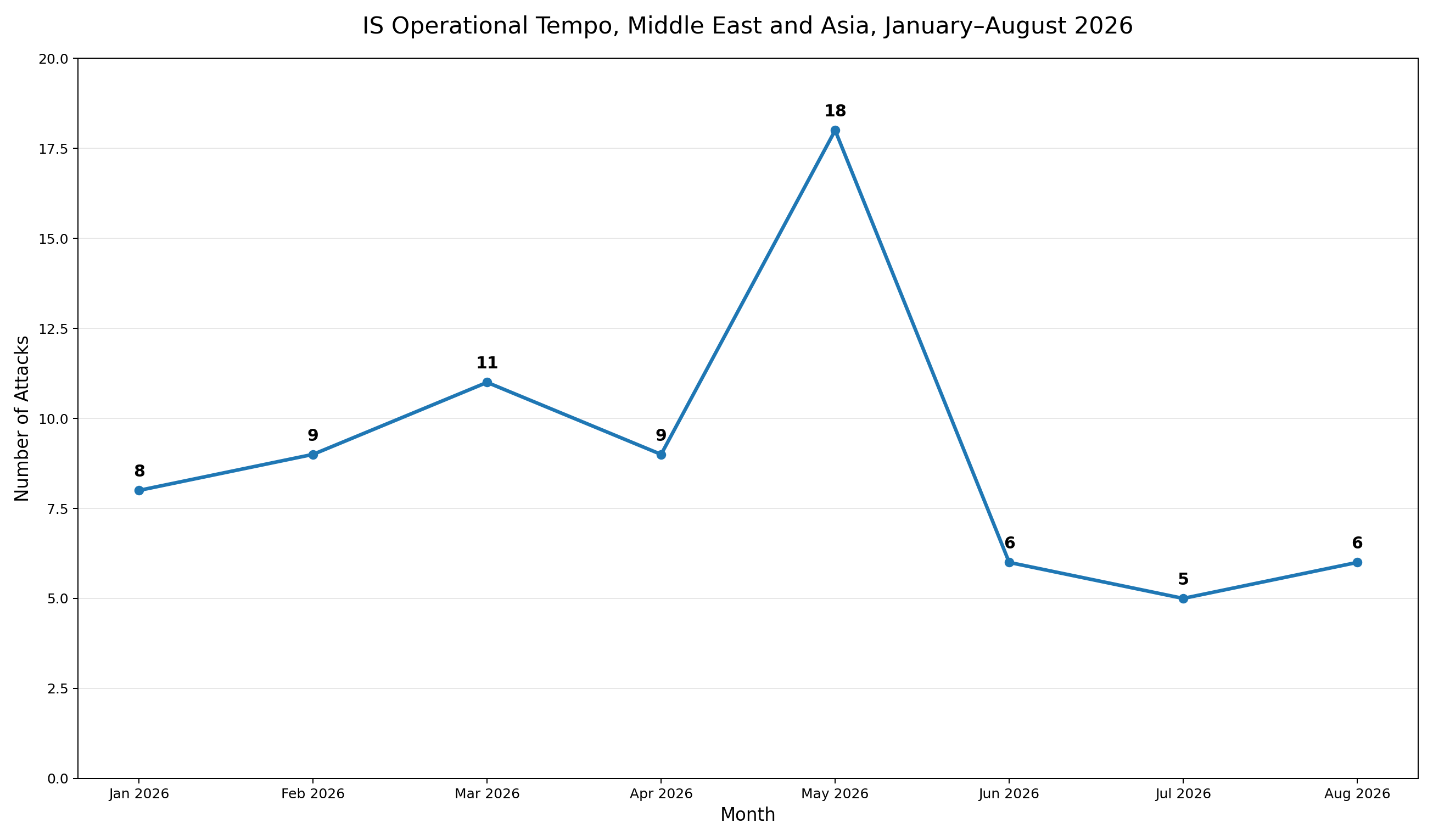
Number of Attacks by Country June 2026 (ISKP also operates in the Pakistani province of Khyber Pakhtunkhwa, which falls within the operational area of the Islamic State of Khorasan province, not the Islamic State of Pakistan province. The division below is not based on IS attacks by province, but by the geographical area where they occurred:
PAKISTAN: 6
Targets: Taliban militia TTP, Pakistani Intelligence Services, politician from the Jamiat Ulema-e-Islam, Peace Committee.
Area (ISKP also operates in the Pakistani province of Khyber Pakhtunkhwa, which falls within the operational area of the Islamic State of Khorasan province, not the Islamic State of Pakistan province.) The division below is not based on IS attacks by province, but by the geographical area where they occurred. The Islamic State hit the following countries this month:
PAKISTAN: Khyber Pakhtunkhwa province.
Analytical and Intelligence Assessments
August 2026 confirms a highly concentrated Islamic State operational footprint in the Middle East and Asia. All six officially recorded attacks occurred in Pakistan, specifically in Khyber Pakhtunkhwa, while no officially claimed operations were recorded in Syria, Iraq or Afghanistan. This concentration is analytically more significant than the relatively low aggregate number. It indicates that the Afghanistan-Pakistan operational ecosystem currently represents the principal source of observable IS activity in the region. However, the attacks involved both ISKP and Islamic State structures operating in Pakistan and should not be treated as a completely homogeneous campaign.
The target profile reinforces this assessment. Pakistani Intelligence Services, a Jamiat Ulema-e-Islam political figure, a Peace Committee, and TTP militants were targeted during the month. The pattern extends beyond conventional attacks against state security forces and reflects a broader effort to contest the local political and militant environment. Targeting TTP personnel demonstrates continued intra-jihadist competition, while attacks against intelligence personnel and locally embedded political and security structures are intended to weaken actors capable of constraining Islamic State networks at community level. The operational logic is therefore simultaneously anti-state, anti-rival, and coercive.
Implications for Decision Makers
The concentration of all confirmed activity in Khyber Pakhtunkhwa makes northwestern Pakistan the immediate intelligence priority within this regional portfolio. The principal risk is not territorial expansion, but the consolidation of small networks able to operate within an already saturated militant environment, where the coexistence of TTP, state forces, tribal security structures and other armed actors creates both operational opportunities and attribution challenges.
The absence of confirmed attacks elsewhere should meanwhile be interpreted cautiously. In Syria particularly, a second consecutive month without official claims contrasts with continued indications of potentially IS-linked violence. For intelligence services, quantitative monitoring of official claims should therefore be complemented by a separate attribution layer that can identify possible low-visibility activity without artificially incorporating uncertain incidents into the confirmed dataset.
Early Warning Indicators
The most important indicators are a further concentration or expansion of attacks across Khyber Pakhtunkhwa, increased targeting of Pakistani intelligence personnel and Peace Committees, repeated violence against Jamiat Ulema e Islam figures, and an intensification of clashes or targeted killings involving TTP. Pay particular attention to any shift from selective attacks to simultaneous operations across several districts, which would indicate increased coordination rather than simple persistence.
Outside Pakistan, renewed official claims in Syria would be especially significant after two consecutive months of silence. Additional indicators include renewed IS activity in Iraq and Afghanistan, or evidence that suspected Syrian attacks are increasingly displaying consistent targeting, tactical and geographic signatures attributable to organised IS cells.
Forecast, 30 to 90 Days
Pakistan is likely to remain the principal source of officially observable Islamic State activity during the next 30 to 90 days, particularly in Khyber Pakhtunkhwa. Continued selective targeting of security personnel, political actors, local counter-militant structures and rival jihadists is more likely than a transition toward sustained high-intensity operations.
A major regional escalation remains unlikely. The more plausible trajectory is continued low-volume but geographically and politically selective violence, punctuated by occasional increases in operational tempo. Syria remains the principal uncertainty. Continued absence of claims would strengthen the assessment of significant suppression or deliberate low-visibility activity, while a sudden return of officially acknowledged attacks would indicate that the current silence reflected operational dormancy rather than structural degradation.
Executive Intelligence Conclusion
August does not indicate an Islamic State resurgence across the Middle East and Asia. It does, however, reveal an increasingly asymmetric regional threat structure. Confirmed operational activity has contracted geographically and is currently concentrated in Pakistan, where Islamic State actors continue to challenge state institutions, local political structures and competing militants simultaneously.
The key intelligence judgment is therefore one of regional contraction without demonstrated strategic neutralisation. Pakistan, particularly Khyber Pakhtunkhwa, represents the immediate operational centre of gravity. At the same time, Syria constitutes the principal intelligence uncertainty because observable propaganda activity and suspected activity on the ground continue to diverge. For decision makers, the priority should be to distinguish genuine network degradation from reduced visibility, particularly where low attack volumes may conceal preserved clandestine infrastructure capable of rapid reactivation.
🔒Executive Intelligence Cycle
This assessment is part of a broader analytical cycle.
Founding subscribers receive the Executive Intelligence Briefing, which integrates all threat assessments, cognitive domain analysis, and a rolling 30–90-day forecast into a single monthly strategic synthesis.
© Daniele Garofalo Monitoring - All rights reserved.
ISSN (International Standard Serial Number): 3103-3520
NATO NCAGE: AX664 (NATO Commercial and Governmental Entity)
UNITED NATIONS Global Marketplace ID: 1210727
ORCID Code: 0009-0006-5289-2874
Daniele Garofalo is an independent researcher and analyst specialising in Intelligence, Jihadist Terrorism, Islamist insurgencies, Non-State Armed Groups (NSAG), Cognitive Warfare, and Hybrid Warfare.
His work focuses on continuous intelligence monitoring, threat assessment, and analysis of propaganda and cognitive/information dynamics, with an emphasis on decision-oriented outputs, early warning, and strategic trend evaluation.