


Executive Intelligence Summary
Ittehad-ul-Mujahidin Pakistan (IMP) represents a low-visibility but potentially destabilising jihadist actor within Pakistan’s militant landscape, operating at the intersection of ideological fragmentation, rivalry with established groups, and external influence.
Scope and Methodology
Although current patterns indicate a stable-to-increasing threat trajectory, the TTP’s demonstrated adaptability and cross-border ties suggest the potential for tactical escalation or diversification beyond its present operational profile, warranting ongoing monitoring.
This Strategic Threat Outlook is based on:
systematic monitoring of jihadist propaganda (videos, photos, statements, claims);
reporting from sources in the field;
Integration of OSINT, IMINT, SOCMINT, and Digital HUMINT.
Sources include primary material from TTP-affiliated channels, open-source reporting, official statements, and local sources. However, limitations such as potential propaganda bias, disinformation, and incomplete reporting from remote areas must be considered when evaluating the reliability of intelligence. Clarifying how these limitations impact operational decisions will help stakeholders interpret the data appropriately and avoid misjudgments.
Limitations
Incomplete or delayed reporting from remote or contested areas;
Exaggeration or omission in group claims;
Potential propaganda bias and disinformation.
Where attacks or claims cannot be independently corroborated, this is explicitly indicated in the assessment.
📌 Inside this Assessment
Overview and Security Threat Assessment
Activity and Operations Analysis — August 2026
Number, Targets, and Areas of Attacks in august 2026
Charts and Statistics
Analytical and Intelligence Assessments
Implications for Decision Makers
Early Warning Indicators
Threat Forecast, 30 to 90 Days
Executive Intelligence Conclusion
Related Intelligence & Analysis:

Previous Strategic Threat Outlook:

Overview and Security Threat Assessment
Ittehad ul Mujahidin Pakistan, IMP, emerged in April 2025 as a new jihadist coalition bringing together the Hafiz Gul Bahadur Group, Lashkar e Islam, and Harkat Inqilab e Islami Pakistan. The alliance was formally announced on 11 April through the official media structures of its constituent organisations and was presented as a unified framework for armed jihad under a common ideological, organisational, and communications architecture.
The founding declaration appointed Mahmood ul Hasan as official spokesperson and established Sada e Ghazwat ul Hind as the alliance’s central media structure. The subsequent transfer of attack claims and propaganda production under the IMP identity was strategically important. It indicated an attempt to move beyond tactical coordination and create a recognisable insurgent brand capable of aggregating previously autonomous militant networks.
Since its formation, IMP has developed from an emerging coalition into an increasingly structured actor within Pakistan’s jihadist landscape. Its significance derives less from numerical strength alone than from the combination of experienced commanders, established militant infrastructure, historical knowledge of the tribal belt, access to cross border sanctuary, and an increasingly diversified tactical repertoire. The group has demonstrated the ability to employ suicide attacks, SVBIEDs, improvised explosive devices, indirect fire, sniper teams, RPGs, and commercially adapted unmanned aerial systems.
This tactical diversification has been accompanied by deliberate capability signalling. Training footage, battlefield imagery, multilingual propaganda, and selective presentation of operational successes indicate an organisation seeking to demonstrate discipline, technological adaptation, and military professionalism. At the same time, IMP has repeatedly limited or suppressed public attribution of attacks when visibility could generate excessive political or operational costs. Consequently, public claims provide only a partial representation of its actual activity.
The group’s centre of gravity remains Khyber Pakhtunkhwa, particularly the southern districts and former tribal areas where the Hafiz Gul Bahadur network and Lashkar e Islam possess longstanding organisational roots. These environments offer difficult terrain, experienced facilitation networks, local intelligence, weapons access, and connectivity with Afghanistan. The widening militant footprint observed across Pakistan since early 2026 increases the possibility that IMP can exploit existing militant corridors to extend activity beyond its traditional core.
The security threat posed by IMP is therefore best understood as an insurgent threat with escalation potential rather than as a conventional terrorist organisation primarily oriented toward indiscriminate civilian mass casualty attacks. Its principal target set has remained the Pakistani security architecture, including the Army, Police, Frontier Corps, Counter Terrorism Department, intelligence personnel, and local security intermediaries. This targeting logic seeks to erode state presence, degrade intelligence collection, intimidate local collaborators, restrict security force mobility, and create greater freedom of action within contested districts.
Ideological Competition with Tehreek-e-Taliban Pakistan
The establishment of IMP challenged the organisational primacy that Tehreek e Taliban Pakistan has attempted to maintain over the Pakistani jihadist movement. TTP’s early response emphasised unity under a single emir, a single command structure, and a single organisational banner, invoking the Afghan Taliban as evidence that disciplined centralisation produces strategic success.
Although much of this messaging avoided direct confrontation with IMP, the underlying competition was clear. The emergence of a separate coalition incorporating experienced militant factions created an alternative pole for fighters, commanders, donors, and local networks unwilling to operate under Noor Wali Mehsud’s leadership.
This competition should not be interpreted as necessarily leading to open armed conflict between the organisations. The more plausible dynamic is simultaneous rivalry and selective coexistence, with both movements exploiting overlapping operational environments while competing for legitimacy, recruits, influence, and territorial access.
Developments during 2026 have made this organisational competition more important. Fragmentation inside the broader TTP ecosystem, particularly developments surrounding Jamaat ul Ahrar, creates potential opportunities for IMP to attract dissatisfied cadres or develop tactical relationships with factions seeking greater autonomy. Any such realignment would improve IMP’s manpower, operational experience, and potentially its access to urban attack networks.
Al Qaeda Linkages and Emerging Militant Nexus
The relationship between IMP and Al Qaeda in the Indian Subcontinent has become an increasingly important component of the threat assessment. Initial accusations that AQIS had encouraged the creation of a parallel militant structure originated largely from pro TTP circles and therefore required caution. Subsequent indicators, however, have strengthened the assessment that AQIS exercises meaningful ideological and organisational influence within the IMP environment.
Recent analytical reporting describes AQIS as having played an important supporting role in the development of the alliance and notes that AQIS propaganda has incorporated IMP operations into its broader presentation of Al Qaeda aligned militant activity. This does not establish that AQIS exercises direct operational command over IMP. It does, however, increase confidence that the relationship extends beyond rhetorical sympathy and includes ideological, media, facilitation, or organisational connectivity.
The potential convergence of AQIS, IMP, and Jamaat ul Ahrar linked networks represents the most consequential medium term development to monitor. JuA retains a history of high impact and urban terrorism, while IMP provides an increasingly coherent insurgent platform and AQIS can contribute ideological guidance, strategic networking, and transnational legitimacy. A durable nexus among these actors could broaden the threat beyond IMP’s current predominantly northwestern security focus.
Afghanistan remains central to this assessment. Pakistani militant networks continue to benefit from geographic depth across the border, while Islamabad increasingly treats Afghan sanctuary as a core driver of domestic insecurity. IMP’s leadership and constituent networks have strong historical connections to this cross border environment. This provides resilience and operational depth but also creates a political vulnerability, since highly visible IMP activity increases pressure on the Afghan Taliban and raises the risk of Pakistani military retaliation.
As of August 2026, IMP should therefore be assessed as an established and adaptive insurgent coalition rather than an experimental militant alliance. Its immediate threat remains concentrated primarily in northwestern Pakistan, but its organisational trajectory, tactical sophistication, AQIS connectivity, and ability to exploit fragmentation within the Pakistani jihadist ecosystem give it credible expansion potential.
The principal intelligence concern is not simply whether IMP increases its monthly attack volume. It is whether the alliance succeeds in transforming current operational resilience into a broader militant network capable of absorbing additional factions, expanding beyond its established geography, and integrating insurgent warfare with the urban attack capabilities historically associated with other Pakistani jihadist actors.
IMP Activities – August 2026
During August 2026, Ittehad ul Mujahidin Pakistan remained operationally active within a Pakistani militant environment characterised by renewed violence and sustained counterterrorism pressure. The group continued to benefit from the same interconnected militant geography that links the former tribal districts, southern Khyber Pakhtunkhwa, and cross border areas adjoining Afghanistan.
Its operational posture remained focused primarily on security and intelligence targets. Rather than shifting toward indiscriminate violence, IMP continued to apply pressure against the institutions responsible for territorial security, counterterrorism, intelligence collection, and local state control. This remains consistent with a strategy of attrition designed to weaken the state’s ability to operate effectively inside contested districts.
The month also demonstrated the resilience of the group’s underlying networks. Pakistani security forces continued to target militants associated with the Hafiz Gul Bahadur environment, including through intelligence based operations in Bannu, Hangu, and North Waziristan. The killing of an identified IMP commander during an operation in Bannu provides direct evidence that the alliance retains an active command presence in one of its principal operational areas.
The persistence of these networks despite sustained security pressure indicates that IMP maintains sufficient organisational redundancy to absorb losses without immediately losing operational continuity. This resilience probably reflects decentralised cells, established local facilitation, access to replacement cadres, and the wider sanctuary environment available to Pakistani jihadist networks.
Tactically, the group continues to operate within an environment increasingly shaped by drones, explosive devices, suicide capability, indirect fire, and short duration assaults. These methods allow militants to impose costs on security forces while limiting prolonged exposure to superior Pakistani firepower. The resulting campaign remains more characteristic of adaptive insurgency than conventional territorial warfare.
August’s broader rise in militant violence across Pakistan also provided IMP with operational concealment inside a heavily contested security environment. Attribution becomes increasingly difficult when several organisations operate against similar targets in overlapping districts. For IMP, this ambiguity can be advantageous because it allows the alliance to preserve operational activity while controlling when and how it publicly associates itself with individual attacks.
From an intelligence perspective, August reinforces the assessment that the principal threat posed by IMP is cumulative. The organisation does not need continuous spectacular attacks to increase strategic relevance. Sustained pressure against security forces, preservation of experienced cadres, repeated adaptation of tactics, and continued access to cross border depth can progressively strengthen its position within Pakistan’s militant ecosystem.
The central issue entering the final months of 2026 is therefore whether IMP remains primarily a regional insurgent platform or begins translating its organisational resilience into broader geographic and factional expansion. Developments involving AQIS aligned networks and militant factions outside TTP’s direct control make the second possibility increasingly important to monitor.
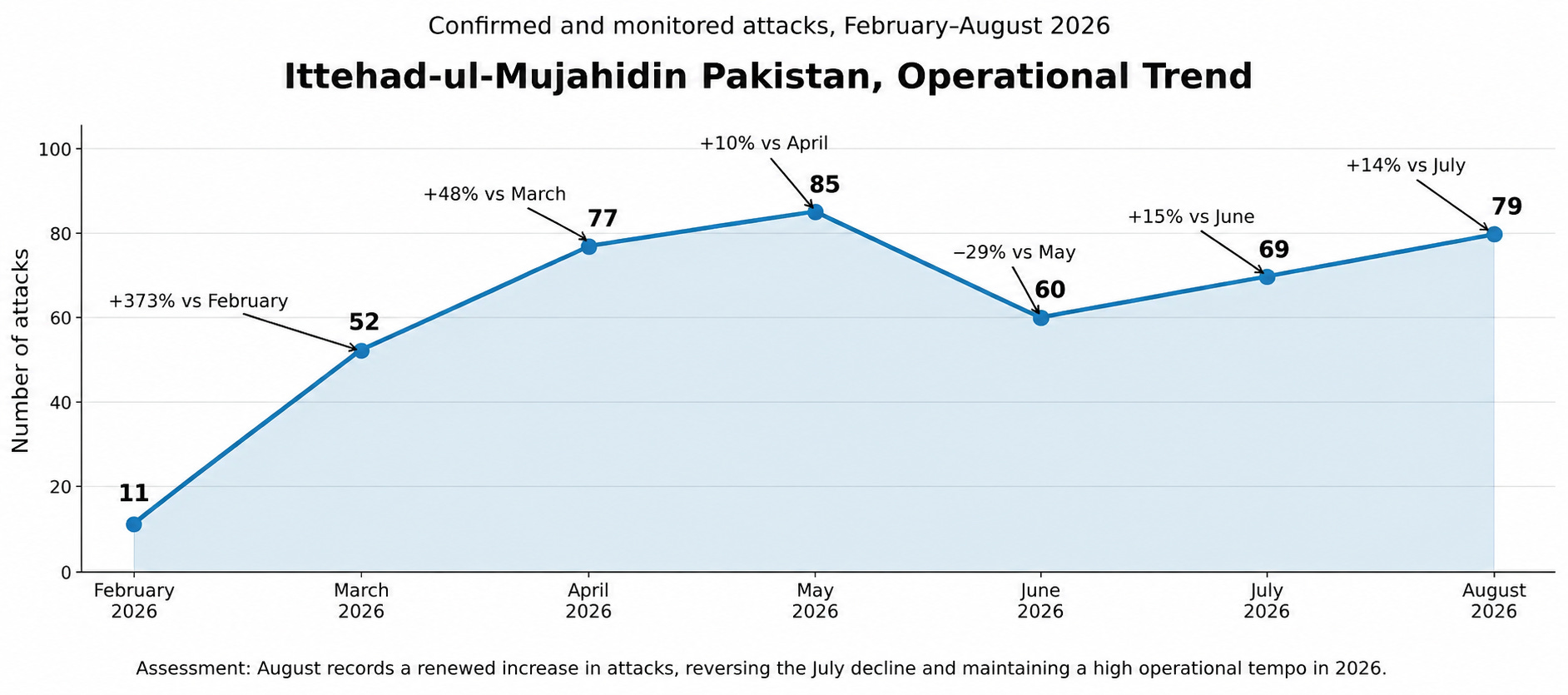
Number of attacks in August 2026: 79
Area: Khyber Pakhtunkhwa Province:
Khyber district,
Bannu district,
North Waziristan district,
South Waziristan district,
Orakzai district.
Target: Pakistan Army, Pakistani Police, Frontier Corps, Counter Terrorism Department Police (CTD), Secret/Peace Committee, and ISI Service.
Analytical and Intelligence Assessments
August 2026 confirms a renewed increase in IMP activity. The group recorded 79 attacks, up from 69 in July, an increase of roughly 14 percent. The figure remains below the May peak, but it strengthens the broader pattern of sustained operational pressure rather than episodic escalation. The geographic picture is more concentrated than in previous months. Activity was confined to Khyber Pakhtunkhwa, specifically Khyber, Bannu, North Waziristan, South Waziristan, and Orakzai. This concentration is significant. It suggests a deliberate prioritisation of the group’s strongest operating environment rather than loss of reach. IMP appears to be concentrating resources where it can exploit established militant infrastructure, cross border access, local facilitation, and difficult terrain.
The target profile remained unchanged and coherent. The Pakistan Army, Police, Frontier Corps, CTD, ISI, and local Secret or Peace Committee structures continued to absorb the group’s violence. This confirms that IMP is still pursuing an insurgent strategy focused on degrading the state’s coercive and intelligence architecture, rather than shifting toward indiscriminate mass casualty terrorism as its primary model.
The reappearance of South Waziristan is notable. It reinforces the strategic importance of the wider Waziristan axis and suggests that the group retains mobility across both northern and southern sectors. At the same time, the disappearance of Diamer from the August map indicates that the Gilgit Baltistan activity observed earlier in the year has not yet developed into a sustained secondary theatre.
The main intelligence judgment is that IMP has achieved a relatively stable operational rhythm. Since March, monthly activity has remained consistently elevated, with fluctuations that appear tactical rather than structural. There is no evidence in the August data of organisational degradation. On the contrary, the group continues to demonstrate resilience, geographic discipline, and the ability to sustain attacks against high value security targets over several consecutive months.
Implications for Decision Makers
For policy makers and military planners, the August pattern points to a more mature insurgent threat. IMP is no longer in a phase where its significance can be judged by whether it expands into new provinces every month. Its main strength lies in the consolidation of a durable operational base inside Khyber Pakhtunkhwa. The priority should therefore be disruption of the enabling architecture rather than simple attrition of fighters. Leadership targeting, local facilitators, weapons supply, explosives production, drone support, cross border transit, and financial nodes are more strategically relevant than tactical success against individual cells.
The continued targeting of CTD, ISI, and Peace Committee structures should receive particular attention. These targets indicate that IMP is actively contesting the state’s intelligence advantage. If local informant networks and district level counterterrorism structures are weakened, the group gains operational space even without territorial control. Khyber, Bannu, North Waziristan, South Waziristan, and Orakzai should be treated as an interconnected security system rather than isolated districts. Movement of cadres, weapons, reconnaissance teams, and facilitators across this belt is likely more important than activity within any single locality.
Early Warning Indicators
The most relevant indicators over the next 30 to 90 days are a return to monthly activity above the May peak, repeated attacks against CTD and ISI personnel, increased targeting of Peace Committee members and local informants, more complex operations against fortified compounds, renewed activity outside Khyber Pakhtunkhwa, and evidence of greater coordination with TTP dissidents, Jamaat ul Ahrar linked networks, or AQIS aligned structures.
A second indicator is the geographic balance between North and South Waziristan. Sustained simultaneous activity across both areas would suggest increased freedom of movement and stronger logistical integration across the group’s core theatre.
A third indicator is the scale and sophistication of Pakistani intelligence based operations. A sudden increase in raids against IMP linked commanders, weapons workshops, drone facilities, or facilitators would likely indicate that security services have detected preparations for a new escalation phase.
Threat Forecast, 30 to 90 Days
The most likely scenario is continued high tempo activity across Khyber Pakhtunkhwa, with the Waziristan belt, Khyber, Bannu, and Orakzai remaining the principal areas of concern. IMP is likely to maintain pressure against the Army, Police, Frontier Corps, CTD, ISI, and local security intermediaries. Probability, high.
A second likely development is qualitative escalation without a dramatic increase in attack volume. IMP may prioritise more complex operations against hardened security targets, combining suicide capability, explosive devices, drones, indirect fire, or coordinated ground assaults. Probability, medium high.
A broader geographic expansion remains possible but is not the baseline. Renewed activity in Diamer, Bajaur, Mohmand, Hangu, Lakki Marwat, or Dera Ismail Khan would indicate renewed lateral expansion. Probability, medium.
A major attack outside the core northwestern theatre remains less likely in the next 90 days, but cannot be excluded. Such an operation would represent a deliberate strategic shift and would probably be intended to demonstrate national reach or organisational competition with TTP.
Executive Intelligence Conclusion
August 2026 confirms that Ittehad ul Mujahidin Pakistan remains a high level insurgent threat inside Khyber Pakhtunkhwa. The group recorded 79 attacks, reversing part of the July decline and maintaining a level of activity consistent with the sustained escalation observed since spring 2026. More important than the numerical increase is the geographic concentration of operations inside the group’s strongest militant belt.
IMP continues to target the institutions most relevant to state control, security forces, intelligence services, counterterrorism personnel, and local security intermediaries. This indicates a deliberate strategy aimed at reducing state visibility and freedom of action rather than producing violence for propaganda effect alone.
The threat should therefore be assessed as high in Khyber Pakhtunkhwa and medium at national level. The strategic trend remains one of consolidation, resilience, and selective escalation. The principal risk over the next 30 to 90 days is not simple quantitative growth, but the possibility that IMP converts its stable operational base into greater tactical sophistication, stronger factional integration, and renewed geographic expansion.
🔒Executive Intelligence Cycle
This assessment is part of a broader analytical cycle.
Founding subscribers receive the Executive Intelligence Briefing, which integrates all threat assessments, cognitive domain analysis, and a rolling 30–90-day forecast into a single monthly strategic synthesis.
© Daniele Garofalo Monitoring - All rights reserved.
ISSN (International Standard Serial Number): 3103-3520
NATO NCAGE: AX664 (NATO Commercial and Governmental Entity)
UNITED NATIONS Global Marketplace ID: 1210727
ORCID Code: 0009-0006-5289-2874
Daniele Garofalo is an independent researcher and analyst specialising in Intelligence, Jihadist Terrorism, Islamist insurgencies, Non-State Armed Groups (NSAG), Cognitive Warfare, and Hybrid Warfare.
His work focuses on continuous intelligence monitoring, threat assessment, and analysis of propaganda and cognitive/information dynamics, with an emphasis on decision-oriented outputs, early warning, and strategic trend evaluation.