


Executive Intelligence Summary
Tehrik-i-Taliban Pakistan (TTP) remains a high and adaptable security threat to Pakistan, especially in Khyber Pakhtunkhwa and along the Afghan–Pakistani border areas. Clarifying threat levels will help stakeholders feel assured about the current risk assessment and trust the evaluation.
The threat remains high and persistent, underscoring the need for stakeholders to stay vigilant and allocate resources effectively over the next 3–6 months to maintain operational effectiveness.
Scope and Methodology
Although current patterns indicate a stable-to-increasing threat trajectory, the TTP’s demonstrated adaptability and cross-border ties highlight the importance of ongoing monitoring to ensure readiness against tactical escalation or diversification.
This Strategic Threat Outlook is based on:
systematic monitoring of jihadist propaganda (videos, photos, statements, claims);
reporting from sources in the field;
Integration of OSINT, IMINT, SOCMINT, and Digital HUMINT.
Sources include primary material from TTP-affiliated channels, open-source reporting, official statements, and local sources. Clarifying how these limitations-such as potential propaganda bias and delayed reporting-impact operational decisions will help stakeholders trust the assessment and interpret the data appropriately.
Limitations
Incomplete or delayed reporting from remote or contested areas;
Exaggeration or omission in group claims;
Potential propaganda bias and disinformation.
Where attacks or claims cannot be independently corroborated, this is explicitly indicated in the assessment.
📌 Inside this Assessment
Brief overview of the TTP
Activity and Operations Analysis — August 2026
Number, Targets, and Areas of Attacks in August 2026
Charts and Statistics
Analytical and Intelligence Assessments
Implications for Decision Makers
Early Warning Indicators
Threat Forecast, 30 to 90 Days
Executive Intelligence Conclusion
Brief overview of the TTP
The Tehrik-i-Taliban Pakistan (TTP), formed in 2007 as a coalition of Pashtun militant groups, remains the main jihadist threat to the Pakistani state today. Led since 2018 by Noor Wali Mehsud, the organisation has consolidated its internal structure by reabsorbing several splinter factions and strengthening its strategic communication. Its ideology is rooted in Deobandi jihadism with strong historical ties to the Afghan Taliban and Al-Qaeda. The TTP operates mainly in Khyber Pakhtunkhwa and Balochistan, but maintains selective capabilities in urban areas. The Afghan rear areas are strategically important, providing depth, training, and cross-border mobility. The group’s military campaign is now characterised by a combination of IEDs, ambushes, and complex attacks targeting police, paramilitary forces, and local administrative apparatus, with a more calibrated use of suicide operations than in the past. In 2024–2025, the TTP was consistently ranked among the most lethal groups globally, with increased operational sophistication and organisational resilience.
Related Intelligence & Analysis:

Previous Strategic Threat Outlook:

TTP Activities – August 2026:
August 2026 confirmed that Tehrik i Taliban Pakistan remained firmly on an offensive trajectory, despite sustained counterterrorism pressure and repeated intelligence-based operations across Khyber Pakhtunkhwa. The broadening security burden, including high-impact attacks outside traditional areas like Swat, indicates a shifting regional threat landscape that requires strategic adaptation and resource reallocation.
The attack in Swat at the beginning of the month was particularly significant because it demonstrated the group’s continuing ability to generate high-impact violence outside the traditional southern frontier belt. The suicide bombing near Kabal police station struck during a pro police gathering and produced substantial civilian and police casualties. The incident carried clear strategic weight because Swat had previously been treated as a largely stabilised theatre. Renewed violence there reinforces concern that the TTP and associated networks are testing areas where state control had been considered more durable.
Police and CTD structures remained under persistent pressure throughout the month. A targeted attack in Peshawar killed a CTD officer, while a grenade attack against a police post in Mohmand wounded several officers. In Bajaur, militants used rocket launchers and small arms against a police position, and in Bannu, security forces reported repeated quadcopter attacks against police infrastructure. Taken together, these incidents show that the TTP campaign is increasingly combining conventional insurgent methods with low-cost technological adaptation, particularly unmanned platforms used for harassment, reconnaissance, or attacks against static positions.
The geographic picture remained centred on the northwestern corridor, but the pattern was more dispersed than in previous months. Bannu, North Waziristan, South Waziristan, Bajaur, Orakzai, Khyber, Peshawar and Swat all remained operationally relevant. The significance lies in the ability to maintain pressure simultaneously across former tribal areas and settled districts. This forces the Pakistani security apparatus to distribute personnel and intelligence resources across a widening battlespace while militant cells retain the initiative in choosing where to concentrate effort.
Pakistani security forces responded with a sustained and increasingly intelligence-driven campaign. Joint military and police operations in Bannu, North Waziristan, Orakzai and Khyber removed multiple TTP-linked militants. In contrast, repeated operations in South Waziristan and Dir have continued to pressure known insurgent corridors. The operational paradox remains unchanged: tactical successes are producing militant losses, but they have not yet translated into a durable reduction in violence. The return of activity to areas previously declared cleared highlights the limits of purely kinetic containment when local facilitation, mobility and governance weaknesses remain unresolved.
August also strengthened the cross-border dimension of the threat. The latest UN monitoring assessment reinforced the judgment that the Afghan Taliban continue to provide the TTP with a permissive environment, while also noting limited attempts by Kabul to restrain the group. The same assessment highlighted operational and facilitation linkages involving TTP, Al Qaeda and other militant networks. This confirms that the organisation’s resilience cannot be assessed solely through activity inside Pakistan. Its strategic depth remains tied to a broader regional militant ecosystem and the persistent absence of effective Pakistan-Afghanistan cooperation.
The group’s organisational development also deserves attention. The emergence of additional internal divisions and the announcement of a specialised air component indicate an effort to formalise command structures and institutionalise tactical innovation. Whether these structures correspond to fully developed capabilities remains uncertain, but the organisational intent is significant. It suggests that the TTP is not operating as a loose collection of militant cells, but is attempting to build a more durable insurgent architecture capable of sustaining pressure over time.
Analytically, August should be read as a month of persistent expansion under pressure. The TTP continued to absorb counterterrorism losses while maintaining operational reach, experimenting with unmanned systems, targeting law enforcement infrastructure, and reappearing in districts previously considered more secure. The most important signal is therefore not a single attack, but the group’s ability to preserve initiative across multiple theatres while forcing the Pakistani state to respond simultaneously at tactical, intelligence, and regional levels.
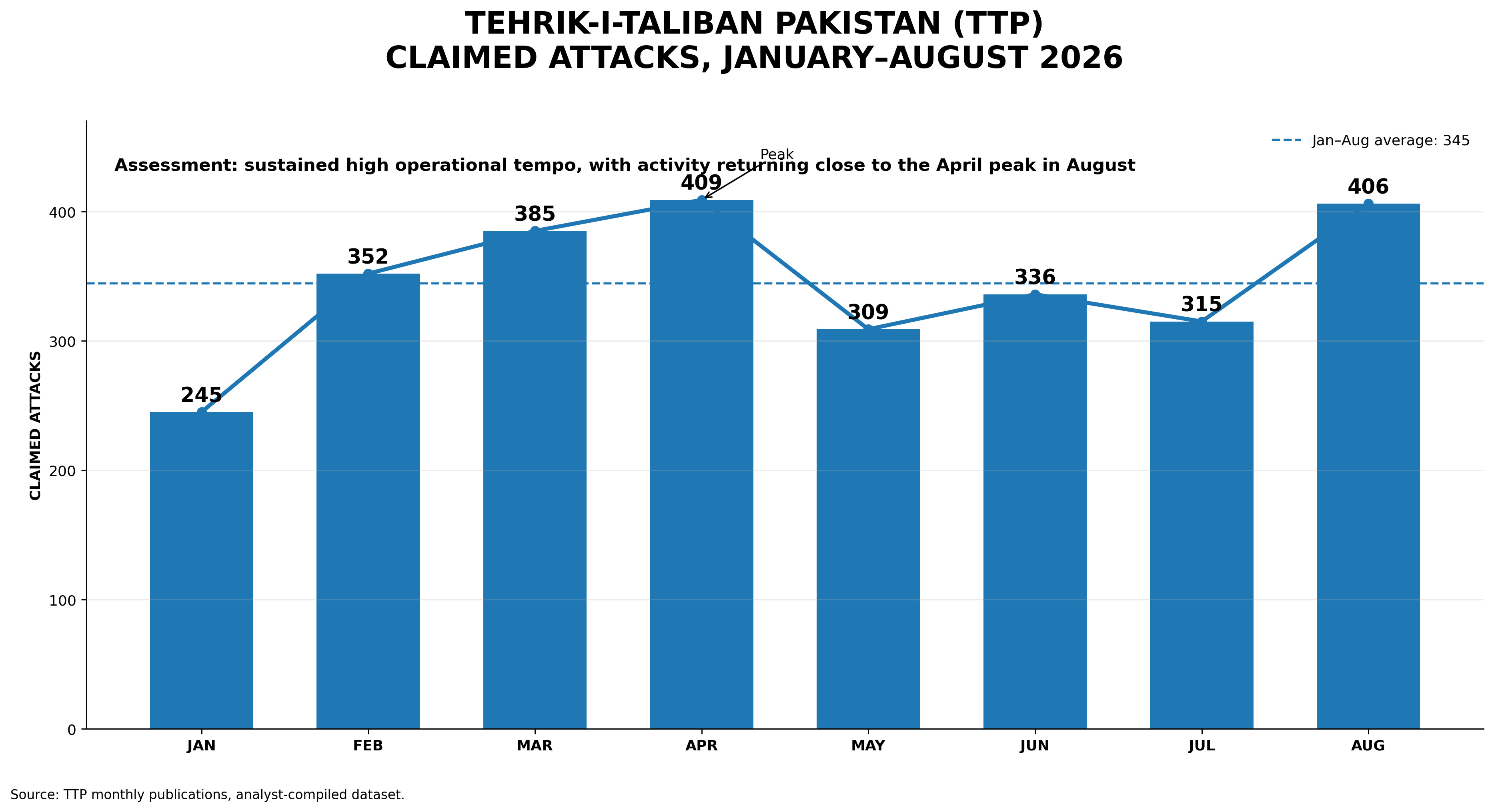
TTP attacks in August 2026: 406
Dead: 294
Wounded: 352
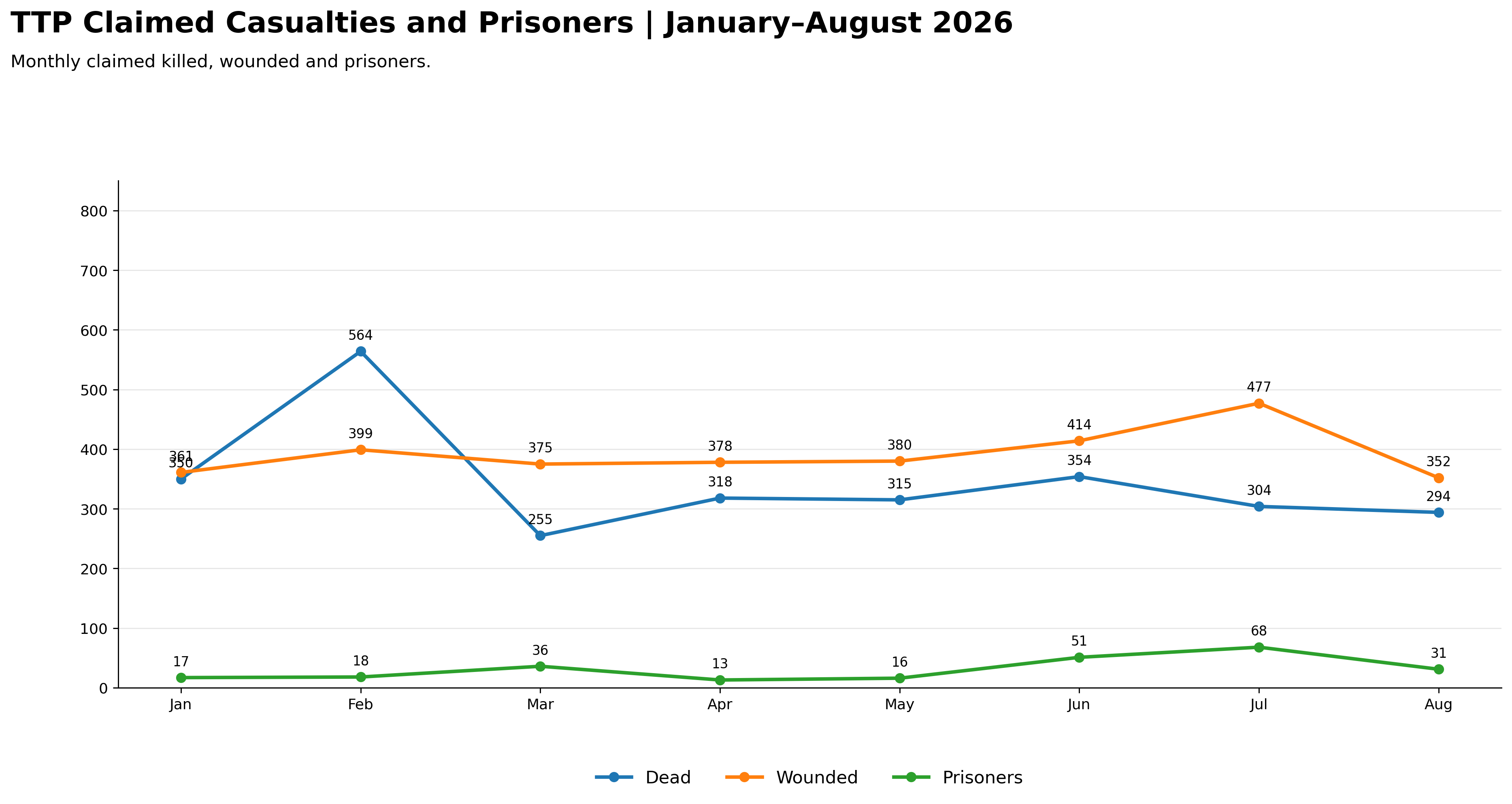
Total casualties: 646
Prisoners: 31
Target: Pakistan Army, Special Service Group (SSG), Frontier Corps, Pakistani Police, Counter Terrorism Department Police (CTD), Secret/Peace Committee.
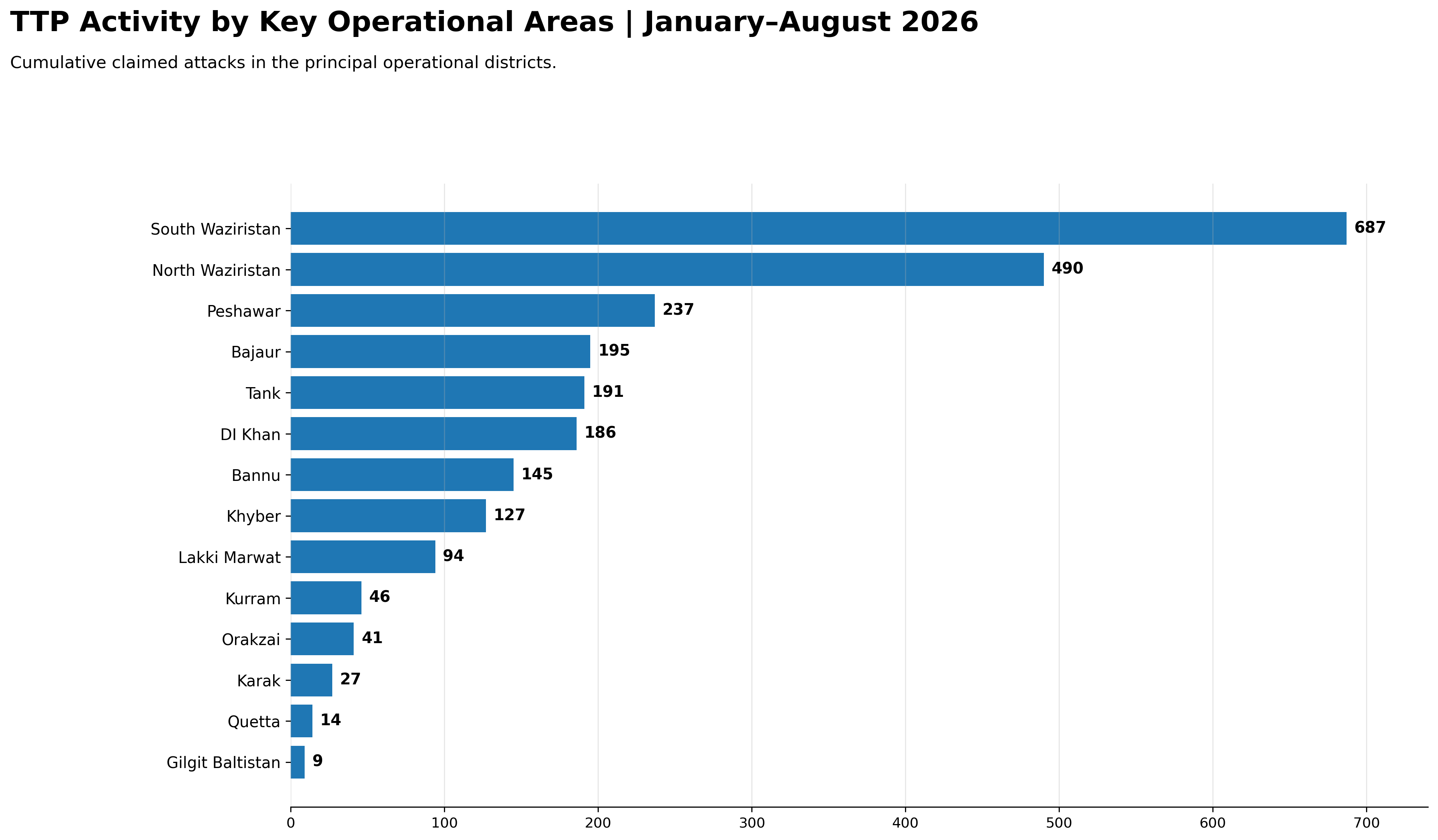
The TTP has managed to conduct attacks in 25 different districts, with the most affected areas being South Waziristan (130 attacks), Khyber (17), DI Khan (23), Bajaur (11), Tank (19), Mohmand (11), Bannu (10), Peshawar (45), Kurram (16), Upper Dir (6), Orakzai (4), Karak (9), and North Waziristan (80).
Analytical and Intelligence Assessment
August 2026 marks a renewed acceleration in TTP activity. The group claimed 406 attacks across 25 districts, returning to a level close to the April peak and reversing the relative moderation observed in June and July. The most important feature is the simultaneous increase in tempo and concentration. South Waziristan accounted for 130 attacks and North Waziristan for 80, meaning that more than half of all claimed operations occurred in the two core Waziristan theatres. This concentration indicates that the TTP is not simply dispersing violence, but retaining the ability to mass operational effort inside its principal insurgent ecosystem while sustaining secondary pressure elsewhere.
The casualty profile is more nuanced. Despite the higher number of attacks, claimed total casualties fell to 646, below the July level. This points to a higher proportion of lower-intensity or harassment operations, consistent with the group’s broader reliance on sniper fire, grenade attacks, targeted strikes, and short guerrilla engagements. The TTP therefore appears to be prioritising sustained operational presence and force exhaustion rather than maximising lethality in every engagement.
Peshawar’s 45 attacks are analytically significant. The district remains well below the Waziristan core in absolute terms. Still, recurring activity near the provincial capital increases political visibility, complicates force allocation, and demonstrates reach into a strategically important security and administrative hub. Activity in Kurram, Mohmand, Khyber and Upper Dir further confirms that the group is maintaining pressure along multiple northern and border corridors.
The decline in prisoner captures from 68 in July to 31 in August suggests that July’s exceptionally high figure was likely driven by a limited number of unusually successful tactical episodes rather than a permanent shift toward large-scale detention. Nevertheless, continued personnel capture remains an indicator of local freedom of action and coercive capacity.
Implications for Decision Makers
The primary concern is the consolidation of the Waziristan centre of gravity. The combined concentration in South and North Waziristan indicates that Pakistani pressure has not significantly disrupted the TTP’s core operating environment. Tactical counterterrorism successes therefore remain insufficient unless they degrade facilitation, logistics, command connectivity and local intelligence support inside this corridor.
The second implication is force dispersion. Twenty-five affected districts require the state to protect multiple security nodes simultaneously, while the TTP retains the initiative to shift emphasis between core and secondary theatres. Peshawar deserves particular attention because recurrent attacks there impose political and institutional costs disproportionate to their numerical share.
The third implication concerns measurement. August shows that rising attack frequency does not necessarily produce rising casualties. Decision makers should therefore avoid using lethality alone as the principal threat indicator. Operational tempo, district spread, target selection, repeated attacks against the same security infrastructure and persistence after counterterrorism operations provide a more accurate measure of insurgent resilience.
The cross-border dimension remains decisive. Any strategy that treats the TTP exclusively as a domestic insurgency will remain incomplete as long as leadership protection, mobility and facilitation linked to Afghan territory are not meaningfully constrained.
Early Warning Indicators
A further rise above 400 monthly attacks would indicate that the TTP has re-established the upper operational tempo observed during the first half of 2026.
Continued activity above 100 attacks in South Waziristan, or above 70 in North Waziristan, would confirm that the core insurgent ecosystem remains largely intact.
Sustained or increasing activity in Peshawar would indicate a deliberate effort to place greater pressure on a provincial political and security centre.
More frequent attacks in Upper Dir, Mohmand, Kurram and Khyber would suggest widening use of northern border corridors and greater geographic flexibility.
A renewed rise in prisoner-taking would indicate improving local tactical dominance or a deliberate expansion of coercive detention.
Increased drone use, especially against police facilities, fixed posts or observation systems, would signal further institutionalisation of unmanned capabilities.
Additional factional restructuring, autonomous claims or defections would increase the risk of competitive escalation within the broader militant ecosystem.
Threat Forecast, 30 to 90 Days
The most likely scenario is continued high-tempo activity, with roughly 330 to 420 attacks per month, with South and North Waziristan remaining the main operational centres. The group is likely to preserve sustained pressure in Peshawar, Bajaur, Dera Ismail Khan, Tank, Khyber, Kurram and Mohmand while using peripheral attacks to complicate Pakistani force allocation.
A moderate escalation scenario would involve a further rise in complex attacks against security installations, police compounds, convoys and CTD personnel, particularly if Pakistan increases pressure on militant infrastructure inside Afghanistan. Such escalation would probably be selective rather than indiscriminate, designed to maximise political and security effect.
A geographic diffusion scenario is also plausible. Greater activity in Upper Dir, Swat, Quetta, or other areas outside the traditional Waziristan-centred battlespace would indicate that the organisation is testing the state’s capacity to defend secondary theatres. A durable decline remains the least likely near-term scenario. August activity shows no evidence of strategic exhaustion, despite continuing Pakistani operations.
Executive Intelligence Conclusion
August 2026 confirms that the TTP remains a high-capacity, adaptive insurgent organisation with both concentration and dispersion capabilities. The group claimed 406 attacks across 25 districts, demonstrating a return to near peak operational tempo while maintaining pressure across a broad geographic footprint. The most important development is the renewed concentration in the Waziristan theatre. South and North Waziristan together accounted for more than half of the month’s claimed attacks, confirming that the TTP’s core operational ecosystem remains resilient despite sustained Pakistani counterterrorism activity.
At the same time, the persistent pressure on Peshawar and other secondary districts shows that the group retains sufficient depth to force security dispersion beyond its traditional strongholds. The lower casualty output relative to attack volume suggests that the TTP is emphasising persistence, harassment, and institutional attrition rather than maximising lethality in every operation. Over the next 30 to 90 days, the most likely trajectory is continued high-intensity insurgent activity with localised escalation. Key indicators to monitor include sustained Waziristan concentration, Peshawar activity, expansion of unmanned capabilities, factional competition, and any renewed deterioration in Pakistan-Afghanistan relations.
🔒Executive Intelligence Cycle
This assessment is part of a broader analytical cycle.
Founding subscribers receive the Executive Intelligence Briefing, which integrates all threat assessments, cognitive domain analysis, and a rolling 30–90-day forecast into a single monthly strategic synthesis.
© Daniele Garofalo Monitoring - All rights reserved.
Daniele Garofalo is an independent researcher and analyst specialising in Intelligence, Jihadist Terrorism, Islamist insurgencies, Non-State Armed Groups (NSAG), Cognitive Warfare, and Hybrid Warfare.
His work focuses on continuous intelligence monitoring, threat assessment, and analysis of propaganda and cognitive/information dynamics, with an emphasis on decision-oriented outputs, early warning, and strategic trend evaluation.
ISSN (International Standard Serial Number): 3103-3520
NATO NCAGE: AX664 (NATO Commercial and Governmental Entity)
UNITED NATIONS Global Marketplace ID: 1210727
ORCID Code: 0009-0006-5289-2874