


Executive Intelligence Assessment
The annual infographic released by the Islamic State for the Islamic year 1447 AH offers a rare strategic-level overview of how the organisation seeks to portray its global military activity and operational footprint. While the figures should be approached cautiously due to the propagandistic nature of the source, the geographical distribution of attacks and operational trends remains broadly consistent with patterns observed throughout the reporting period.
The data illustrates an organisation that has completed a significant strategic transformation. The Islamic State is no longer primarily a Middle Eastern insurgent movement with overseas branches. Instead, it increasingly resembles a decentralised global network whose operational centre of gravity has shifted decisively toward Africa.
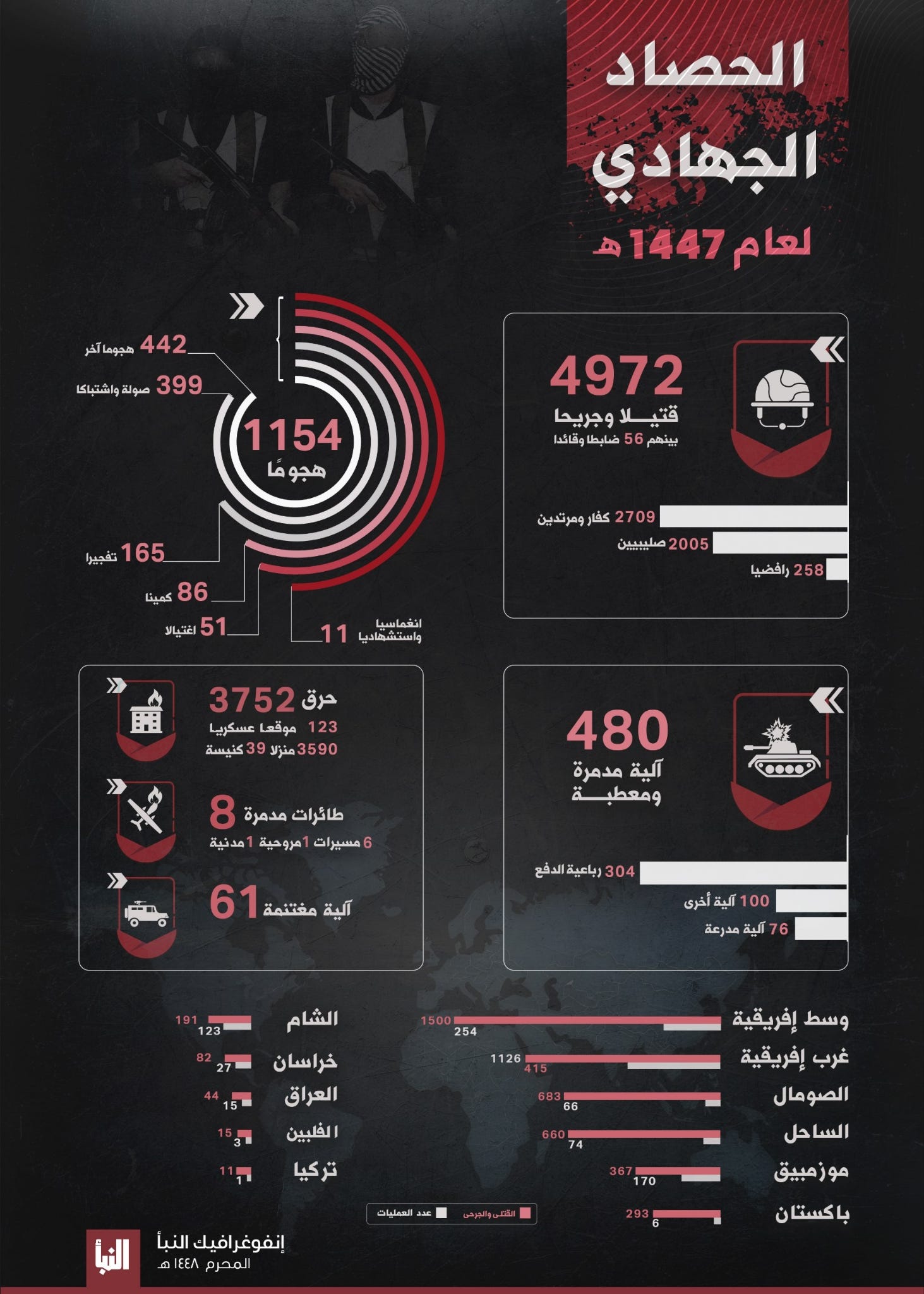
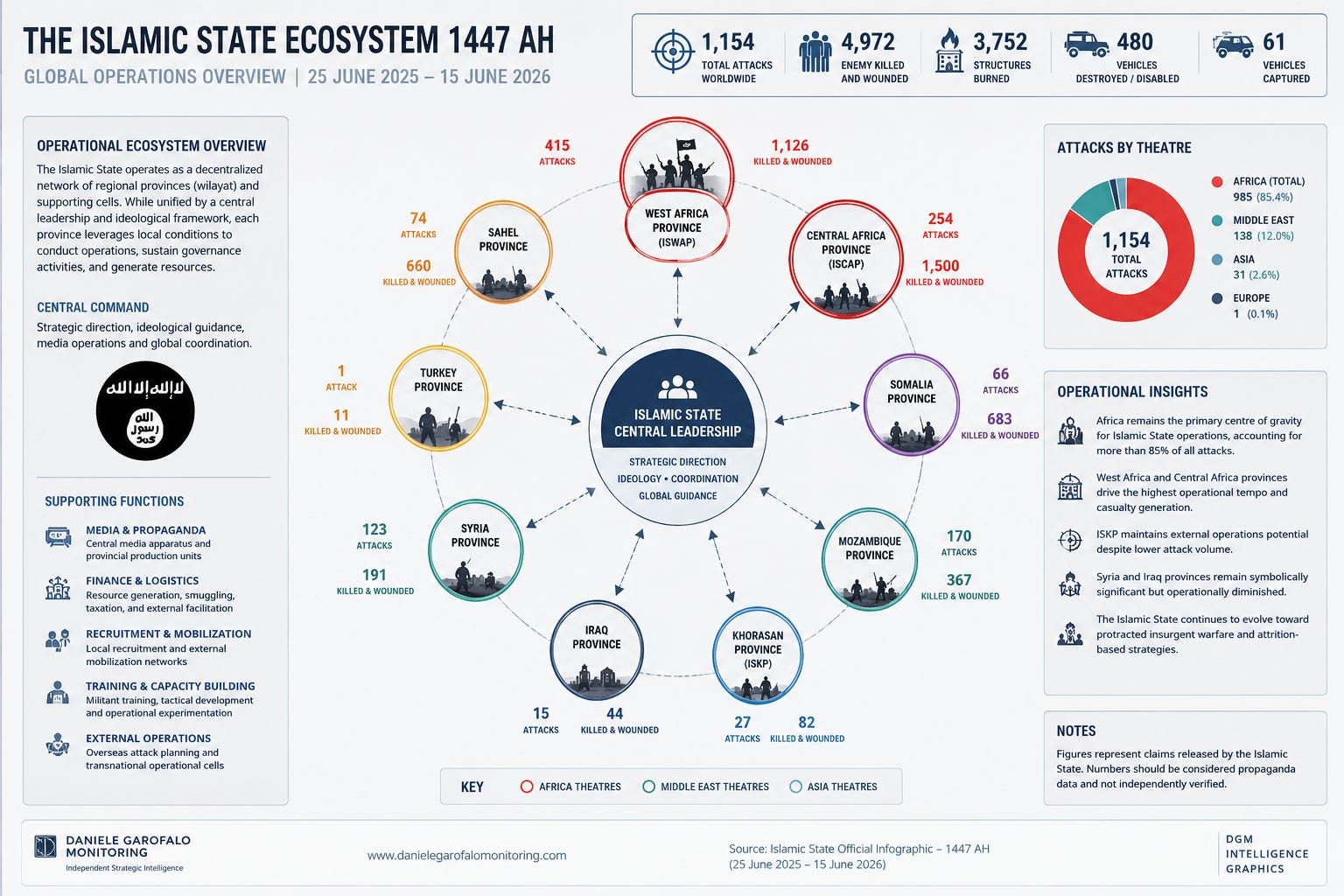
The infographic reports 1,154 attacks worldwide, resulting in 4,972 claimed casualties, the destruction or disabling of 480 vehicles, the burning of 3,752 structures and the capture of 61 vehicles. More importantly, it reveals where the organisation believes its future lies and where it seeks to demonstrate strategic momentum.
Reliability and Propaganda Assessment
As with all Islamic State reporting, the infographic serves both informational and psychological functions. The objective is not merely to report operational activity but to reinforce perceptions of organisational resilience, geographical reach and sustained offensive capability.
Individual figures relating to enemy casualties, destroyed equipment and material losses cannot be independently verified and should therefore be treated as claims rather than confirmed data.
However, previous comparisons between Islamic State annual reports and independent monitoring suggest that geographical trends and relative distributions often provide useful insight into the group’s strategic priorities. Consequently, while absolute numbers may be inflated, the broader operational picture remains analytically valuable.
The Global Distribution of Violence
The most significant finding emerging from the infographic is the overwhelming concentration of activity in Africa.
According to the Islamic State’s own data, operational activity was distributed as follows:
Central Africa Province: 254 attacks, 1,500 casualties claimed
West Africa Province: 415 attacks, 1,126 casualties claimed
Somalia Province: 66 attacks, 683 casualties claimed
Sahel Province: 74 attacks, 660 casualties claimed
Mozambique Province: 170 attacks, 367 casualties claimed
Pakistan Province: 6 attacks, 293 casualties claimed
Syria Province: 123 attacks, 191 casualties claimed
Khorasan Province: 27 attacks, 82 casualties claimed
Iraq Province: 15 attacks, 44 casualties claimed
Philippines (ISEAP): 3 attacks, 15 casualties claimed
Turkey: 1 attack, 11 casualties claimed
West Africa remains the most active operational theatre in terms of attack volume, accounting for approximately 36 percent of all operations claimed globally. Central Africa follows with approximately 22 percent of total attacks but generates the highest claimed casualty count.
Together, African provinces account for more than 85 percent of all attacks claimed by the organisation during the reporting period.
The African Centre of Gravity
The data confirms a trend visible for several years but now impossible to ignore.
Africa has become the primary theatre of jihadist warfare for the Islamic State.
The Lake Chad Basin, eastern Democratic Republic of Congo, northern Mozambique, the Somalia theatre and the Sahel collectively represent the organisation’s most active and strategically significant operating environments.
Several factors explain this shift.
First, state fragility remains widespread across multiple African regions, creating permissive operating environments.
Second, local conflicts provide opportunities for recruitment, territorial penetration and parallel governance structures.
Third, many affected regions suffer from limited intelligence coverage and reduced international military presence compared with Iraq and Syria.
Finally, insurgent warfare in Africa allows Islamic State affiliates to sustain long-term campaigns without facing the level of military pressure experienced by earlier generations of the organisation.
The figures suggest that Africa is no longer a peripheral theatre. It is now the main battlefield of the Islamic State project.
Syria and Iraq: Symbolic Centres, Not Operational Centres
The infographic also illustrates the continuing decline of Syria and Iraq as primary operational theatres.
The Syrian province reported 123 attacks and 191 casualties, while Iraq reported only 15 attacks and 44 casualties.
These numbers would have been unthinkable during the organisation’s territorial peak between 2014 and 2017.
Nevertheless, Syria and Iraq continue to perform critical strategic functions. They remain the ideological heartland of the Caliphate narrative and continue to provide historical legitimacy to the organisation’s leadership.
They serve as important logistical, communication and coordination hubs linking multiple branches. Therefore, while operational gravity has shifted elsewhere, symbolic gravity remains firmly rooted in the Levant.
The Strategic Significance of ISKP
The Khorasan Province remains one of the most strategically important components of the Islamic State ecosystem despite relatively modest attack numbers.
The province reported 27 attacks and 82 casualties. Although operational output remains significantly below that observed in Africa, ISKP continues to possess characteristics not shared by most other branches.
These include advanced external operations capabilities, multilingual propaganda production, transnational recruitment networks and demonstrated intent to target actors beyond its immediate operating environment. For this reason, ISKP remains disproportionately important from an international security perspective.
Operational Evolution: Attrition Rather Than Conquest
The operational breakdown provides important insight into how the organisation now fights.
According to the infographic:
399 armed engagements
165 explosive attacks
86 ambushes
51 assassinations
11 suicide operations
442 various or other types of attacks.
This reflects a broader strategic adaptation. The contemporary Islamic State increasingly relies on sustainable insurgent warfare based on raids, ambushes, harassment attacks, improvised explosive devices and targeted killings.
Rather than pursuing territorial conquest, the organisation seeks to exhaust state institutions through persistent low-cost violence.
Targeting Patterns and Coercive Violence
The infographic highlights extensive attacks against infrastructure and civilian assets.
The organisation claims to have burned:
3,590 houses
123 military facilities
39 churches
This pattern reinforces a longstanding feature of Islamic State insurgencies.
Violence is not directed exclusively against military targets. It also serves to intimidate local populations, punish perceived collaborators, enforce compliance and undermine state legitimacy.
The destruction of residential property remains a powerful mechanism for coercive control, particularly in rural insurgent environments where communities possess limited protection capabilities.
Centre of Gravity Assessment
Military Centre of Gravity:
African Provinces
Operational Centre of Gravity:
West Africa and Central Africa
Casualty Generation Centre of Gravity:
Central Africa Province
External Operations Centre of Gravity:
Khorasan Province
Ideological Centre of Gravity:
Syria and Iraq
Strategic Communications Centre of Gravity:
Islamic State Central Media Apparatus.
Implications for Counterterrorism Decision Makers
The infographic indirectly exposes a growing mismatch between where policymakers often focus attention and where the organisation actually generates operational momentum.
Counterterrorism discourse continues to devote substantial attention to Syria and Iraq. However, the Islamic State’s own reporting demonstrates that the majority of its operational mass now resides in African theatres.
This does not imply that the Levant has become irrelevant. Rather, it indicates that future strategic threats are increasingly likely to emerge from African conflict ecosystems characterised by weak governance, expanding insurgencies and limited international engagement.
Failure to address these environments may allow local Islamic State branches to evolve into increasingly autonomous strategic actors with growing regional influence.
Threat Forecast: 2026–2027
Baseline Scenario (60%)
African affiliates continue to expand operationally while maintaining pressure on local security forces. ISKP sustains moderate activity levels and preserves external operations potential. Syria and Iraq remain low-intensity insurgent theatres.
Escalation Scenario (25%)
One or more African provinces achieve significant territorial gains, particularly in the Sahel, Lake Chad Basin or eastern Democratic Republic of Congo. Increased governance activity and parallel administration structures emerge.
Disruption Scenario (15%)
Sustained military pressure, leadership losses and resource constraints weaken several provincial networks. Internal fragmentation and declining operational coordination reduce overall attack levels.
Executive Intelligence Conclusion
The Islamic State’s annual infographic for 1447 AH does not depict an organisation in strategic retreat. Rather, it portrays a movement that has successfully adapted to the post-Caliphate environment through geographical decentralisation and insurgent warfare.
The most important conclusion is not the number of attacks claimed, but where those attacks occurred.
The centre of gravity of the Islamic State has shifted from the Middle East to Africa. The future trajectory of the organisation will therefore be shaped less by developments in Mosul or Raqqa and increasingly by events in the Lake Chad Basin, the Sahel, eastern Democratic Republic of Congo, northern Mozambique and Somalia.
For intelligence services, military planners and policymakers, the implication is clear. Understanding the future of the Islamic State increasingly requires understanding Africa.
🔒 Executive Intelligence Cycle
This assessment is part of a broader analytical cycle.
Founding subscribers receive the Executive Intelligence Briefing, which integrates all threat assessments, cognitive domain analysis, and a rolling 30–90-day forecast into a single monthly strategic synthesis.
© Daniele Garofalo Monitoring - All rights reserved.
Daniele Garofalo is an independent researcher and analyst specialising in jihadist terrorism, Islamist insurgencies, and armed non-state actors.
His work focuses on continuous intelligence monitoring, threat assessment, and analysis of propaganda and cognitive/information dynamics, with an emphasis on decision-oriented outputs, early warning, and strategic trend evaluation.
ISSN (International Standard Serial Number): 3103-3520
NATO NCAGE: AX664 (NATO Commercial and Governmental Entity)
UNITED NATIONS Global Marketplace ID: 1210727
ORCID Code: 0009-0006-5289-2874