


Executive Intelligence Assessment
The first six months of 2026 confirm that the Islamic State remains a resilient and adaptive insurgent organisation, capable of sustaining coordinated military activity across multiple theatres despite the absence of the territorial Caliphate it once controlled in Iraq and Syria. The latest operational infographic released by Amaq News Agency, summarising activity from 1 January to 30 June 2026, provides valuable insight into how the organisation interprets its own performance and, perhaps more importantly, how it seeks to project strength to supporters, rivals and state adversaries.
According to the group’s claims, the Islamic State conducted 587 operations worldwide during the first half of the year, causing 2,529 deaths and injuries, destroying or damaging 380 military vehicles, capturing 56 vehicles, destroying 8 aircraft and burning more than 1,500 civilian homes alongside dozens of military facilities and churches. While these figures cannot be independently verified and should not be interpreted as factual operational statistics, they nevertheless offer an important perspective on the organisation’s strategic priorities, geographical focus and preferred methods of warfare.
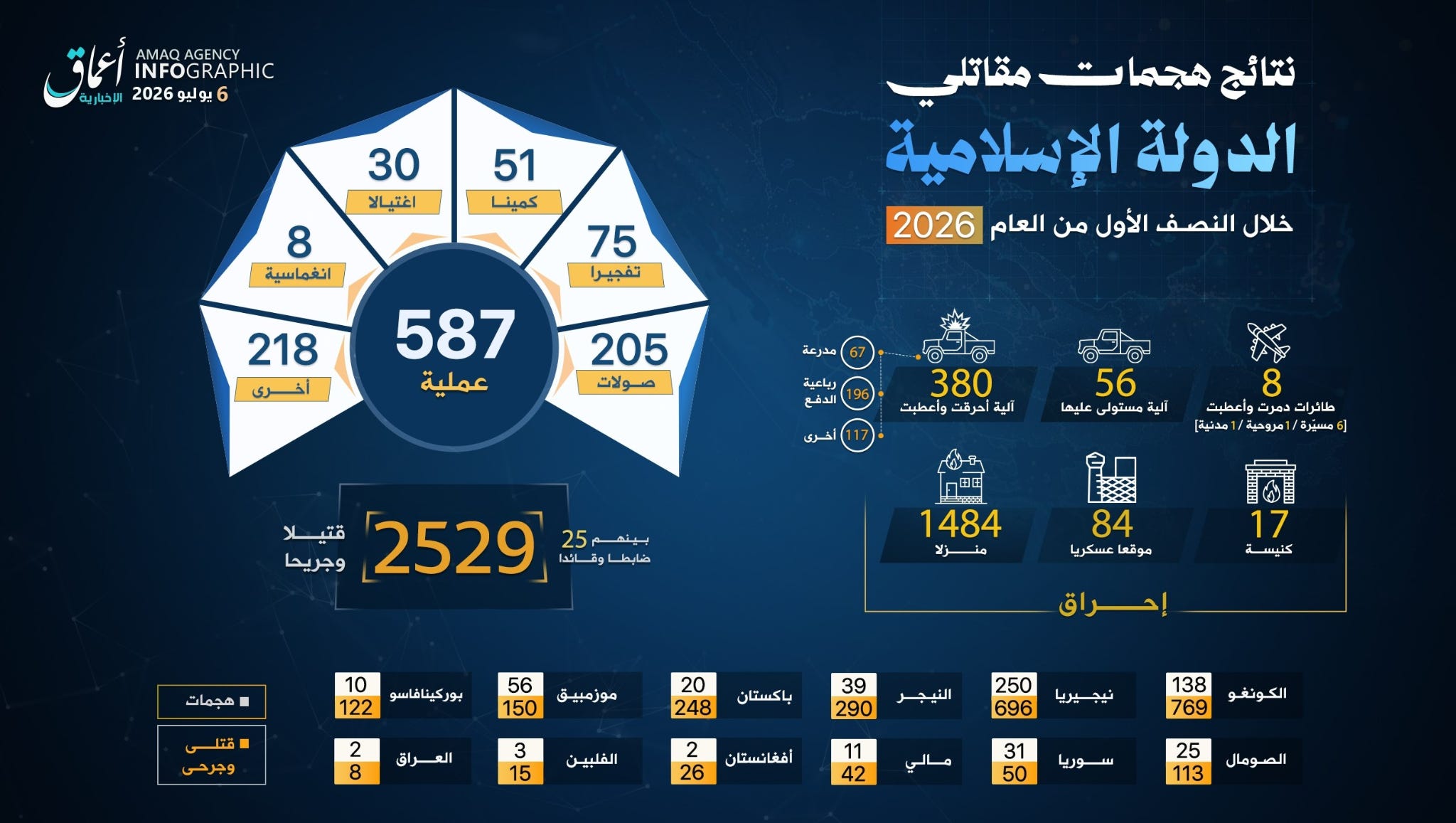
Beyond the aggregate figures, the infographic highlights three developments that deserve particular attention.
Africa has firmly consolidated its position as the operational centre of gravity of the Islamic State. Provinces in Nigeria, the Democratic Republic of Congo, Mozambique, Somalia, Mali and Niger account for the overwhelming majority of attacks and claimed casualties, confirming a trend that has become increasingly evident over the past several years. Rather than representing isolated insurgencies, these provinces now form the core of the organisation’s global military activity.
The data reinforces the Islamic State’s continued evolution toward a decentralised model of insurgent warfare. The organisation no longer seeks to demonstrate its strength primarily through territorial conquest or large-scale conventional offensives. Instead, it emphasises sustained operational tempo, repeated attacks against security forces, selective destruction of infrastructure and continuous pressure on state authority. The relatively small number of suicide operations compared with armed assaults, bombings and ambushes illustrates a strategic preference for lower-cost, sustainable forms of violence capable of maintaining long-term military pressure.
Recent propaganda produced by the Central Africa Province (ISCAP) suggests that the organisation’s objectives increasingly extend beyond inflicting casualties. Alongside attacks against military and civilian targets, Islamic State messaging now places growing emphasis on the temporary seizure of villages, mining sites and weapons depots. This evolution indicates that certain provincial branches are increasingly integrating economic considerations into their military strategy, seeking access to resources that can sustain insurgent activity over time rather than pursuing territorial expansion for its own sake.
Taken together, these developments suggest that the Islamic State should no longer be assessed primarily through the lens of its former territorial project in Iraq and Syria. The organisation has evolved into a geographically dispersed insurgent ecosystem in which regional affiliates enjoy considerable operational autonomy while remaining connected through a shared ideological framework, centralised media architecture and common strategic narrative.
The principal analytical question is therefore no longer whether the Islamic State can rebuild the Caliphate as it existed in 2014, but whether its increasingly self-sufficient regional branches can develop durable military and economic ecosystems capable of sustaining insurgencies over the long term. The first half of 2026 indicates that, in several African theatres, this transformation is already well underway.
Understanding the Dataset
This assessment is based primarily on the operational infographic published by Amaq News Agency covering Islamic State activity between 1 January and 30 June 2026. The infographic summarises attacks claimed by the organisation across all officially recognised provinces and provides aggregated data regarding operational methods, claimed casualties, destroyed equipment and damaged infrastructure.
Like all official Islamic State publications, the infographic serves both an informational and a propagandistic purpose. Its primary objective is to reinforce perceptions of organisational resilience, operational effectiveness and global reach among supporters and adversaries alike. Consequently, the numerical claims contained within the document should not be treated as independently verified statistics.
Throughout this assessment, all quantitative figures referring to attacks, casualties or material losses are therefore presented as Islamic State claims rather than confirmed facts. Independent verification of individual incidents remains uneven across theatres, particularly in remote areas of Central Africa, the Sahel and northern Mozambique, where limited media access and weak institutional reporting frequently constrain external validation.
At the same time, dismissing the infographic as mere propaganda would overlook its intelligence value. Historical comparison between official Islamic State reporting and independent conflict monitoring demonstrates that, while absolute figures may be inflated or selectively reported, broader geographical patterns, operational priorities and long-term strategic trends often correspond closely with developments observed through open-source reporting and local security assessments.
A second methodological point concerns the interpretation of the provincial statistics presented in the infographic. Each province includes two separate indicators that must not be confused. The white figures represent the number of operations claimed by the organisation, while the yellow figures indicate the number of enemy personnel allegedly killed or wounded during those operations. The latter should therefore be interpreted as claimed casualties rather than attack totals.