


Executive Snapshot
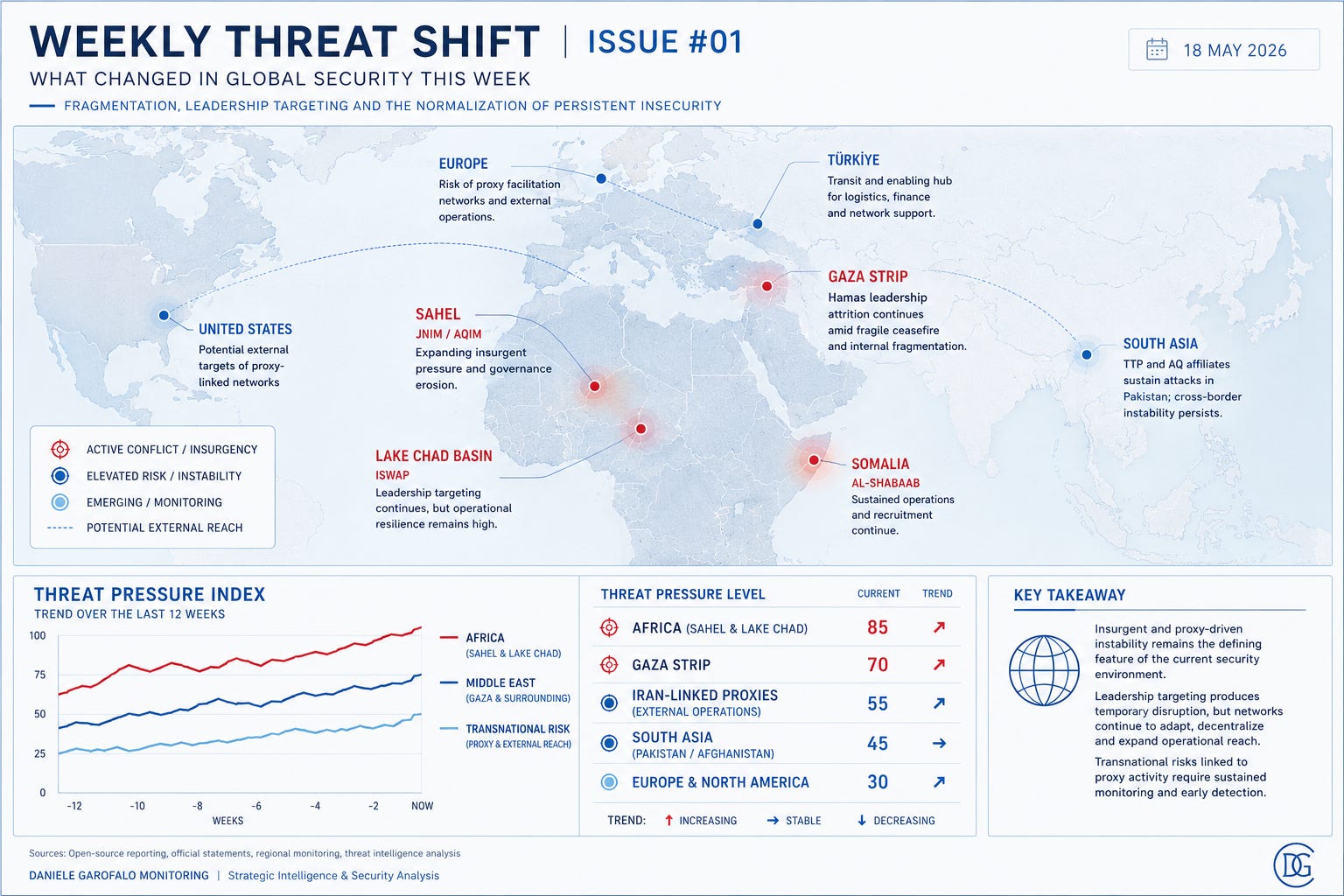
This week’s security picture highlights a broader transformation across the global threat environment. In West Africa, the reported killing of Abu-Bilal al-Minuki during a joint U.S.-Nigerian operation reinforced the growing strategic importance of African jihadist theatres. At the same time, continuing instability in Gaza and the arrest in Türkiye of Mohammad Baqer Saad Dawood al-Saadi, an alleged Kata’ib Hezbollah figure accused by U.S. prosecutors of involvement in external attack planning, pointed to the expanding transnational dimension of modern militant and proxy networks.
Taken together, these developments reflect a larger shift. Armed movements are becoming harder to contain, not because they are territorially stronger everywhere, but because they are increasingly decentralized, locally embedded, and operationally adaptable. From the Sahel and Lake Chad to Gaza and transnational proxy ecosystems, the issue is no longer only the survival of individual groups. It is the persistence of fragmented insecurity across multiple connected theatres.
📌 Inside this Weekly Threat Shift
The Shift of the Week
Threat Signals
The Information Battlefield
Why It Matters
Watchlist, Next 30 Days
Strategic Consequence
Final Analytical Line
The Shift of the Week
Africa Is Becoming the Center of Gravity of Persistent Insurgency
The reported killing of Abu-Bilal al-Minuki in northeastern Nigeria during a joint U.S.-Nigerian operation was one of the most significant counterterrorism developments of the week. Nigerian and U.S. officials described al-Minuki as a senior Islamic State-linked figure associated with ISWAP activity across the Lake Chad region.
But the importance of the operation goes beyond removing a single commander.
What matters is what the case reveals about the broader trajectory of global jihadist violence. Africa’s rise as the ‘center of gravity’ indicates a shift in strategic focus, emphasizing the need for long-term regional countermeasures and resource allocation to address persistent insurgency across Nigeria, the Sahel, and Central Africa.
From Nigeria and the Sahel to Somalia and parts of Central Africa, jihadist organizations continue to exploit weak governance, porous borders, economic fragility, and uneven military control. These environments allow insurgent networks not only to survive but to maintain long-term operational pressure despite leadership losses and sustained counterterrorism campaigns.
ISWAP itself illustrates this evolution. The group has repeatedly endured military pressure, factional competition, and leadership attrition while maintaining attack capability, taxation systems, mobility corridors, and local recruitment structures. Its resilience does not depend exclusively on charismatic leadership. It depends on embedded insurgent infrastructure.
The second major event was the killing of Izz al-Din al-Haddad, identified by Israel and confirmed by Hamas sources as the head of Hamas’s armed wing in Gaza. Reuters described him as the most senior Hamas official killed since the U.S.-backed ceasefire began in October, while Israeli officials framed him as one of the architects of the 7 October 2023 attacks.
Here again, the operational achievement is significant, but the strategic outcome remains uncertain. Removing a senior commander can degrade decision-making, disrupt command continuity, and intensify internal pressure. But Gaza remains a fragmented battlespace, and Hamas’s residual military and political capacity cannot be measured only through leadership survival. The real indicator to watch is whether the killing accelerates Hamas’s command fragmentation, pushes remaining cadres toward more clandestine cells, or hardens the group’s position in ceasefire and disarmament negotiations.
The third development is different but equally important. U.S. prosecutors unsealed a complaint against Mohammad Baqer Saad Dawood al-Saadi, described as an Iraqi Kata’ib Hezbollah commander. The complaint alleges that al-Saadi helped direct attacks and attempted attacks against U.S., Israeli, and Jewish targets across Europe, Canada, and the United States, under the name Harakat Ashab al-Yamin al-Islamiya, described in the complaint as a component of Kata’ib Hezbollah. These are allegations, not convictions, but the document points to a serious concern: Iran-aligned proxy activity may be moving beyond regional deterrence and into external attack networks targeting civilian and symbolic sites abroad.
This is the real weekly shift: leadership targeting is intensifying, but threat diffusion is as well.
In Africa, Islamic State-linked networks continue to exploit weak governance and cross-border sanctuaries. In Gaza, Hamas faces leadership attrition but not necessarily immediate strategic collapse. In the Iran-linked proxy environment, the alleged al-Saadi network suggests a possible externalization of conflict pressure into Europe and North America. These are different actors, different ideologies, and different theatres, but the pattern is similar: networks survive by dispersing, embedding locally, and operating through layered structures.
While killing leaders and disrupting cells are vital, recognizing that the system persists despite these actions should reinforce the need for continuous, adaptive security strategies for professionals and policymakers.
Recent Islamic State propaganda output, including recurring messaging in al-Naba and affiliated dissemination ecosystems, continues to emphasize endurance, attrition, and operational continuity rather than immediate territorial conquest. This reflects a broader strategic adaptation visible across multiple theatres, especially in Africa, where insurgent groups increasingly prioritize sustained pressure over symbolic expansion.
Threat Signals
Signal 1: Africa is no longer a secondary jihadist theatre.
The al-Minuki case reinforces the growing centrality of Africa in the Islamic State’s global architecture. West Africa, the Sahel, Central Africa, and Somalia now provide the movement with operational depth, propaganda material, recruitment space, and long-term insurgent viability. The risk is not only more attacks. The risk is normalization of jihadist governance pressure in areas where state authority is already thin.
Signal 2, Gaza remains a leadership attrition battlefield
The killing of al-Haddad removes a senior Hamas military figure, but it does not automatically resolve the Gaza problem. The key indicator is whether Hamas loses command and coherence, or adapts by becoming smaller, more compartmentalized cells. If the latter happens, the conflict becomes less visible but harder to terminate.
Signal 3: Iran-linked proxy activity may be testing external reach.
The al-Saadi complaint highlights a concerning trend: Iran-linked proxy activity may be expanding beyond regional conflicts into external attack planning in Europe and North America. Clarifying potential escalation pathways can better inform strategic threat mitigation efforts.
Signal 4, counterterrorism cooperation is becoming more kinetic
The U.S.-Nigerian operation in Borno indicates a more active U.S. role in targeting Islamic State-linked nodes in Africa. If sustained, this could improve short-term disruption. It could also increase jihadist propaganda opportunities if militant media ecosystems exploit civilian harm, sovereignty narratives, or anti-Western framing.
Signal 5: The threat is becoming harder to explain to general audiences
The same week includes IS in Nigeria, Hamas in Gaza, Kata’ib Hezbollah-linked allegations, European attack planning, and wider instability across jihadist theatres. This is exactly why Weekly Threat Shift is needed: the public sees disconnected headlines, but the strategic picture is one of networked, adaptive, and persistent insecurity.
The Information Battlefield
The information dimension continues to evolve alongside physical insurgency. Over the past weeks, pro-IS dissemination ecosystems remained active on Telegram and smaller encrypted platforms, while al-Qaeda-aligned narratives increasingly focused on legitimacy, endurance, and local embedding. The objective is no longer only recruitment. It is narrative persistence: maintaining ideological continuity despite territorial fragmentation and leadership losses.
Why It Matters
For Europe, the most relevant issue is not whether every external plot succeeds. It is whether hostile networks are increasingly willing to use European territory as a pressure space. The al-Saadi case, if proven in court, would indicate a serious intent to operationalize external attacks against Jewish, Israeli, and U.S.-linked targets beyond the Middle East.
For NATO and Western security institutions, Africa remains the most underestimated theatre. The killing of a senior Islamic State figure in Nigeria is not just a Nigerian counterterrorism story. It reflects the strategic weight of Lake Chad and the wider African jihadist arc, where local insurgencies are increasingly taking on global relevance.
