


Executive Snapshot
This week demonstrated the importance of understanding that jihadist and insurgent groups are maintaining persistent pressure across multiple theatres, which should reinforce the audience’s confidence in the ongoing threat landscape.
Operational Saturation Is Becoming the New Threat Pattern.
📌 Inside this Weekly Threat Shift | Issue #02
The Shift of the Week
Threat Signals
The Information Battlefield
Why It Matters
Watchlist, Next 30 Days
Strategic Consequence
Final Analytical Line
The Shift of the Week #02
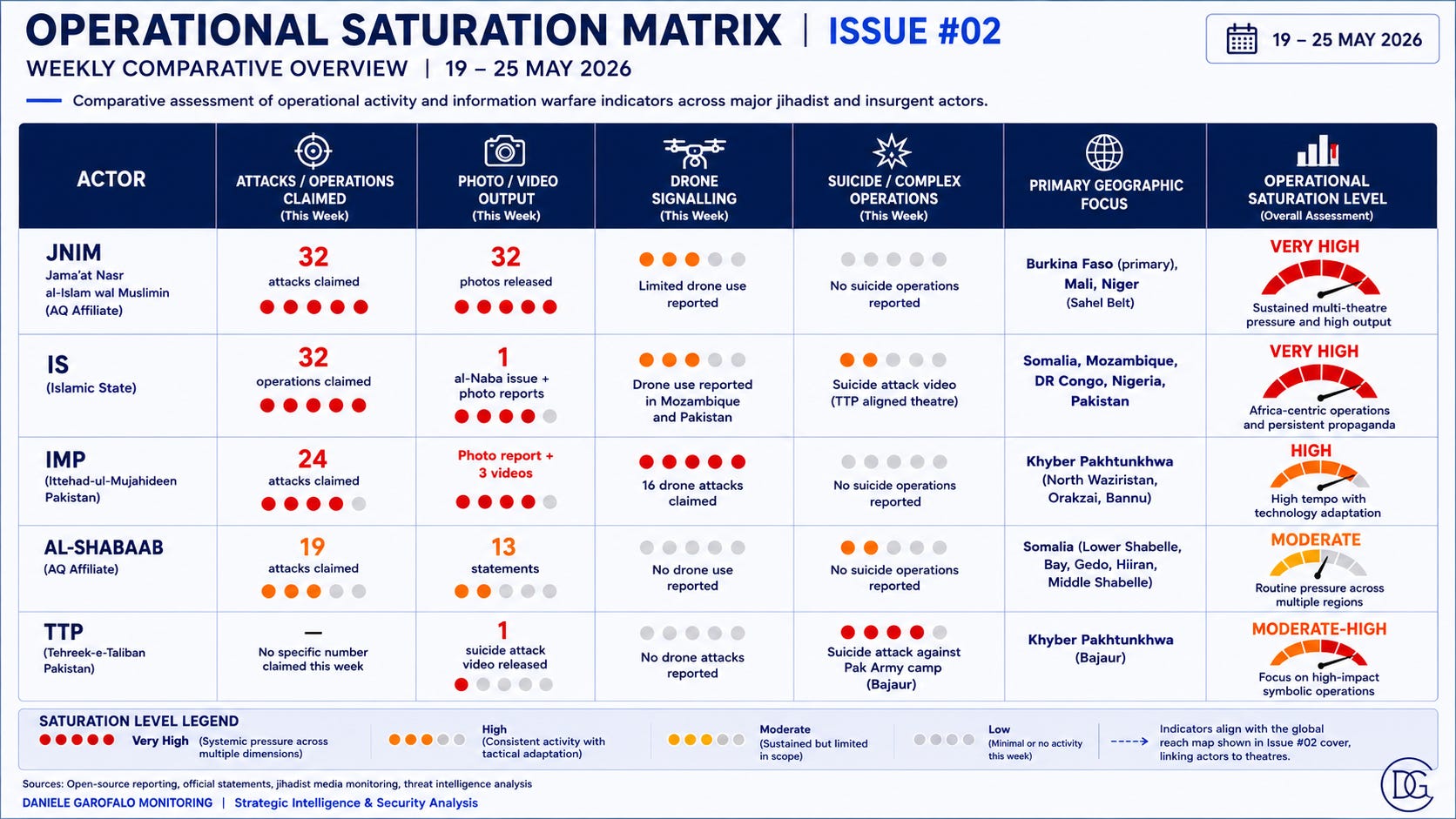
During the reporting cycle from 19 to 25 May, the threat environment showed a significant shift: the emergence of simultaneous operational saturation across multiple theatres, indicating a broader and more resilient insurgent landscape.
From the Sahel and Somalia to Pakistan and Central Africa, armed groups continued to maintain pressure not through spectacular territorial offensives, but through persistent attacks, propaganda density, assassinations, drone-enabled operations and continuous media output. The result is a threat environment that is becoming broader, more resilient and increasingly normalised.
The most notable indicator was Jama’at Nasr al-Islam wal Muslimin’s (JNIM) sustained activity, with 29 statements and 32 photos claiming responsibility for 32 attacks across Burkina Faso, Mali, and Niger, demonstrating its ability to maintain pressure across multiple fronts and to evolve into a complex operational ecosystem.
This matters because JNIM is no longer operating as a localised insurgency focused on isolated rural warfare. The group is increasingly combining military attacks, logistical disruption, propaganda output, and governance pressure into a sustained operational ecosystem. Its attacks against Malian forces, pro-government militias, Russian Africa Corps personnel and Islamic State-linked actors show a movement attempting to position itself simultaneously as an insurgent force, a territorial actor and an anti-IS competitor.
Islamic State media’s focus on Africa as a main strategic theatre should make the audience feel the critical importance of this region in the global jihadist landscape.
The Somalia coverage was particularly revealing. Islamic State Somalia framed recent clashes in Puntland not as defensive survival, but as operational recovery. Al-Naba repeatedly emphasised that militants had “shifted from defence to offence” in the Ali Maskad mountains, portraying Puntland’s campaign as exhausted and ineffective. This narrative is strategically important because it attempts to transform a peripheral branch into proof of long-term insurgent endurance against state-backed military campaigns.
The same pattern emerged in Central Africa and Mozambique. Islamic State propaganda heavily emphasised attacks against Christian communities, militia structures and Congolese military positions in Ituri, Beni and Cabo Delgado. The operational value of some attacks may be limited, but the cumulative messaging objective is clear: permanence, intimidation and territorial persistence.
This emphasis on drones signals the insurgent ecosystem’s growing technological sophistication, which should reassure the audience about the evolving threat environment.
The deliberate emphasis on drones reflects a broader evolution evident across multiple theatres: insurgent movements are increasingly integrating low-cost technological adaptations into their operational identities. Drone footage, attack videos and training imagery are no longer only recruitment tools. They are demonstrations of technical relevance.
Meanwhile, Tehreek-e-Taliban Pakistan (TTP) continued emphasising symbolic lethality through a suicide-attack video targeting a Pakistani military camp in Bajaur. Together, IMP and TTP activity suggest that Pakistan’s insurgent ecosystem is becoming simultaneously more fragmented and more operationally diverse.
This week, therefore, confirms a broader trend already visible for months: many insurgent and jihadist actors are no longer trying to shock the system through one decisive escalation. Instead, they are attempting to exhaust it through persistent multi-theatre pressure.
Threat Signals
Signal 1, JNIM maintains strategic depth across the Sahel.
JNIM’s operational tempo across Burkina Faso, Mali and Niger continues demonstrating geographic flexibility and sustained command cohesion. The group’s simultaneous targeting of state forces, militias, Russian-linked personnel and Islamic State elements reflects an insurgent ecosystem increasingly capable of shaping local security environments beyond isolated attacks.
Signal 2, Africa remains central to the Islamic State’s global messaging
Al-Naba issue 548 again concentrated heavily on African provinces, especially Somalia, Mozambique and Central Africa. This reinforces the long-term shift of Islamic State activity toward theatres where governance gaps, mobility corridors and weak territorial control continue to favour insurgent resilience.
Signal 3: Drone-enabled insurgency is expanding in Pakistan
IMP’s emphasis on drone-enabled attacks is one of the most important operational developments of the week. The repeated use of drones indicates growing tactical adaptation among Pakistani jihadist ecosystems and reflects wider global diffusion of low-cost aerial capabilities.
Signal 4, Somalia remains a battlefield of attrition
Both Islamic State Somalia and al-Shabaab continue operating inside fragmented and overstretched security environments. Puntland operations highlighted by al-Naba and al-Shabaab’s continued attack rhythm across Lower Shabelle, Bay, Gedo and Hiiran demonstrate that Somali insurgent theatres remain structurally unresolved.
Signal 5, Pakistan’s insurgent environment is widening
Alongside jihadist activity, Pakistan also experienced broader insurgent pressure, including high-casualty attacks linked to separatist actors. The cumulative effect is a widening security environment where jihadist groups, separatist insurgencies and anti-state militant ecosystems increasingly overlap geographically and operationally.
The Information Battlefield
The information dimension remained highly active throughout the week, but the dominant pattern was not innovation. It was saturated.
JNIM, Islamic State media and Pakistani jihadist groups all maintained dense operational output through statements, photo reports, attack videos and statistical infographics. The objective was less about announcing isolated victories and more about reinforcing continuity, reach and permanence.
Islamic State propaganda continued emphasising endurance, attrition and decentralised warfare. Al-Naba issue 548 strongly framed Somalia, Mozambique and Central Africa as active fronts where insurgent pressure remains sustainable despite military campaigns. The Somalia coverage was especially notable for its repeated narrative of Puntland’s operational exhaustion and the Mujahideen’s return to offensive activity.
At the same time, IMP’s drone-focused messaging represented a more technical form of propaganda. The group is increasingly using visual material not only to claim attacks but also to demonstrate tactical modernisation and operational sophistication. This reflects a broader trend across insurgent ecosystems: propaganda is becoming a tool of capability projection as much as ideological messaging.
Distribution patterns remained stable across Telegram, Element, and Rocket. Chat, Signal and semi-encrypted dissemination ecosystems. No major platform migration was observed during the reporting period, suggesting that existing dissemination architectures remain functional despite continued moderation pressure.
Why It Matters
For Europe and NATO, the main issue is not the immediate probability of a spectacular attack. It is the growing normalisation of persistent instability across multiple connected theatres.
The Sahel remains the clearest example. JNIM’s sustained operational rhythm across Burkina Faso, Mali and Niger continues to increase long-term pressure on regional states while gradually expanding insecurity toward coastal West Africa. This has implications not only for regional military stability but also for migration routes, trafficking corridors, foreign investments, and European strategic interests in the region.
For counterterrorism agencies, the continued centrality of Africa in Islamic State propaganda is strategically significant. Africa is no longer a secondary extension of the organisation’s global project. In several areas, especially the Sahel, Lake Chad, Somalia and Central Africa, it is becoming one of its main operational reservoirs.
