


Executive Snapshot Weekly Threat Shift | Issue #04
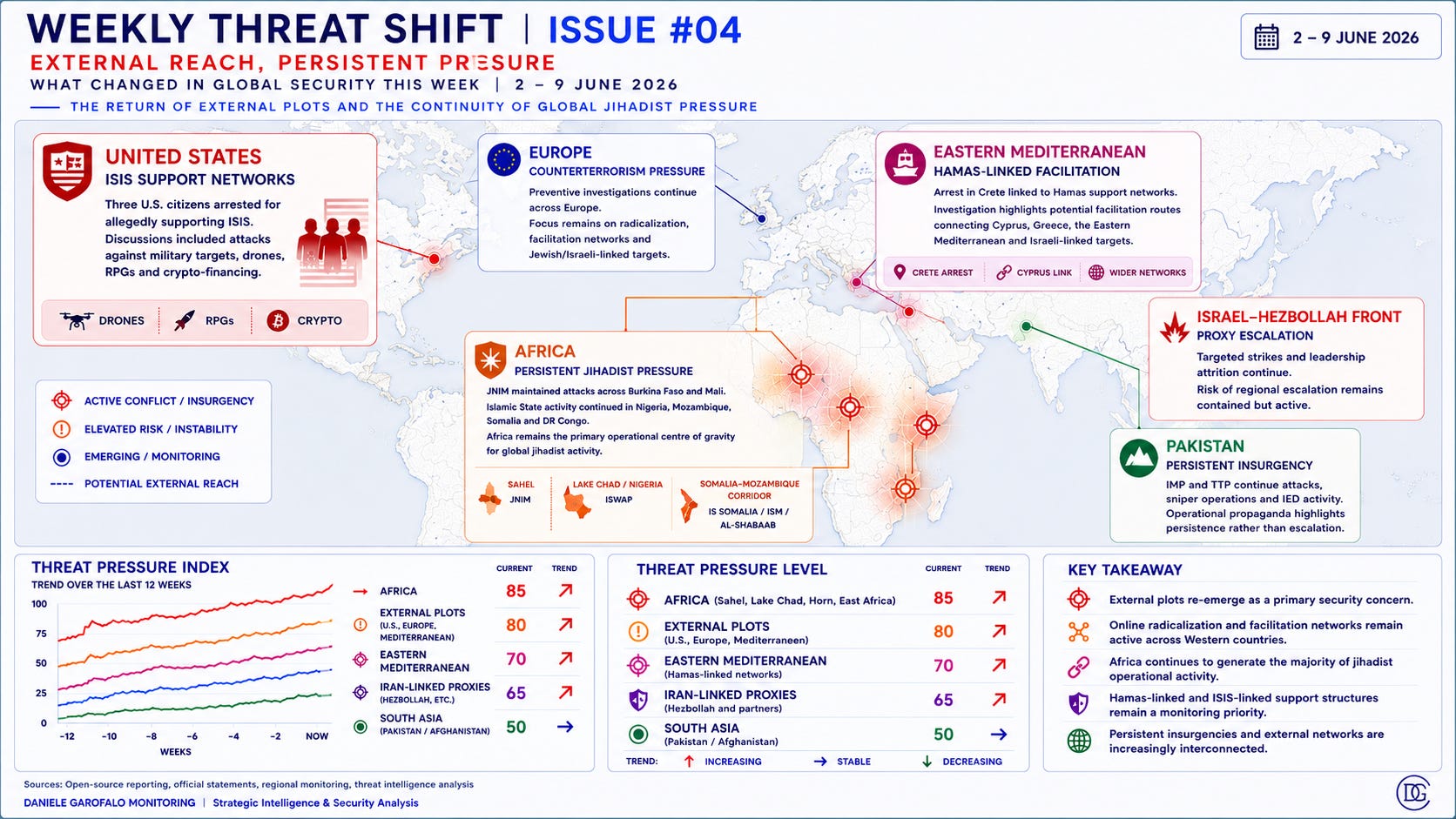
The week of 2–9 June 2026 highlighted a dual-track threat environment. While jihadist organisations across Africa and South Asia maintained a steady operational tempo, a series of arrests and counterterrorism investigations in the United States, Europe and the Eastern Mediterranean underscored the continued relevance of external facilitation networks, online radicalisation and low-cost attack planning.
In the operational domain, Africa remained the principal centre of gravity for jihadist activity. Jama’at Nasr al-Islam wal Muslimin (JNIM) sustained pressure across Burkina Faso and Mali. At the same time, the Islamic State continued to prioritise African theatres through operations in Nigeria, the Democratic Republic of Congo, Mozambique, Somalia and the Sahel. Al-Shabaab maintained attacks across multiple regions of Somalia, and Pakistani jihadist actors continued to demonstrate resilience through attacks, sniper operations, IED activity and increasingly sophisticated media messaging.
At the same time, developments outside traditional conflict zones attracted growing attention. Terrorism-related arrests in the United States, Greece and. At the same time, other European jurisdictions reinforced concerns regarding decentralised support networks, online mobilisation and the potential re-emergence of externally inspired attack planning. These developments do not indicate a coordinated global campaign, but they do suggest that the boundary between local insurgencies and transnational security threats remains increasingly blurred.
The broader picture remains one of adaptation rather than escalation. Jihadist organisations continue to preserve operational relevance in their primary theatres while maintaining ideological reach far beyond the areas in which they physically operate.
📌 Inside this Weekly Threat Shift #04
The Shift of the Week
Threat Signals
The Information Battlefield
Why It Matters
Watchlist, Next 30 Days
Strategic Consequence
Final Analytical Line
The Shift of the Week
External Reach, Persistent Pressure
The week of 2–9 June 2026 did not produce a single defining event capable of reshaping the global threat environment. Instead, it revealed a more significant and potentially enduring development: the simultaneous persistence of insurgent pressure across established theatres and the continued emergence of external facilitation networks, attack planning and radicalisation activity far beyond active conflict zones.
This dual dynamic has become increasingly visible over the past year. On one side, jihadist organisations continue to operate within familiar battlefields such as the Sahel, Somalia, Pakistan and the Lake Chad region. On the other hand, security services across North America, Europe and the Eastern Mediterranean are confronting a growing number of cases involving online radicalisation, ideological mobilisation, logistical facilitation and suspected attack planning. These developments do not yet constitute a coordinated international campaign. However, they demonstrate that the strategic influence of jihadist movements cannot be measured solely through battlefield activity.
The arrests announced in the United States, involving individuals accused of supporting the Islamic State and discussing potential attacks against military personnel, illustrate how contemporary threat ecosystems increasingly combine virtual spaces, encrypted communications, cryptocurrency-based financing and tactical aspirations. The significance of these cases lies less in the operational sophistication of the suspects and more in their ability to connect ideological commitment with practical planning despite operating thousands of kilometres away from traditional conflict zones.
A similar pattern emerged in the Eastern Mediterranean. The arrest in Crete of a Palestinian suspect reportedly linked to Hamas-related networks highlights the continuing importance of facilitation routes, diaspora connections and transnational support structures. Whether or not individual investigations ultimately reveal operational intent, they reinforce a broader reality: the geographic boundaries separating conflict theatres from external environments are becoming increasingly porous.
At the same time, the operational core of the jihadist landscape remains firmly anchored in Africa and parts of South Asia. JNIM maintained pressure across Burkina Faso and Mali while continuing to position itself as the most resilient al-Qaeda affiliate in the Sahel. The Islamic State once again concentrated much of its messaging and operational reporting on African provinces, particularly Nigeria, Mozambique, the Democratic Republic of Congo and Somalia. Al-Shabaab sustained attacks across multiple Somali regions, while Pakistani militant actors continued to demonstrate persistence through attacks, sniper operations, IED activity and increasingly sophisticated media output.
The strategic lesson from this reporting period is therefore not one of escalation, but of convergence. Local insurgencies remain active, while external networks continue to demonstrate their ability to inspire, facilitate or potentially support activity far beyond the territories where these groups physically operate. The result is a threat environment that is increasingly interconnected, decentralised and difficult to compartmentalise.
Threat Signals
Several developments during the week reinforce the assessment that the global threat landscape is becoming more diffuse rather than more concentrated.
