


Executive Summary
This report analyses the military activity of the Islamic State (IS) during 2025, based on the annual infographic published by Amaq Agency, the organisation’s official media outlet.
The source represents jihadist primary material, coming from internal channels of operational reporting, traditionally used by IS to monitor and coordinate the activity of its wilayats.
The analysis highlights high operational resilience and global persistence of violence, in the absence of any credible indicator of strategic rebirth or reconstitution of a state entity modelled on the “Caliphate” 2014–2019.
Key Judgements
The Islamic State is not in the process of strategic resurrection in 2025, but it demonstrates a marked capacity for survival and adaptation in contexts of state fragility.
Africa represents the organisation’s main operational and lethal centre of gravity, steadily surpassing the Middle East and Asia in terms of casualties and destabilising impact.
The high number of attacks (1218) does not translate into territorial, political or strategic gains, confirming a dynamic of high-frequency but low-strategic-return violence.
The structure of IS is today radically decentralised: the wilayats operate with broad tactical autonomy, while the “centre” serves predominantly as an ideological, media and methodological hub.
Targeting is predominantly opportunistic and asymmetric, focused on local security forces, civilians, and weakly protected infrastructure, with a primary function of attrition and destabilisation.
Reliability and Source Limitations
Nature of the source
Primary jihadist source, internal to the organization used by IS as a tool to:
internal reporting
external propaganda
intra-jihadist competition
Reliability Assessment
The numbers for the number of attacks are generally reliable. The figures for deaths and injuries tend to be inflated, especially about:
security forces
officers and commanders.
➡️ IS exaggerates the impact, but rarely invents operations.
Methodology
Full and contextualised translation of the Amaq infographic (Arabic language).
Descriptive quantitative analysis of the declared data.
Critical approach to propaganda, distinguishing:
real operational output
ideological and symbolic framing
The report does not take IS data as the absolute truth, but as a reliable indicator of operational activities and priorities, if correctly interpreted.
Analytical Implications
The IS threat in 2025 is chronic, not existential.
The greatest risk is not the return of the Caliphate, but:
the normalization of jihadist violence
the progressive erosion of fragile states
Counterterrorism strategies focused exclusively on leadership decapitation are insufficient without structural interventions on local governance and security.
Full translation of the infographic
Source: Amaq Agency – Infographic
Publication date: January 3, 2026
Title: “Results of attacks by Islamic State fighters during the Gregorian year 2025”
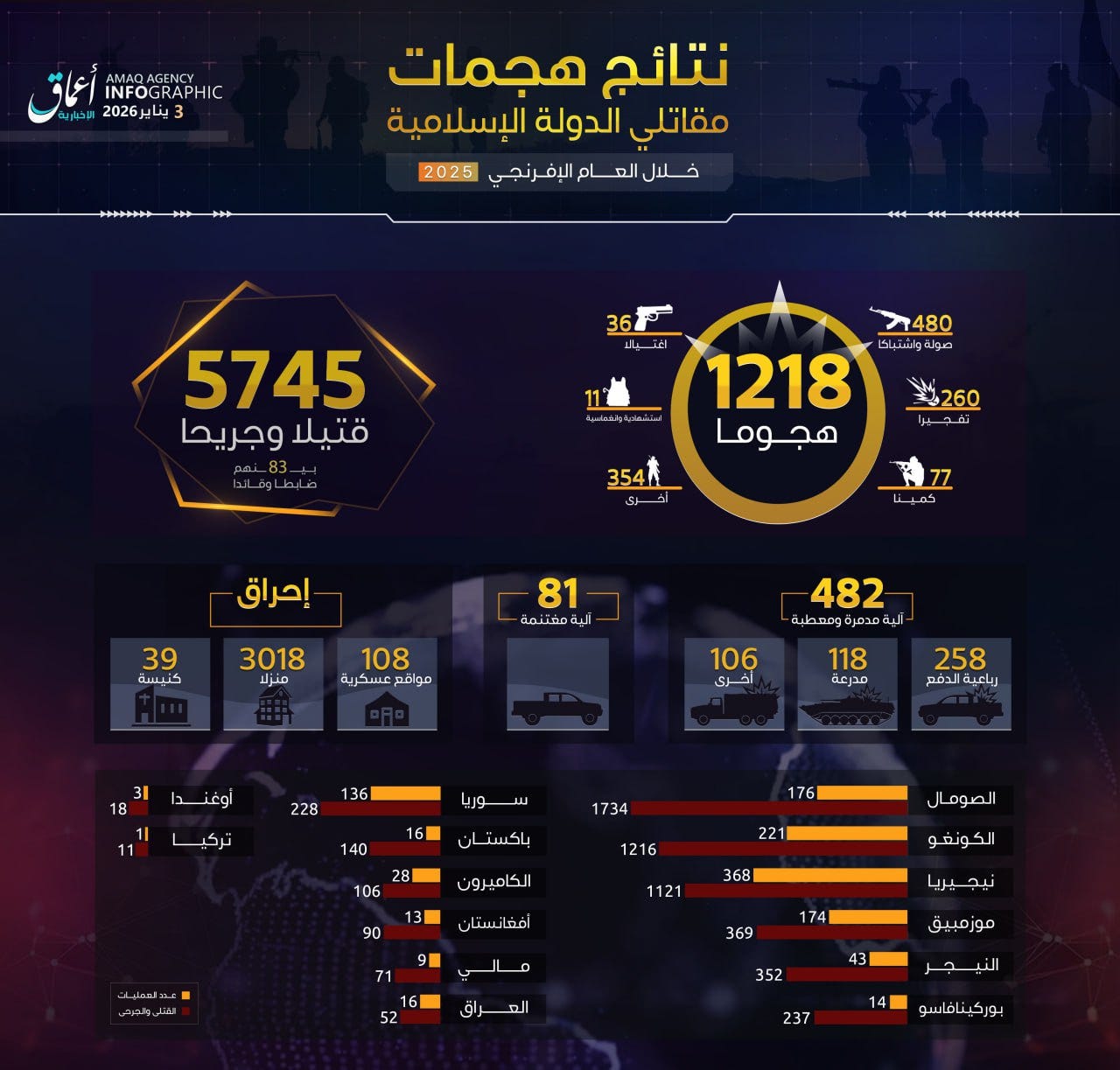
Overall activity
1218 attacks
5,745 dead and injured
of which 83 officers, commanders and command figures.
This is a classic distinction of IS propaganda: it serves to demonstrate “quality” in addition to quantity.
Type of attacks
Distribution of the 1218 attacks:
480 – Assault and clash
260 – Explosions / explosive devices
77 – Ambush
36 – Targeted Assassinations
11 – Suicide and Infiltration
354 – Other (elastic container: night raids, hit-and-run attacks).
Destruction and sabotage
Burning:
3018 House
108 military site
39 churches
The data on churches is symbolic propaganda: it serves to reinforce the anti-Christian and anti-“crusade” narrative.
Vehicles affected
81 civilian vehicles
482 military vehicles destroyed or damaged:
258 4x4 vehicles
118 armored vehicles
106 other military vehicles.
Geographical distribution of attacks
(IS distinguishes the number of operations in yellow and deaths/injuries in red)
Africa (operational epicentre):
Somalia: 176
Nigeria: 368
Mozambique: 174
Niger: 43
Burkina Faso: 14
Democratic Republic of Congo: 221
Cameroon: 22
Mali: 9
Uganda: 3
Africa is clearly the global centre of gravity of the Islamic State in 2025.
Middle East and Asia:
Syria: 136
Iraq: 16
Afghanistan: 13
Pakistan: 16
Affected areas not official provinces:
Türkiye: 1
Strategic analysis: continuity without escalation
The overall analysis of the Islamic State’s activity in 2025 in no way supports the hypothesis of a strategic rebirth of the organisation, but rather highlights a dynamic of business continuity characterised by high resilience, low tactical sophistication, and a marked ability to adapt to local contexts. The high number of claimed attacks, when read in relation to the absence of territorial advances, governance structures, or sustained population control, confirms that IS no longer operates as a proto-state actor, but rather as a widespread network of low-intensity regional insurgencies. This configuration is the direct product of a now structural decentralisation process, in which the wilayats, particularly those in Africa, enjoy broad operational and decision-making autonomy, while the so-called “core” of the Islamic State performs a predominantly logistical, ideological and methodological function, lacking effective managerial control over operations on the ground. Within this framework, the “Caliphate” survives not as a political-territorial entity, but as an ideological brand and as a set of operational practices that can be replicated in contexts of state fragility.
The targeting pattern observed in 2025 further strengthens this reading. Civilians continue to account for the prevailing share of casualties, while local security forces constitute the primary target of operations, in line with a strategy of attrition aimed at weakening the coercive capacity of the State rather than achieving decisive military results. Attacks against symbolic targets, including religious structures and prominent figures, serve primarily a propaganda and communication function, rather than a coherent strategic design. Overall, the organisation does not pursue military victory or the reconstitution of a state entity, but aims to produce ungovernability, progressively erode state institutions, and delegitimise local authorities, exploiting unresolved conflicts, power vacuums, and structural weaknesses in governance.
The analytical implications of this framework are relevant. The threat posed by the Islamic State in 2025 must be considered chronic rather than existential: the main risk is not the return of the Caliphate, but the normalisation of jihadist violence as a structural component of numerous theatres of crisis, particularly in Africa. In the absence of targeted interventions on strengthening governance, local security, and the institutional resilience of fragile states, counterterrorism strategies focused exclusively on decapitating leadership appear insufficient and unable to impact the conditions that allow IS to survive and adapt in the long term.
Policy Implications
Empirical evidence regarding Islamic State activity in 2025 indicates the need for a realignment of policies to counter jihadist terrorism. Approaches designed to address a proto-state or hierarchically centralised organisation are increasingly inadequate in the face of a fragmented, adaptive actor rooted in contexts of chronic fragility. In particular, strategies based predominantly on leadership decapitation, while maintaining tactical value in the short term, show structural limitations in the medium- to long-term, as they do not impact the local dynamics that allow wilayats to regenerate and operate with high autonomy.
In this context, security policies should, as a matter of priority, focus on strengthening local State capacities, particularly in the areas of territorial security, civil administration and justice, reducing the power vacuums that constitute the main multiplier of jihadist resilience. In African theatres, where the Islamic State has consolidated its operational centre of gravity, the absence of effective governance and the weakness of local security forces are more determining factors than the military capacity of the organisation itself. Exclusively military interventions, unaccompanied by structural stabilisation and institutional development measures, therefore risk temporarily containing violence without changing its root causes.
Finally, the analysis suggests the need to move beyond a reading of the IS threat in emergency or existential terms. The challenge posed by the Islamic State in 2025 is not that of a sudden return of the Caliphate, but that of persistent, low-intensity, and geographically widespread violence, capable of progressively wearing down fragile states and complicating any long-term stabilisation process. Countering policies should therefore integrate instruments of security, governance and social resilience, accepting that containment, rather than rapid eradication, is the realistic goal in the short to medium term.
Conclusions
In 2025, the Islamic State does not conquer territories or govern populations, but survives by exploiting power vacuums, unresolved conflicts, and institutional weakness. Its capacity for persistence stems not from renewed strategic strength or advanced military sophistication, but from a combination of operational resilience, local adaptation and geographical fragmentation. The organisation has definitively abandoned the proto-state dimension to transform itself into a constellation of regional insurgencies, capable of inflicting continuous violence without assuming the burden of territorial control or governance.
From this perspective, interpreting the activity of the Islamic State as the prelude to a new expansion of the Caliphate constitutes an analytical error that risks distorting political and security responses. The most concrete threat is not the return of a jihadist state entity, but the progressive normalisation of violence as a tool for chronic destabilisation in already fragile contexts. As long as such contexts continue to offer room for manoeuvre, the Islamic State will not need to win to survive: it will simply need to continue to exist.
🔒 Executive Intelligence Cycle
This assessment is part of a broader analytical cycle.
Founding subscribers receive the Executive Intelligence Briefing, which integrates all threat assessments, cognitive domain analysis, and a rolling 30–90 day forecast into a single monthly strategic synthesis.
© Daniele Garofalo Monitoring - All rights reserved.
Daniele Garofalo is an independent researcher and analyst specialising in jihadist terrorism, Islamist insurgencies, and armed non-state actors.
His work focuses on continuous intelligence monitoring, threat assessment, and analysis of propaganda and cognitive/information dynamics, with an emphasis on decision-oriented outputs, early warning, and strategic trend evaluation.
Daniele Garofalo Monitoring is registered with the Italian National ISSN Centre and the International Centre for the Registration of Serial Publications (CIEPS) in Paris.ISSN (International Standard Serial Number): 3103-3520ORCID Code: 0009-0006-5289-2874Support my research, analysis and monitoring with a donation here, PayPal.Me/DanieleGarofalo88