


Executive Assessment
The expansion of Jama’at Nusrat al-Islam wal-Muslimin (JNIM) represents one of the most significant transformations in the West African jihadist landscape, not merely due to the geographical reach the organisation has attained, but above all because of its growing capacity to exert various forms of military, economic, and territorial pressure across vastly different operational environments. Its spread from Mali into Burkina Faso, Niger, and the northern regions of coastal states is frequently interpreted through the lens of rising attack numbers and the widening of violence-affected areas. While important, these indicators do not fully explain the nature of the ongoing shift.
An insurgent organisation can intensify its operations without significantly expanding its area of activity; conversely, it can penetrate new regions through a relatively limited number of attacks by exploiting mobility corridors, facilitation networks, and local vulnerabilities. Similarly, targeting new types of assets does not necessarily imply a transformation in military capabilities, whereas employing established offensive tactics can yield different strategic consequences when directed at economic infrastructure, logistical links, or communities involved in counter-insurgency efforts.
An analysis of an original dataset comprising 170 violent incidents attributed to JNIM between January 2019 and September 2026 highlights precisely this divergence. While the geographical distribution of violence has expanded, the composition of targets has shifted considerably, and certain operations have taken on a more pronounced economic and coercive function, the organization’s core tactical repertoire has remained relatively stable. Direct attacks, complex operations, improvised explosive devices (IEDs), and ambushes continue to be central tools of the organisation’s activity, even as immediate objectives and intended outcomes evolve. The primary result, therefore, is not the emergence of a JNIM that is radically different in military terms, but rather its ability to employ an established set of tools across a broader and more complex geographical area. This evolution can be interpreted as a form of “adaptive diffusion,” in which operational capabilities remain consistent. At the same time, variations occur in target selection, the methods of applying violence, and the functions assigned to operations. The progressive regionalisation of the threat is evident but remains highly uneven: Mali and Burkina Faso still constitute the core, whereas Niger, Benin, Togo, and Côte d’Ivoire exhibit varying levels of penetration, recurrence, and persistence.
Methodological Note
The analysis is based on an original corpus of 170 unique events attributed to JNIM between January 2019 and September 2026, selected according to criteria regarding attribution and evidence quality, and cross-referenced with institutional documentation and independent sources. The corpus does not constitute a probability sample of the organisation’s entire activity; the data therefore describe the characteristics of the included events rather than the total frequency of attacks. Source coverage varies over time and across locations, and the data for 2026 cover only the first nine months.
📌 Inside this Assessment
The Changing Geography of JNIM Violence
Changing Targets, Persistent Tactics
Beyond the Battlefield: Economic Coercion and Territorial Pressure
From Spatial Replication to Adaptive Diffusion
Strategic Implications and Early Warning Indicators
Strategic Outlook
Strategic Conclusion
Sources and References
Related Intelligence & Analysis:


The Changing Geography of JNIM Violence
JNIM’s geographical evolution must be understood in light of a fundamental characteristic: its regional expansion has not entailed abandoning its original Sahelian core. Mali and Burkina Faso remain where the organisation concentrates much of its activity, maintains greater operational continuity, and exerts pressure across a wide range of terrains.
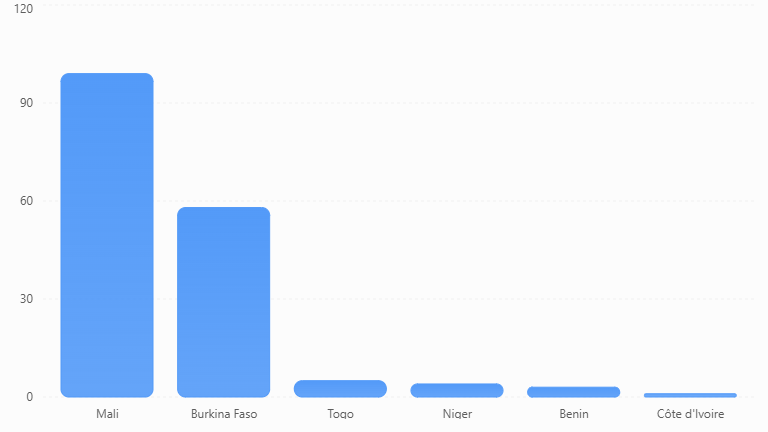
In the analysed dataset, 99 events occurred in Mali and 58 in Burkina Faso, totalling 157 incidents, or 92.4% of the observations. The remaining 13 events were distributed across Togo, Niger, Benin, and Côte d’Ivoire. This concentration does not imply that JNIM’s presence in peripheral states is strategically marginal; rather, it highlights that the group’s expansion has not resulted in a uniform redistribution of violence.
This transformation becomes clearer when the analysis is conducted at the subnational level. In 2019, the events analysed involved five distinct combinations of country and first-level administrative unit; by 2022, this figure had risen to nine, reaching ten in 2023 and 2024, and seventeen in 2025. In the first nine months of 2026, the dataset comprises thirteen units, a figure that must be interpreted in light of the period’s incompleteness and variations in documentation coverage.
The increase in geographical spread does not necessarily align with a rise in the number of observed incidents. For instance, the 2023 dataset contains fewer events than that of 2022, yet shows a slightly broader geographical distribution. This discrepancy highlights a recurring issue in assessing the jihadist threat: using the intensity of violence as a proxy for expansion can obscure territorial shifts that precede, accompany, or unfold independently of any increase in attacks.
The picture becomes even more complex when considering the differences between peripheral theatres. In Côte d’Ivoire, the dataset records a single isolated incident during the initial period, with no subsequent sequence comparable to that observed in the primary countries. Togo and Benin show recurring activity spread across different periods, while Niger appears at multiple stages of the timeframe, albeit with a limited number of recorded incidents. These subsets are too small to support independent statistical conclusions, yet they gain significance when compared against United Nations assessments and regional documentation regarding the organisation’s expansion.
In this context, eastern and southern Burkina Faso take on particular importance. The cross-border areas linked to the W-Arly-Pendjari complex allow for an examination of the relationship between territories with a significant jihadist presence and areas used for mobility, operational projection, and exerting pressure on Benin, Togo, and Niger. Assessments by the United Nations Monitoring Team have documented concentrations of fighters in southern Burkina Faso and the potential for these forces to launch operations into the Gulf of Guinea states, confirming that the regional spread cannot be described solely by the location of past attacks.
