


Executive Intelligence Summary
Africa remains the Islamic State’s primary global theatre of operations, surpassing the Middle East and Asia in attack volume and organisational strength, underscoring the critical need for vigilance among security and policy leaders to address this evolving threat.
Scope and Methodology
This Strategic Threat Outlook is based on:
systematic monitoring of Islamic State propaganda (videos, photos, statements, claims);
reporting from sources in the field;
While integrating OSINT, SOCMINT, IMINT, and Digital HUMINT enhances intelligence breadth, it is crucial to acknowledge their respective reliability, sources-including primary Islamic State media channels and local reports-and limitations to ensure accurate threat assessments.
Sources include primary Islamic State media channels, open-source reporting, official statements, and local sources across affected regions.
Limitations
Incomplete or delayed reporting from conflict zones;
Exaggeration or omission in group claims;
Propaganda bias and potential disinformation.
Where verification is not possible, this is explicitly noted.
📌 Inside this Assessment
Overview and Security Threat Assessment
Activity and Operations Analysis — August 2026
Number, Targets, and Areas of Attacks in August 2026
Charts and Statistics
Analytical and Intelligence Assessments
Implications for Decision Makers
Early Warning Indicators
Threat Forecast, 30 to 90 Days
Executive Intelligence Conclusion and Risk and Threat Overview
Provincial Snapshots
Islamic State West Africa Province (ISWAP)
Islamic State Sahel Province
Islamic State Central Africa Province (ISCAP)
Islamic State Somalia Province
Islamic State Mozambique Province (ISM)
Related Intelligence & Analysis:


Overview – Islamic State in Africa
The Islamic State’s presence in Africa is resilient and adaptive, demonstrating high operational continuity despite counterterrorism efforts, reinforcing the importance of sustained strategic focus for security officials to counter this persistent threat.
In Africa, IS affiliates demonstrate high operational continuity, executing attacks with diverse tactics like assaults, ambushes, kidnappings, and terror campaigns, especially against Christian communities, in recent months.
The epicentre of this dynamic remains sub-Saharan and central-eastern Africa, with particularly worrying developments in the Democratic Republic of Congo and Mozambique, where IS affiliates have demonstrated not only a capacity for sustained violence, but also a growing level of coordination, intermittent territorial control, and integration with local criminal economies. In such contexts, violence is not episodic but part of a strategy of progressive erosion of state authority, exploiting structural fragility, socio-economic marginalisation, inter-community conflicts, and governance vacuums.
On March 20, 2025, the Islamic State officially announced the launch of a new military campaign, called “Burning Camps,” with a stated focus primarily on Africa. This campaign’s implications include heightened regional instability, increased displacement, and the need for enhanced security cooperation among affected nations to counteract these threats.
The strategy remains consistent with the Islamic State’s operating model: creating chronic instability, delegitimising the state, presenting itself as an alternative (or inevitable) actor, and exploiting chaos to facilitate recruitment, logistical support, and territorial entrenchment. In this sense, IS does not aim exclusively at permanent territorial conquest but at fluid, opportunistic control sufficient to maintain freedom of manoeuvre and offensive capability.
Currently, the Islamic State is actively and continuously operating in at least eight African countries, with monthly variations in geographical distribution and intensity of activities. During the period under review, the organisation focused its efforts on fewer theatres without reducing overall capacity, indicating a decentralised yet functional structure.
A central and often underestimated element is the propaganda dimension. Every significant attack has been followed by intense media activity. In the month analysed, the Islamic State disseminated a significant volume of content, photographs, videos, and press releases through its central channels, in particular the Amaq news agency and the weekly al-Naba. Propaganda is not limited to claims of responsibility but constructs a narrative of success, resilience, and inevitability, aimed at both local supporters and a global jihadist audience.
In summary, the African picture shows an Islamic State that is not in decline but in a phase of adaptive consolidation, capable of absorbing losses, reorienting priorities, and exploiting the structural weaknesses of local contexts. For intelligence, security, and political and military decision-makers, Africa is not a secondary front but the current centre of gravity of the threat posed by the Islamic State, emphasising the need for sustained vigilance.
Islamic State in Africa - Activities — August 2026
During August 2026, Islamic State activity across Africa remained concentrated in its established operational theatres, but the month also highlighted continued adaptation under sustained counterterrorism pressure. The principal centres of activity remained northeastern Nigeria, eastern Democratic Republic of the Congo, northern Mozambique, the central Sahel and Puntland, each displaying distinct local dynamics but a common pattern of organisational persistence, mobility and exploitation of uneven state control.
In Nigeria, Islamic State West Africa Province continued to operate across Borno and Yobe despite an intensified Nigerian military campaign combining ground operations, arrests of facilitators and precision airstrikes. ISWAP retained the ability to mass fighters for assaults against forward military positions, including an attempted attack on the Gajiram base in Nganzai, while simultaneously maintaining logistical and support networks around Monguno, Geidam, Damasak and the Sambisa axis. Nigerian operations during the month disrupted several support cells. They reportedly removed mid-level personnel, but the group continued to demonstrate a resilient insurgent infrastructure capable of regenerating local attack capacity and sustaining pressure on military deployments.
In eastern Democratic Republic of the Congo, the Allied Democratic Forces continued to exploit the security fragmentation generated by simultaneous armed conflicts and stretched government forces. The operational footprint remained anchored in North Kivu and Ituri, but the progressive movement toward Haut Uele and the western approaches toward Tshopo became increasingly significant. Militant units continued to rely on mobile formations, killings of civilians, abductions, looting and attacks around economic corridors, while retaining the ability to regenerate after pressure from Congolese and Ugandan forces. The growing northern and western displacement of ADF cells has widened the geographic area requiring security coverage and has increased the exposure of previously less affected communities and resource zones.
Northern Mozambique presented one of the clearest examples of operational adaptation during the month. Sustained pressure by Mozambican and Rwandan forces around the Catupa forest and Macomia axis displaced Islamic State Mozambique elements southward and westward rather than eliminating them. Fighters moved through Quissanga, Meluco, Ancuabe and Chiúre, while other elements pushed toward Montepuez and the approaches to Niassa. This movement exposed highways, mining sites and rural communities to kidnapping, extortion and predatory activity. Military pursuit into areas close to the Niassa Special Reserve inflicted significant losses on insurgent elements. Still, the wider pattern confirmed the group’s capacity to trade territorial concentration for mobility and dispersion when confronted by superior forces.
The Sahelian theatre remained characterised by persistent Islamic State presence within an increasingly contested jihadist environment. Western Niger continued to represent the principal area of Islamic State Sahel Province activity, while competition with JNIM shaped access to communities, routes and local influence. The wider security environment remained fragile, with pressure on Nigerien forces compounded by internal military instability and the continuing requirement to defend dispersed positions against both Islamic State and al Qaeda affiliated formations. The theatre therefore remained defined less by uninterrupted territorial control than by competition over mobility corridors, rural influence and the capacity to exploit weakly governed borderlands.
In Puntland, Islamic State Somalia remained under sustained pressure from local security forces and associated counterterrorism operations. Its kinetic footprint remained substantially smaller than those of the major African branches. Still, surviving networks in the Bari region preserved relevance through difficult terrain, dispersed cells, and broader financial and facilitation functions. The security environment along the Puntland coastline also remained increasingly complex because of parallel maritime insecurity, creating additional demands on local surveillance and security resources.
Across the continent, August therefore reflected continuity rather than transformation. Islamic State branches remained capable of absorbing military pressure, dispersing geographically, preserving local support structures and exploiting security gaps without requiring uniform tactical behaviour across theatres. The African network continued to function through multiple locally adapted insurgencies, with operational persistence sustained by mobility, fragmented governance, weak rural security coverage and the capacity to shift activity between established and peripheral operating areas.
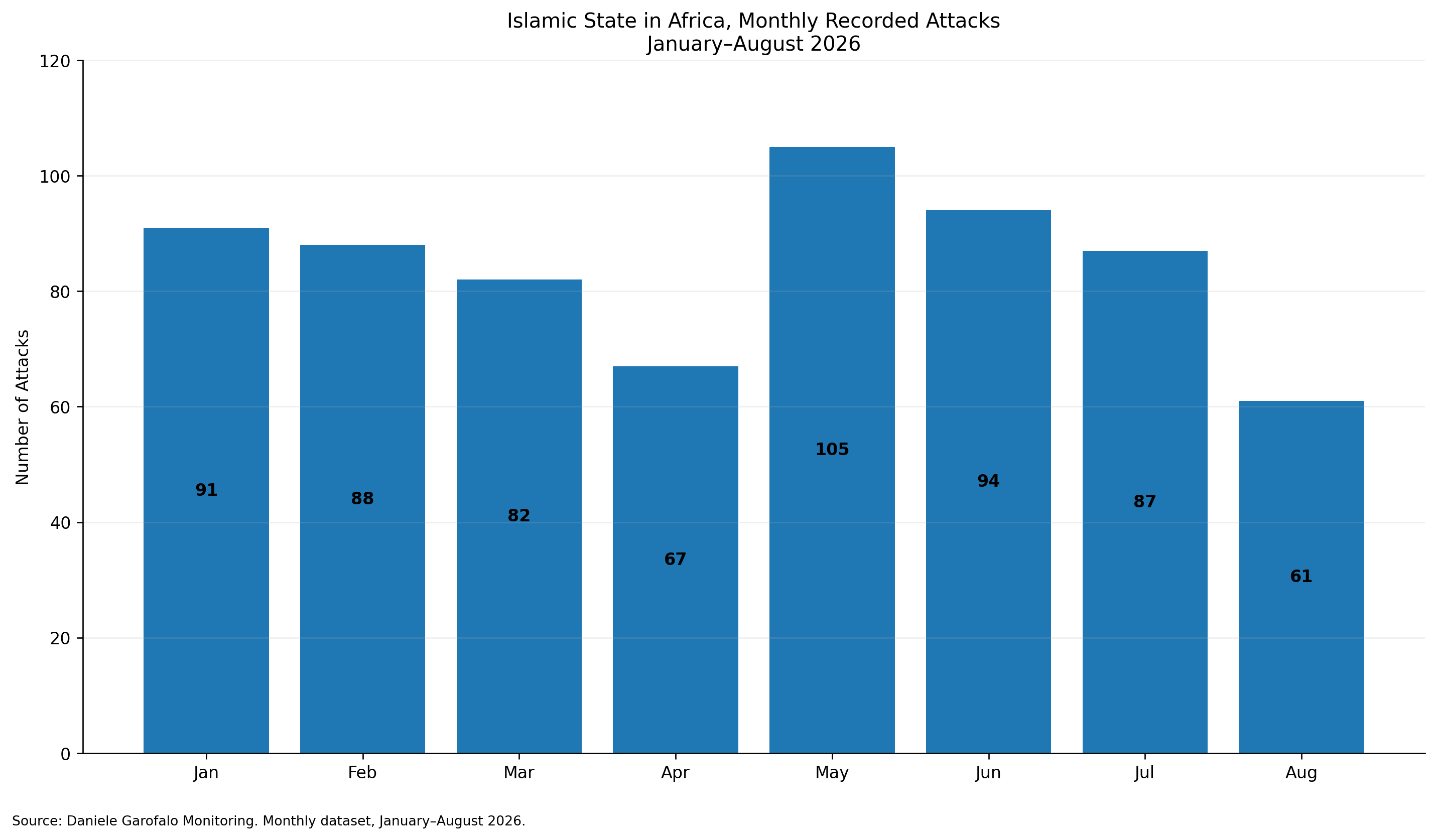
Number of attacks in August 2026: 61
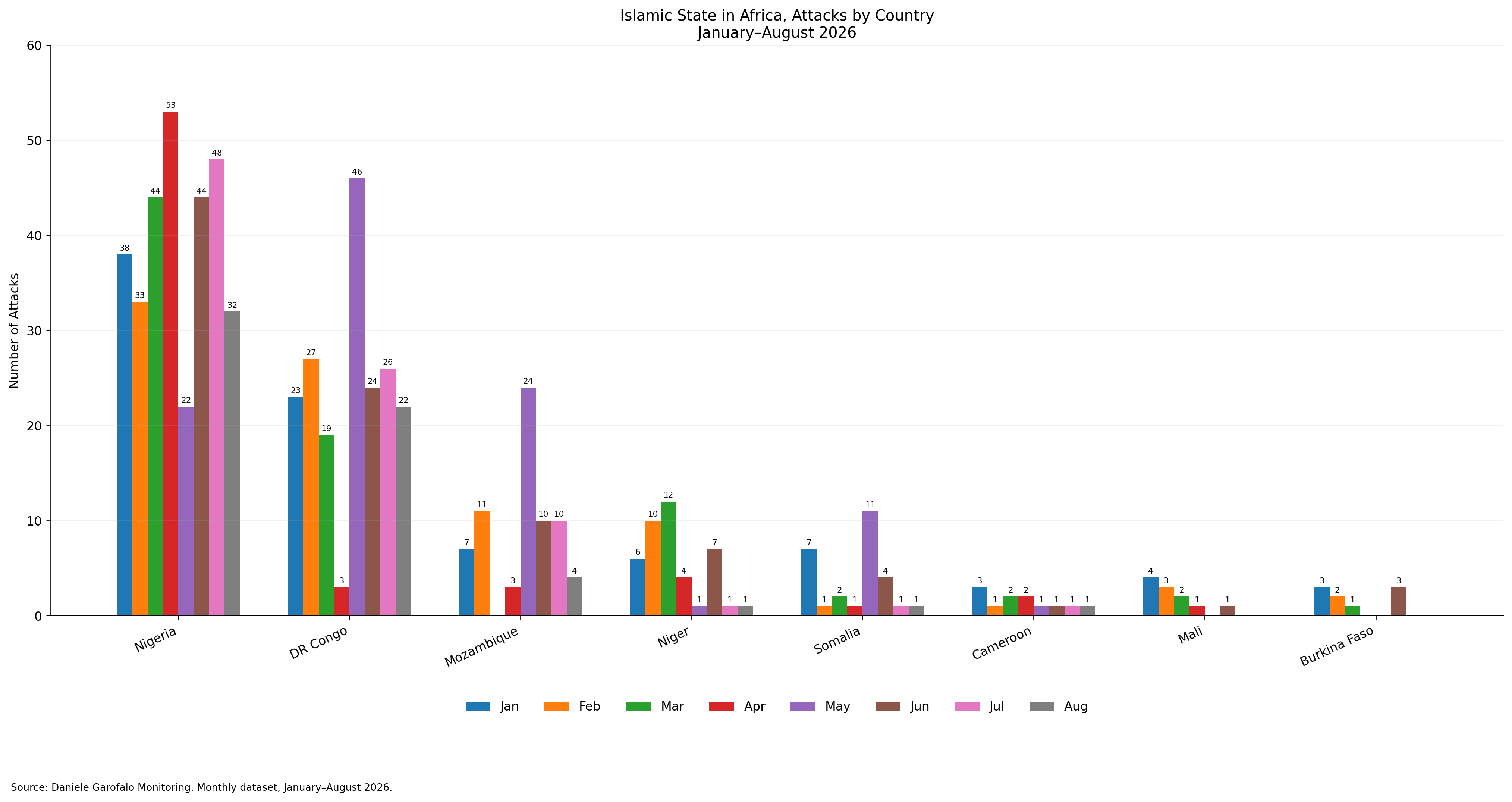
Number of Attacks by Country, August 2026:
DR CONGO: 22
NIGERIA: 32
NIGER: 1
CAMEROON: 1
SOMALIA: 1
MOZAMBIQUE: 4
Targets:
IS’s military targets this month have been many, and they are as follows:
Nigerian Army, Nigerian Pro-Government Militias, Niger Army, Congolese Army, Congolese Pro-Government Militias, Mozambican Army, Mozambican Pro-Government Militias, Cameroonian Army, Puntland Security Forces, Chinese agricultural Companies (in Mozambique), Christian Civilians.
Area:
The Islamic State hit the following countries this month:
DR CONGO: Ituri province, Haute Uele province, North Kivu province;
NIGERIA: Borno State, èYobe State;
NIGER: Diffa region;
CAMEROON: Maroua area, Far North Region;
SOMALIA: Bari administrative region, Puntland State.
MOZAMBIQUE: Quissanga district, Palma district, Montepuez district, Macomia district, Cabo Delgado province.
Analytical and Intelligence Assessment
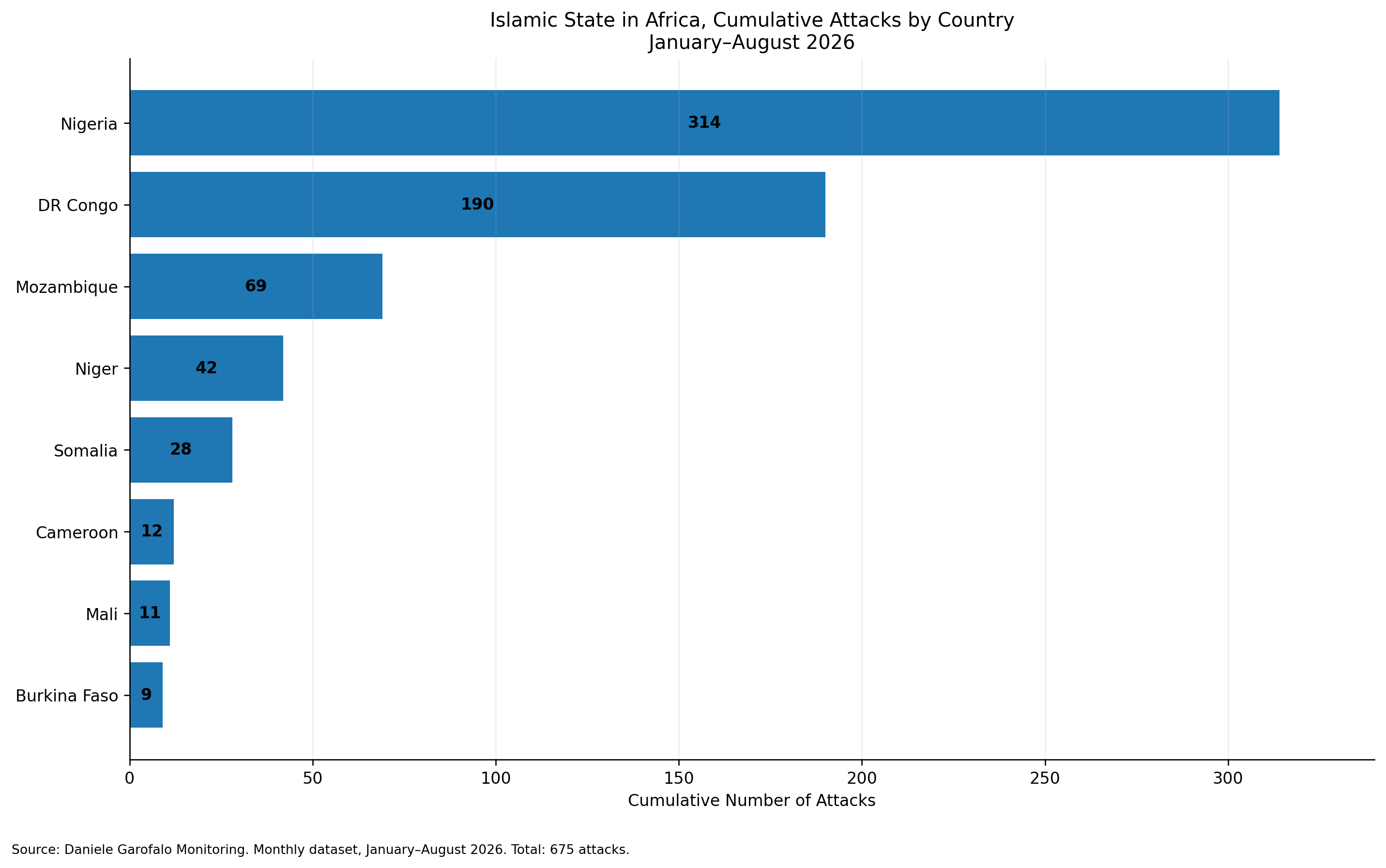
August 2026 marks a clear contraction in Islamic State attack volume in Africa, with 61 recorded attacks, down from 87 in July and from the higher tempo observed during May and June. The decline is operationally relevant, but it does not indicate a corresponding reduction in structural threat. Activity remained distributed across six countries, with Nigeria and the Democratic Republic of the Congo again accounting for the overwhelming majority of incidents. The current picture is therefore better assessed as a phase of reduced kinetic output within a still resilient multi theatre system, rather than as broad organisational degradation.
Nigeria remained the principal operational centre, with 32 attacks concentrated in Borno and Yobe. ISWAP continued to focus on military and auxiliary security structures, indicating sustained intent to erode the state’s rural security architecture rather than pursue symbolic targets. The persistence of activity despite intensified counterterrorism pressure suggests the branch retains sufficient manpower, local intelligence, logistical access, and freedom of movement to maintain meaningful operational continuity. The reduction from July is more consistent with temporary fluctuation, tactical caution or force preservation than with loss of core capability.
The Democratic Republic of the Congo recorded 22 attacks across Ituri, North Kivu and Haute Uele. The continued three province footprint remains one of the most significant features of the African Islamic State threat. The group is no longer confined to a narrow operational corridor and continues to exploit the effects of military pressure by dispersing mobile cells across a widening battlespace. Attacks against Congolese forces, pro-government militias and Christian civilians reinforce a combined model of attritional warfare and coercive population control, with civilian victimisation serving to generate displacement, deter cooperation with security forces and preserve local freedom of action.
Mozambique recorded only four attacks, but the geographic distribution across Quissanga, Palma, Montepuez and Macomia is analytically more important than the monthly total. The inclusion of a Chinese agricultural company among the targets indicates a continued willingness to strike economic interests and foreign-linked civilian infrastructure when tactically accessible. This expands the risk picture beyond direct military confrontation and reinforces the relevance of commercial exposure in Cabo Delgado.
Niger, Cameroon, and Puntland remained low-volume theatres. Their limited activity should not be interpreted as strategic irrelevance. In each case, Islamic State retains residual access, networks and local operational knowledge that can support renewed activity if the security environment becomes more permissive.
Implications for Decision Makers
The principal implication is that the August decline in attacks should not trigger a reduction in intelligence or counterterrorism priority. Islamic State in Africa continues to demonstrate geographic redundancy, with the capacity to preserve multiple nodes even when aggregate activity falls. A lower monthly total may reduce immediate tactical pressure, but it can also give militant networks time to replenish manpower, reorganise logistics, and prepare more complex operations.
Nigeria should remain the primary focus for operational intelligence. The persistence of attacks against the Nigerian Army and pro government militias confirms that ISWAP continues to target the security mechanisms underpinning state presence in rural areas. Collection priorities should remain concentrated on mobility corridors, local taxation networks, resupply chains, staging areas and evidence of concentration around forward military positions.
In the DRC, decision makers should prioritise early detection of further geographic diffusion. The continued presence in Haute Uele is particularly significant because it indicates that counterterrorism pressure can displace rather than dismantle militant structures. Intelligence coordination between Congolese and Ugandan forces should therefore focus not only on known camps and commanders, but also on movement corridors, facilitators and emerging rear areas.
In Mozambique, the targeting of commercial interests requires closer integration between counterterrorism intelligence and economic security. Foreign companies, logistics routes and development assets in Cabo Delgado should be treated as part of the operational risk environment, particularly where militant movement intersects with poorly protected rural infrastructure.
Early Warning Indicators
The most important indicator would be a renewed rise in Nigerian attacks accompanied by larger assault formations, coordinated raids or increased pressure on forward operating bases. Such a development would indicate that the current reduction reflects regrouping rather than degradation.
In the DRC, sustained activity beyond Ituri, North Kivu, and Haute Uele would signal a significant warning of further geographic expansion. Increased attacks on road networks, mining areas or isolated Christian communities would also suggest an effort to consolidate coercive influence over peripheral zones.
In Mozambique, repeated attacks against foreign commercial assets, movement toward Palma-related infrastructure, or a renewed concentration of incidents around Macomia would indicate growing confidence and an attempt to broaden the cost imposed on the state and external partners.
In Niger, Cameroon and Puntland, even a modest but sustained increase over several consecutive weeks should be treated as an early signal of network regeneration, particularly if accompanied by more sophisticated explosive attacks, ambushes or attacks beyond established operating areas.
Forecast, 30 to 90 Days
The most likely scenario is a partial rebound in Islamic State activity after the August decline, particularly in Nigeria and the Democratic Republic of the Congo. Nigeria is likely to remain the main kinetic centre, with continued attacks against military positions, militias and rural security infrastructure across Borno and Yobe.
The DRC is expected to maintain a high level of operational persistence, with attacks distributed across Ituri and North Kivu and continued risk of activity in Haute Uele. Civilian communities are likely to remain highly exposed, particularly where militant units are displaced by military operations and seek concealment, supplies or retaliation.
Mozambique is likely to remain volatile but uneven. A return to very high attack volume is not the most probable scenario, but continued low intensity operations across multiple districts remain likely. The risk to foreign commercial and development interests should be considered elevated where security coverage is limited.
Secondary theatres are likely to remain comparatively quiet, although the possibility of episodic escalation in Niger, Cameroon or Puntland remains credible. A simultaneous rebound across two or more theatres would significantly alter the threat picture and indicate renewed operational momentum across the wider African network.
Executive Intelligence Conclusion
August 2026 represents a quantitative decline, but not a strategic break, in Islamic State activity across Africa. The 61 recorded attacks confirm a lower operational tempo, yet the group preserved activity across six countries and retained its principal centres of gravity in Nigeria and the Democratic Republic of the Congo.
The central intelligence judgment is that the African Islamic State system remains resilient because its strength derives less from constant attack volume than from geographic dispersion, local adaptation and the ability to preserve operational infrastructure under pressure. Nigeria continues to provide the largest kinetic base, the DRC remains the most important environment for diffusion and civilian coercion. At the same time, Mozambique retains the capacity to threaten both security forces and economic interests.
For senior decision makers, the principal risk is misreading the August decline as evidence of strategic retreat. The more prudent assessment is that Islamic State remains in a phase of sustained pressure and adaptation, with a credible capacity to regenerate attack tempo over the next quarter. The overall threat level should therefore remain assessed as High, with a short term trend of reduced activity but persistent escalation potential.
Previous Strategic Threat Outlook:
Islamic State in Africa : Continental Operational Trends, Risk Assessment, and Forecast — July 2026. Strategic Threat Outlook

🔒Executive Intelligence Cycle
This assessment is part of a broader analytical cycle.
Founding subscribers receive the Executive Intelligence Briefing, which integrates all threat assessments, cognitive domain analysis, and a rolling 30–90-day forecast into a single monthly strategic synthesis.
© Daniele Garofalo Monitoring - All rights reserved.
ISSN (International Standard Serial Number): 3103-3520
NATO NCAGE: AX664 (NATO Commercial and Governmental Entity)
UNITED NATIONS Global Marketplace ID: 1210727
ORCID Code: 0009-0006-5289-2874
Daniele Garofalo is an independent researcher and analyst specialising in Intelligence, Jihadist Terrorism, Islamist insurgencies, Non-State Armed Groups (NSAG), Cognitive Warfare, and Hybrid Warfare.
His work focuses on continuous intelligence monitoring, threat assessment, and analysis of propaganda and cognitive/information dynamics, with an emphasis on decision-oriented outputs, early warning, and strategic trend evaluation.