


Current assessments of cyber jihadist activity remain disproportionately focused on technical capabilities, overlooking the primary function of these operations within a broader cognitive ecosystem. Available evidence indicates that jihadist actors operate with limited, fragmented, and largely opportunistic cyber means. However, their strategic effectiveness derives not from technical sophistication, but from their ability to generate perception, amplify presence, and influence target audiences through coordinated use of low-level cyber actions and media output. Observed patterns across primary jihadist sources indicate a consistent prioritisation of psychological signalling over disruptive capability. Cyber activities are embedded within wider propaganda and mobilisation architectures, where even unverified or technically negligible actions are leveraged to produce strategic effects. This dynamic creates a persistent misalignment in threat perception, with a tendency to overestimate technical risk while underestimating cognitive intent. This assessment builds on direct monitoring of jihadist media ecosystems and prior cognitive domain analyses.
What’s changing
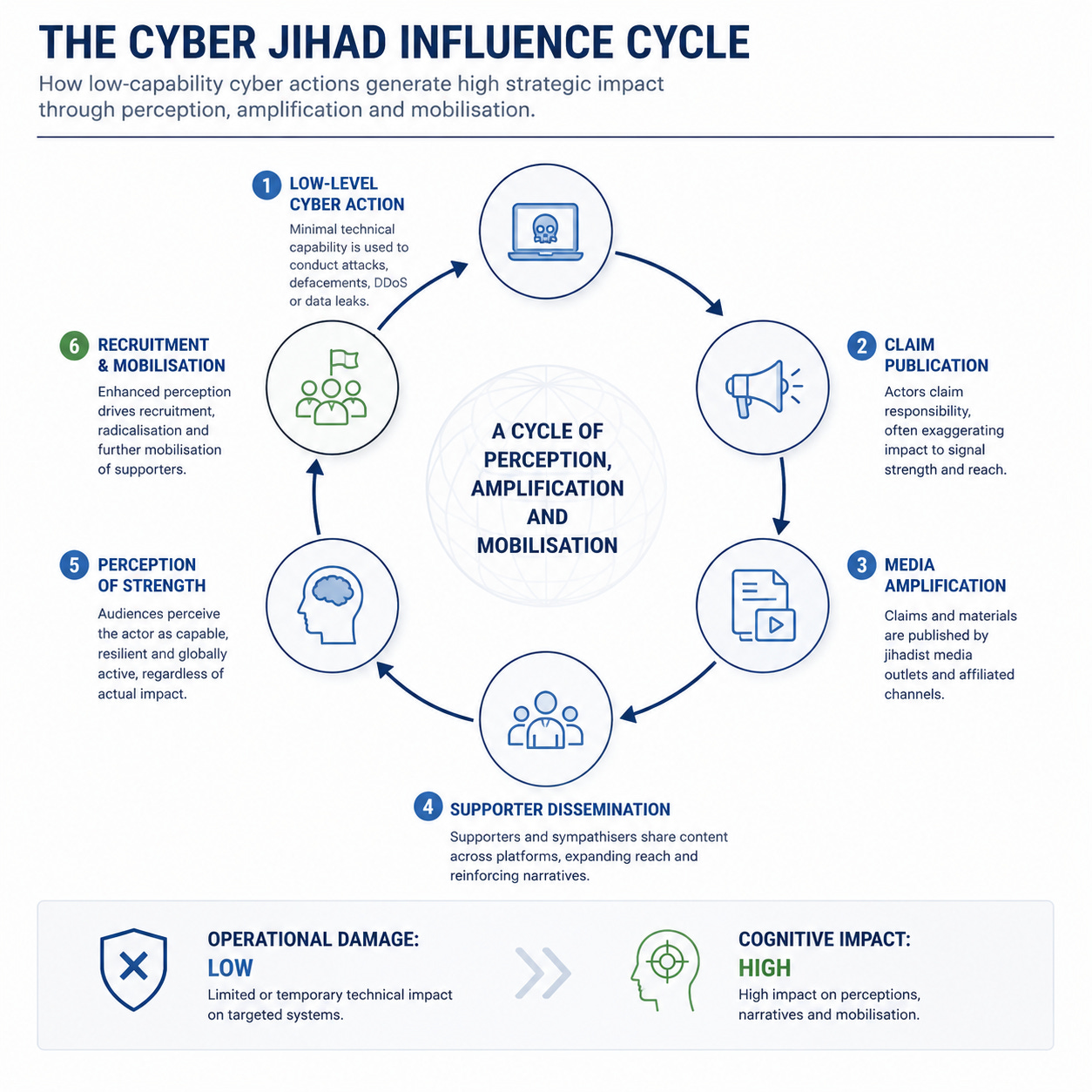
The role of cyber within the jihadist ecosystem is shifting. Advanced capabilities are no longer necessary to generate strategic impact. Low-complexity attacks, defacements, and claim-based campaigns are used to construct perceptions of strength, resilience, and global reach and are rapidly amplified through coordinated media output. An example emerges from a recent al-Qaeda Inspire production, which frames the cyber domain as accessible, decentralised, and replicable. The emphasis is not on technical sophistication, but on enabling individual participation through low-cost tools, lowering the barrier to entry and encouraging autonomous mobilisation. A second case involves the “Jihad Cyber Movement” and pro-IS networks that have claimed cyberattacks against Western targets and provided guidance on their execution, supported by synchronised media dissemination. In these cases, the strategic value lies in perception rather than measurable damage.
Artificial Intelligence and the Future of Cyber Jihad
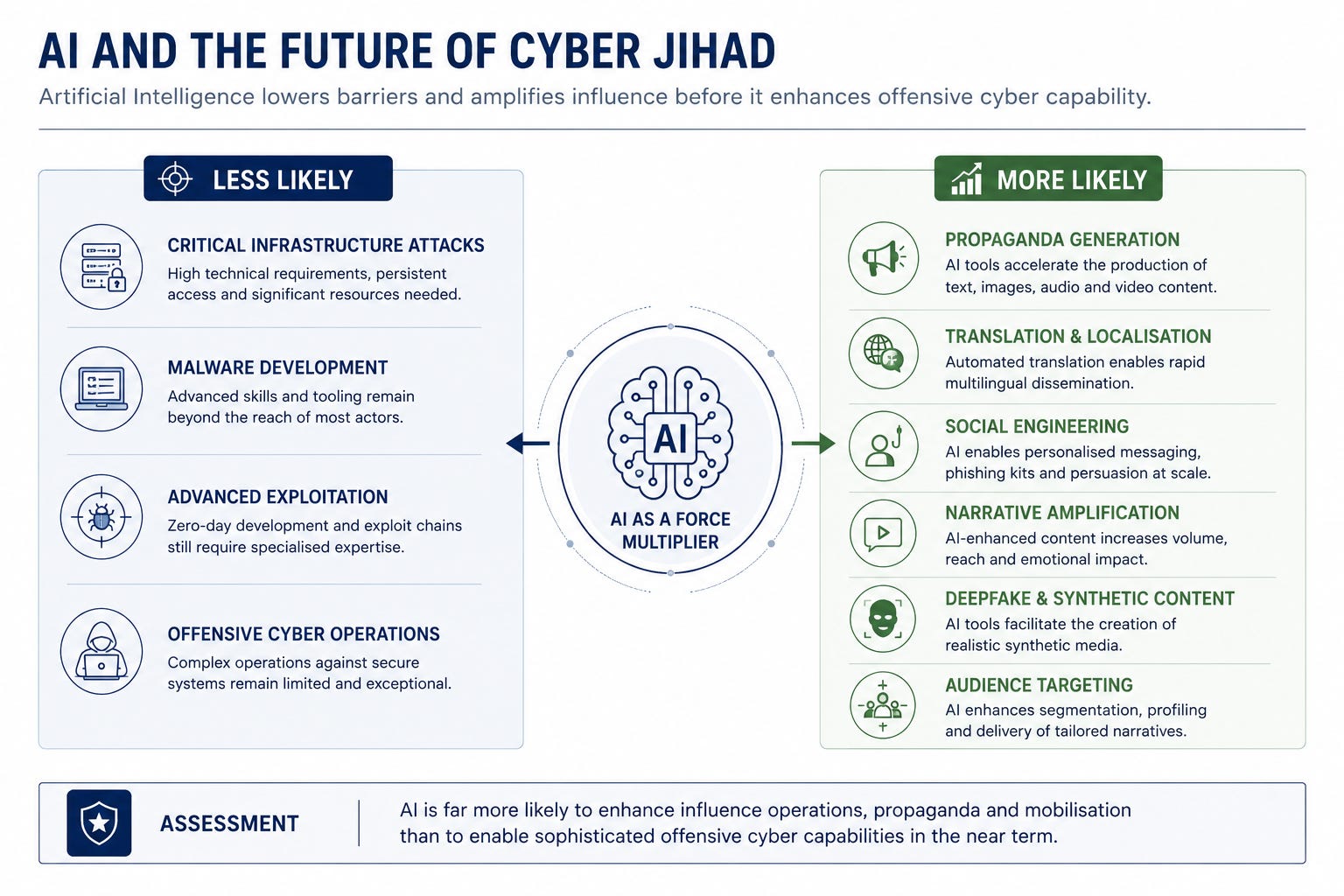
Artificial intelligence is likely to become a significant force multiplier within jihadist cyber ecosystems, not by enabling sophisticated offensive cyber operations, but by lowering the barriers to participation, content production, and audience targeting. The most plausible short-term development is the integration of commercially available AI tools into propaganda, recruitment, and influence activities. Generative AI can accelerate multilingual content production, improve narrative adaptation for local audiences, automate the generation of visual propaganda, and enhance social engineering campaigns through increasingly personalised messaging. These developments may allow low-capability actors to generate disproportionate cognitive effects without acquiring advanced technical expertise. While there is currently limited evidence that jihadist organisations can employ AI for complex cyber operations against critical infrastructure, the growing accessibility of AI-enabled tools is likely to strengthen their ability to influence perceptions, amplify grievances, and sustain mobilisation efforts across digital environments.
Implications for NATO
NATO faces a dual risk. Overestimating technical capabilities may lead to inefficient resource allocation, while underestimating the cognitive dimension can obscure the actual objectives of jihadist actors. The core issue is not system penetration, but the ability to shape perceptions, polarise audiences, and activate individuals through narrative and signalling. This divergence between actual capability and perceived threat poses a concrete risk of strategic misallocation, in which resources are directed toward overstated technical risks. At the same time, the cognitive impact remains insufficiently addressed. These dynamics have direct implications for information resilience, strategic communication, and threat assessment frameworks.
Resilience and Partner-Oriented Implications
Cyber jihad directly affects societal resilience, particularly in fragile or high-exposure environments. Digital platforms are used to exploit vulnerabilities, amplify grievances, and construct alternative narratives to state legitimacy, increasing risks of radicalisation and institutional distrust.
For NATO and its partners, this requires strengthening cognitive resilience alongside technical capabilities, including support to strategic communication, digital literacy, and monitoring capacities. The decentralised nature of these activities also demands enhanced cooperation with partner states and digital platforms to identify and mitigate emerging campaigns.
Threat Matrix: Capability versus Strategic Effect
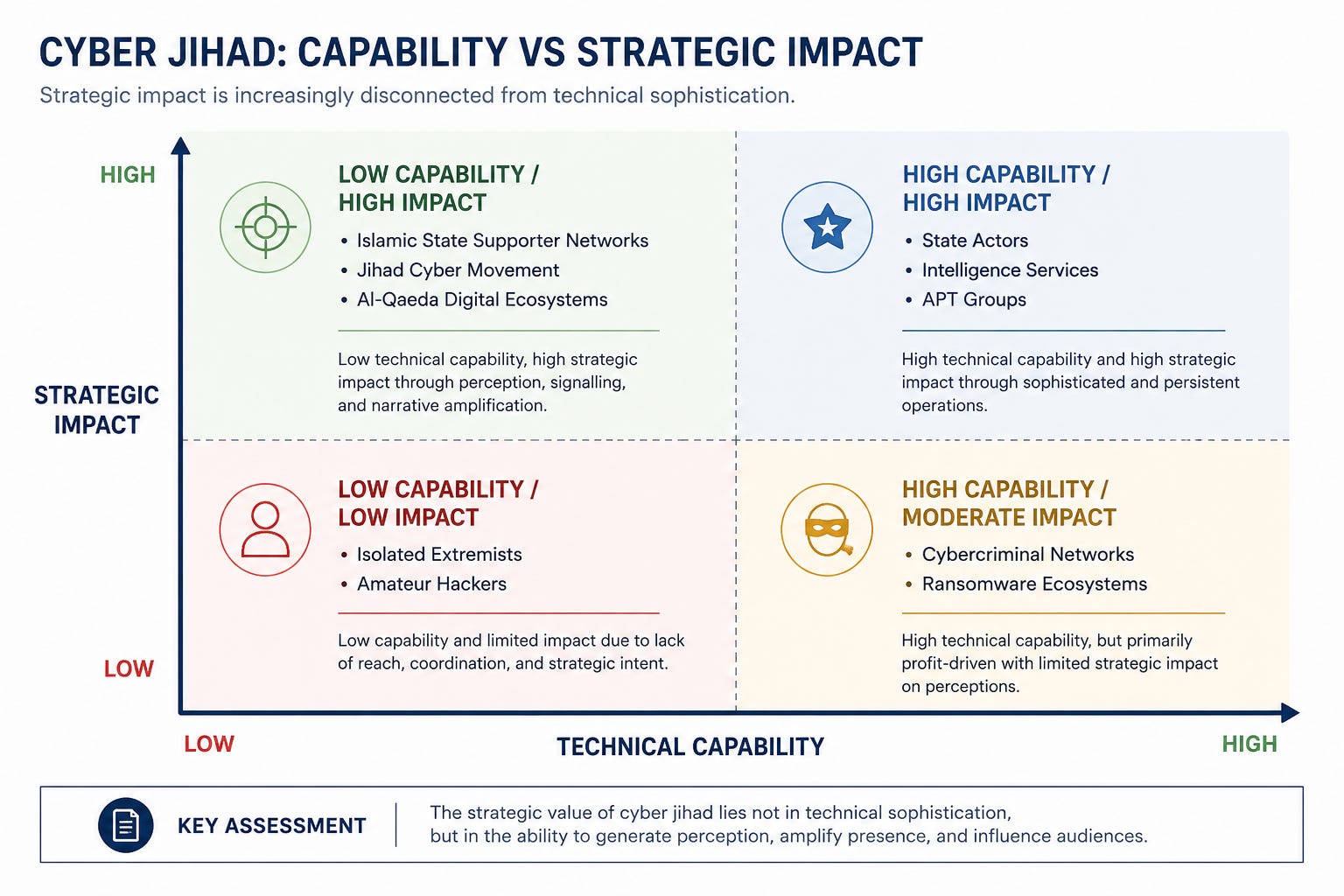
The contemporary cyber jihadist ecosystem occupies a distinct position within the broader threat landscape. Unlike state-sponsored actors or advanced cybercriminal networks, it does not derive its strategic relevance primarily from technical sophistication.
High Capability – High Strategic Effect
State-sponsored cyber actors.
Advanced persistent threat groups.
National intelligence services.
High Capability – Moderate Strategic Effect
Organised cybercriminal networks.
Financially motivated ransomware groups.
Low Capability – High Strategic Effect
Jihadist cyber ecosystems.
Ideologically motivated influence networks.
Decentralised online extremist communities.
Low Capability – Low Strategic Effect
Isolated online activists.
Opportunistic amateur hackers.
Uncoordinated extremist supporters.
This distribution highlights a central analytical challenge. Strategic impact is increasingly disconnected from technical capability. Jihadist actors can generate significant psychological, informational, and societal effects despite possessing limited offensive cyber capacity, creating a persistent risk of threat misperception among policymakers and security institutions.
What to do
Effective response requires a structural reorientation of threat assessment frameworks, distinguishing clearly between technical capability and cognitive impact. NATO and partner resilience frameworks should formally integrate the cognitive domain, moving beyond infrastructure-centric models to account for perception-based threats. Monitoring of non-conventional platforms must be strengthened, and findings systematically fed into shared early-warning mechanisms. Responses should remain proportionate and developed in coordination with partner states, avoiding the strategic overreaction that low-capability actors are designed to provoke.
Early Warning Indicators
Increased publication of cyber-related guidance within official and semi-official jihadist media outlets.
Growth of dedicated cyber-focused supporter communities across encrypted and decentralised platforms.
Expansion of multilingual cyber propaganda targeting Western audiences.
Greater integration of cyber narratives into broader mobilisation and recruitment campaigns.
Simultaneous dissemination of cyber claims and physical attack reporting.
Increased use of artificial intelligence for propaganda production, translation, and audience segmentation.
Emergence of collaborations between cyber-oriented supporters and established media dissemination networks.
Growing references to critical infrastructure, digital dependence, and societal vulnerabilities within jihadist messaging.
Forecast (12–24 Months)
Most Likely Scenario
Cyber activity will remain primarily cognitive rather than operational. Jihadist organisations will continue to employ cyber narratives as force multipliers designed to amplify perceived reach, resilience, and relevance. Artificial intelligence will increasingly support propaganda production, translation, and dissemination, enabling more sophisticated influence operations without a corresponding increase in technical cyber capabilities. The cyber domain will become increasingly integrated into broader cognitive warfare strategies targeting Western audiences and vulnerable communities.
Moderately Likely Scenario
Supporter-driven cyber communities will expand their activities through coordinated low-level attacks, website defacements, distributed denial-of-service campaigns, and information operations. While the direct operational impact of these activities will remain limited, their psychological and media effects may be amplified through the systematic exploitation of propaganda and coordinated online dissemination.
Low Probability, High Impact Scenario
Jihadist actors could gain access to external technical expertise through cooperation with criminal cyber ecosystems, individual facilitators, or sympathetic specialists. Such developments could enable more sophisticated operations against government networks, private-sector entities, or critical infrastructure. Although current evidence does not indicate an imminent transition toward this model, the strategic consequences would be significant and warrant continued monitoring.
Overall Assessment
The most probable evolution of cyber jihad over the next two years is not a transition toward advanced cyber warfare, but a refinement of cognitive warfare techniques operating through digital channels. The primary challenge for NATO and partner states will therefore be maintaining an accurate distinction between technical capability and cognitive impact, ensuring that threat assessments reflect the strategic objectives of these actors rather than the limited sophistication of their cyber tools.
Conclusion
Cyber jihad is consolidating as a low-cost, high-impact cognitive tool. Its strategic value lies in the ability to shape perception rather than deliver technical disruption. While limited capability development remains possible, the most likely trajectory is toward increasing narrative sophistication and signalling aimed at Western audiences. For NATO, the primary risk is not technical vulnerability but persistent misalignment in threat perception and response, allowing a low-capability actor to generate disproportionate strategic effects over time.
🔒 Executive Intelligence Cycle
This assessment is part of a broader analytical cycle.
Founding subscribers receive the Executive Intelligence Briefing, which integrates all threat assessments, cognitive domain analysis, and a rolling 30–90-day forecast into a single monthly strategic synthesis.
© Daniele Garofalo Monitoring - All rights reserved.
Daniele Garofalo is an independent researcher and analyst specialising in jihadist terrorism, Islamist insurgencies, and armed non-state actors.
His work focuses on continuous intelligence monitoring, threat assessment, and analysis of propaganda and cognitive/information dynamics, with an emphasis on decision-oriented outputs, early warning, and strategic trend evaluation.
ISSN (International Standard Serial Number): 3103-3520
NATO NCAGE: AX664 (NATO Commercial and Governmental Entity)
UNITED NATIONS Global Marketplace ID: 1210727
ORCID Code: 0009-0006-5289-2874
Sharp reframing. The key insight, that strategic effect has decoupled from technical capability, is what most threat frameworks still won't internalize. We keep scoring adversaries on what they can breach rather than what they can make people believe.
Two things worth pushing further:
The "perception of strength" is the payload. A defacement or unverified claim costs almost nothing, yet our own reporting and overreaction become the real amplifier. The attacker outsources the force-multiplication to us, that's a feedback loop, not just signaling.
And on AI as an accessibility engine rather than an offensive one, easily the most underrated point here. The near-term risk isn't autonomous malware; it's frictionless, multilingual narrative production tuned to local grievances. IOC-based detection is structurally blind to it.
Cognitive resilience, not just cyber hardening. Well argued.
A strong assessment. The key asymmetry is not only low capability producing high strategic effect, but low capability forcing a high-cost response.
Once institutions assess technical sophistication without separating it from induced cognitive pressure, weak actors can begin shaping resource allocation, escalation thresholds, and public risk perception.
In that sense, part of the strategic payload is carried by the defender’s own reaction architecture. Distinguishing actual cyber capacity from cognitively amplified effect is therefore essential to avoid granting low-capability actors more strategic power than they possess.